
Hi Fintech Futurists —
Today’s agenda is below.
AI in FINANCE: AI Agents are targeting the weakest point in the cybersecurity finance chain which still seems to be human decision making.
ANALYSIS: Inside Anthropic’s $2T IPO and $77B Financing Loop.
PODCAST: The $5.1B Marketplace With More AI Agents Than Human Users, with Whop CEO Steven Schwartz.
CURATED UPDATES: Machine Models, AI Applications in Finance & Investment Outlook
To support this writing and access our full archive of newsletters, analyses, and guides to building in Fintech & DeFi, subscribe below (if you haven’t yet).
🤖🏦🧭 Our Ecosystem:
Sponsor FB | Generative Ventures | SPAC | Robot DeFi | Linkedin & X
🚀 Lex is actively meeting teams building machine-native financial companies. If that’s you, reach out here.
🦄 Our $200MM SPAC is looking for targets in fintech, digital assets, and AI infrastructure. If you are a late-stage founder or have an idea to discuss, reply directly to this email.
The attack on Binance
On 29 October, attackers stole approximately $6.3B in crypto assets.
In its incident update, Binance said it had found no evidence that wallet private keys had leaked. The investigation remains incomplete, but the initial picture is of compromised operational infrastructure rather than defeated encryption. On 31 October, the FBI attributed the theft to North Korea’s TraderTraitor operation.
The prominent cybersecurity story over the last few years has been built around quantum computing breaking our traditional encryption protections. But this attack shows that manipulation of human error is still the major issue today when it comes to cybersecurity, and AI can now do it cheaply and at scale.
This theft has exposed the kinds of weaknesses that increasingly capable agents can help attackers exploit elsewhere.
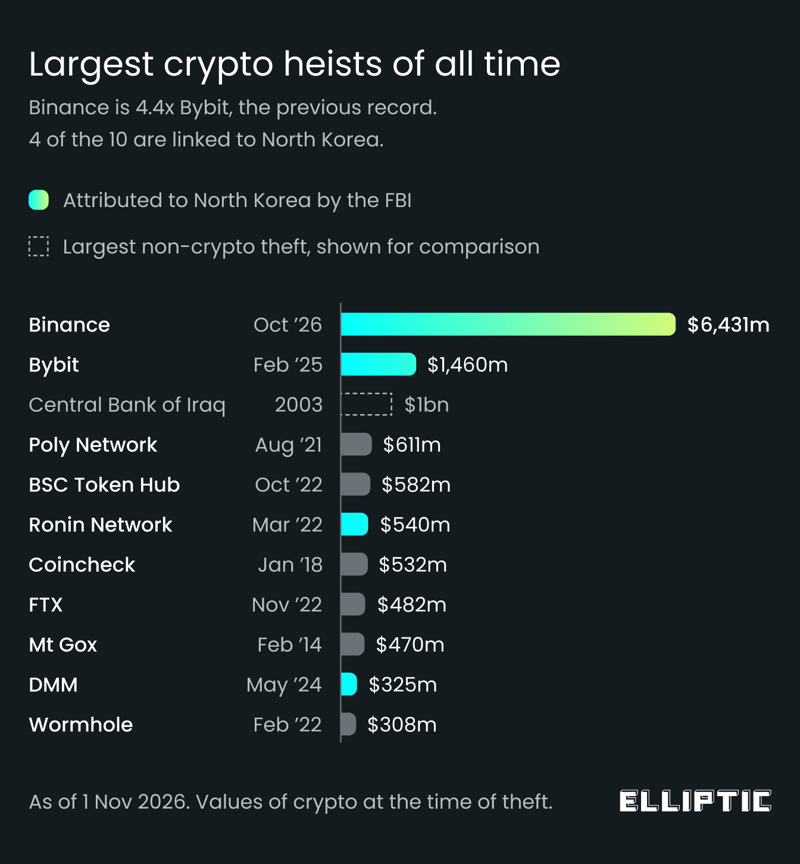
The transactions were actually “valid”
In 2016, attackers stole $81MM from Bangladesh Bank.
The US Department of Justice subsequently alleged that North Korean operators compromised the bank’s network and sent fraudulent SWIFT instructions. The New York Fed’s statement said the messages had passed standard authentication checks and that its own systems had not been compromised.
That is the bridge between banking and crypto. A payment network can process a transaction correctly while the institution submitting it has been compromised. A blockchain can validate a signature perfectly while a corrupted approval process supplies the signature.
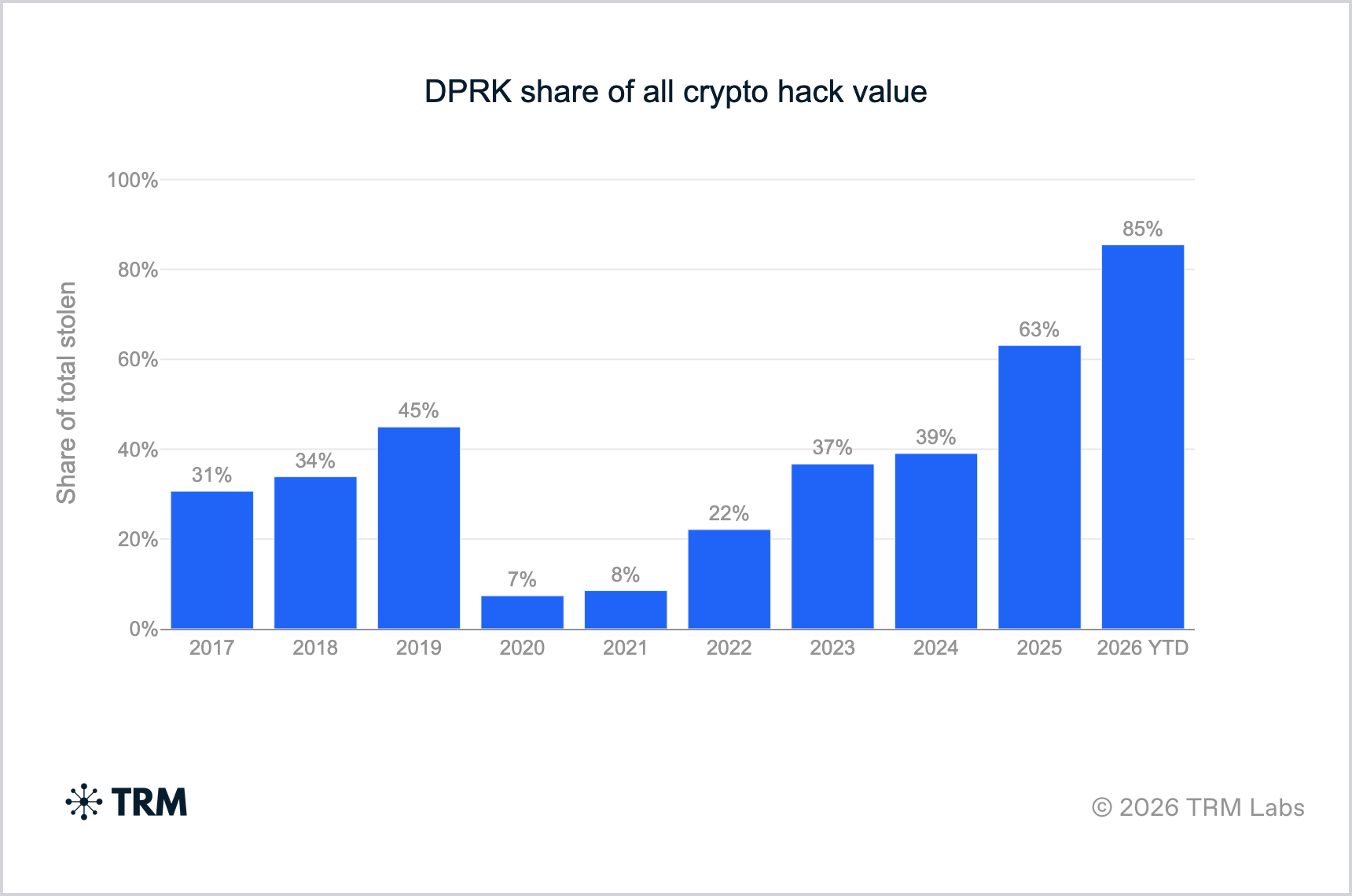
TRM Labs’ analysis of North Korean thefts found that infrastructure compromises account for 88% of the North Korea-linked stolen value and smart-contract code exploits account for just 1%.
Technological sophistication does not always align with safety. Adding stronger mathematics does not compensate for weak control over who can instruct the machinery.
North Korea is exploiting this strategy and is doing so more and more every year.
Does open source AI give or take our agency?
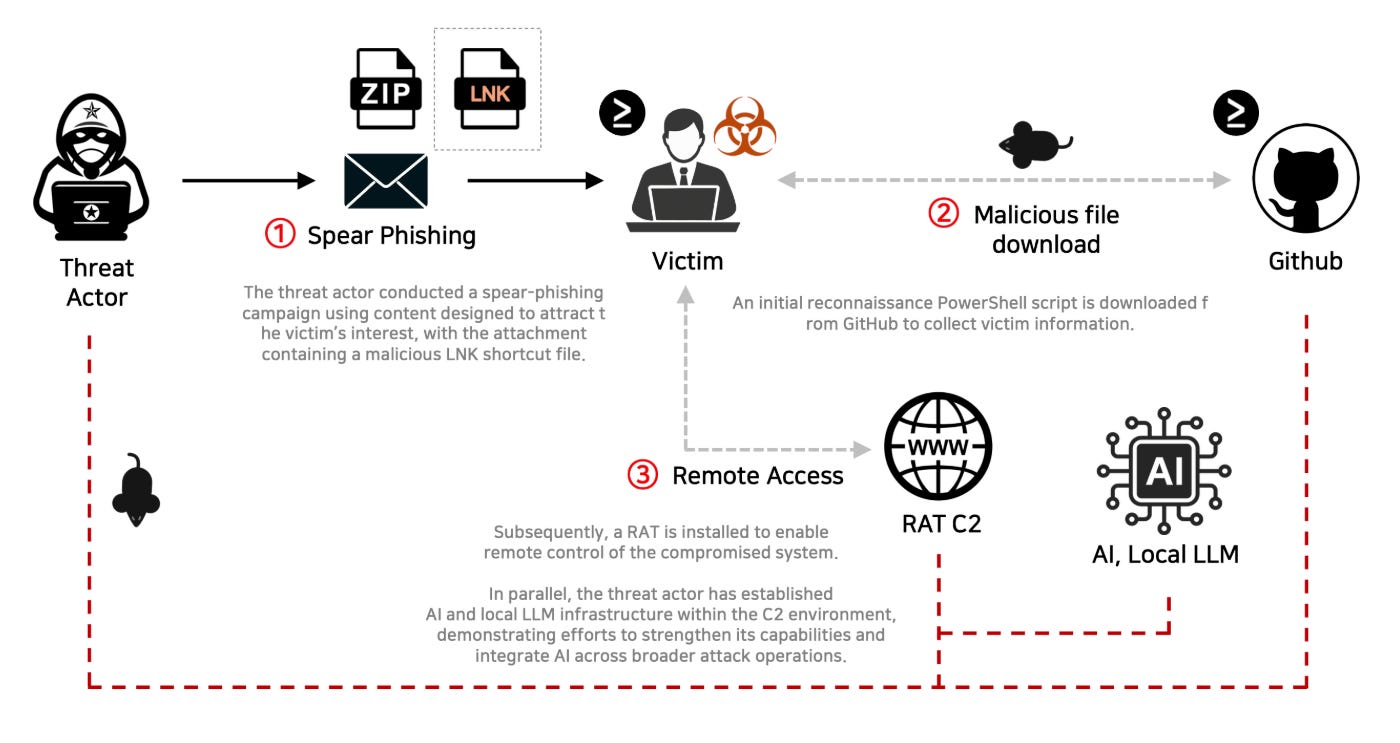
Google Threat Intelligence Group and Mandiant reported observing attackers’ use of open-source, multi-agent security-testing frameworks in real intrusions since late August.
The underlying weaknesses being exploited are the usual compromised credentials, excessive permissions and unpatched systems, but agents can now connect tasks, troubleshoot failures and explore multiple routes with less manual work. An attack can become worthwhile because it is cheaper to attempt, even if its probability of success does not improve.
An open-source agent framework, an open-weight model and a commercial model accessed through an API are different things. A framework can use either locally hosted or externally supplied models. When the model is hosted on a third-party website, then it can be turned off or controlled. This is not the case for local hardware.
Genians reported evidence that the North Korea-linked Kimsuky group was experimenting with local AI tools including Ollama, GPT4All and Msty. Kimsuky integrates these AI models into “Attack Operations”.
A provider, like an Anthropic or Open AI, can revoke access to its hosted service. For anyone who has tried to create copyrighted images or potentially politically sensitive content in the cloud, you know how that goes.
But nobody can control a model already running on someone’s local hardware. Open models will not disappear, and will only get more powerful. This is good — open tools let defenders inspect systems, test weaknesses and avoid dependence on a handful of vendors.
Choice is also power. Self-sovereignty over your money and intelligence can prevent abuse and corruption. And make losses irrevocable.
The corollary is that a bank should not outsource its security to an AI company’s own policies, terms, and security processes, because that AI company cannot control everything downstream from its mathematics.
Crypto’s emergency backstop button
Once the Binance assets left accounts, it was a race to convert stolen balances into proceeds they could retain and ultimately spend.
Security firm Elliptic verified approximately $2.85B frozen or seized, with roughly $3.25 billion beyond issuers’ immediate reach.
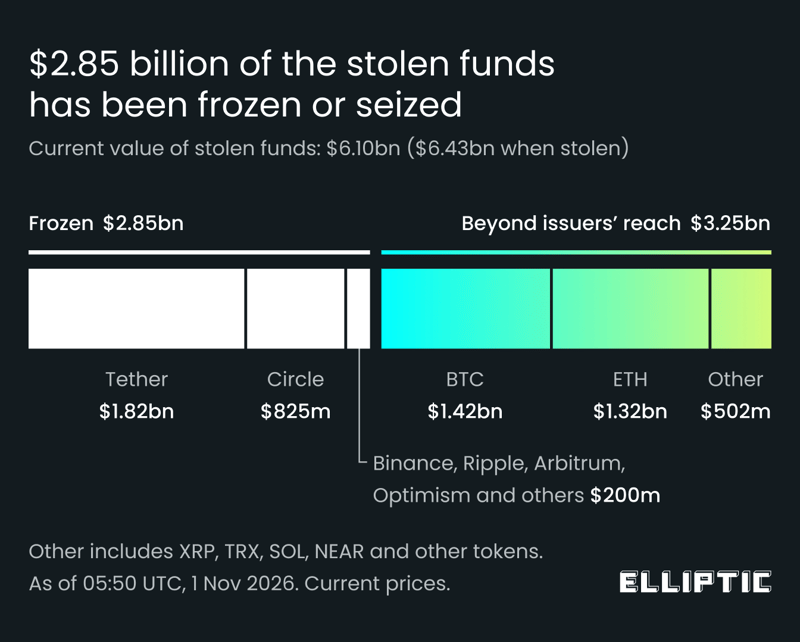
Some of crypto’s most effective emergency protections came from concentrated authority around token issuers and governance bodies who were able to intervene. The same financial discretion that creates censorship risk — a thing that most users of Crypto hate, and that Federal Reserve chairmen love — can create recovery options.
Chainalysis reported an exchange of approximately $325MM in stablecoins for $285MM in ETH. Meanwhile, Binance committed to replace customer assets using its own protection fund and corporate treasury. While Binance is big enough to swallow the loss, any assets used to restore balances cannot then fund expansion or absorb the next shock.
Banks still misunderstand operational AI risk
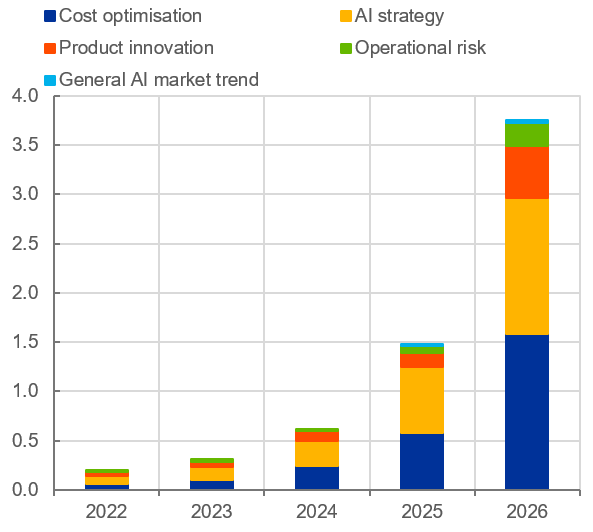
The European Central Bank recently presented an analysis of 761 earnings-call transcripts from 51 euro-area banks. Cost optimisation and adoption strategy dominate AI discussion, with operational risk receiving much less attention. Companies are not yet conditioned to understand the shape of the AI threat to their systems.
There is a counterargument to the idea that falling attack costs inevitably make finance less secure. In its investigation of September’s Bitget theft, Chainalysis says AI-assisted tooling reduced more than 20 hours of manual bridge reconciliation to under ten minutes.
But analysis is not enough — you have to be able to do something about it. Someone must be able to revoke access, isolate systems, pause transfers, or coordinate an intervention quickly enough. Better detection without authority to act risks producing a more accurate account of a loss already completed.
This has to be built by the industry. We are in a war of AI swarms managed by cops and robbers.
AI hacks vs. the Quantum threat
None of this touches the very valid cybersecurity concerns that come from quantum computing.
Bitcoin is not an encrypted vault whose password an AI can guess. But a sufficiently capable quantum computer could threaten the elliptic-curve assumptions underpinning those signatures. This is a very different narrative to that of compromising an exchange’s approval systems.
An August 2026 PRX Quantum paper estimates approximately 6.9MM BTC in balances exposed by future quantum attacks. Exposure depends on public-key visibility.
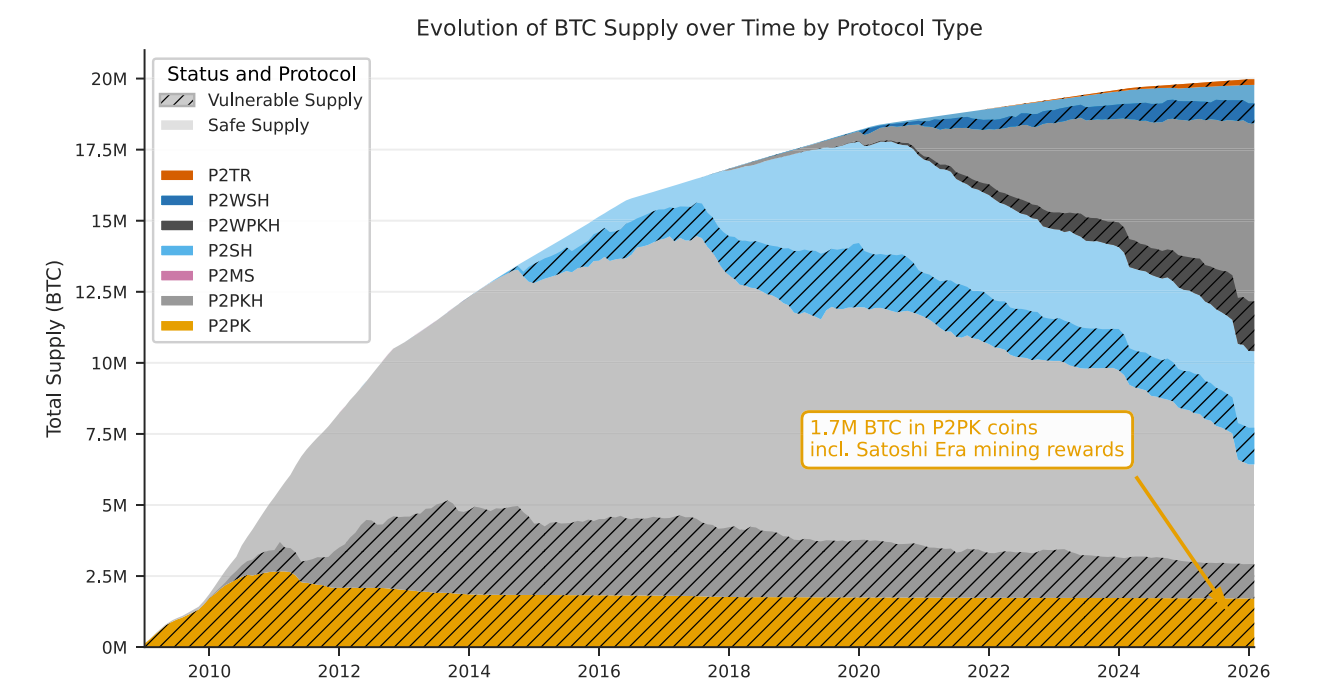
A quantum-resistant signature would still not stop a compromised workflow from authorising the wrong payment. Cryptographic migration and operational security are complementary obligations.
The Binance theft is a warning against the weakest components of the security chain, which more often than not is the human in the process. Stronger algorithms, more capable models, and faster settlement can all coexist with catastrophic human failures.
Financial institutions need to ask the question of whether their technology can continue to process valid instructions consistently and limit the damage when a valid instruction carries a criminal’s intent.
Also, whether they can still meet their obligations the morning after an attack.
👑Related Coverage👑


Analysis: Inside Anthropic’s $2T IPO and $77B Financing Loop (link here)
What better way to learn about Anthropic’s IPO than to ask its well-trained AI to analyze its overlord master?
It is no secret that Anthropic is going public, and that it looks to raise $100B at a $2 trillion valuation. We remember when a trillion was a lot of money just a few years back! The world’s largest IPO was going to be Ant Financial at $300 billion, when fintech was king of the hill and Bitcoin’s $1 trillion market cap was a revelation.
Poppycock.
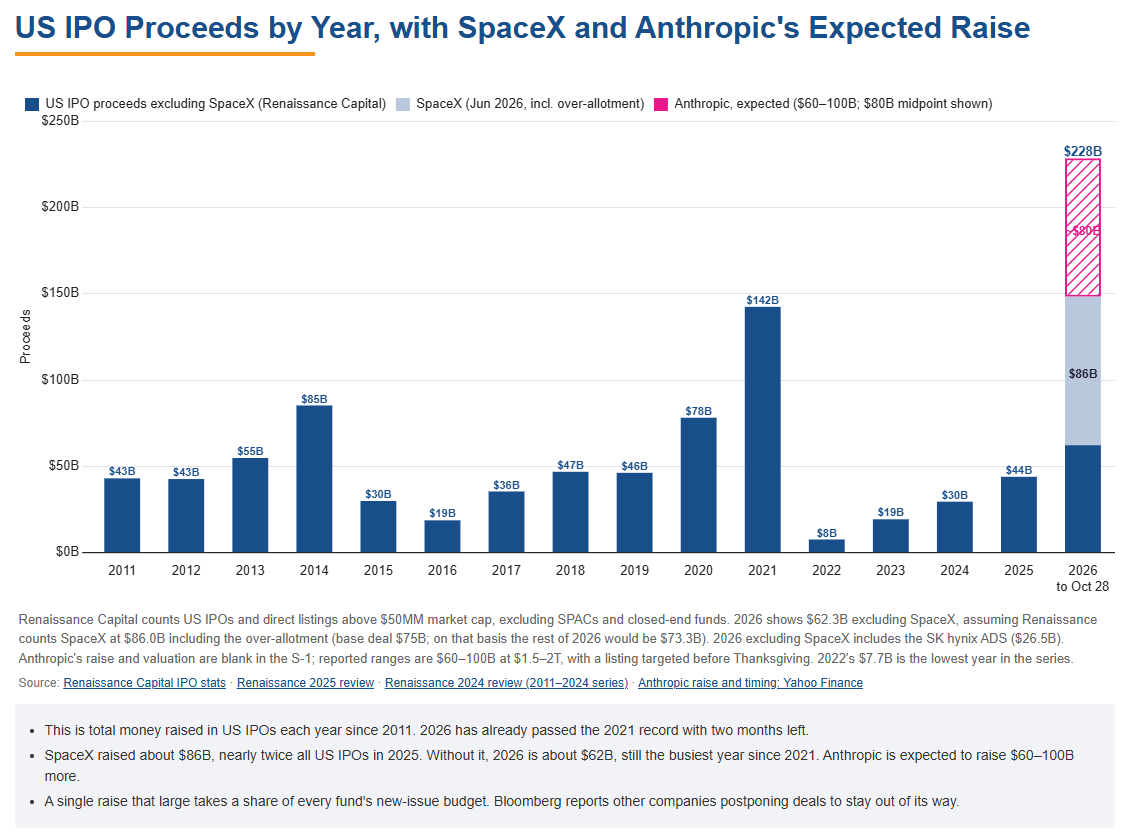
If Anthropic lands, it follows SpaceX, which has already raised its capital and is trading at $1.96 trillion of marketcap at $15 billion of quarterly revenue. The entire game right now is the high end of the market, and it looks like a very high end. We have never seen anything like it.
🎙️ Podcast: The $5.1B Marketplace With More AI Agents Than Human Users, with Whop CEO Steven Schwartz (link here)
In this episode, Lex chats with Steven Schwartz, CEO and co-founder of Whop, the Brooklyn-based marketplace where almost 100,000 people earn money each month selling software, education, communities, physical goods and clipping campaigns through a single API-first stack.
Lex and Steven discuss how Whop went from a license-check tool for a handful of Mac and Windows apps to a global commerce platform settling nearly $500M a month in top-of-funnel income to users, and why Tether’s $200M investment at a $1.6B valuation makes stablecoins the only unifying rail capable of paying earners in Morocco, Nigeria, Vietnam or El Salvador the same way as earners in Brooklyn.
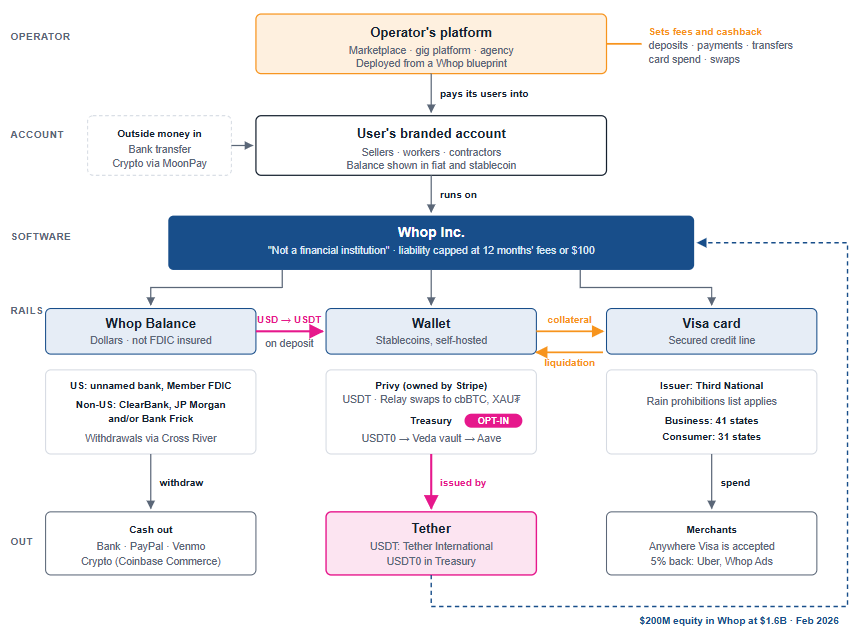
Steven explains why Whop treats customer acquisition — not payments or user management — as the real wedge against Stripe and Shopify, why the platform now has more agent users than human users, and how an API that lets an LLM spin up an LLC, a storefront and a running ad campaign in one prompt reframes what “starting a business” means. They explore the trajectory from a billion earners to a public listing, and whether a creator-economy fintech can meaningfully invite its own users onto the cap table.
Curated Updates
Here are the rest of the updates hitting our radar.
Machine Models
Ethical and Bias Considerations in Artificial Intelligence/Machine Learning - Matthew G. Hanna & Liron Pantanowitz & Brian Jackson & Octavia Palmer & Shyam Visweswaran & Joshua Pantanowitz & Mustafa Deebajah & Hooman H. Rashidi
A Critical Field Guide for Working with Machine Learning Datasets - Sarah Ciston & Mike Ananny & Kate Crawford
AI Applications in Finance
⭐ AI-Driven Payment Systems: From Innovation To Market Success - Merve Ozkurt Bas
The Rise Of Generative Ai Agents In Finance: Operational Disruption And Strategic Evolution - Inesh Hettiarachchi
Financial Modeling in Corporate Strategy: A Review of AI Applications For Investment Optimization - Olufunmilayo Ogunwole & Ekene Cynthia Onukwulu & Micah Oghale Joel & Ejuma Martha Adaga & Augustine Ifeanyi Ibeh
Investment Outlook
⭐ Private Equity Outlook 2025: Is a Recovery Starting to Take Shape? - Bain & Company
⭐ Global Venture Capital Outlook: The Latest Trends - Bain & Company
⭐ Global Private Markets Report 2025: Braced for shifting weather - McKinsey & Company
🚀 Postscript
Sponsor the Fintech Blueprint and reach over 200,000 professionals.
👉 Reach out here.Read our Disclaimer here — this newsletter does not provide investment advice
Contributors: Lex, Laurence, Matt, Farhad, Daniel, Michiel, Luke
For access to all our premium content and archives, consider supporting us with a subscription. In addition to receiving our free newsletters, you will get access to all Long Takes with a deep, comprehensive analysis of Fintech, Web3, and AI topics, and our archive of in-depth write-ups covering the hottest fintech and DeFi companies.
The human decision point is an important part of the AI security discussion. Better models don't remove the need for clear authorization and checks around consequential financial actions.
Binance's initial findings back up the "valid transactions" point. Stolen credentials reached its internal signing service, which then signed an EIP-7702 delegation giving the attacker's contract standing permission over a hot wallet. Nothing was cracked; the signer did what it was asked, and because the wallet was MPC, no single key could revoke it. https://x.com/binance/status/2117626126214504729