
Analysis: Stripe's $10B OpenRouter Bid and the AI Value Chain
The battle for AI profits is shifting from building models to owning distribution, enterprise deployment, and inference infrastructure.
Gm Fintech Architects —
Today we are diving into the following topics:
Summary: We connect three seemingly unrelated events — the $7B acquisition of Wealth Enhancement Group by Bain and Carlyle, Mariner’s deployment of 700 AI employees through Humanity Labs, and Stripe’s reported $10B bid for OpenRouter — into a single AI value chain. We argue that wealth managers own distribution over $10T of client assets, AI services firms are rebuilding enterprise cost structures through large-scale workflow automation, and inference platforms are commoditizing intelligence by routing demand across competing language models. As AI models become cheaper, implementation, orchestration, and distribution become the primary sources of value, driving investment from private equity, AI labs, and fintech infrastructure providers. We conclude that Stripe’s interest in OpenRouter reflects a strategy to own the metering layer of AI inference, positioning itself to capture economics from every transaction flowing through the emerging machine economy.
Topics: Wealth Enhancement Group, Bain Capital, The Carlyle Group, Mariner, Humanity Labs, Anthropic, OpenAI, Ode, DeployCo, Blackstone, Hellman & Friedman, Goldman Sachs, TPG, Palantir, Stripe, OpenRouter, Cursor, SpaceX, Privy, Tempo, Bridge, Ramp, DeepSeek, Qwen
Thanks as always for your time and attention,
Lex
To support this writing and access our full archive of newsletters, analyses, and guides to building in the Fintech & DeFi industries, see subscription options below.
🤖🏦🧭 Our Ecosystem:
Generative Ventures | AI Research | Robot Money | Linkedin & Twitter | Sponsors
🚀 Lex is actively meeting teams building machine-native financial companies. If that’s you, reach out here.
🤖 AI & Robotics Industry Encyclopedia: In this 100+ page report, we collate all the meaningful companies across public quities, private equity, and digital assets related to the machine economy. 👉Learn more here
🦄 In partnership with InterPrivate, we just launched a $200MM SPAC looking for targets in fintech, digital assets, and AI infrastructure. If you are a late-stage founder or have an idea to discuss, reply directly to this email.
Long Take
Seeing from top to bottom
Three separate events caught my eye this week.
Private Equity firms Bain and Carlyle are buying $150B RIA roll-up Wealth Enhancement Group for $7B
RIA Mariner and AI services company Humanity Labs launch a five-year partnership targeting 700 AI employees in the firm’s back office
Stripe bids $10B to buy OpenRouter, 70x revenues and 10x its valuation earlier this year
Are these all separate and distinct, or can we weave a framework that pulls it all together?
Let’s try to go across markets — large-scale late-stage private equity, bootstrap venture, and mid-stage fintech — and across industries — from wealth, to payments, and to AI and understand what is happening holistically.
I’ll start with the answer, and then we get to the detail.
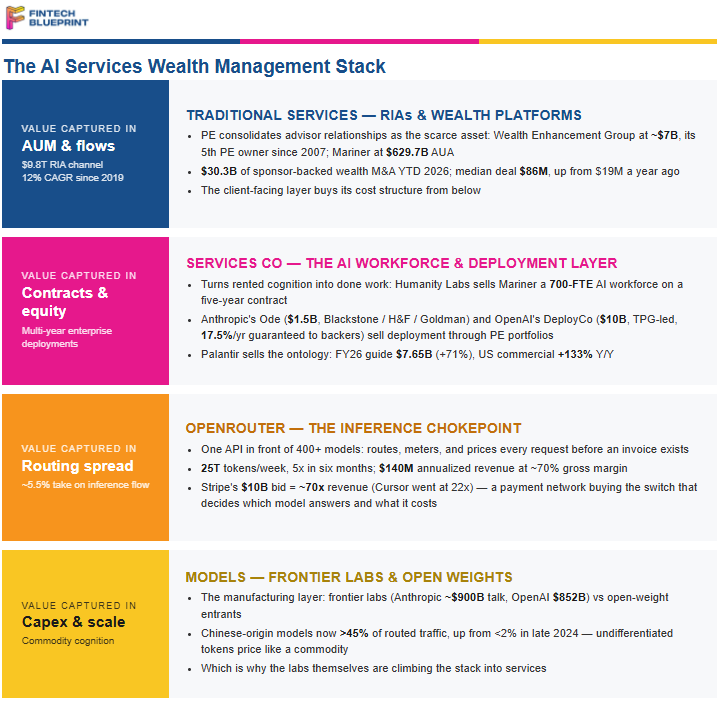
At the high end of the chart are our traditional firms.
We can take any industry, but let’s anchor in wealth management. Wealth management is a distribution story, placing financial products across $10 trillion of assets, growing at 12% per year. This growth is effectively stock market appreciation. Still, technology has done little to derail the ability of the RIA (Registered Investment Advisor) channel to tap into millions of households and sell them ETFs, portfolios, and stocks.
Even with Robinhood, Polymarket, Hyperliquid, and the rest of gamble-finance, an enormous amount of assets is managed professionally and conservatively.
It is difficult to grow at this end of the market, because it is fully saturated. Wirehouses, advisors, digital solutions, exchanges, brokers — all these players are full-blasting distribution into the retail consumer. So the way you grow is through (1) natural investment performance, and (2) acquisitions of subscale players or those with dying business model. If you sold mutual funds, you will be eaten by those selling ETFs. Eventually, those who sell tokenized assets may eat ETFs.
Private equity firms are the sponsors of many of these acquisitions, because they can put leverage on such businesses. The game is to borrow against the cash flow of the business you are acquiring, and let the combination pay for itself. In 2026 alone, nearly $30B of wealth manager combinations have taken place.
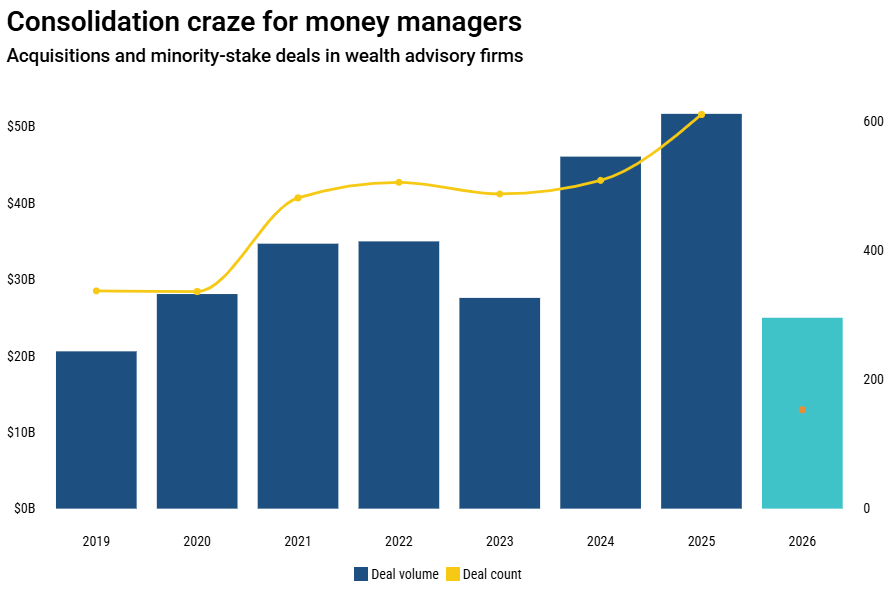
It is not easy to centralize the distribution of financial products — nobody has a full monopoly. The reason is that the population graph is extremely diverse in characteristics and preferences, and you can always build and grow a material boutique that captures a niche.
A mass-affluent mid-Western broker-dealer.
A Silicon Valley roboadvisor for tech founders.
A HNW ex-Goldman Sachs multi-family office in New York.
A retail small-cap day-trading options bucket shop in Chicago.
A Bitcoin crypto exchange in Asia
And so on.
So large private equity firms have something to do, buying up $150B of assets for $7B — about 4.6% of assets. This is expensive, relatively speaking. My rule of thumb is that AUM should trade at 2%, but it all depends on profitability and how much you can borrow.
Below we pull up the comps for 10 public asset managers across different asset classes.
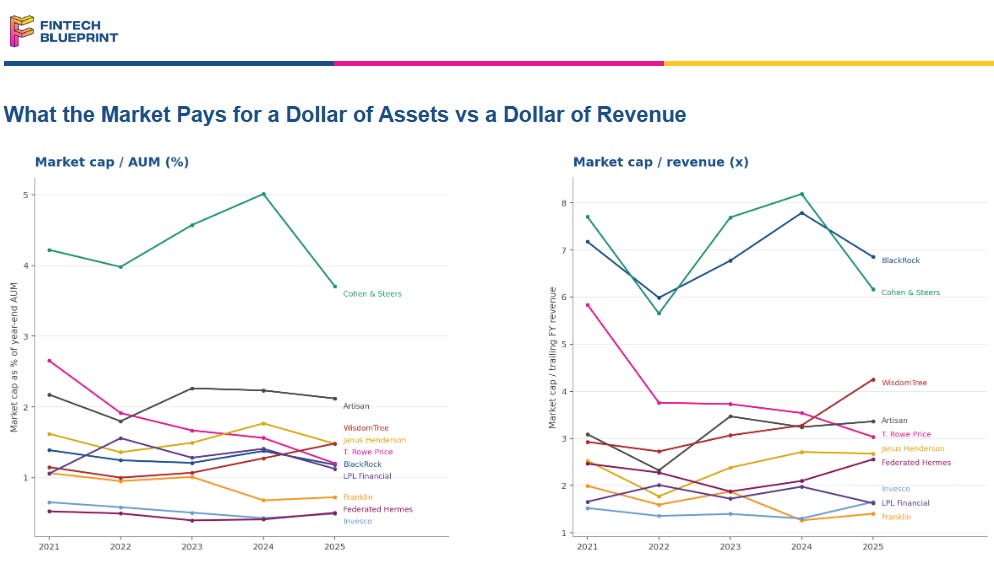
You can see that most % AUM valuations cluster between 0.50% and 2.5%. In terms of revenue, generally multiples are in the 0.5x to 4x range, with growth and product mix playing a major role. WisdomTree and Artisan have a lot more room to grow than Franklin Templeton and Invesco, just because of smaller size.
So far, this is pure capital markets arbitrage and consolidation.
But such consolidation is a short-term game, and a sale would be the 5th PE owner for Wealth Enhancement Group since 2007. Most of these businesses are commoditized, and sit on comparable technology — from Envestnet to Orion or a custodian proprietary stack, like Altruist. And private equity firms, generally, have no idea how to modernize.
But the AI firms beg to differ. Let’s discuss those.