
Gm Fintech Architects —
Today we are diving into the following topics.
This is a Premium issue we have kept open for the entire readership as it is a powerful concept I hope you will share!
Summary: We revisit a 2018 framework for how banks, fintechs, and big tech would converge, and argue that the emerging winner is a new model we call the Hyperbank: a technology company that owns the financial stack down to the regulatory or sovereign root. Column illustrates the model with just $1.77B in assets but roughly $200MM in revenue, a potential $6B valuation, and customers including Ramp, Brex, Bilt, Mercury, and Wise, while vertically integrating stablecoins, card issuing, global banking, multicurrency accounts, and core infrastructure. We distinguish Hyperbanks from Deep Fintechs, which build difficult-to-copy technologies such as blockchains, zero-knowledge proofs, AI underwriting, and advanced trading infrastructure, and Neobranches, which own digital distribution while renting the underlying financial factory.
Topics: Column, Altruist, Erebor, Nubank, Revolut, Chime, Robinhood, Ramp, Brex, Bilt, Mercury, Wise, Carta, Plaid, Vanguard, Schwab, Fidelity, Circle, Ripple, Paxos, BitGo, Coinbase, MetaMask, Binance, Apple, Google, Synapse, FIS, Fiserv
Thanks as always for your time and attention,
Lex
To support this writing and access our full archive of newsletters, analyses, and guides to building in the Fintech & DeFi industries, see subscription options below.
Partner Webinar: Staying ahead of fraud with AI

Most fraud and risk teams can build a model. The hard part is keeping it effective in production as fraud patterns and customer behavior evolve.
In this conversation with Dennis Kramer, Director of Data Science and Risk at Purpose Financial, we break down the framework needed to operationalize continuous decisioning at scale, including data, people, processes, and tools.
Long Take: Hyperbanks and Deep Fintech
In 2018, I was at Autonomous Research and published a long report on Fintech called Future Vision.
There were two core diagrams that asked the key question at the time — when fintechs, big tech firms, and banks all go after the same customer, who wins? Here are the multiple-choice answers:
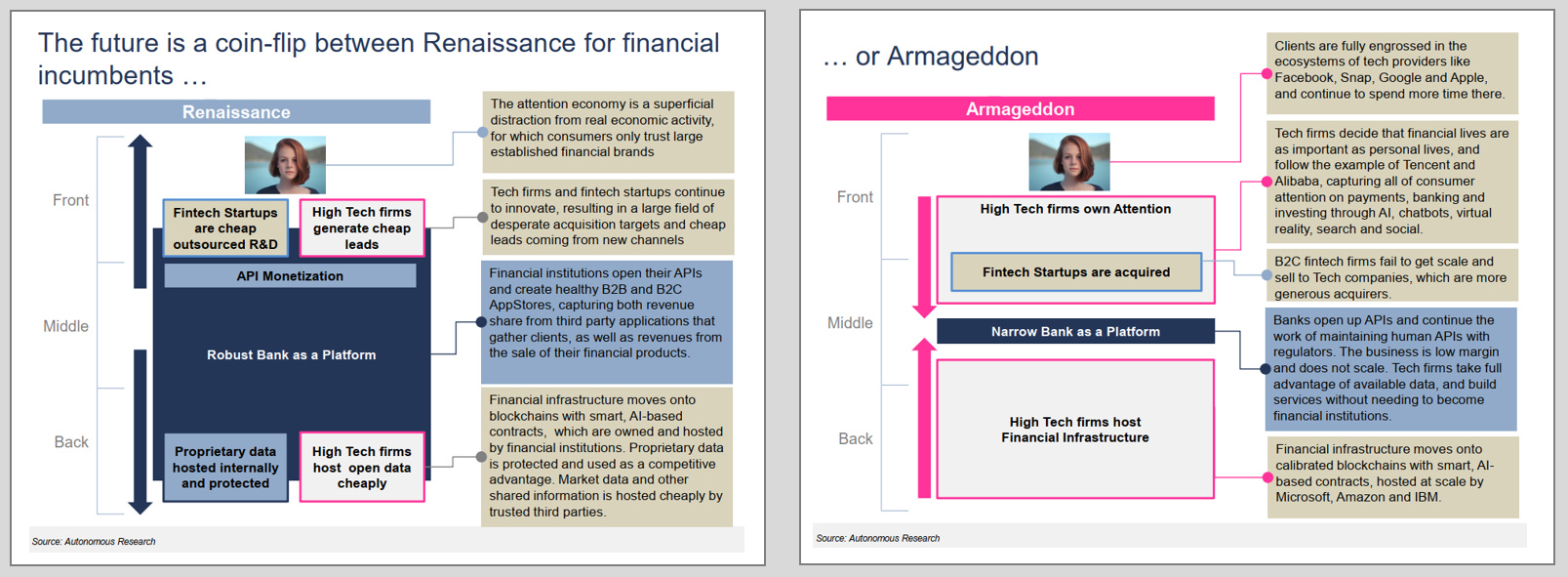
The two pictures were called Renaissance and Armageddon.
In the Renaissance, incumbents win. The bank sits in the middle as a robust platform. It opens its APIs, runs B2B and B2C app stores, and takes revenue share from every third party that brings it a client. Fintech startups turn into cheap outsourced R&D and a large field of desperate acquisition targets. High-tech firms become a source of cheap leads. The bank keeps its proprietary data inside and treats it as an advantage. The attention economy turns out to be a distraction, and consumers only trust large financial brands with their money.
In Armageddon, tech firms win. Facebook, Snap, Google, and Apple own attention, and they decide that financial lives matter as much as personal lives, following Tencent and Alibaba. B2C fintechs fail to reach scale and sell to tech companies, which are the more generous buyers. The bank shrinks to a narrow platform in the middle. It keeps its APIs open and keeps the human APIs with regulators, and the business is low margin and does not scale. Tech firms host the financial infrastructure at the back, on blockchains run by Microsoft, Amazon, and IBM, without ever becoming financial institutions.
Both scenarios assumed a bank would sit between the customer-facing front and the infrastructure at the back. The main question was how fat that bank would be.
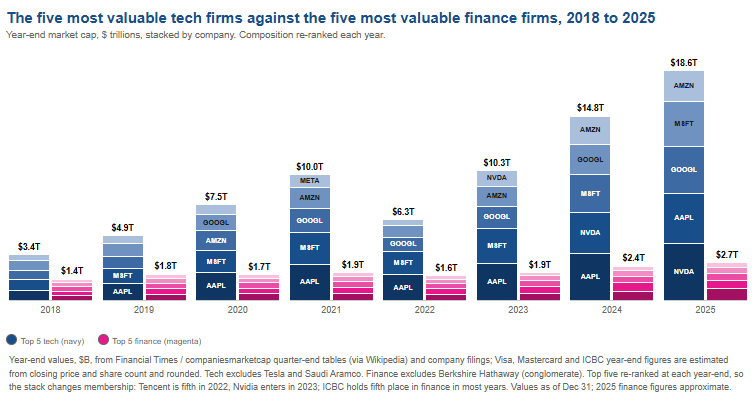
Reality is turning out a bit more complex. And for the curious, tech definitely won the marketcap game.
Vertical Integration and Column Bank
I was inspired by the following news to revisit this question, which touches on the role of high-tech, embedded fintech, and regulatory capture.
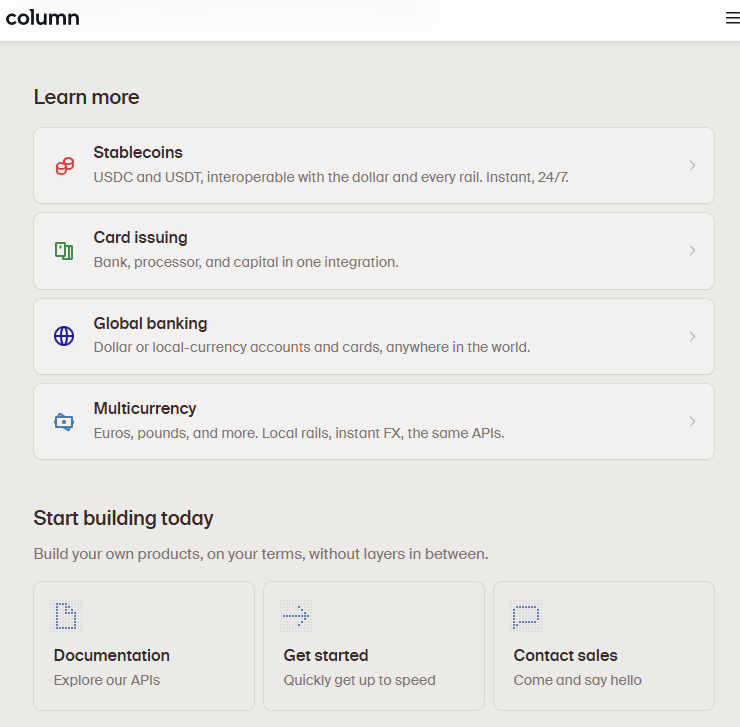
In particular, this week Column, the bank co-founded by Plaid’s William Hockey, released four key products. Four years ago, this was all still in development after Hockey bought NorCal bank, a small single-branch bank from California, for $50MM.

Column is a nationally chartered bank with about $1.77B in assets, which makes it small. Its customers, however, are the top of the Fintech foodchain: Ramp, Brex, Bilt, Mercury, Slash, Kapital, Wise, and Carta.
A profile earlier this year put Column revenue near $200MM, and a possible valuation around $6B — a buzzy 30x for a bank. Hockey says he started Column to rebuild every part of the financial system from scratch, so any technology company could build on top of it. Note the word “technology company” and what that implies (i.e., banking cores and community banks need not apply).
It’s also the same pitch as Cross River Bank and the various embedded fintechs and sponsor banks before it, but the launches are already impressive:
Stablecoins: USDC and USDT sit on the same ledger as the bank account. They convert to dollars 24/7 and move over ACH, Fedwire, RTP, FedNow, and SWIFT. No prefunding. No outside orchestrator. Solana is the default chain.
Full-stack card issuing: Column built its own issuer processor. That means the bank, the processing, and the capital for a Visa or Mastercard program all come from one integration. It covers debit, credit, and stablecoin-backed cards.
Global banking: dollar or local-currency accounts and cards for verified customers outside the United States, using the same compliance tools Column uses at home.
Multicurrency accounts: foreign-currency accounts with their own account numbers, instant FX to dollars, and connections to rails like SEPA Instant
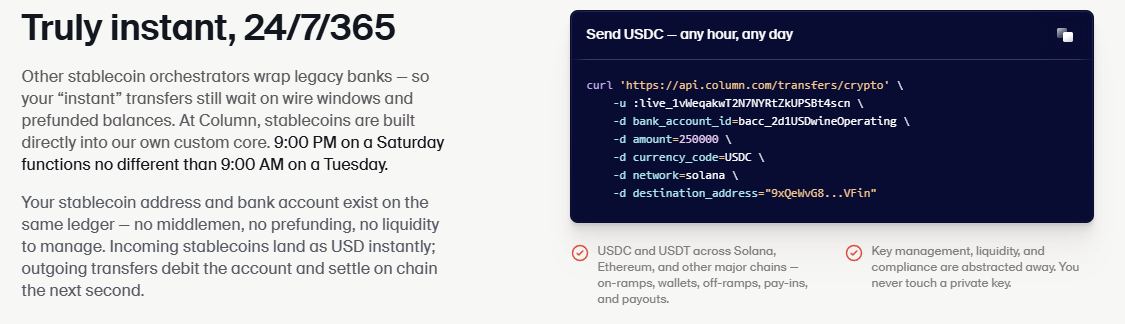
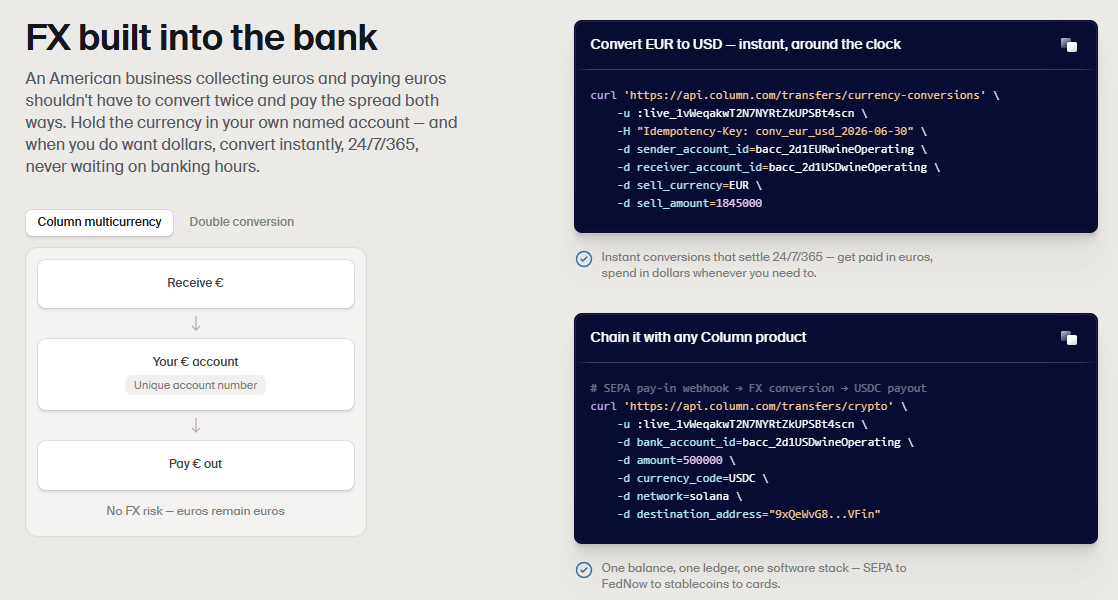
Each product replaces a company: (1) a stablecoin orchestrator, (2) an issuer processor like Marqeta or Galileo, (3) a sponsor-bank program manager, (4) a cross-border payout company, (5) a core banking vendor. Each of those sits between a licensed bank and a developer. Column’s pitch is that if you are a megatech firm or a large attention- economy brand, you now need one bank, and that bank is Column.
Relatedly, Vanguard had just agreed to buy Altruist for a reported $4B to $4.6B in cash. We covered the deal a few weeks back.

Altruist is not an app for advisors. It is a self-clearing broker-dealer and custodian, with more than 6,000 advisors on the platform. It competes directly with Schwab and Fidelity for the plumbing under independent wealth management. Vanguard bought the custodian and the modern software stack that was purpose-built for the modern era.
Then there is Erebor. Palmer Luckey and Joe Lonsdale filed for a brand new national bank charter in June 2025. The OCC gave conditional approval in October and the final charter on February 6, 2026. The bank opened with $625MM in capital. By the end of July it reportedly held $4.6B in deposits, was earning about $100MM a year, and was valued at $9.5B.

Luckey’s reason for going straight to a full charter: if you rent a bank, that bank can cut you off, and it can limit what you sell. Only the company that holds the charter can run settlement, mint and redeem stablecoins, and custody digital assets itself.
The OCC charters, they keep coming.
On December 12, 2025, the OCC gave conditional approval to five national trust charters in a single day: Circle, Ripple, Paxos, BitGo, and Fidelity Digital Assets. Coinbase got conditional approval in April, Circle got final approval in July. Nubank filed for a full national bank charter on September 30, 2025, and had conditional approval 121 days later.
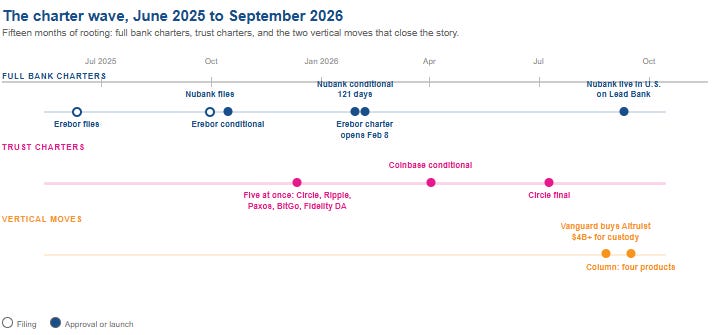
What do all of these have in common?
None of them sit on top of a banking-as-a-service platform. They go all the way down, through the charter, through the Fed master account or the clearing membership, down to the place where the government creates money and allows financial products to be made. And they were built by technologists who know how to scale software.
That combination is not something I saw in 2018.
What is a financial object?
Let’s step back for a second and ask why it matters to go all the way down. Apologies in advance for the armchair philosophy.
Take, for example, a simple chair. Is it a chair? Or is it four planks and a seat? Or wood fibers? Or a cloud of atoms held in a pattern? At what level do we conflate the map and the territory?
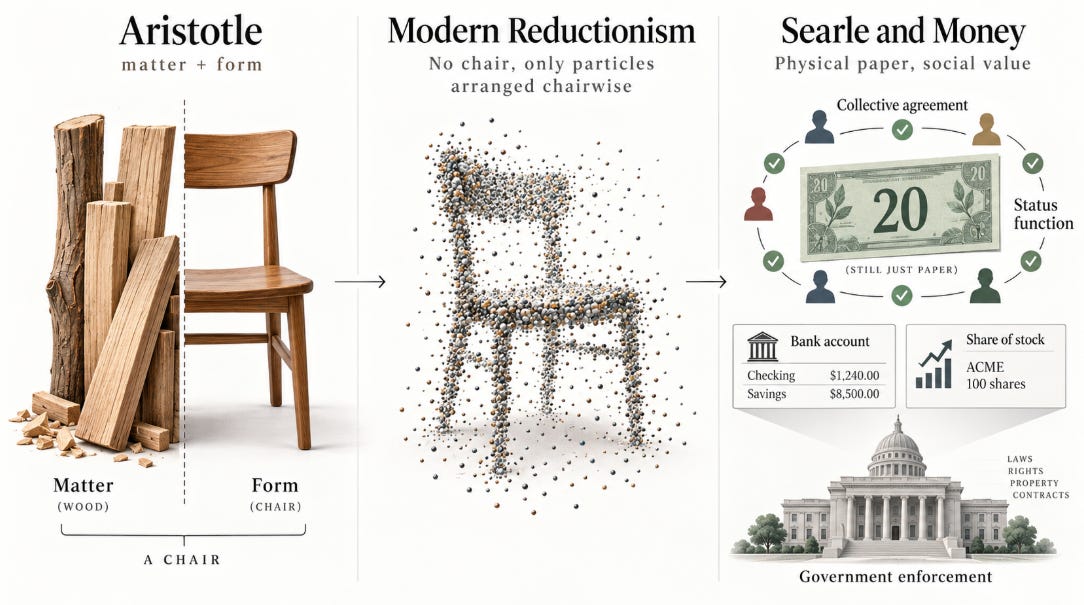
Aristotle said a chair is matter plus form: (1) the wood is the matter, and (2) the shape that lets you sit on it is the form. You need both. Some modern philosophers go further and say there is no chair at all, only particles arranged like a chair, and we call it a chair because that is useful. Or, perhaps, there is some multi-dimensional chair pattern that the human mind constructs to succeed in a physical world.
Between those two views, John Searle gave the answer as it relates to money. Some objects exist only because we all agree they do. A piece of paper counts as a twenty-dollar bill in the United States, because enough people accept that rule. Searle called this a “status function”. Take the people away, and the paper is still paper, but it is no longer money or has its social meaning.
Another example of a Searle object is a bank account, or a stock of a company. They are patterns of agreement placed on top of something physical. And at the very bottom of the chain, a government enforces the agreement.
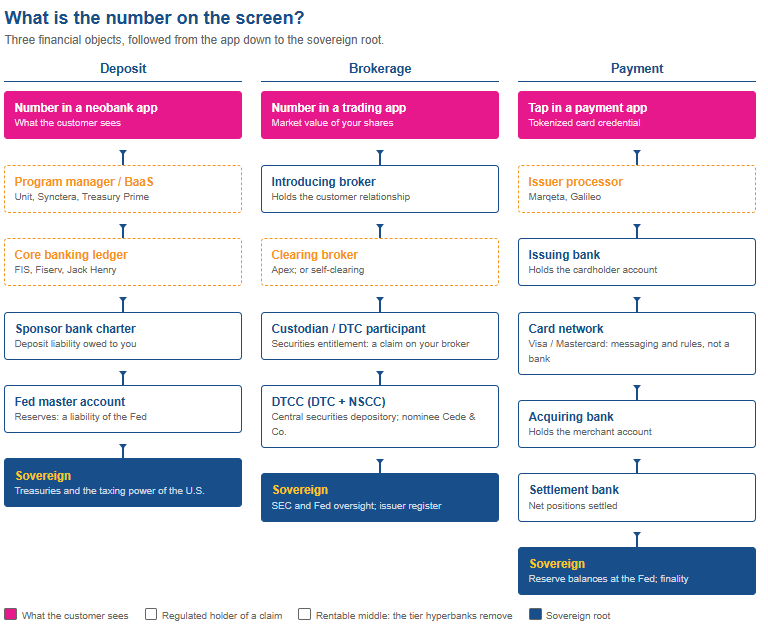
Now open a neobank app. There is a number on the screen. What is that number?
The number is a display of an entry in the neobank’s ledger. That ledger is usually not the neobank’s own. It is a core banking system, run by FIS, Fiserv, Jack Henry, or one of the newer cores, and licensed by a sponsor bank. The entry in the core records a deposit. A deposit is money that the sponsor bank owes you. The sponsor bank, in turn, keeps reserves at a Federal Reserve Bank through its master account. Those reserves are money the Fed owes the bank. Behind the Fed sit Treasuries and the taxing power of the United States.
Follow the number on your screen all the way down, and it is a claim on a claim on a claim on the government. It is a human construction on some mental relational abstraction, passed around by corporations.
Now open Robinhood.
There is a number. What is it? It is the value of shares that an introducing broker holds for you. The introducing broker sends its trades to a clearing broker. For Robinhood that used to be Apex, and today it is Robinhood’s own self-clearing arm. The clearing broker is a member of the Depository Trust Company, or DTC, which is the central securities depository for the United States. DTC holds the shares in the name of Cede & Co., its nominee. Your name is not on the company’s share register. What you own is called a securities entitlement. It is a claim against your broker, which has a claim against DTC, which is the registered owner. The National Securities Clearing Corporation nets the trades in between. The SEC and the Fed sit above all of it.
Hahaha, hurts to think about!
Payments are the third chain. Tap a card in a payment app. The app holds a token for a card issued by an issuing bank. The merchant’s acquirer sends the authorization through Visa or Mastercard. The card network is a messaging and rules system, not a bank. No money moves at the tap. It moves later, when the network works out who owes whom, and the issuing and acquiring banks settle those amounts through a settlement bank, and in the end through reserve balances at the Fed. Nothing is final until the reserve balances move at the Fed.
The three value chains have a screen with a number at the top. And at the bottom, there is the government enforcing a contract and an obligation. In between sits a long stack of middlemen, each wanting to be a fintech unicorn!

Much of fintech has been about sitting at the top of that stack and renting the rest. The customer sees a nice app. The app sees a sponsor bank. The sponsor bank sees a core vendor.
Column, Altruist, and Erebor remove those intermediate links from the chain instead of adding more. It is harder, but also more valuable to solve the large problem anew.
Column’s stablecoin product works because the stablecoin address and the deposit account live in the same ledger, and that ledger belongs to a chartered bank with direct access to the payment rails. Altruist can beat Schwab on custody pricing because it clears its own trades and holds its own DTC membership. Erebor can offer on-chain settlement and stablecoin minting because it is the bank of record, with its own balance sheet and its own examiner.
In each case, a technology company went down the value chain until it hit the social contract regulated by the government, and then built up from there.
A new framework: Hyperbanks and Deep Fintechs
Fintech has become too broad of a term to be useful.
It covers Column, which is a bank that sells infrastructure to developers. It covers Chime, which is a marketing company with a debit card. It covers Revolut, which spent years waiting for a UK license and built its own core in the meantime. From the outside they look alike, with an app and a number on a screen. Underneath, they are different animals.
So let’s introduce some new ideas.
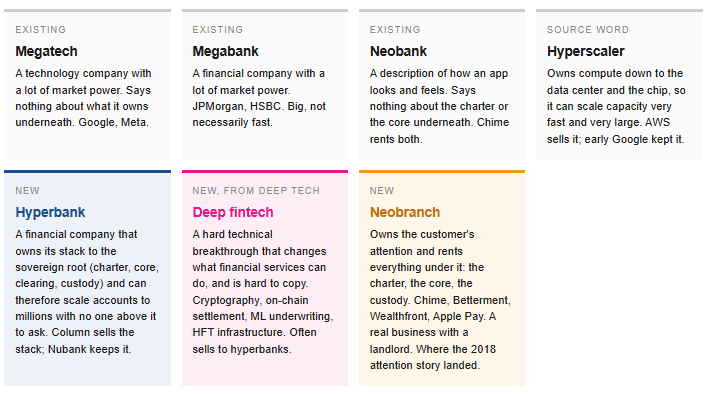
The first one is a *Hyperbank*.
The word comes from hyperscaler — a company that can grow its computing power very fast and very large, because it owns the data centers and, increasingly, the chips. That’s different from a mega-tech, which is a technology company with a lot of market power. In finance, we would call the market power signal a mega-bank. A hyperscaler describes owned industrial capacity that can be scaled quickly and far.
A hyperbank is a financial company that owns its stack all the way to the government root, and because of that can scale the manufacturing of financial products to millions of accounts without asking anyone’s permission along the way. It’s different from a neobank, which describes how a banking app looks and feels in a web or mobile user experience. I also use the word “bank” liberally to point to the broad idea of a financial company.

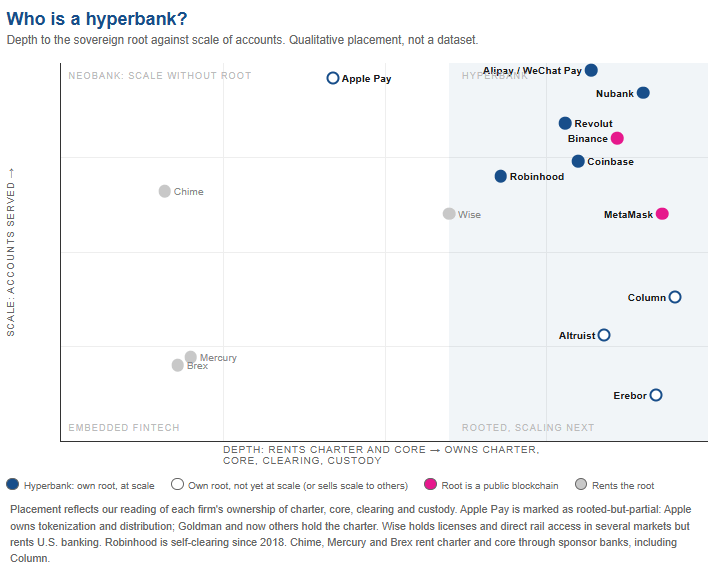
Notice that some hyperscalers, like AWS, mostly sell capacity to others. Others, like Google in its early years, built it first for themselves. The same split shows up here. Column sells its rooted stack to developers. Nubank, with more than 127 million customers on its own core and licenses, uses its stack to power its own app. Altruist is a hyperbank in wealth management. That is a strange thing to say about a company that began as advisor software, but the custody is the point. Erebor, if deposits keep growing at this rate, will be one soon.
Is MetaMask? In a sense, yes. It scaled a financial object, the self-custodied wallet, to tens of millions of people with no middleman at all, because the root there is a public blockchain instead of a government. Binance is the same on the exchange side. The Asian super-apps, Alipay, WeChat Pay, and Grab, are hyperbanks in everything but the name.
The second concept is a *Deep Fintech*.
This one comes from Deep Tech, whose investors back hardware, chips, materials, energy, and now AI, robotics, and drones. What they are buying is a breakthrough that is hard in a physical or mathematical way. The breakthrough is a secret, which becomes a moat, and that lets you ride a platform shift.
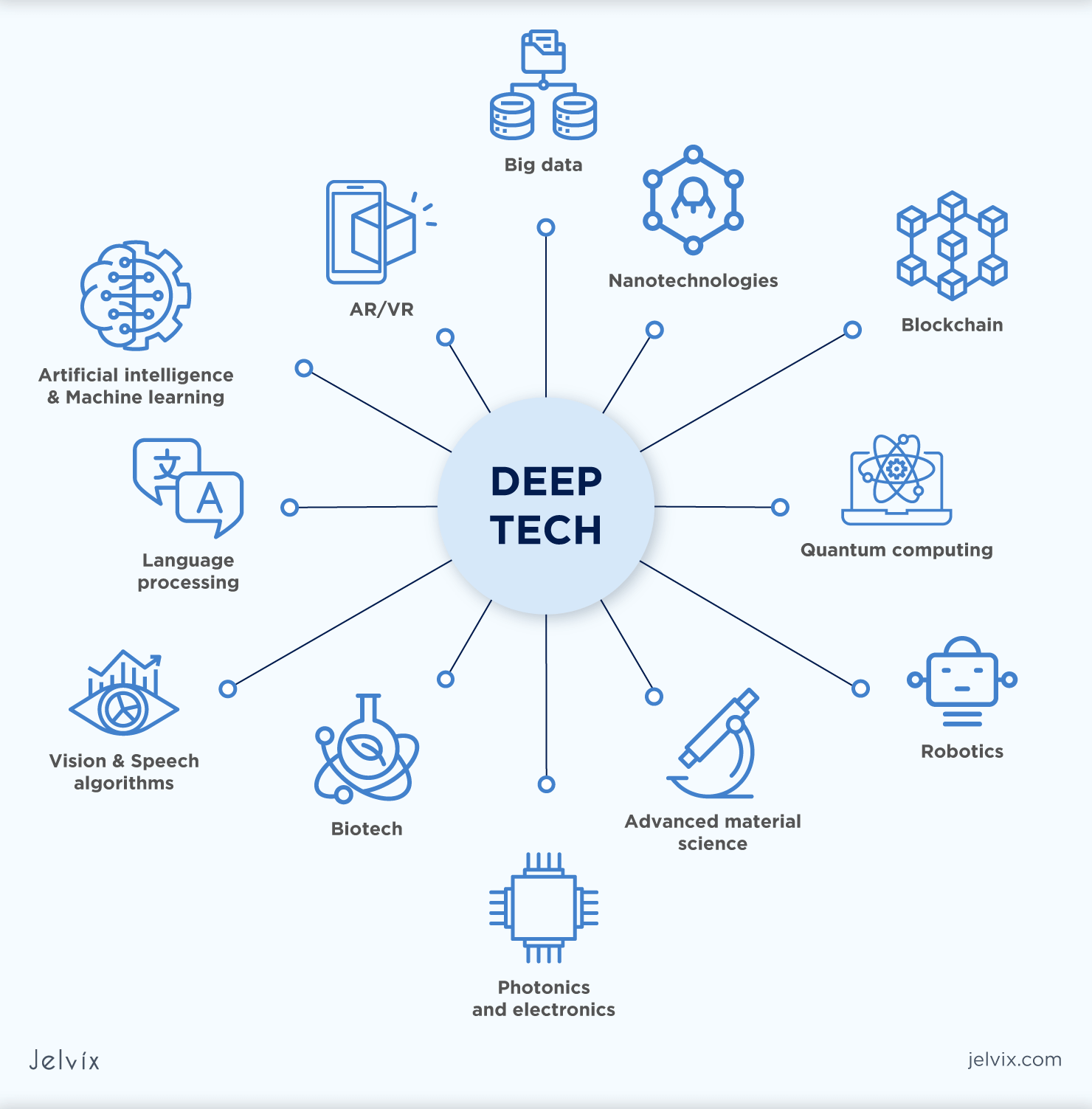
Deep fintech, then, is deep technical innovation that changes what is possible in financial services:
Cryptography and blockchains are deep fintech
Zero-knowledge proofs that let a bank prove it is solvent without showing its books are deep fintech
Machine learning for underwriting is deep fintech, when it moves the loss curve
The infrastructure behind high-frequency trading, from co-location to FPGAs to microwave towers between Chicago and New Jersey, is deep fintech
Large language models working inside real risk, compliance, and investment workflows are on their way to being deep fintech
The test is whether it can be copied. Deep fintech leans into technology that is hard to copy. It does not lean into pushing a financial product out to everyone. It may never touch a consumer, and its consumers are often the hyperbanks.
The third concept is a Neobranch.
I’m combining the digital storefront for financial products — a roboadvisor, a neobank, a digital lender, a neobroker.
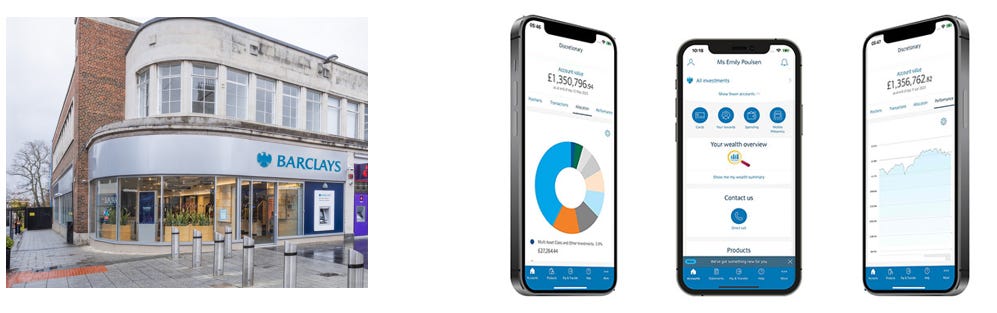
By now you understand that the two pictures above are the same thing.
A hyperbank owns the financial factory, and often the distribution store too. A deep fintech builds the machines the factory runs on. A neobranch is the modern channel optimizer, with product rented from somebody else.
Consider —
Chime gets its charter from Bancorp and Stride
Betterment and Wealthfront rent custody and clearing
Apple Pay rents the charter behind Apple Card
The branch network moves into a phone, and this can be wildly profitable. Chime went public in 2025 at over $11B on this model. Neobranches either go down and buy the factory, as Nubank and Revolut did, or stay up and pay for it.
Big tech without a charter is a neobranch as well, with a bigger attention footprint and less appreciation for financial products. Apple Pay may vertically integrate, or may float on top of existing bank partners.
Redrawing the picture
Let’s score the two 2018 pages against what happened again.
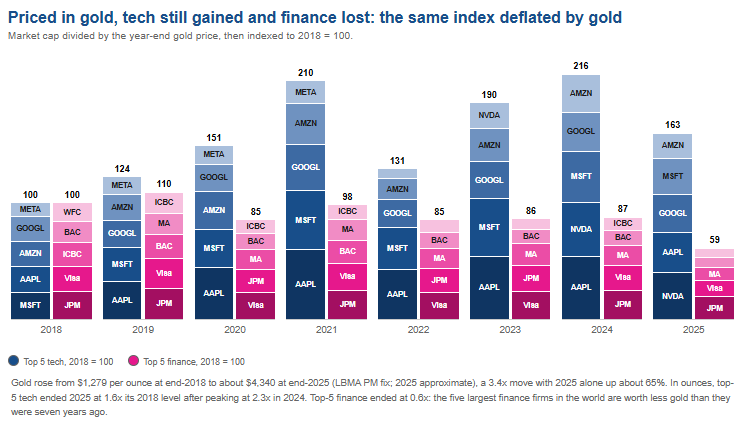
As I said, Armageddon got the value part right. The five biggest tech firms went from $3.4T to $18.6T between 2018 and 2025. The five biggest finance firms went from $1.4T to $2.7T. Tech grew 5.5x, finance 2x — and if we are clever and divide the numbers by Gold, a proxy for moneyness, finance in fact shrank. The Bitcoin version is even funnier.
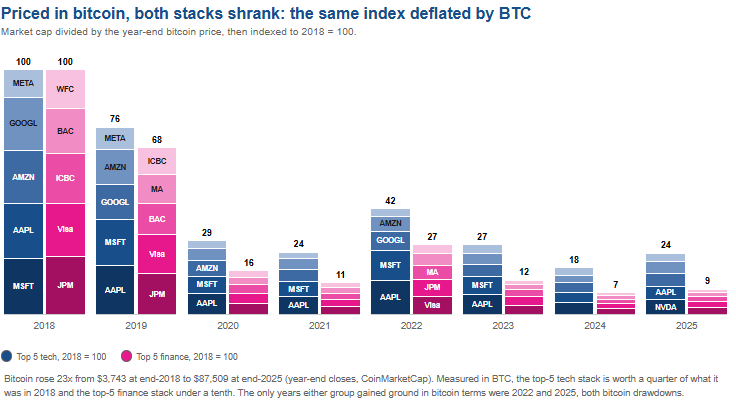
But the Armageddon scenario said tech would take over financial plumbing through hosting bank back-offices and internalizing their function.
This didn’t really happen — Google failed out and killed Plex in 2021. Goldman spent billions on Apple Card and the whole thing was a commercial mess. Big tech did not file for a charter; they mostly left banking alone.


The Renaissance scenario got the shape directionally right but the players wrong. It said the bank in the middle would be a platform, with APIs and revenue share from every app on top. That is exactly what Column does. It just is not Wells Fargo.
I expected there would be players in the middle — sponsor banks, BaaS platforms, issuer processors, orchestrators — and this is where the technology risk hid. Synapse went bankrupt in 2024 with tens of millions in customer deposits lost between its ledger and its partner banks’. Evolve, Blue Ridge, Lineage and Piermont all got consent orders. A hyperbank is the answer to this problem.
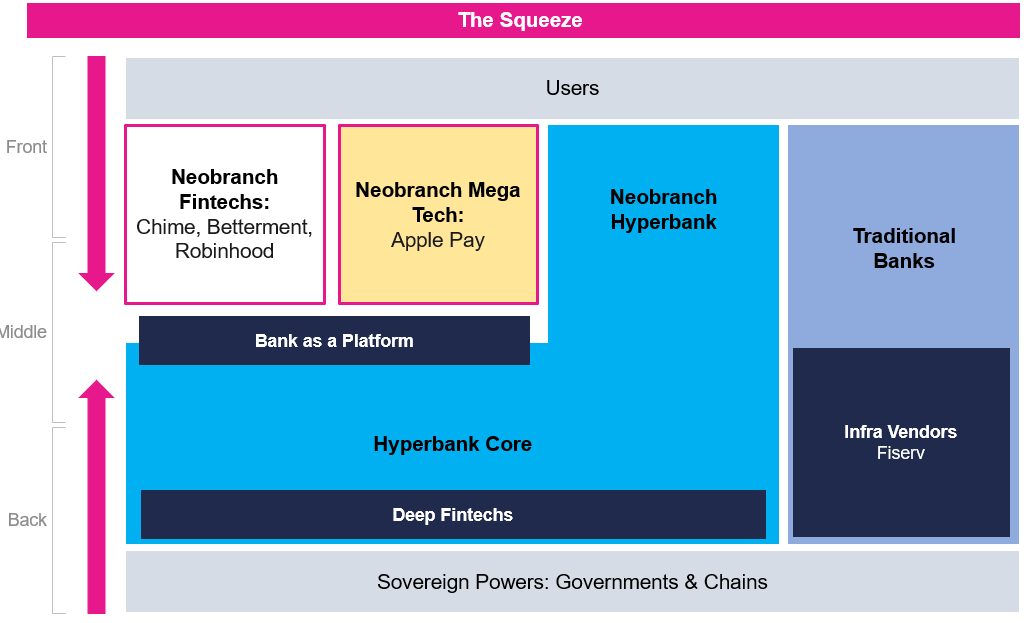
Let’s call the new picture the Squeeze.
Users sit on top. Sovereign powers sit at the bottom, including blockchains as well as governments.
In between, the pressure comes from both ends. Three kinds of neobranches compete for the same users: fintechs like Chime and Robinhood, megatechs like Apple Pay, and the hyperbank’s own store, which is Nubank’s or Revolut’s app.
At the back, the hyperbank core owns the factory: charter, ledger, clearing, custody, underwriting, and so on. Deep fintechs sit inside that core, supplying the next generation machine parts. Bank-as-a-platform, which we drew as the fat middle in 2018, is a thin bar the hyperbank rents to neobranches.
Traditional banks stand off to the side with their infra vendors, Fiserv and FIS, holding the same tiers but largely not connected to the new stores, because they are already at scale — an older IBM to the new Anthropic.
Anyway, that’s how I would build a trillion-dollar financial company.
🤖🏦🧭 Our Ecosystem:
Generative Ventures | AI Research | Robot Money | Linkedin & Twitter | Sponsors
🚀 Lex is actively meeting teams building machine-native financial companies. If that’s you, reach out here.
🦄 In partnership with InterPrivate, we run a $200MM SPAC looking for targets in fintech, digital assets, and AI infrastructure. If you are a late-stage founder or have an idea to discuss, reply directly to this email.
🚀 Postscript
Sponsor the Fintech Blueprint and reach over 200,000 professionals.
👉 Reach out here.Check out our AI newsletter, the Future Blueprint, 👉 here.
Read our Disclaimer here — this newsletter does not provide investment advice
Be your own bank 👍
The funding side is where I'd look hardest. A $1.77B bank whose customers are Ramp, Brex, Mercury and Wise is largely holding other fintechs' cash, and that can move much faster than a normal deposit base. I'd love to know how much of it sits with the top ten clients.