
Gm Fintech Architects —
Today we are diving into the following topics:
Summary: We examine whether robotics is following the AI investment blueprint, from components and training data to industrial and household applications. We estimate that robotics-related companies represent roughly $3.8 trillion in value, although most of that sits inside large technology and legacy industrial companies rather than pure-play robot makers. China has approximately $190 billion across 43 listed robotics companies, compared with about $430 billion across selected American, European, and Japanese automation and component companies. Chinese robotics IPOs have generally produced an initial pop followed by deterioration: the 14 robotics companies listed in 2026 rose a median 12% on day one but now sit 13% below offer price, with 9 of 14 underwater. We argue that robotics valuations are being shaped as much by market structure, insider liquidity, lock-up expiries, and speculative positioning as by commercial fundamentals, making these companies part industrial chassis and part science-fiction meme equity.
Topics: NVIDIA, Anthropic, Scale AI, Tesla, Hyundai, Aptiv, Samsara, Horizon Robotics, Parker Hannifin, Unitree, Figure AI, UBTECH, RoboSense, Pony.ai, Black Sesame, Zhipu, AgiBot, Galbot, EngineAI, LeaderDrive
Thanks as always for your time and attention,
Lex
To support this writing and access our full archive of newsletters, analyses, and guides to building in the Fintech & DeFi industries, see subscription options below.
🤖🏦🧭 Our Ecosystem:
Generative Ventures | SPAC | Robot Money | Linkedin & Twitter | Sponsors
🚀 Lex is actively meeting teams building machine-native financial companies. If that’s you, reach out here.
🦄 In partnership with InterPrivate, we run a $200MM SPAC looking for targets in fintech, digital assets, and AI infrastructure. If you are a late-stage founder or have an idea to discuss, reply directly to this email.
Long Take
The Robot Markets
There has been an increase recently in capital markets activity around Robotics companies, and we now have some results. Hong Kong listed 16 robotics companies in the past year. Fifteen of the 22 robot makers and parts suppliers now listed there trade below their offer price.
Meanwhile, a queue of humanoid startups is waiting to list, and Beijing has started to slow it down.
It’s an appealing narrative. First, we have software AI that comes for our thinking work. Then, we have hardware AI that comes for our physical labor. The addressable market is all human cognition and creation.
As a result, investors have tried to repeat the AI Lab trade by mapping its value chain onto robotics. That has led to the following analogies —
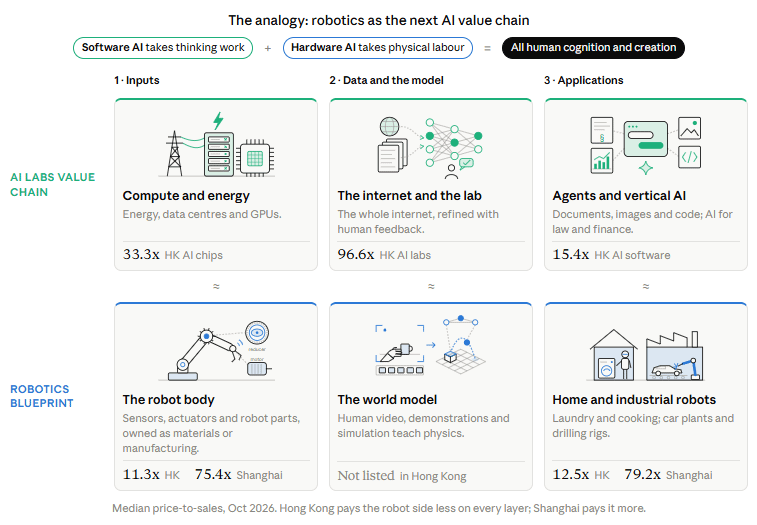
Whereas AI needs capital-intensive investment in energy, data centers, and GPUs, robots, or at least humanoids, need very particular sensors, actuators, and other parts of the robot body. Capturing the supply of these parts, either in raw material form or through manufacturing, is like investing in NVIDIA.
Whereas AI needed the entire corpus of the Internet for its training, then reinforced by companies like Scale AI through human training, robots will need thousands of hours of egocentric (i.e., first-person) video, or imitation learning through demonstration, or better yet, all data ever in order to create a world model. The world model will incorporate not just neural connections, but physical ones, creating a company many times bigger than Anthropic.
Whereas AI agents and chatbots help people make documents, images, and software, robots will have both home and industrial uses. You may want one to do the laundry and cook, and another one to make cars or drill underwater. This is akin to there being unicorns focusing on AI in the legal sector, or AI for finance.
This trade is being carried out mostly on the private markets in the West, and more visibly in public markets in Asia.
In our machine economy database analysis, we see around $3.8 trillion of value sitting in these companies, most of which is inside Big Tech companies like Tesla and legacy manufacturers like Hyundai. These are not pure-plays, but incumbents adding intelligence into their approach, or manufacturing for a robot wave yet to come.
If we look downstream towards applications, meaning examples of actual robot labor or commercial implementation, the value is thinner and more volatile.
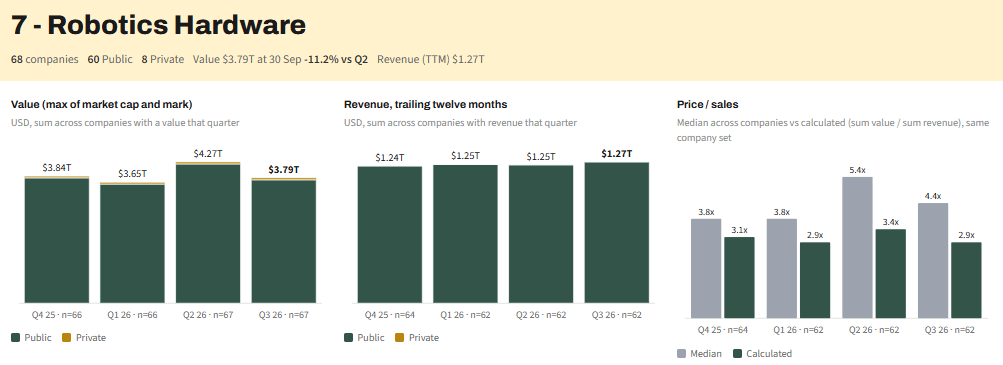
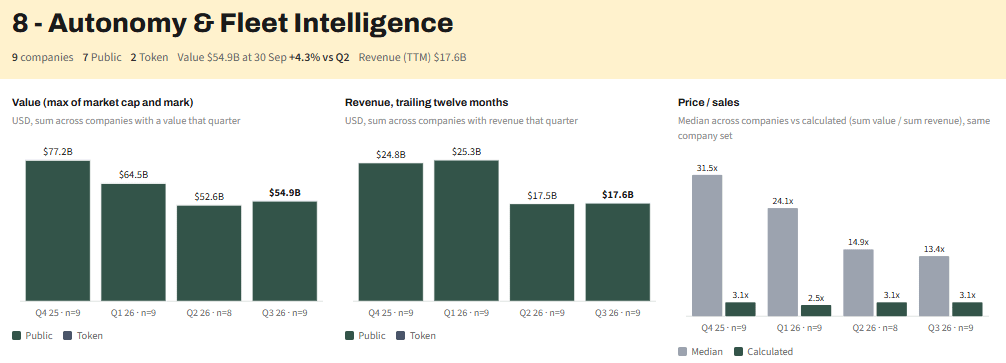
In the latter category, we track companies like Aptiv, Samsara, and Horizon Robotics. You can see the median valuation has fallen over the last 4 quarters as expectations come down to reality. There is a long tail of private companies on the venture side that are seeing the same outcomes. We are told by founders and other investors that the funding and experimentation with world models is slowing down.
China — at least in the public mind — has been portrayed as having a material advantage in the robotics market due to its advanced manufacturing capability and supply chain. Simultaneously, the Chinese capital markets have recently prioritized IPOs in this sector, and many have made the headlines. If you want a deeper operational dive into the sector, check out this great write-up as well.
We are going to focus on the capital markets element and to see how the Chinese robotics IPOs have performed this year. In many ways, this can tell us about the future of the space in the West.
Public Robots
First, let’s look at the public robotics companies in China compared to their public US, European, and Japanese counterparts. We exclude Big Tech to avoid missing the forest for the trees.
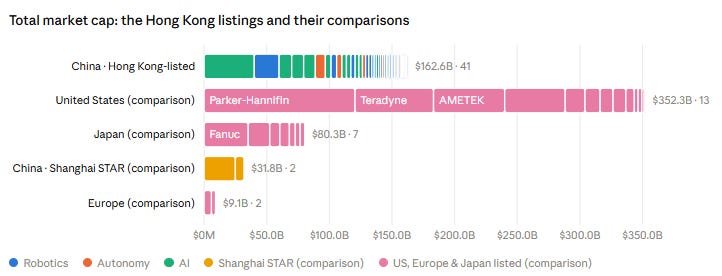
There is around $190B of market capitalization across 43 companies in China, most of which are listed in Hong Kong, and a handful in mainland Shanghai. The 22 US, European and Japanese companies we track build components and industrial automation and are worth a combined $440 billion.
Here is an example of what the largest American tracked company makes.
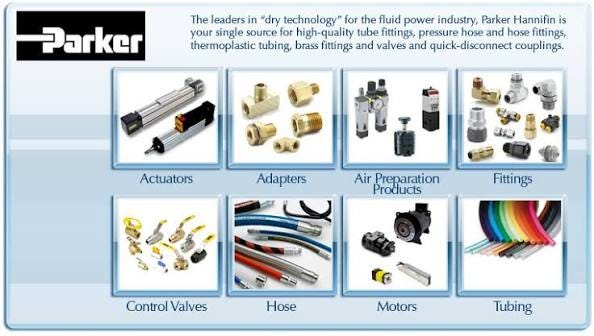
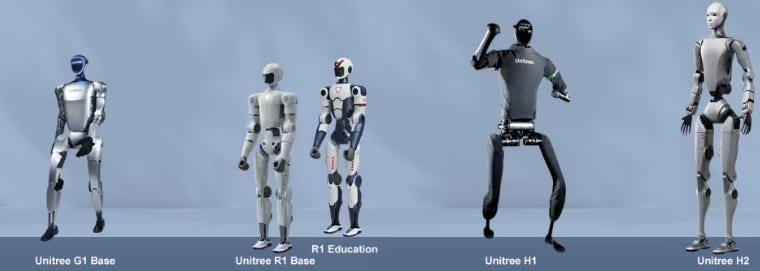
This is certainly correlated with robotics, but probably not the same thing as Unitree.
From a valuation perspective, the Western robotics companies can often lead in the headlines, but have done so by remaining private and raising on visions about the future, which is surprising to nobody. These are long-term capital-intensive businesses, and such reality distortion is required.
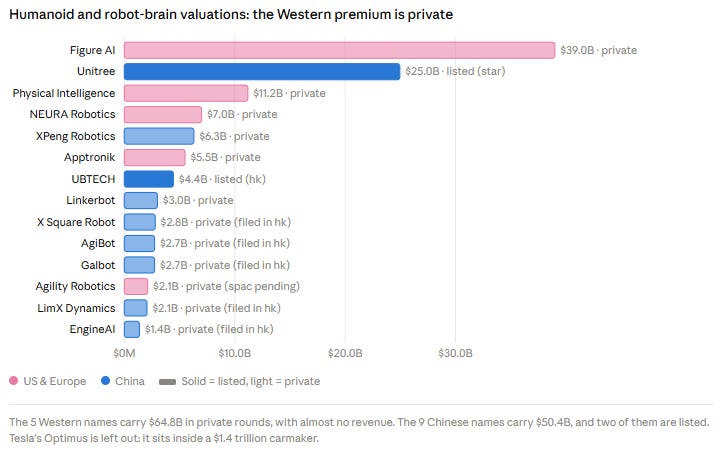
Figure AI is worth $39 billion in private rounds, more than any listed maker, with little disclosed revenue. Five Western startups are worth about $65 billion between them, and none trades on a stock market. China’s biggest names, Unitree and UBTECH, are already public. Its private challengers are mostly worth $1–3 billion each, and many have applied to list in Hong Kong. The West keeps its humanoid bets private, while China takes them public.
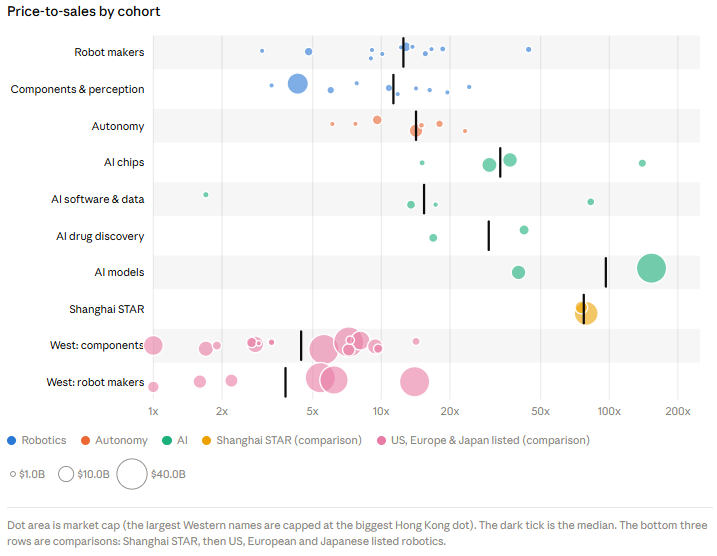
The chart above compares what investors pay for each dollar of a company’s sales.
Hong Kong values its robotics companies at about 12x sales, a little below most of its AI names and far below its AI labs at about 97x sales. Shanghai pays about 77x for Unitree and LeaderDrive. Listed robotics companies in the US, Europe and Japan get about 4x — Western robotics companies are valued at lower valuations because, as we said, many are legacy industrial companies. Hong Kong treats robots as factory businesses as well. Only Shanghai prices them as AI.
Is it Worth It?
So let’s focus on the Chinese IPOs below.
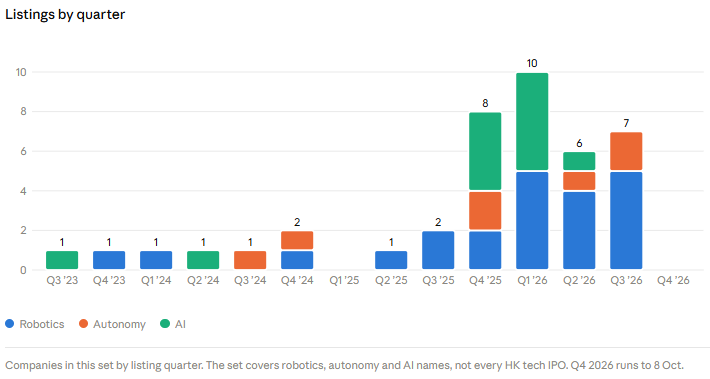
Hong Kong's robotics and AI listings came in a rush. From September 2023 to September 2025, this set of companies added about one listing a quarter, ten in two years. In the past four quarters it added 31, including 16 robotics companies. The wave peaked earlier this year with several AI listings in Q1 2026, while showing sustained strength on the robotics side.
Below we also highlight the key market venues where the launches happened — these assets are in part geopolitical and are not really meant for American investors.

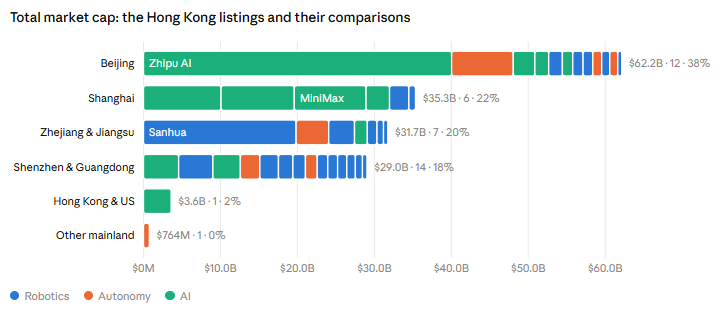
Most of the market capitalization is sitting in Hong Kong, while the companies have their headquarters in Beijing, Shanghai, Zhejiang, and Shenzhen. Over 90% of this cohort, unsurprisingly, was founded in China. Some, like Pony.ai and WeRide, were founded in the United States, but chose to go public in Asia anyway.
So here’s the main question — how did they do as a cohort?