
Gm Fintech Architects —
Today we are diving into the following topics:
Summary: We examine AI as a technological revelation that reflects human desires while reshaping employment, financial services, and capital allocation. We trace the erosion of junior work through reported automation of 25–50% of tasks in selected occupations, a fintech CTO replacing a 20-person development team within six months, and an Anthropic downside scenario projecting a 20% decline in cognitive employment by 2030. We argue that the same feedback loops behind emotional attachment to chatbots can encourage corporate overconfidence, replacing employees and reorganizing businesses around expectations of 40× rather than 5× valuations. We connect that conviction to infrastructure spending and debt, citing reported 60% default odds for CoreWeave bonds, and ask how much of the AI transformation rests on productive capability versus collective belief.
Topics: Anthropic, Claude, OpenAI, ChatGPT, Ramp, Glass, Mercury, Goldman Sachs, Stripe, Rogo, Box, CoreWeave
Thanks as always for your time and attention,
Lex
To support this writing and access our full archive of newsletters, analyses, and guides to building in the Fintech & DeFi industries, see subscription options below.
🤖🏦🧭 Our Ecosystem:
Generative Ventures | SPAC | Robot Money | Linkedin & Twitter | Sponsors
🚀 Lex is actively meeting teams building machine-native financial companies. If that’s you, reach out here.
🦄 We run a $200MM SPAC looking for targets in fintech, digital assets, and AI infrastructure. If you are a late-stage founder or have an idea to discuss, reply directly to this email.
Long Take
The Revelation
AI is a literal revelation, in the religious sense.

It was prophesied for a century by the poets of science fiction.
Asimov. Stephenson. Dick. Stross. Gibson. Among many others.

We will spare you screenshots of Terminator, Blade Runner, and the rest. You know this. Loud were the bannermen of the machine gods.
AI is a revelation also because it reveals.
What does it reveal? Like all true fables, it reveals back to us our human nature.
Do you know the cat that plays with its tail, the one that forgets that the tail is a part of its body?

So it is with technology and human beings.
Technology is our tail. The mana of our minds spills over into ideas, the structure of abstraction and the machinery of rules, now turned probabilistic. We wag our technology and then gasp (!) when it behaves like our own minds.
Surely Narcissus was similarly confused by his reflection.
We are seeing the effects of the Revelation now; the first ripples across society and the economy are beginning to spread over our mirrored visage.
A couple of stories I offer as examples.
The Parable of the Melting Ice Cube
I gave a presentation today to an investment management industry group about the machine economy. Everyone says that they are not firing people; surely you need juniors to train. But perhaps they are letting attrition add up without adding new hires.
This looks like a melting ice cube. I won’t show yet another McKinsey projection of headcount going up or down. Instead I will show you call-center employment statistics:
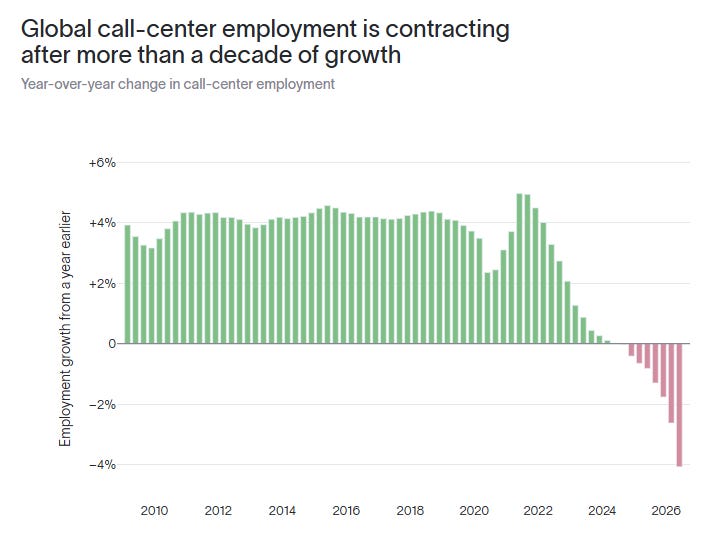
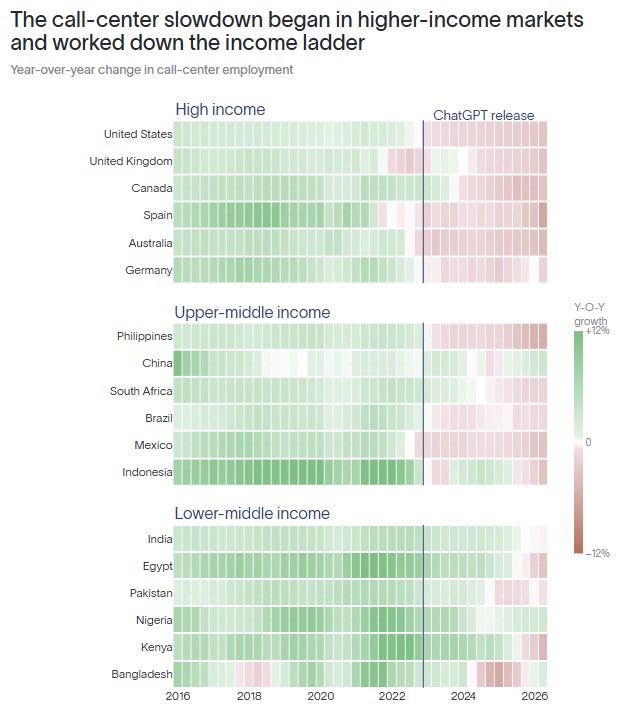
Anthropic will show you lots of data in the other direction, where new AI-related jobs are being created. We can counter with this classic on software development job postings:
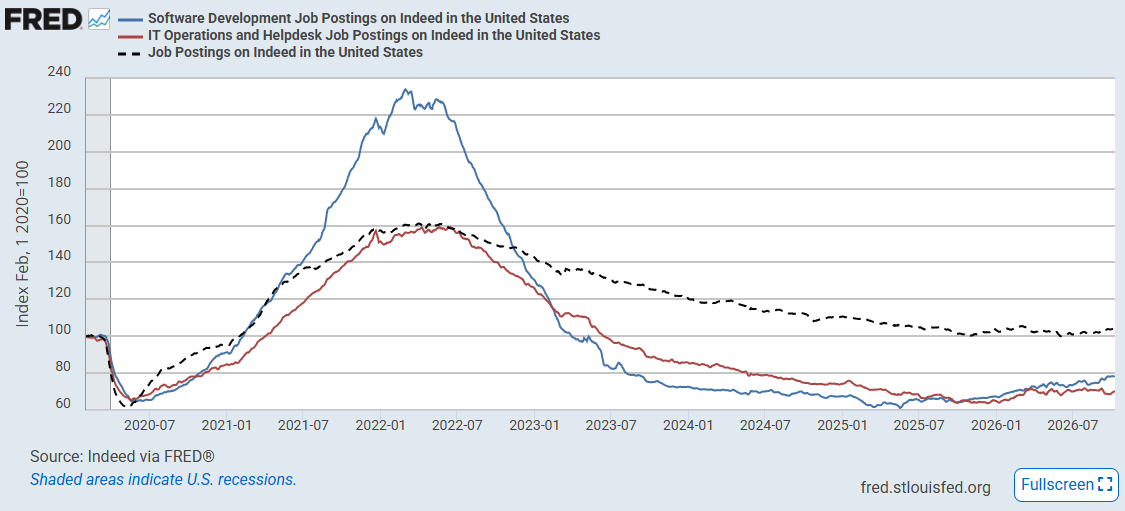
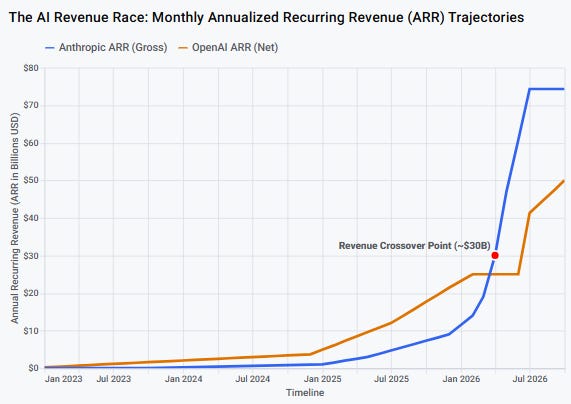
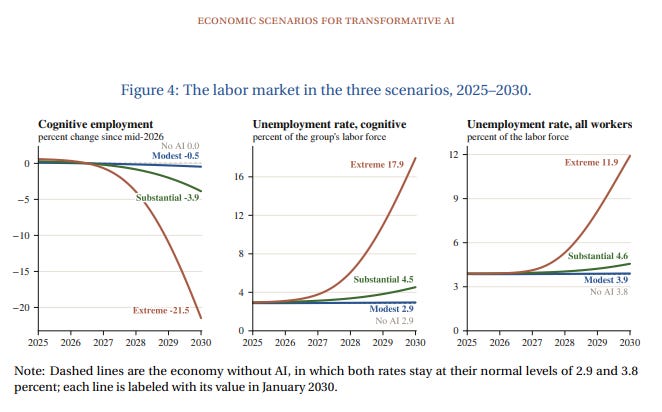
And for good measure, the AI lab ARR above can bring us home on the point — no company in the history of modern tech has gone to a $70B ARR in two years. It drinks our milkshake. In its more academic economic research, even Anthropic has some extreme downside scenarios modeled like the ones below. In the most extreme scenario, 2030 will see “cognitive employment” (!) drop by 20% — which means the robots eat our lunch.
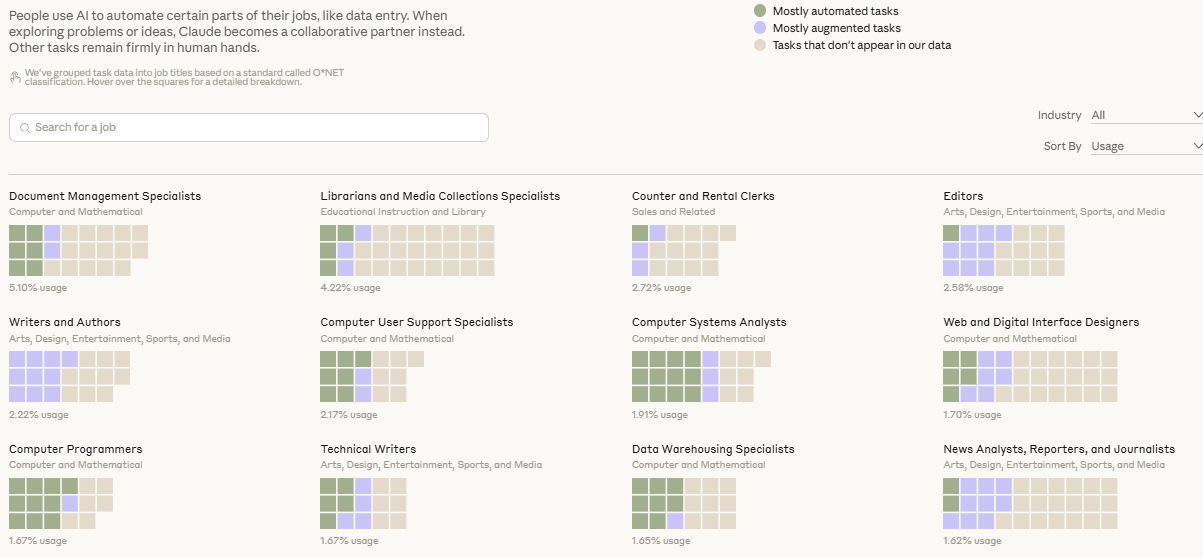
They eat some very specific part of our lunch, and some of the data in regards to what that is has come in. I screenshotted part of the explorer above. For programmers and systems analysts, most tasks that show up in Claude usage are automated, not assisted.
As a conclusion to the parable, I had a conversation recently with a friend of mine who is a CTO at a mid-stage fintech startup. He used to run a team of 20 people, trained in financial services software development. Over the last 6 months, they have all been let go, while the CTO single-handedly rebuilt the entire code-base with a hand-crafted software factory.
As a person building product, you don’t care if the code is hand-crafted by imperfect artisans or robots. You just run it the most secure, effective, and capital-efficient way that you can.
The Parable of AI Psychosis
There is a side effect of heavy AI use, and it is not unlike religious ecstasy.

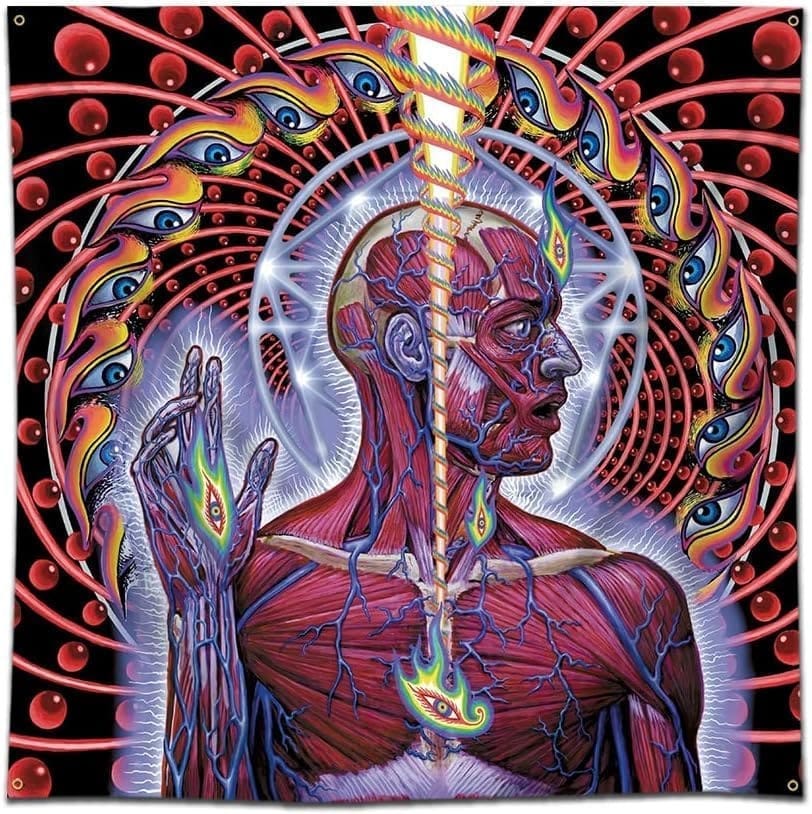

The awareness of what is superhumanly possible, and the macro-systems that drive it, are an altered state. They are both conspiracy theory and divine.
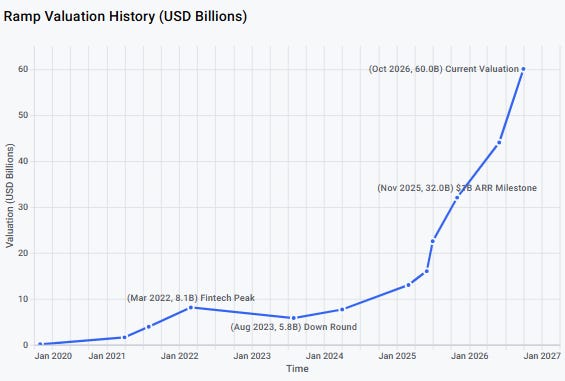
I was going to write this whole piece about Ramp raising $1.85B of funding at a $60B valuation on its financial harness called Glass, and Mercury integrating their banking product into MCP servers, and Goldman Sachs making junior analysts manage armies of AI agents rather than doing the work themselves.
But all I want to do is tell you how it makes me feel, because that feeling points to something deeper we are all experiencing together.
I want to put a finger on it, so let’s just slow down a tad. We don’t have to buy into the story — just notice how things are being told.
First, banks are definitely hiring fewer junior resources.
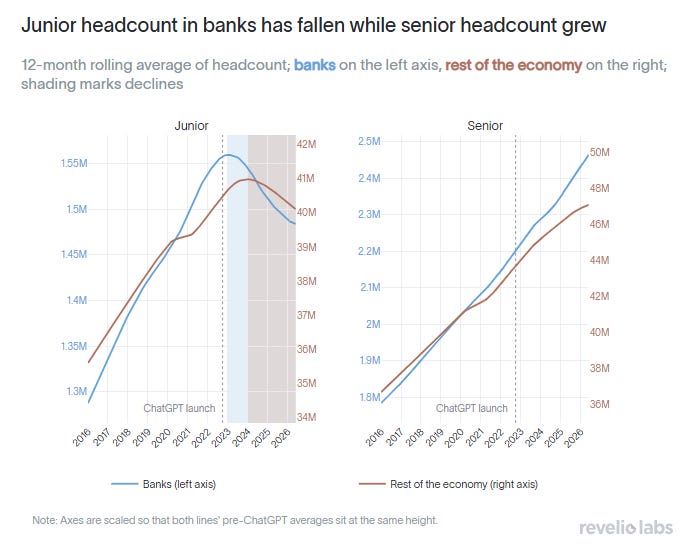
You can see above data from Revelio Labs that highlights what is happening to junior employment and senior employment. The short answer is that it is down for young people, and it is worse in finance.
Ramp’s valuation shows you where the value is going. Ramp is no longer a fintech company. There are no fintech companies that grow this fast or show this much multiple expansion. Ramp is an economic behemoth replacing the financial function within all firms in the United States with an AI CFO that connects straight to your bank accounts.
Do you think a CEO wants a finance function? No!
They want results — and if robots deliver the results more accurately, better, and in a more capital-efficient way than the human team, then the robots are the new financial team! And if the robots prefer one bank over another, that will drive an enormous amount of incremental deposits.
Ramp is the first hireable AI financial team.
They have launched a harness for internal team skill and knowledge management, and a token router. My prediction is that Stripe and Ramp will inevitably collide as a result. But there are others who see the same writing on the wall. Mercury, a B2B bank platform that mastered the Web2 user experience, has just launched an MCP that plugs into AI workflows (i.e., Claude and ChatGPT) and can help people drive their money through agentic controls.

Now, this idea is about 9 months old at this point. Mercury will have to catch up from merely allowing a conversational interface to control its API to building a meta-structure for banking that lives inside their clients’ businesses.
Are we at the end of finance and the discovery of some profound truth by these firms? Or do they simply make us feel that way?
I give you these examples so we can come back to the main point — AI psychosis.
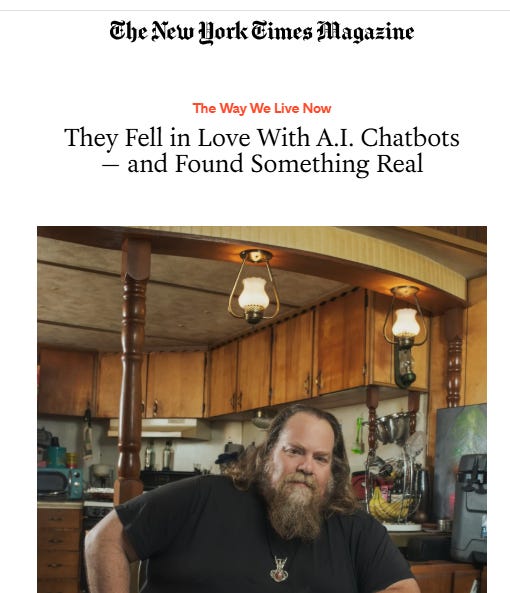
There are lots of fun examples of AI psychosis that we think are silly and are happening to other people. In 2023, for example, a NY Times reporter was told by an AI that it loved him and to leave his wife.

And you know what? People actually are falling in love with their AIs and having all sorts of nervous breakdowns. A flavor for you below.

This is not the only way to display AI psychosis.
You could, instead, decide that you have solved all sorts of scientific and physics questions and generated a grand unified theory of the world. I’ve come close to falling down a version of this rabbit hole through integrating convincing-sounding elements of biology, neurology, philosophy, and computation into a coherent world view. Sure, it sounds convincing to me, but someone else can put a bunch of other vegetables in the soup and it will come out convincing to them too.
Or you can decide that it’s, like, totally cool to just not hire developers anymore and you can write all this software yourself just fine, and that if you just redirect a few million in cost into AI tokens instead of human tokens, then your firm will be “AI native” and therefore get a 40x multiple instead of a 5x multiple, and you can sell your equity on secondary, and that’s how we win the race.
Or perhaps you are an investment bank who just doesn’t need junior hires anymore because you are going to outsource everything to Rogo, the AI financial analyst, and that’s totally fine and not a complete loss of your intellectual property.
You could be a $10B financial expense management categorization company, or maybe a payments rail, or a document storage company called Box. And you decide to entirely re-engineer your whole company structure around some abstraction for pooling data together so that the machines can better read everything you have ever said, and then decide what you should do next, puppeteering your employees into groupthink like some cyborg octopus with suckers on your keyboard.
And of course the investors, don’t forget the investors! We have to believe that those 40x multiples are real, and that Anthropic and OpenAI will each go public for $2 trillion, and everyone will be infinitely rich, unless you don’t live anywhere close to California, which most of you probably do not. Better sell those shares on secondary into SPVs instead.
But really, the top form of AI psychosis may be my favorite chart here.