
Gm Fintech Architects —
Today we are diving into the following topics:
Summary: Onchain finance is moving from issuing assets to allocating them, with investment management and agent pitches reaching 14% of Generative Ventures’ deal flow, up from 5% in 2023. We compare the $331 billion stablecoin and tokenized asset market with Schwab’s third-party fund shelf in 2006, finding an expanding product universe but only about $11 billion in curated vaults. We explore how self-custodial portfolios and AI agents could automate allocation while undermining retention, illustrated by Yearn’s roughly 98% decline in assets and Schwab’s 21% deposit decline during cash sorting.
Topics: OKX, Intercontinental Exchange, Nasdaq, JPMorgan, Charles Schwab, Fidelity, BlackRock, Franklin Templeton, Coinbase, Robinhood, Kraken, MetaMask, Morpho, Steakhouse, Sentora, Gauntlet, kpk, Glider, Zyfai, Yearn, Ethereum, Solana, Generative Ventures
Thanks as always for your time and attention,
Lex
To support this writing and access our full archive of newsletters, analyses, and guides to building in the Fintech & DeFi industries, see subscription options below.
🤖🏦🧭 Our Ecosystem:
Generative Ventures | SPAC | Robot Money | Linkedin & Twitter | Sponsors
🚀 Lex is actively meeting teams building machine-native financial companies. If that’s you, reach out here.
🦄 We run a $200MM SPAC looking for targets in fintech, digital assets, and AI infrastructure. If you are a late-stage founder or have an idea to discuss, reply directly to this email.
Long Take
Capital Markets and Onchain Wealth Management
Andrew Cuomo is now the co-chairman of OKXICE, a 50-50 joint venture between the cryptocurrency exchange OKX and Intercontinental Exchange (ICE), the parent company of the New York Stock Exchange.
This is totally normal.
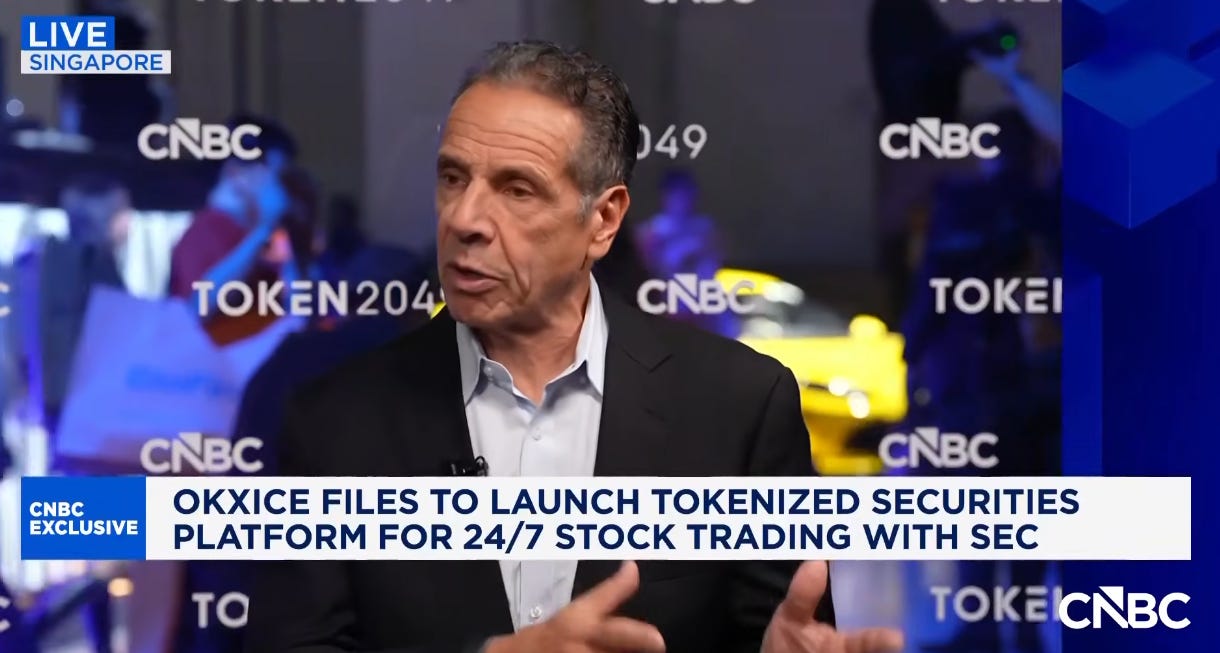
It plans to launch with roughly 60 US stocks, like Nvidia and Apple, available for round-the-clock global trading on mobile devices. Eat your heart out Hyperliquid!
Nasdaq published an FAQ last month telling public companies how to say *No* to tokenized versions of their own stock on platforms like this. Under the SEC’s new innovation exemption, a venue can trade a third-party token of your shares unless you object within 30 days. The objection only applies to the venue that sent the notice.
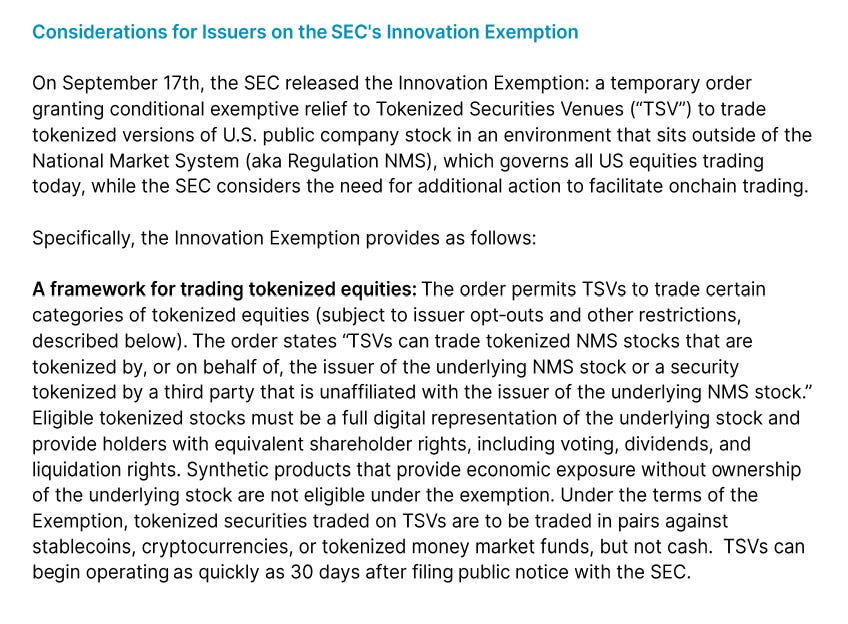
Nasdaq, as an issuer, says it will opt out of all of them. Nine companies, including Broadcom, Verizon and UnitedHealth, have already objected to OKX and ICE’s joint venue.
The same week, Citi and Bank of America joined JPMorgan in blocking third-party AI agents from customer accounts.
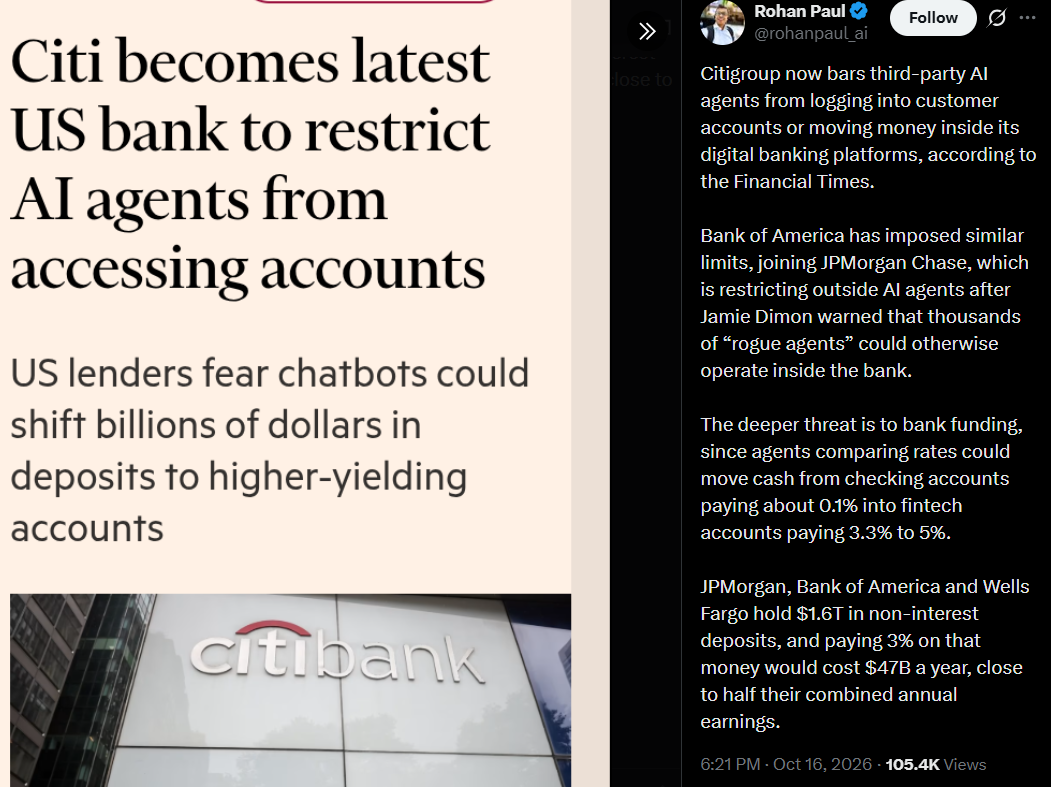
Schwab’s CEO said his firm actively blocks unauthorized agents, including Meta’s Muse, from moving client money.
People are defending their businesses from technology that flows around their moats like water and erodes any hope of competitive advantage. It reminds us of the battle 10 years ago over screen scraping, financial data sharing, and open banking.
The customer, superpowered by Big Tech firms, against their bank.
There is no real way to stop the change — only a variety of ways to slow it down. The obvious trend is that all assets will be tokenized and agents will be able to control them with onchain intents. But today, most of the noise is still about manufacturing / issuance, meaning who gets to create and trade the asset.
Supply and Demand
Generative Ventures has logged roughly 2,800 pitches since we started, most focused on the machine economy. The deals we see already reflect a highly opinionated thesis.
For each deal, our database robots tag by company sector, and below I highlight three relevant groups. This is in order of adoption across the investment value chain:
Capital markets tracks issuance: tokenization, exchanges, private-market access, credit markets.
Investment management is what happens after the asset exists: portfolio construction, financial planning, performance reporting, fund tech, managed accounts and yield vaults.
The third group is agents that hold wallets and move money.
Issuance pitches rose from 44 in 2023 to 79 so far in 2026. Investment management pitches went from 30 to 52, after a 2024 dip to 15. Agent wallet pitches went from 6 to 81. Inside that group, agentic payments and machine wallets went from 1 to 54.
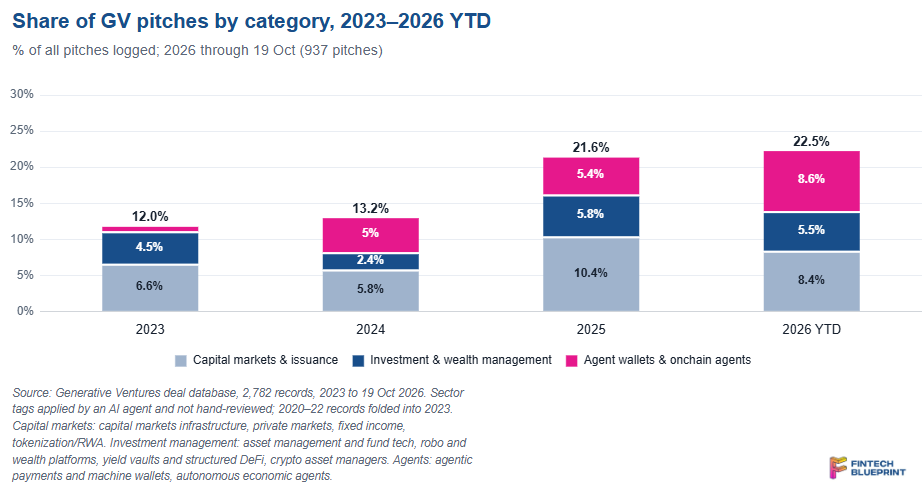
Taken together, investment management and agents now make up 14% of everything we see, up from 5% in 2023.
This is the first time that onchain distribution is outnumbering manufacturing, highlighting how alternative products make it into the wealth management industry.
First come the standalone products, like a particular token or wrapper fund.
Then regulators write rules that make them legitimate — the GENIUS Act and the SEC’s tokenized stock exemption have opened the doors.
Then we start to see open architecture platforms around all the choices, and the commercial opportunity moves from fund manufacturing to asset allocation.
As a result, there is now a wave of onchain investment managers who want to edit the existing menu rather than create new things.
The chain is the self-sovereign Custodian
Open architecture is an old idea in wealth management.
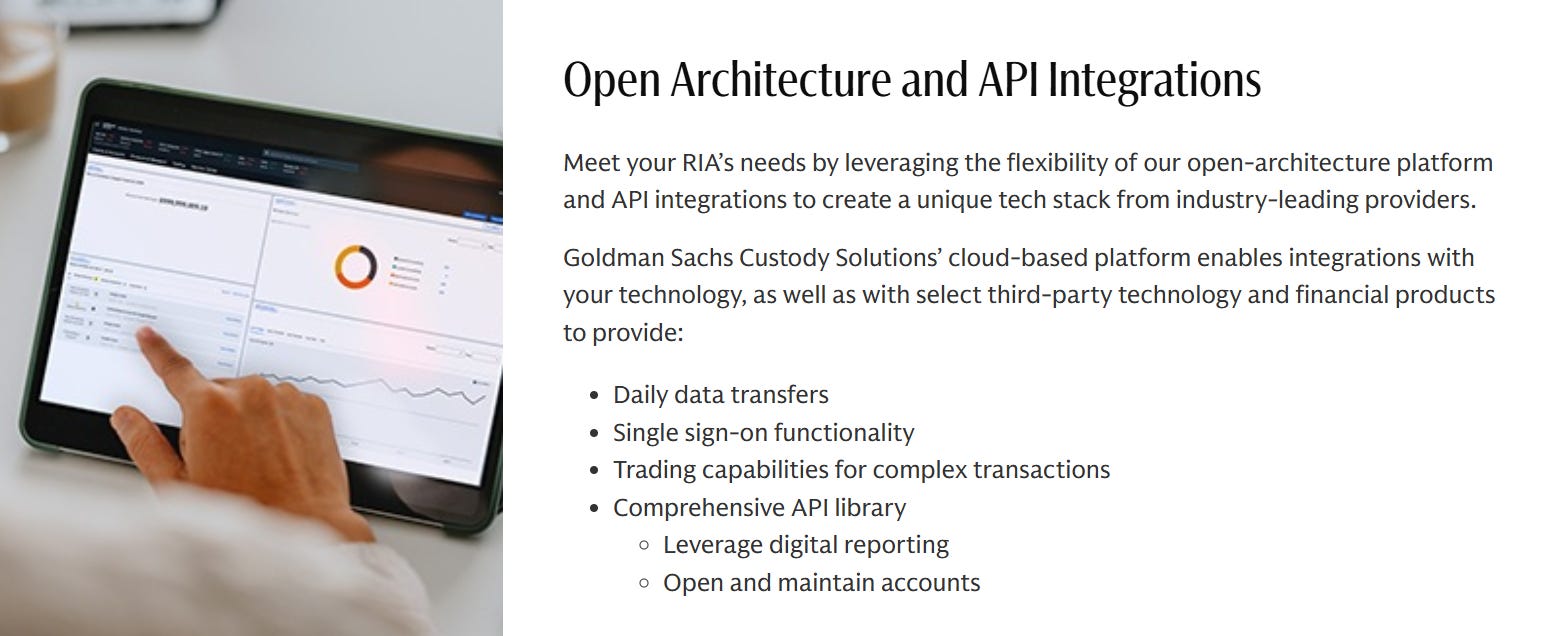
Whether you look at Goldman, Fidelity, Schwab, or Merrill, the open architecture platform is prevalent. Clients can buy both third-party and proprietary products.
For example, in early 2006, Schwab Institutional custodied $439B for independent advisors. Schwab’s Mutual Fund OneSource held $148B in third-party funds. The custodians provided the shelf and the infrastructure. The advisor picked the products and owned the client. Fidelity and TD Ameritrade ran the same model.
Manufacturers fought for shelf space, and the platform got paid on assets and cash. Just like in a Walmart.
A blockchain does the custodian’s job. It holds the assets and settles trades on a record every integrated app can read. Today, that can be a DeFi app or some permissioned chain that is writing proofs to mainnet. Any protocol can list an asset on it without asking.
So how big is the Web3 shelf, relatively speaking?
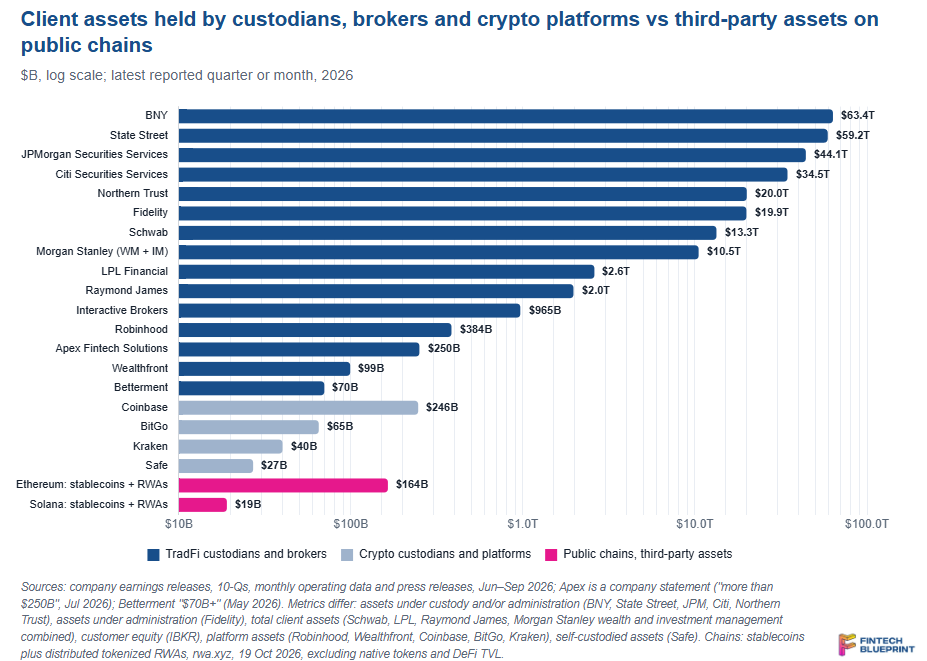
Still very small.
Today, across all chains, stablecoins and tokenized real-world assets add up to $331B. Ethereum holds $164B of that and Solana $19B.
At Schwab, third-party mutual funds and ETFs came to $4.9T in September. In early 2006, its third-party mutual funds held $305B.
So the entire onchain shelf is about where Schwab’s was in 2006.
That’s not an insult. Schwab’s third-party mutual fund complex alone grew 6x in the twenty years since. Add the third-party ETFs, which Schwab didn’t report separately in 2006, and the shelf is 16x bigger.
Crypto’s open architecture is starting to get serious products.
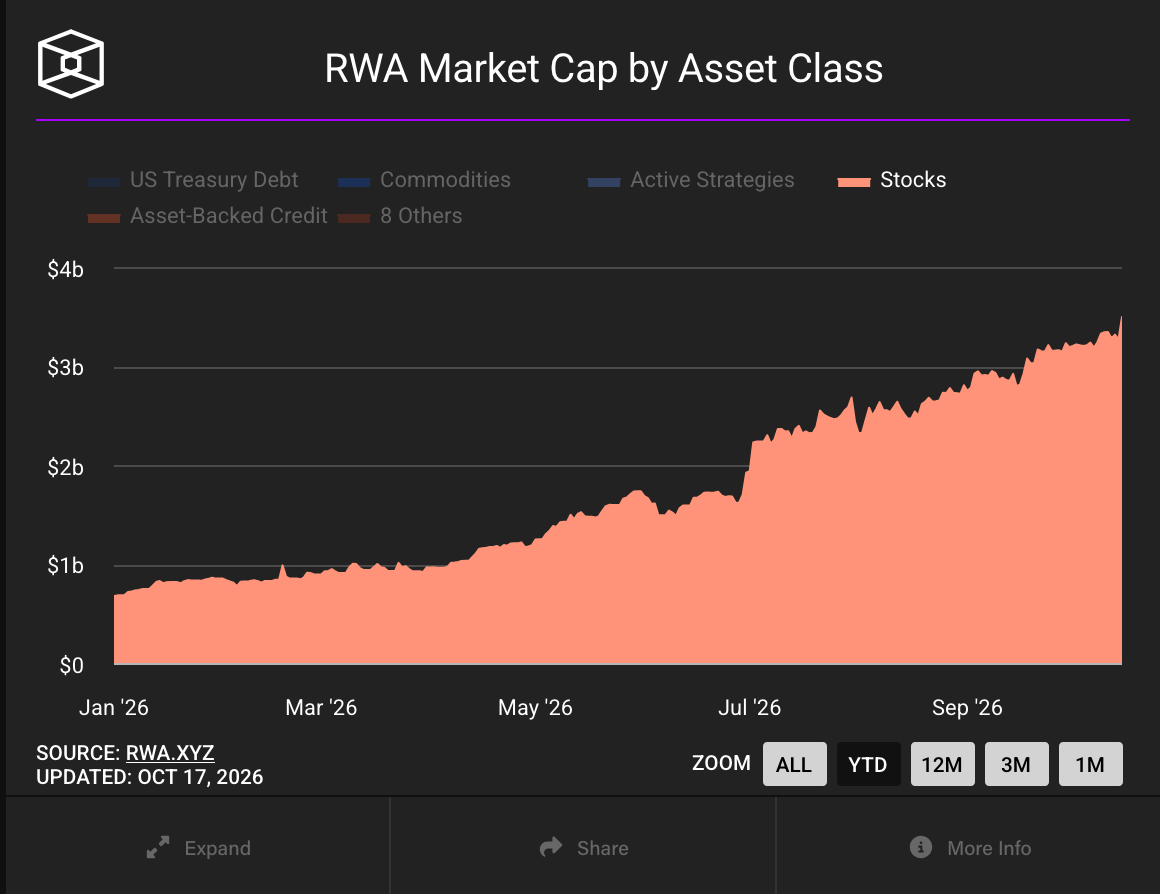
Tokenized Treasuries alone are $14.7B, and the manufacturers are the ones you would expect: BlackRock’s BUIDL holds $2.2B, Franklin Templeton runs $2.5B across four funds, and WisdomTree, Invesco and Janus Henderson all have a product. JPMorgan’s deposit token, which it has run on its own chain since 2019, arrived on Ethereum this week. Robinhood sells tokenized US stocks to Europeans. Tokenized stocks across all venues are $3.5B, up from $680MM in January.
We have talked about institutions coming onchain forever. The product set is no longer DeFi native — three stablecoins and a lending pool.
It is all the stuff.
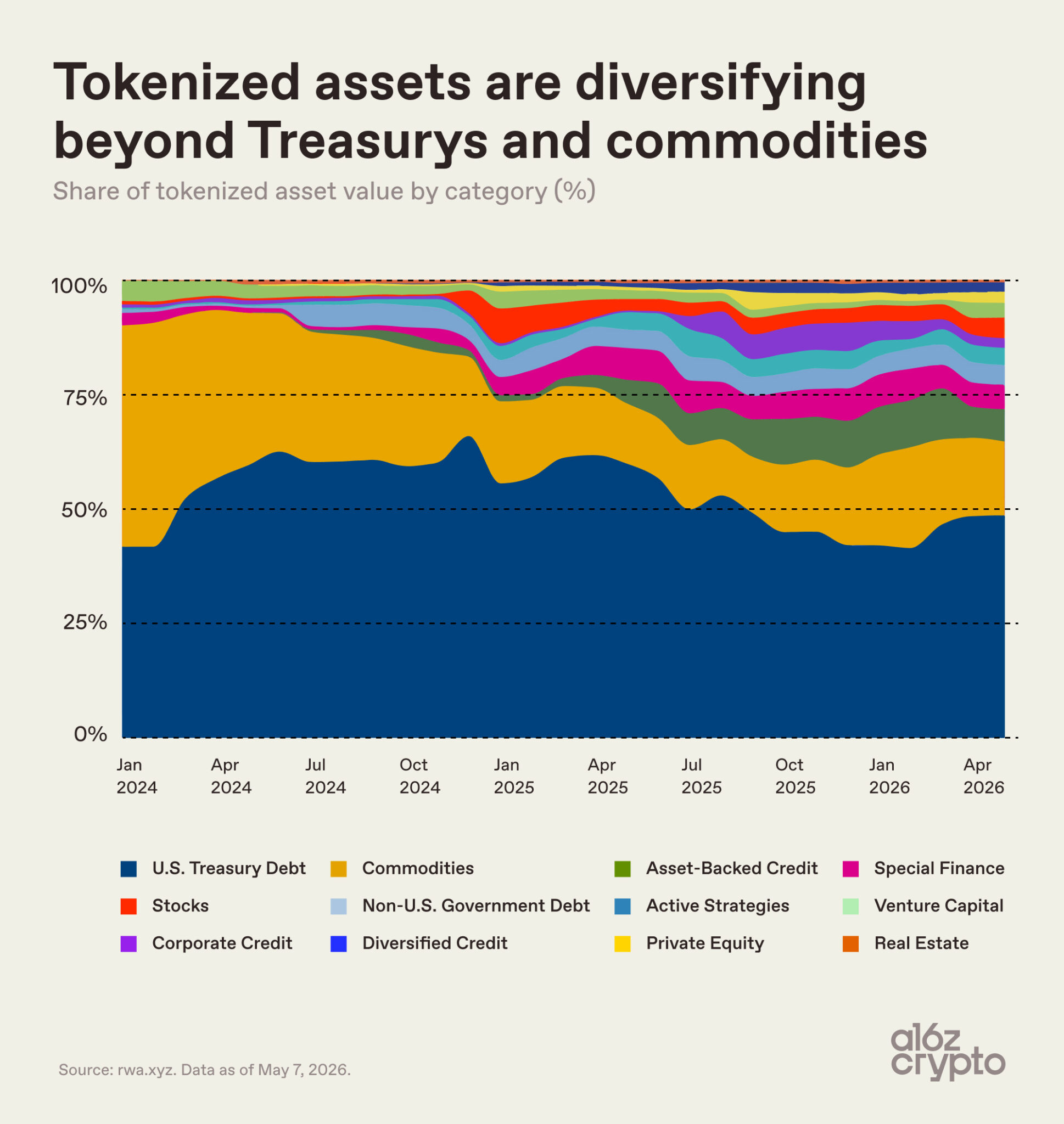
But almost none of it is managed. Curated vaults hold about $11B, which is 3% of the $331B of third-party assets onchain. The rest sits in wallets, on exchanges and in treasuries where almost nobody creates a proper allocation.
In traditional finance, the ratio runs the other way: most retail assets sit inside a fund, an advisor model, or a managed account. So the supply side has been built, while the advice side has barely started.
The Assets needs an Editor
Open architecture has a problem.
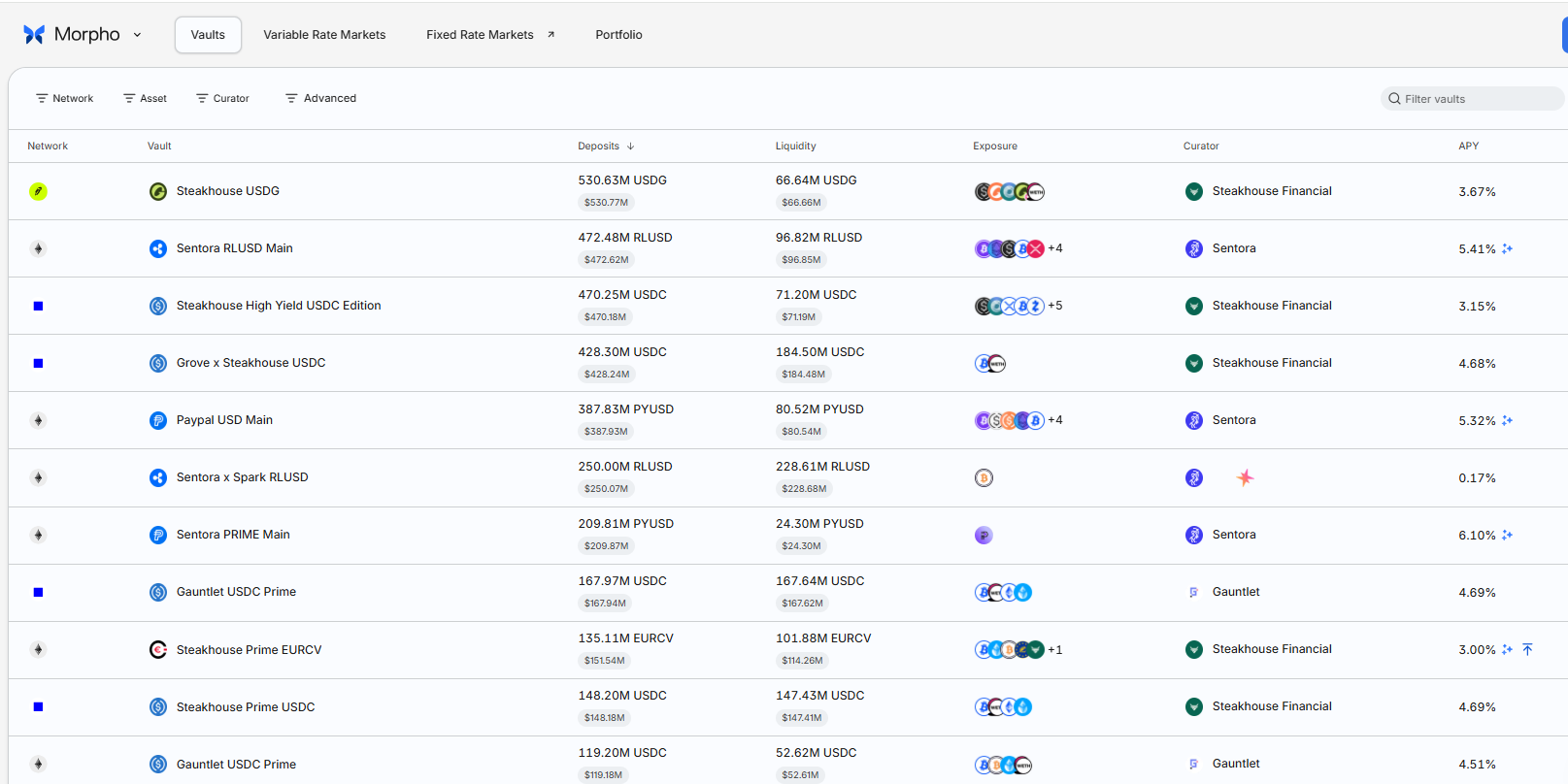
When there are 10,000 funds on the shelf, it is hard to figure out which ones fit where. Sure, you can sort by size and Sharpe ratio, but most people don’t enjoy this and it is easy to be wrong. Traditional finance solved that with the financial advisor, who picks the products and is responsible for the outcome of the allocation.
DeFi has evolved out a similar entity, called a curator.
A curator sets the risk rules for a lending vault. It decides which collateral is allowed, at what loan-to-value, with which oracle, and how much exposure each market gets. Depositors give the vault cash and the curator decides where it goes.
S&P counts about $1.5B in these lending vaults in September 2024 and about $10B in September 2026. Vaults.fyi tracks $11.3B across 856 curated vaults run by 131 curators. Morpho’s TVL grew from $182MM at the end of 2022 to $11B by September 2026.
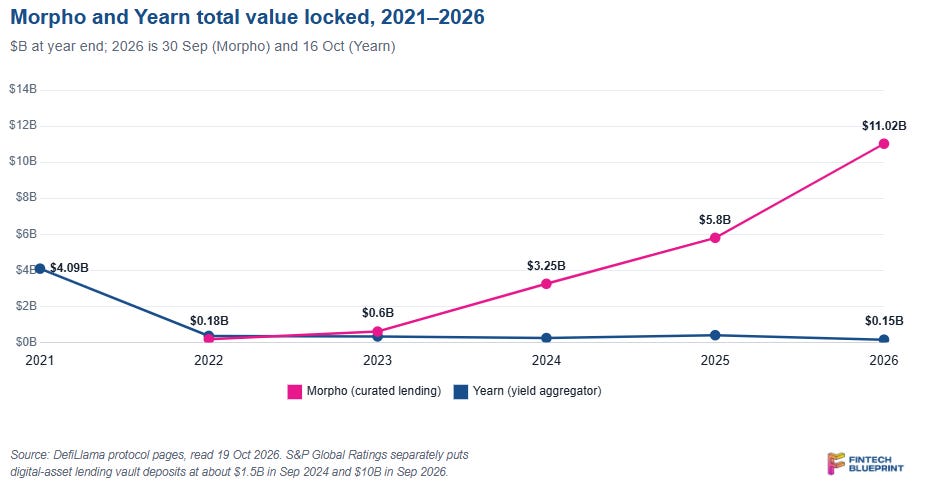
There are already signs of oligopoly and brand value in the market.
Early entrants lead — Steakhouse curates about $2.5B and Sentora about $2.5B. Gauntlet runs $1.6B in vaults, before counting its risk mandates at Aave and Compound. Below them, Nonce Capital has $591MM, Hyperithm $257MM and kpk $219MM. In July, the top three curators held 76% of all curated vault assets.
The big consumer apps and centralized exchanges arrived as well.
Coinbase routes over $500MM of USDC lending through Steakhouse vaults on Morpho. Robinhood’s earn product passed $500MM. Kraken launched DeFi Earn on Veda vaults curated by Sentora and Chaos Labs. A Sentora bitcoin vault on Kraken took $30MM from 4,000 wallets in its first ten hours. Bitwise, Galaxy and Wintermute now curate vaults too. MetaMask provides its self-custodial users with MetaMask Money, an integration into yield providers as well.
Key Opinion Leaders, Advisors, and Fiduciaries
In traditional finance, an investment adviser owes the client a fiduciary duty: care and loyalty, enforced by the SEC under the Investment Advisers Act of 1940. There are 16,544 SEC-registered advisers.

In crypto, the person who tells you where to put your money is often a key opinion leader on X, paid in tokens to post “this vault is printing” at 2am. This looks a lot more like the sweatshop brokers of the 1980s, combined with a healthy dose of attention economy bravado and fraud.
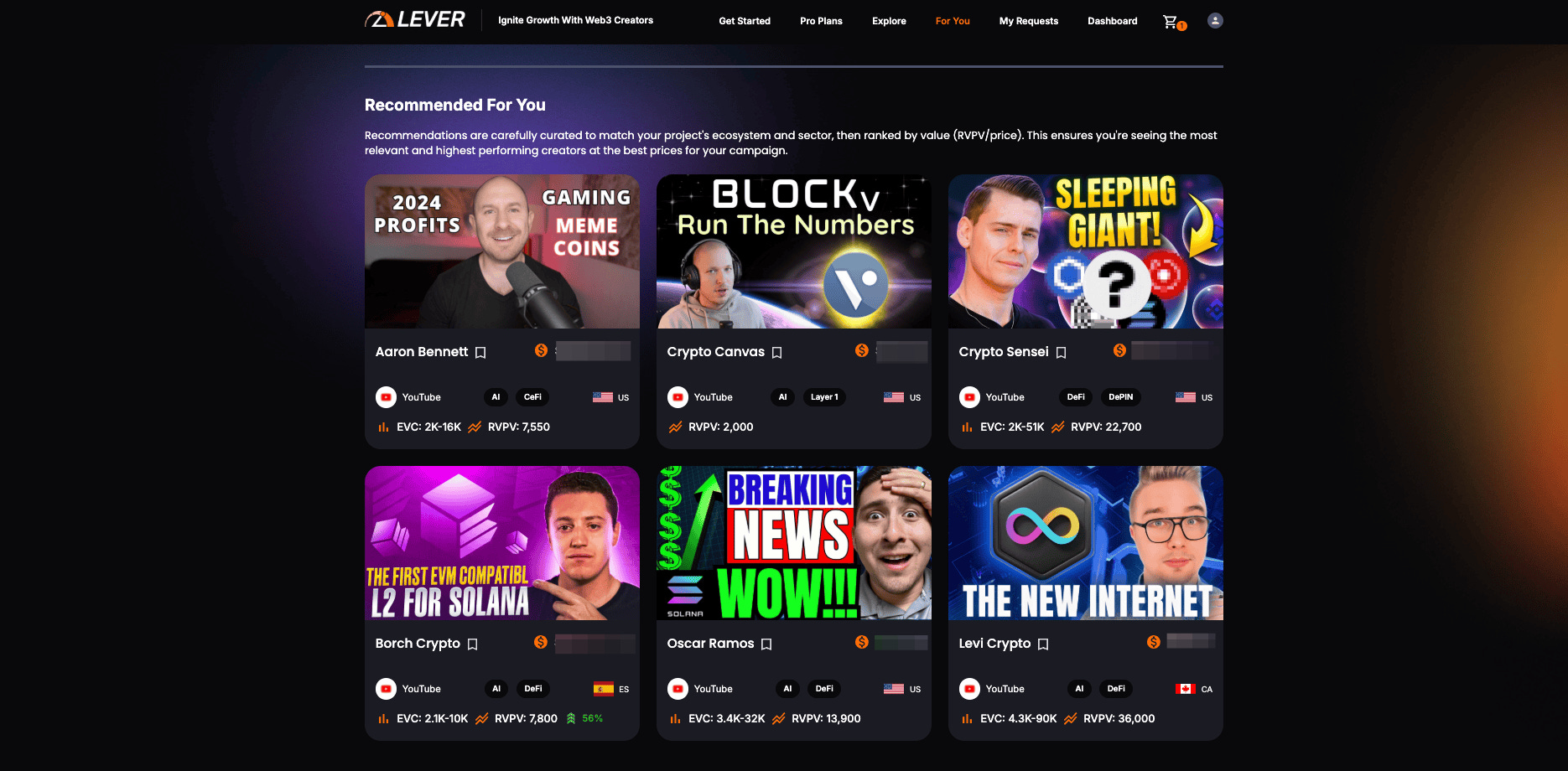
It’s generally good when an expert who acts for you can be held accountable for doing it badly. People are less likely to be misled into losing their money, and become more loyal clients to high quality providers. Here is one clear example —