
Gm Fintech Architects —
Today we are diving into the following topics:
Summary: We examine Vanguard’s extraordinary $4B acquisition of Altruist, only its second acquisition in 51 years, as a strategic move into the infrastructure underlying independent wealth management. Altruist has grown to 6,500 advisors by vertically integrating custody, clearing, advisor software, and Hazel AI into a single stack. We argue the acquisition gives Vanguard both a credible third player in RIA custody and an AI-native wealth platform capable of reshaping how financial advice is produced and distributed.
Topics: Vanguard, Altruist, Charles Schwab, Fidelity, Hazel, FormulaFolios, Brookstone Capital, Envestnet, Orion, AdvisorEngine, Betterment, Robinhood, Shareholders Service Group, BNY Pershing, LPL, BlackRock, GIC, Salesforce Ventures, ICONIQ Growth, Baillie Gifford, WisdomTree, Franklin Templeton, Anthropic, OpenAI
Thanks as always for your time and attention,
Lex
To support this writing and access our full archive of newsletters, analyses, and guides to building in the Fintech & DeFi industries, see subscription options below.
🤖🏦🧭 Our Ecosystem:
Generative Ventures | AI Research | Robot Money | Linkedin & Twitter | Sponsors
🚀 Lex is actively meeting teams building machine-native financial companies. If that’s you, reach out here.
🤖 AI & Robotics Industry Encyclopedia: In this 100+ page report, we collate all the meaningful companies across public quities, private equity, and digital assets related to the machine economy. 👉Learn more here
🦄 In partnership with InterPrivate, we just launched a $200MM SPAC looking for targets in fintech, digital assets, and AI infrastructure. If you are a late-stage founder or have an idea to discuss, reply directly to this email.
Long Take
Vanguard Buys Altruist, Shaking up the Custody Duopoly
Vanguard does not just buy things.
In 51 years, its entire M&A record is Just Invest, a small direct-indexing shop it picked up in 2021. The mutual ownership structure is built to prevent aggregation: the funds own the company, so it runs at cost and hands the savings back to fundholders.
There is no acquisition currency and no empire to build, just AUM to grow at a low cost for clients. Vanguard is an exceptional firm.
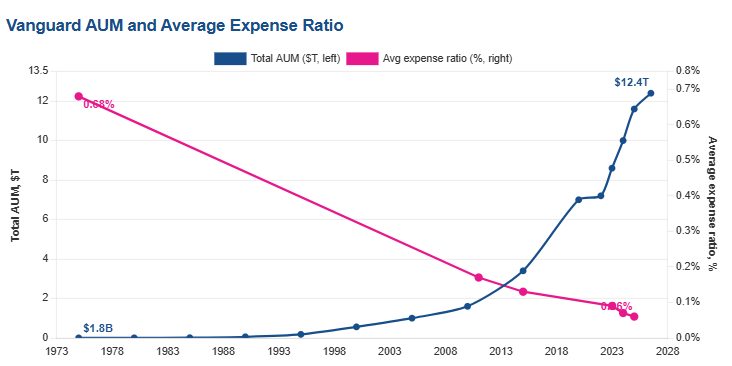
But things can change. The Wall Street Journal reports that Vanguard has agreed to buy Altruist for roughly $4B in cash — the largest check in Vanguard’s history for an eight-year-old custodian.
The asset manager had invested in Altruist’s $110MM Series C in November 2021 and took a board seat, so they have seen progress from the inside. Five years later, Vanguard bought the entire company at more than double the last private round.
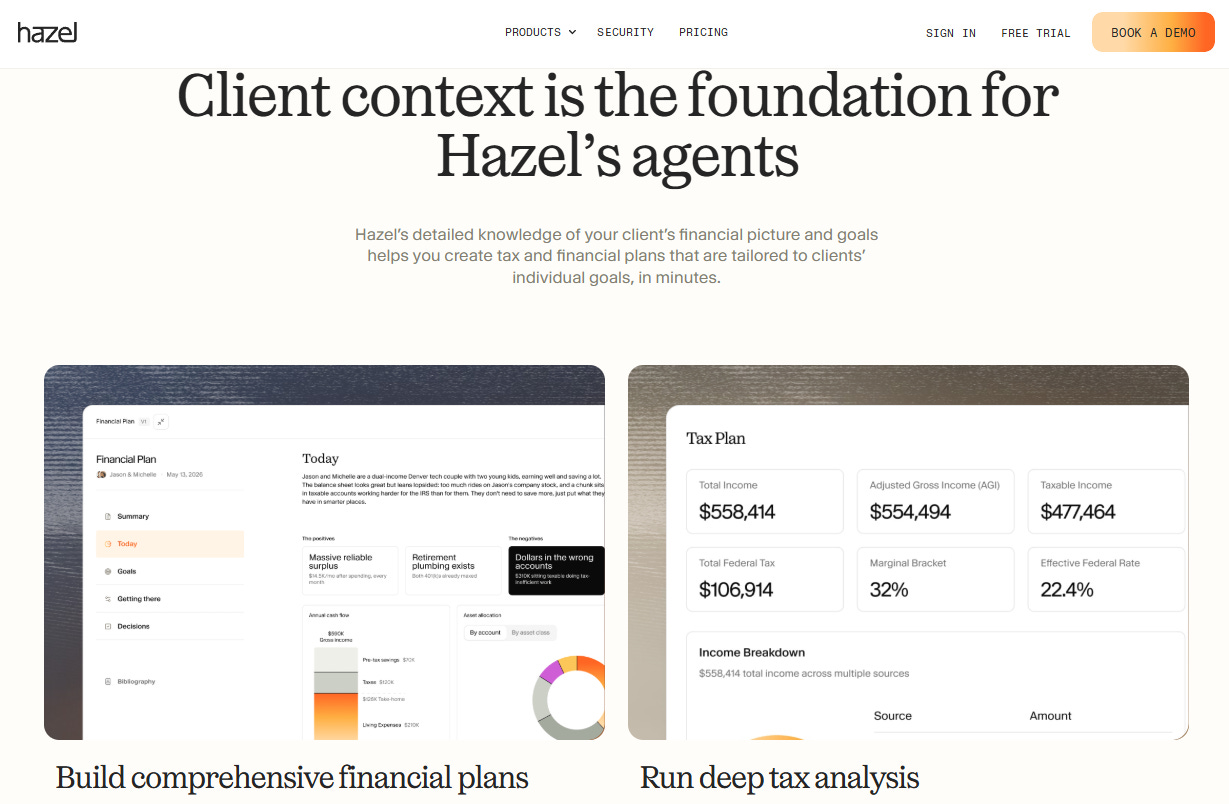
I think it bought two things: (1) a large and growing fundamentals-driven custody business that puts Vanguard as a mega-player into a new game, and (2) a financial AI lab that touches wealth management.
Let’s dig in.
The Deal
Jason Wenk, the CEO of Altruist, is deeply committed to the wealth management industry and is a true supporter of the independent financial advisor.

Many other entrepreneurs have tried to automate away wealth management, put an AI in the driver’s seat, or redirect users to the lowest-cost roboadvisor. Jason has built a behemoth on improving the existing industry, and his reputation follows from the operating success of his several business ventures in the wealthtech space.
Altogether, Altruist raised a bit over $600MM since 2018, so early investors are well compensated with a $4B exit. The last private valuation was $1.9B, set by the $152MM Series F that GIC led in April 2025 alongside Salesforce Ventures, ICONIQ Growth, and Baillie Gifford. The main thing that has changed since 2025 is the idea that AI will turbo-charge financial services, and that AI-native companies are like the LLM labs, and trade at a premium.
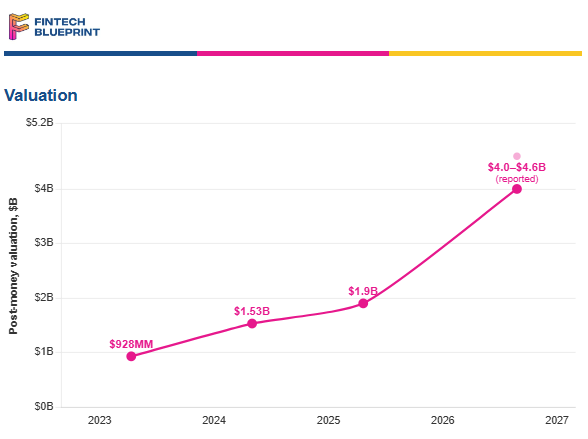


Above is our prior coverage of the company’s growth. You can trace Altruist’s position from vertically integrated wealthtech distribution, to industry-scale digital transformation, and AI-led advisor acceleration. The acquisition announcement says the deal will close later this year pending regulatory approval, and Altruist will remain a standalone entity.
To better understand the company, we should start with the start-up that defined Jason earlier on — FormulaFolios.
This was a Turnkey Asset Management Platform. A TAMP's core job is to provide portfolio management, asset allocation, and back-office support to independent RIAs. That means having a shelf of ready-to-go investment products that advisors can distribute, and a team that implements all of the customer onboarding and money movement to a custodian.
Most TAMPs position themselves as a solution to reduce complexity and fix the cost side. Envestnet, Orion, AdvisorEngine, and many others (e.g., Betterment for Advisors) play in this space.
But the real product here was actually not the back-office. It was distribution — FormulaFolios worked out how to market independent RIAs to consumers. It is much better to sell revenue growth than to sell cost savings.
A financial advisor shop with $5–10MM under management has no marketing department, and it is a difficult path to get to $50MM in AUM. Wenk had taught himself online acquisition across the 2000s, first with a $20-a-month 401(k) advice app bought through penny-a-click search ads, then with an RIA he grew on blogging, SEO, and an early YouTube channel.
FormulaFolios industrialized that for other advisors.
It ran national direct-response campaigns like an affiliate network, funded from each advisor’s own budget, with leads routed home by geography — which is how its own marketing spend stayed under $200K a year. An advisor cost just under $600 to sign, and each one showed up with $5–10MM of client assets attached. Wenk started it with $100,000, charged 20–50bps, and reached roughly $60MM of ARR on a ten-person service team. It was profitable in two years.
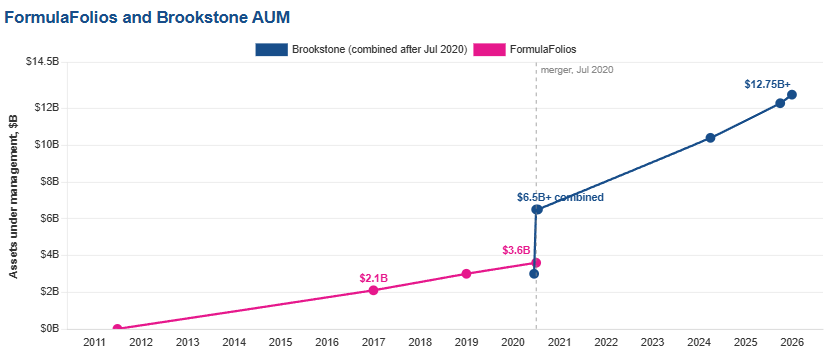
FormulaFolios merged into Brookstone Capital in 2020, but by then Jason was two years into Altruist and going after the plumbing directly rather than building more workarounds. Fun fact — Brookstone was the first large customer of AdvisorEngine, the wealthtech company I co-founded back in 2014, for exactly the platform tech stack described above.
On our podcast, Wenk gave the post-mortem himself: FormulaFolios leaned “way too much” on downstream vendors — the custodians and everything bolted to them — and their processes meant he always charged more than he wanted and never scaled the way Robinhood or Betterment could on rails they owned.
The downstream vendor economics add up quickly as you have to pay for software that does trading, portfolio management, asset allocation, account management, CRM, financial planning, performance reporting, billing, and so on. If the client fee has to live in 20-50 bps, this is hard to escape.
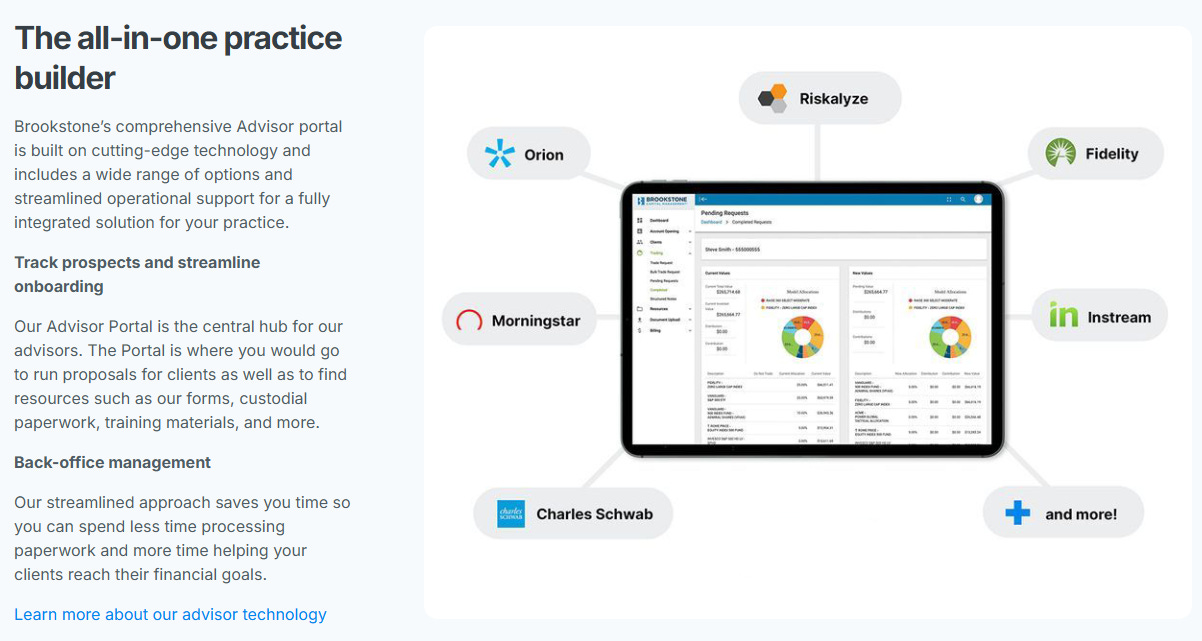
So the answer is not a single tech platform, but vertical integration into investment management and custody, where you can earn fees on cash sweep and other financial products, to subsidize the tech. And if you bite the bullet and build everything vertically integrated, then you will have large upfront regulatory and fixed costs, but can bake in high-quality tech into the infrastructure from day one.
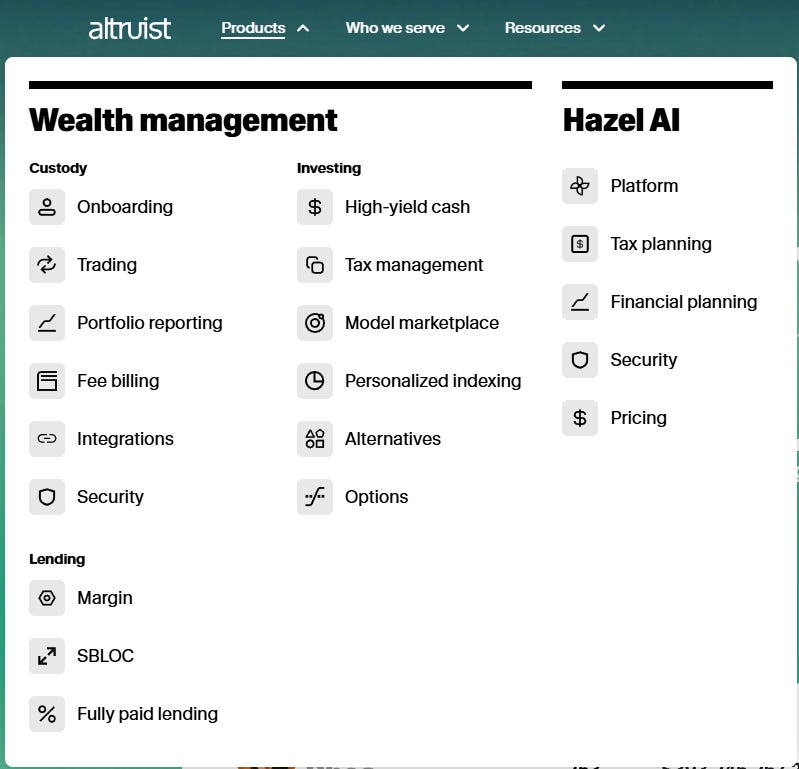
It is no surprise that Altruist is a self-clearing broker-dealer welded to the software an advisory firm actually runs on — one stack where an RIA normally assembles endless vendors. Same play as FormulaFolios, solve the advisor’s growth problem and get paid on the assets, except this time Wenk built the entire structure.
The idea is older than the company. We had Jason on the podcast in August 2021, three months, as it turned out, before Vanguard’s first check, and the thesis he laid out dated back to 2004.
As a first-time RIA founder he couldn’t get Fidelity or Schwab to call him back. TD Waterhouse took him on, and when he asked how to open accounts and run billing, they pointed him at an “affinity center” of third-party vendors.
The question that became the company was already in his head: the custodian has the data, so why is it shipping a flat file over SFTP for some other vendor to charge you to reassemble?