
Gm Fintech Architects —
Today we are diving into the following topics:
Summary: We examine Anthropic’s proposed $100 billion IPO at a $2 trillion valuation, arguing that its financing structure is as consequential as the intelligence it sells. We unpack $131.7 billion in cash and investments, roughly $431 billion in future compute commitments, and $77 billion in vendor financing that ties the company’s fortunes to its suppliers. We question the durability of consumption-based revenue as customers pursue cheaper models, while cloud marketplaces distribute 48% of revenue and collect an estimated 35% fee on those sales. We connect Anthropic’s spending to SpaceX’s cloud revenue and the wider infrastructure cycle, arguing that public investors are buying into an increasingly interdependent financial system whose participants need the same growth story to hold.
Topics: Anthropic, Claude, OpenAI, SpaceX, NVIDIA, Amazon, AWS, Google, Google Cloud, Microsoft Azure, Broadcom, Oracle, CoreWeave, Palantir, Stripe, Ramp, Robinhood, BlackRock, Circle, Coinbase, xAI, Cursor, X, Starlink, Colossus, OlympusDAO, MicroStrategy, Lucent, Nortel, Gemini, BitGo, Klarna, Wealthfront
Thanks as always for your time and attention,
Lex
To support this writing and access our full archive of newsletters, analyses, and guides to building in the Fintech & DeFi industries, see subscription options below.
🤖🏦🧭 Our Ecosystem:
Generative Ventures | SPAC | Robot Money | Linkedin & Twitter | Sponsors
🚀 Lex is actively meeting teams building machine-native financial companies. If that’s you, reach out here.
🦄 In partnership with InterPrivate, we run a $200MM SPAC looking for targets in fintech, digital assets, and AI infrastructure. If you are a late-stage founder or have an idea to discuss, reply directly to this email.
Long Take
Cybernetization
What better way to learn about Anthropic’s IPO than to ask its well-trained AI to analyze its overlord master?
It is no secret that Anthropic is going public, and that it looks to raise $100B at a $2 trillion valuation. We remember when a trillion was a lot of money just a few years back! The world’s largest IPO was going to be Ant Financial at $300 billion, when fintech was king of the hill and Bitcoin’s $1 trillion market cap was a revelation.
Poppycock.
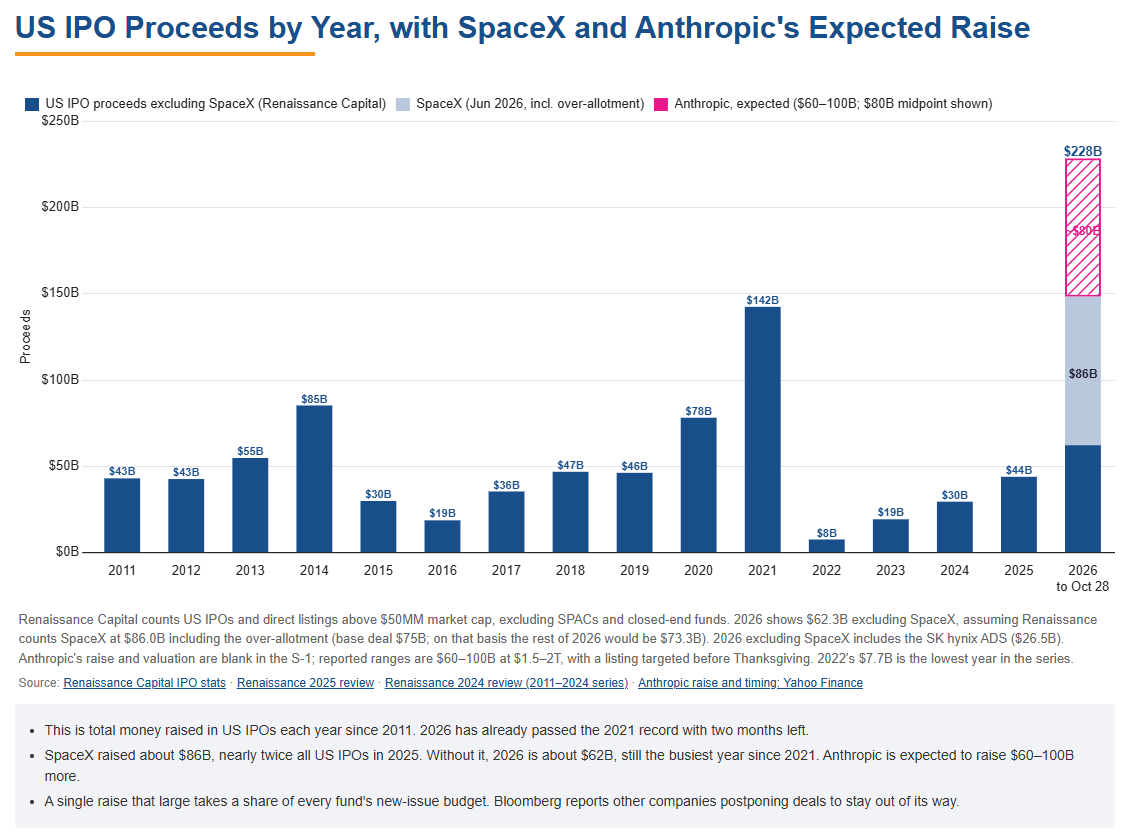
If Anthropic lands, it follows SpaceX, which has already raised its capital and is trading at $1.96 trillion of marketcap at $15 billion of quarterly revenue. The entire game right now is the high end of the market, and it looks like a very high end. We have never seen anything like it.
Our analysis robots have torn apart the Anthropic S-1 to pull out the most widely discussed and interesting bits, and we will present them shortly. What’s not there is also important, especially from the point of view of financial services.
Anthropic is not taking over banking, and its documents do not really talk about financial products. It does not want to own payments, banking, trading, or asset management — these jobs are left for Stripe, Ramp, Robinhood, and BlackRock. While there have been many features sold by Anthropic to its bank enterprise customers, or private equity partners, those are merely clumps of intelligence packaged for usage by others. It took Google and Apple a long time before they started to compete for the wallet.
Anthropic does sell the shovels. But the thing that people are using the shovels for is the complete terraforming, or rather digitization and cybernetization, of their own industries. Whoever runs their car into the wall fastest wins, I guess.
There are certainly impacts on banks and finance as it relates to security. This is a big one. The models are way, way smarter than us. They are better at math, systems thinking, and banging their heads against problems until the problems fall over. And in this way, they are better at breaking old systems, porous security solutions, and ancient encryption methods. In a world where the default password for your personal data in government agencies is “password”, it doesn’t take much to start tearing things down. To the extent Anthropic, OpenAI, and others build models that can tear apart the fabric of software engineering, the financial system is certainly implicated.
The most financial thing about Anthropic is, actually, its finances.
We may think about the wonder of how AI can make video, write code, and speak with a human voice.
But the real wonder is how a company this young can have $130B of cash on its balance sheet, earning $1B in interest, while being financed by its GPU suppliers, who lend against future revenue and get repaid in Anthropic stock.
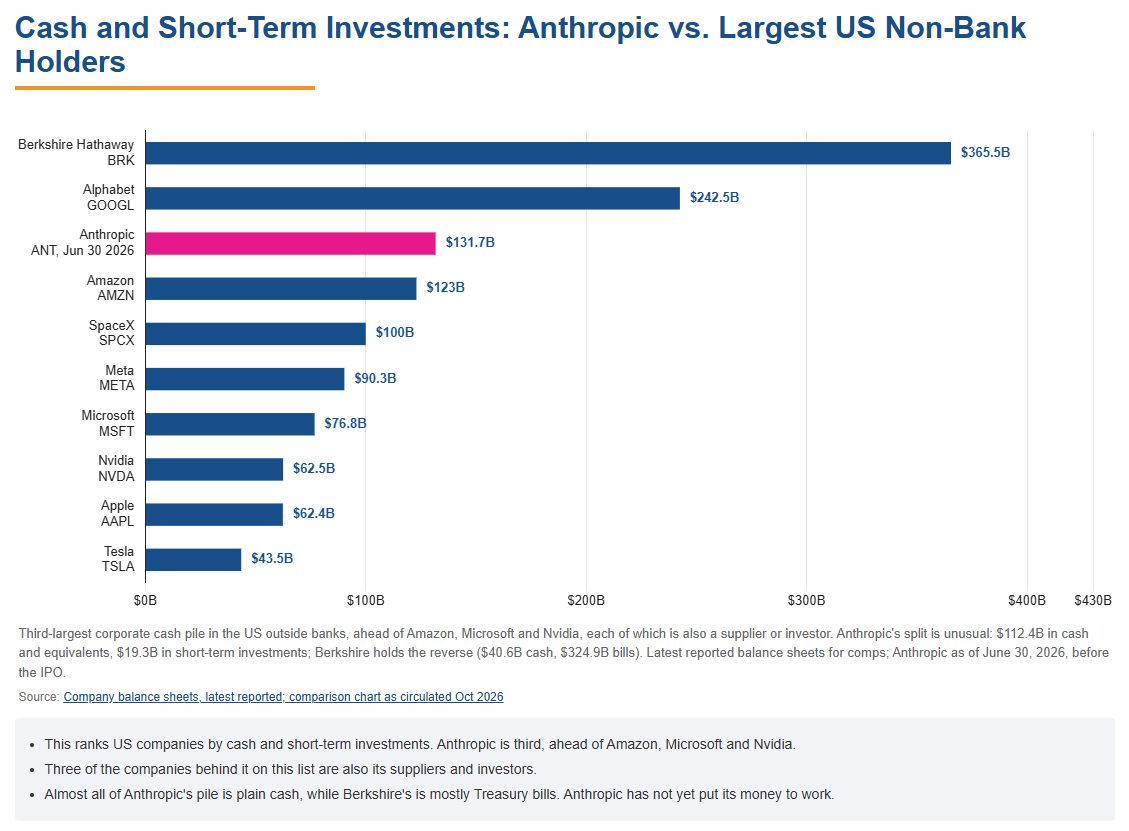
This financial engineering trick is a $2 trillion miracle.
The reason it works is that, on paper, everyone makes money.
Not just Anthropic or OpenAI, but NVIDIA and the private equity lenders, and Amazon, and the venture investors in every supplier along the way, and the founders of the companies that Anthropic or SpaceX are buying using its own equity. All this generates directional gravity, and reminds us so profoundly of Bitcoin and Ethereum in the early days, where somehow against all laws of financial physics, attention and code resulted in ungodly sums of easy money.
A footnote from DeFi history comes to mind. OlympusDAO is/was a project that created a self-fulfilling capital machine for a while. It attracted real money in exchange for issued tokens in a 50-50 ratio (to power liquidity in a trading pool) and then played games in order to obfuscate where things were going. People didn’t realize they were taking a 50% haircut because they projected trading revenues in a circular way, and then were compelled to stake their assets under the threat of hyperinflation. Most Anthropic secondary investors — those paying the layering fees on top of SPVs as insiders sell — have no ability to exit either.
Anthropic is no OlympusDAO — they make a true, useful, and incredibly powerful product available to billions of people. But finance people will do finance things.


Another somewhat obvious point is about off-balance sheet arrangements. Anthropic doesn’t buy its data center capacity; it rents it. The way it rents it is in advance and in large amounts. It borrows from providers to do so, who then get to book the revenue later. These sort of arrangements are not wrong per se, but give off Lehman Brothers MBS vibes in the aggregate.
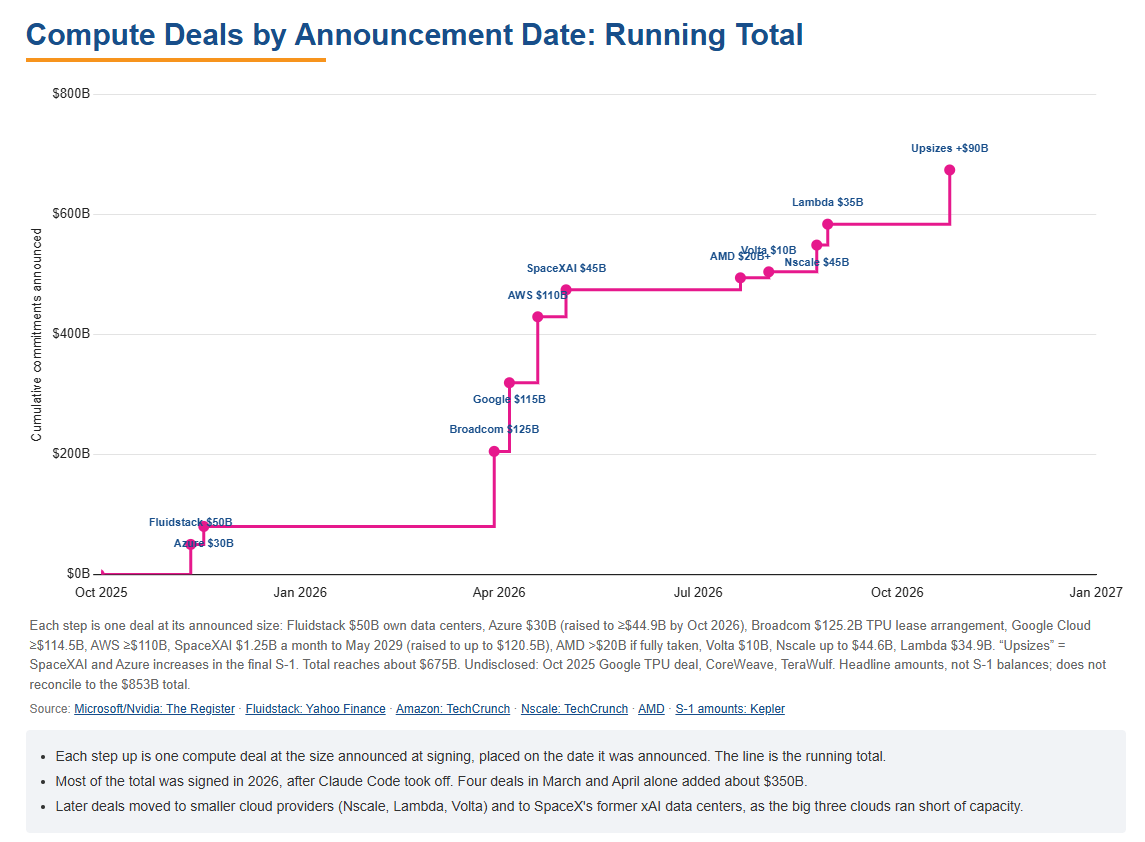
We covered the AI debt story a few times, and we advise the curious reader to take a brief tour through the main points below as well. Overfinancing an infrastructure build-out is an often repeated pattern, and while it is fantastic for the customer in about a decade after the economic melt-down, it’s not always fantastic for the financial instruments involved.
If the debt doesn’t add up, everything all at once is in trouble. Given that Anthropic has $130B of cash, we are probably not quite there yet. But at the same time, since tech companies continue to want to raise more money and the capital markets are starting to (in a very small way) slow down in extending credit, one should pay attention.


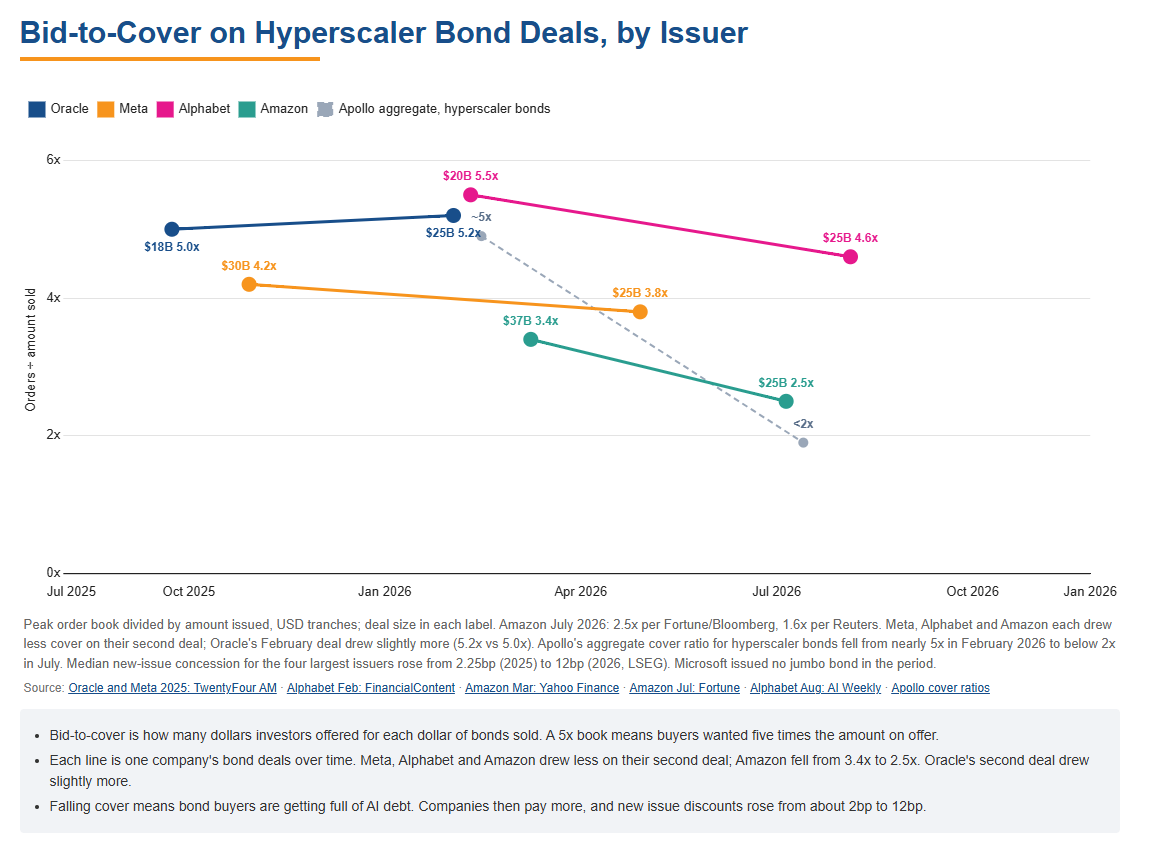
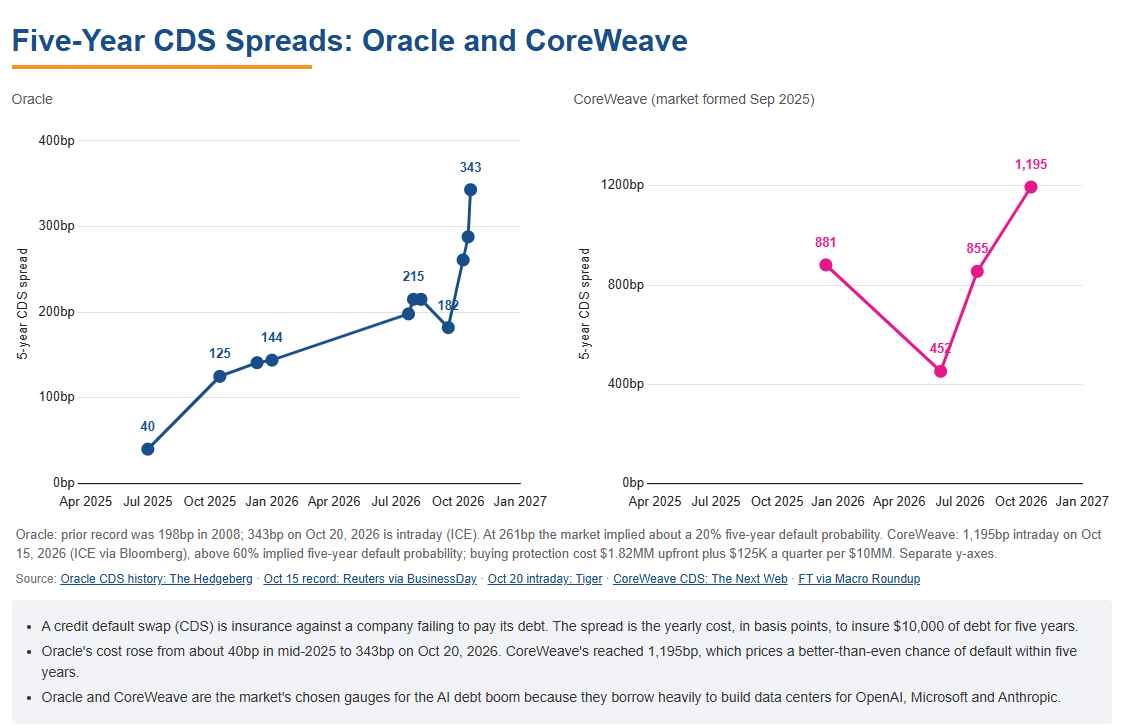
CoreWeave could default, Oracle will follow, and all of the hyperscalers will get re-rated down 50%. The word hyperscaler will sound like the word metaverse — trendy at the time, embarrassing now.
The two charts above show the market feedback. The first one is a measure of how excited investors are to finance the hyperscalers. The numbers say that there is still more interest than supply, but they are falling dramatically. Debt offerings are, in the aggregate, getting 2x the interest rather than 5x at the beginning of the year.
The second chart tracks the 5-year CDS spread, which is the cost of insurance against default on debt. All we can say is that this cost is going up.
Claude on Claude: Revenues
That was a bit wonky, but we wanted to get the financial points out of the way first. Let’s get back to the basics of Anthropic’s economics.
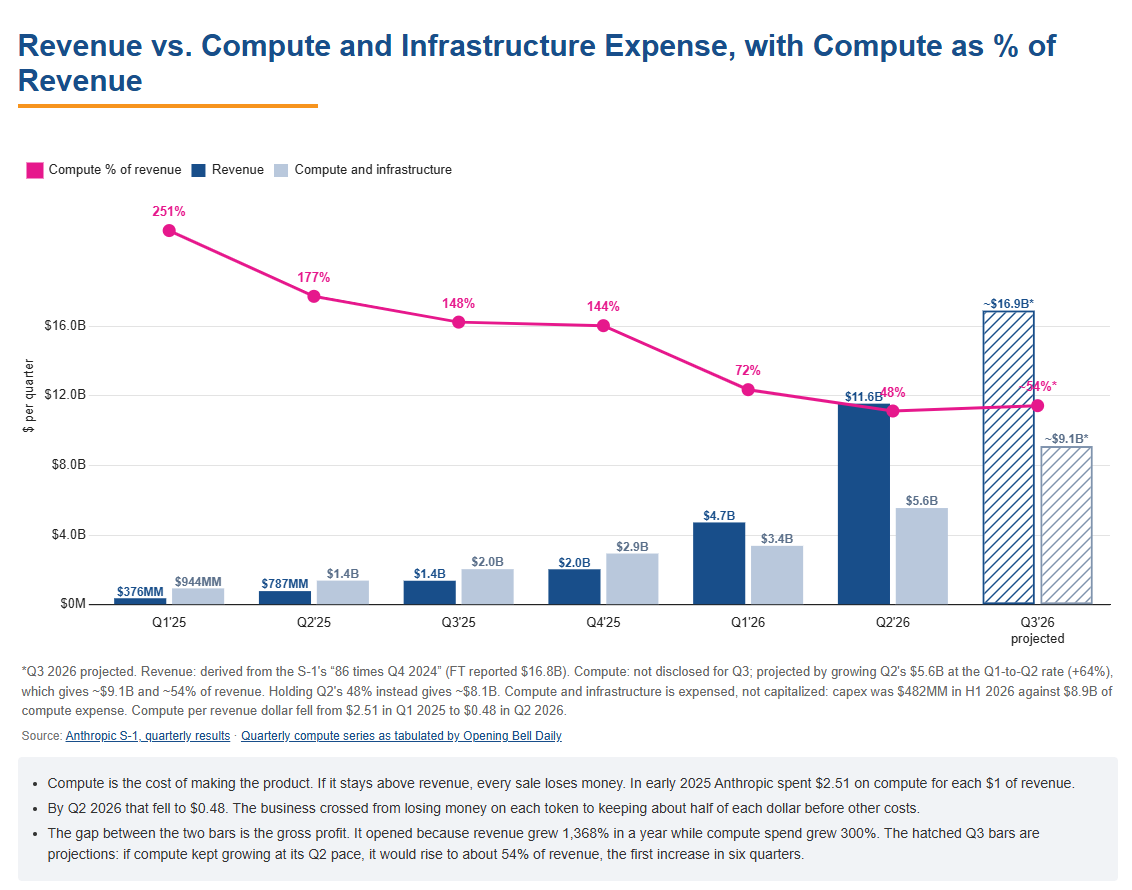
The company's growth is absolutely incredible, and demand for tokens is up and to the right.
You can see three data points above: (1) actual revenue, (2) the cost of compute and infrastructure, and (3) the ratio of compute cost to revenue. If we think back to the machine economy value chain, machine intelligence is a product built from the raw materials of energy and GPU chips. To the extent the company sells $1 of intelligence (i.e., AI tokens) for less than it costs to produce them, it is a money-burning exercise. To the extent the ratio falls below 100%, the company can make a profit and will defend a margin.
A few things to note.
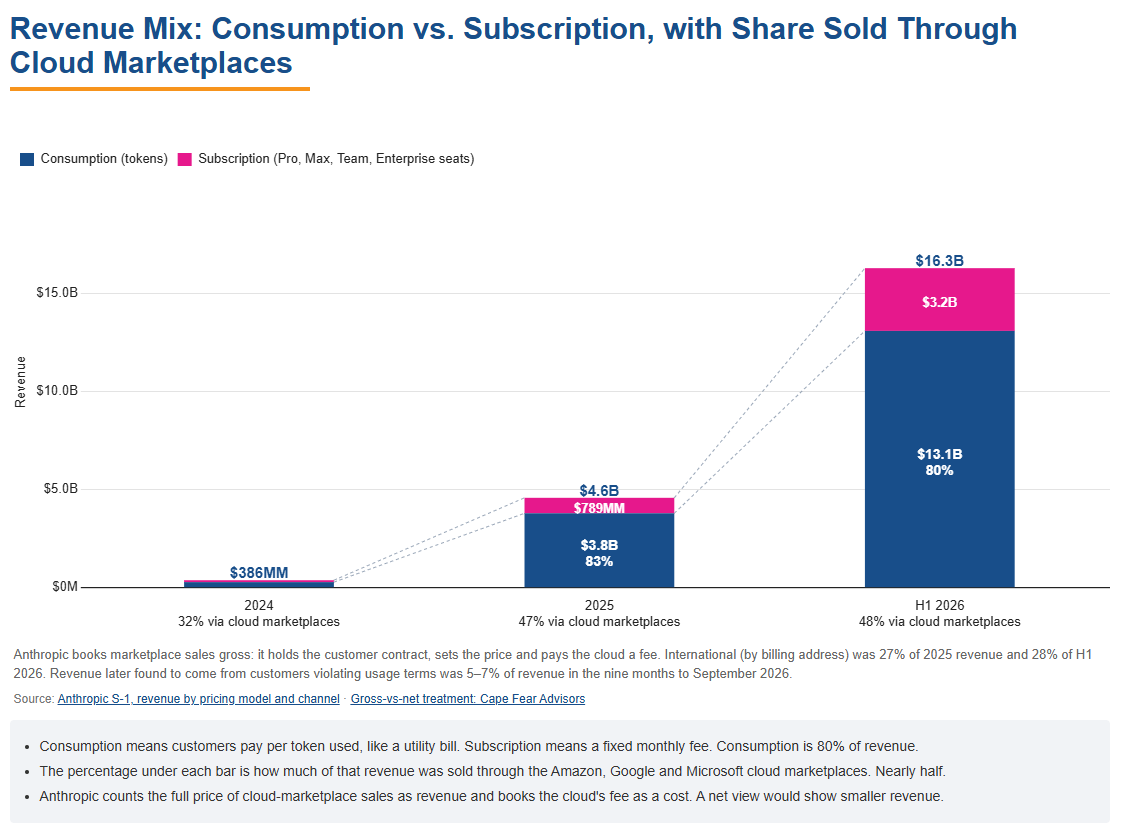
First, nobody knows how sticky Anthropic or OpenAI inference revenue really is. People have a sort-of good sense of how much a data center can make in selling compute to the AI labs, but it is more uncertain how AI labs can continue to charge people and enterprises. Whereas OpenAI targeted consumers first, who have a more limited willingness to pay, Anthropic locked in the workplace with consumption-based contracts.
Hire the robot software developers, fire the human software developers.
Consumption-based variable pricing is the thing that makes Anthropic economics work, and is also the thing that every technically competent corporation, like Palantir, will do their best to replace with (1) local open-source Chinese models, on (2) hardware they own in their technology stack. In the medium term, the rest of the world will catch up on open models as well.
In order to buy the bull-case, which is that we can ignore the giant obligations pile to the cloud providers, because they will be set off against revenue which is marginally profitable, and that demand will grow, we have to believe that consumption-based token pricing can maintain its growth trajectory as Anthropic eats more of the economy. To be clear, we do think there is a lot more of the economy to eat.
Another comment on the revenue chart is that the difference in revenue growth between Q1-Q2 and Q2-Q3 is slowing down. Adding $5B in top-line — which is a guesstimate, by the way — is not bad at all.
But what one wants to see in this scenario is $10-20B chunks of revenue that continue the acceleration towards a $250B revenue steady state.
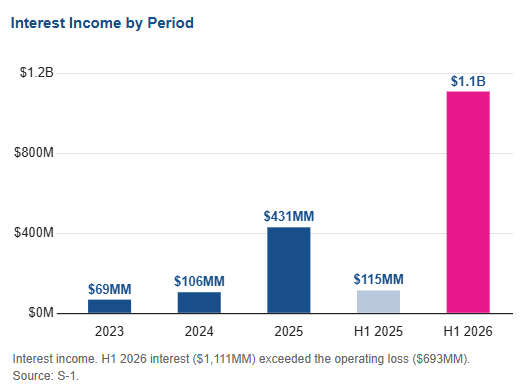
Incidentally, Anthropic has a second material business — its own treasury. The company holds $131.7B of cash and investments on its balance sheet, which earned $1.1B of interest in six months. At current rates, that is a $2B-a-year float, comparable to a mid-sized bank’s net interest income, and about half of the company’s 2025 revenue.
Claude would like to tell you that the S-1 is partly a prospectus for a money-market fund with a lab attached.
Anthropic’s Cost Story
All this winning does not come cheap! The costs reveal a very interesting story.