
Gm Fintech Architects —
Quite a few of you liked the Hyperbank concept. Awesome! I’ll continue thinking in that direction and highlighting relevant evidence. One obvious version of this is Nubank looking to buy Monzo (a $59B acquirer and $13B target)—a vertically integrated banking stack, going geography by geography, to supplant national champions. Yum.
Today we are diving into the following topics:
Summary: We revisit the idea of finance as a feature, as Whop launches a blueprint that lets platforms, creators, and entrepreneurs assemble their own branded “neobank” on top of regulated third-party infrastructure. Whop combines balances, cards, stablecoins, crypto yield, payouts, and payments using partners including Rain, Cross River, Privy, Tether, Coinbase, and ClearBank, while letting operators control the customer-facing brand and economics. We argue this is another step toward dramatically smaller economic units, where AI and embedded financial infrastructure let individuals build businesses with capabilities once reserved for large institutions. Stripe’s acquisition of Parafin points in the same direction, embedding capital, spend, savings, and credit into platforms that can redistribute those products to their own customers. The result is a more literal version of democratized finance: financial products become composable features that increasingly anyone can package, brand, and distribute, even as the regulatory and risk questions remain unresolved.
Topics: Whop, Stripe, Parafin, Tether, Rain, Cross River, Privy, Coinbase, ClearBank, JP Morgan, Bank Frick, Veda, Aave, MoonPay, Visa, Third National, Apple, Goldman Sachs, Anthropic, OpenAI, OpenClaw
Thanks as always for your time and attention,
Lex
To support this writing and access our full archive of newsletters, analyses, and guides to building in the Fintech & DeFi industries, see subscription options below.
In Partnership with Plaid Intelligent Finance

The wheel needed roads. Electricity needed the grid. Every leap forward has needed infrastructure underneath it.
AI in finance is only as good as what it knows. Plaid makes permissioned financial data not just accessible, but understood, a paycheck read as income, an irregular pattern recognized as potential fraud. That data is handled securely, and our models are built specifically to understand financial behavior.
That understanding can’t be prompted. It has to be built.
Innovation needs infrastructure.
Plaid makes AI work in finance.
See how 👇 👇 👇
Long Take
Finance as a Feature
Many moons ago, we made the following prediction.
As people fight each other in the attention economy, big tech will eat up all the attention. Their algorithmic brain tendrils will puppeteer us, and in turn we will perform for each other by generating spectacles to witness.
In this context, finance is a mere feature of the attention economy, a bolted-on embedded bit that can be used to monetize the spectacle itself. Early on, we termed it “financial generics”. If the brand or distributor is non-financial, then having a generic financial feature is as good as a branded one. Apple doesn’t need Goldman to power its bank account.
This turned out only partly true. A lot of financial services sit outside the attention economy, and much of it — in fact — financializes the spectacle. Real embedded finance companies power commerce and capital markets front-ends (and robots) that people also find useful. And generics can stack too! A platform that embeds payouts and savings can then re-sell its own stack as a private-label to its SME customers, who then pass it on to consumers.
Whop — a mega-platform for the attention economy entrepreneur — has discovered just that. Whop works by simplifying certain features for the online hustle generation, from connecting to APIs to payment processing to eCommerce stores, but attaching them into a Lego-like integrated storefront. People can add on their own features and business templates, called blueprints. Then they can get paid if other people use the blueprints.
Hey look — it’s a Fintech Blueprint!
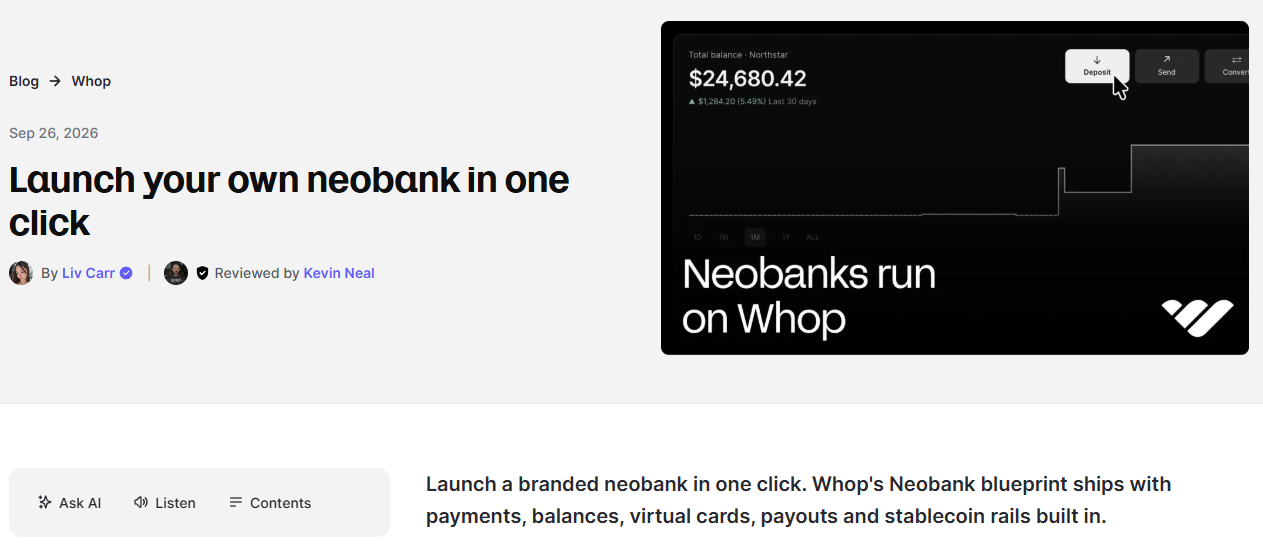
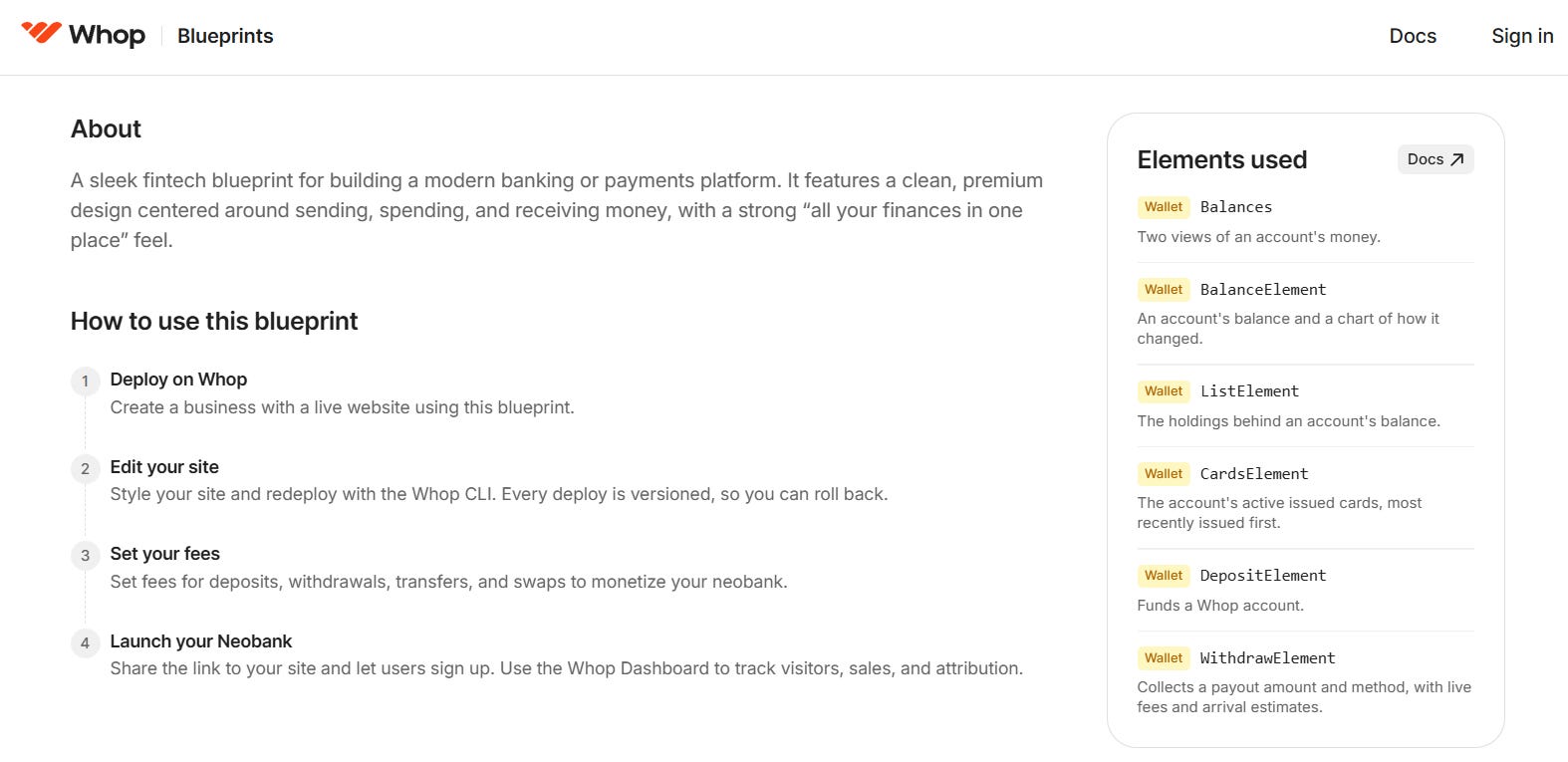
What exactly is happening here?
Well, Whop announced a “launch your own neobank” blueprint that has set the Fintech commentariat ablaze. Our good friend Bruno, for example, has started to break down how the stack works.
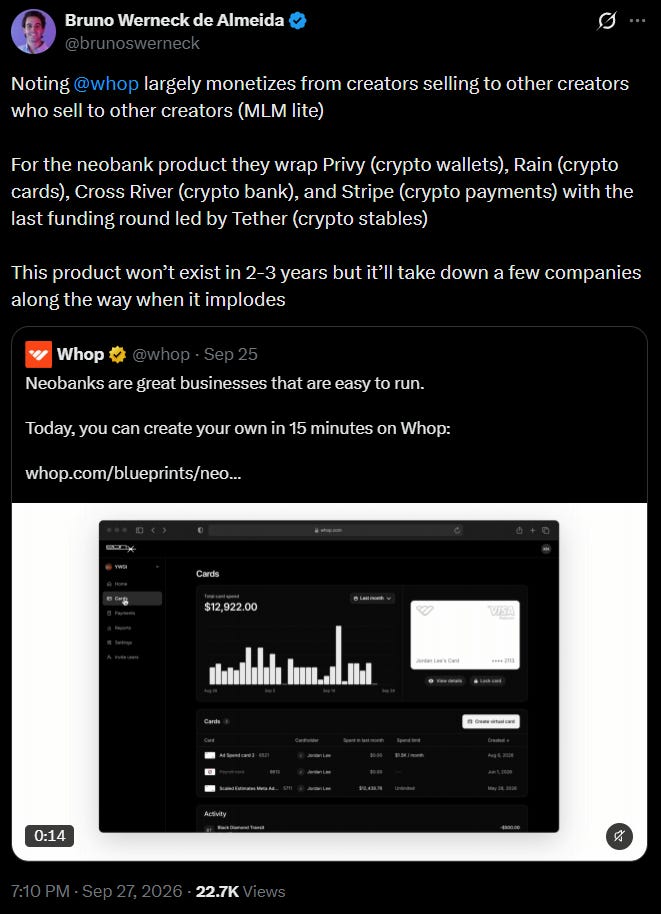
We had our robots comb through the Terms of Service and other legal documents on the Whop site to get the following summary of the product and its underlying operations.
The summary below covers it with sources and visualizes the entire structure, starting with the role of the operator, or Whop’s customer, the accounts that are virtualized from different parts of the platform, and the various regulated entities underneath.
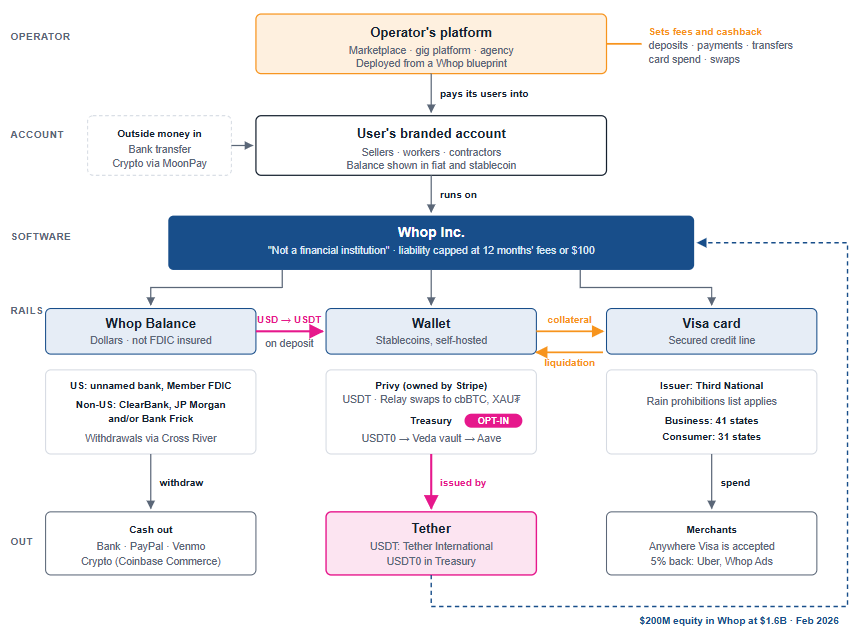
Who uses it. Whop sells a white-label neobank template. A marketplace, gig platform or agency deploys it for the people it pays. The operator sets its own fees on deposits, transfers, card spend and swaps. Whop is not a bank. Its terms say licensed partners move the money. They also cap Whop’s liability at 12 months’ fees or $100.
Where the money sits. Payments land in a Whop Balance held in pooled FBO accounts. US funds sit at an unnamed FDIC-member bank. Non-US funds sit at ClearBank, JP Morgan or Bank Frick, and withdrawals run through Cross River, per Whop’s international terms. Neither balance is FDIC insured. Users cash out by ACH, wire, PayPal or crypto via Coinbase Commerce, per Whop’s payout docs. Every account also has a self-custodial wallet from Privy, which Stripe bought in 2025. Moving dollars into the wallet converts them into USDT, issued by Tether International. An opt-in Treasury feature routes balances through a Veda vault into Aave for yield. The same report says crypto deposits come in through MoonPay. Tether invested $200 million in Whop in February 2026.
The card and the rules. The Visa card is a secured credit line issued by Third National, under Rain’s program rules. The credit limit equals the stablecoin collateral in the user’s wallet. Whop prices that collateral and can liquidate it without notice, per the consumer terms. Those terms also give cardholders chargeback rights under the Fair Credit Billing Act. The business card bans personal, family or household use. The consumer card is live in 31 states; the business card in 41. Whop’s terms ban P2P transfers for personal use, and any payment that would need a money transmitter license. Under the GENIUS Act, US platforms have until July 2028 to drop stablecoins from non-approved issuers. Tether’s answer is USAT, its US-focused coin.
Quite a while back, we wrote about understanding platforms and how the shape of the products can explain the needs of the platforms, linked below.

This is still helpful — and for those of you who can’t figure out why Stripe or Apex or Alpaca or ZeroHash or Plaid are valuable, it is the right resource. In order to want to sell generics, you have to be in the business of supporting other brands.
The Fintech Blueprint Blueprint
Of course, it is tempting to click the button and see what you can actually make.
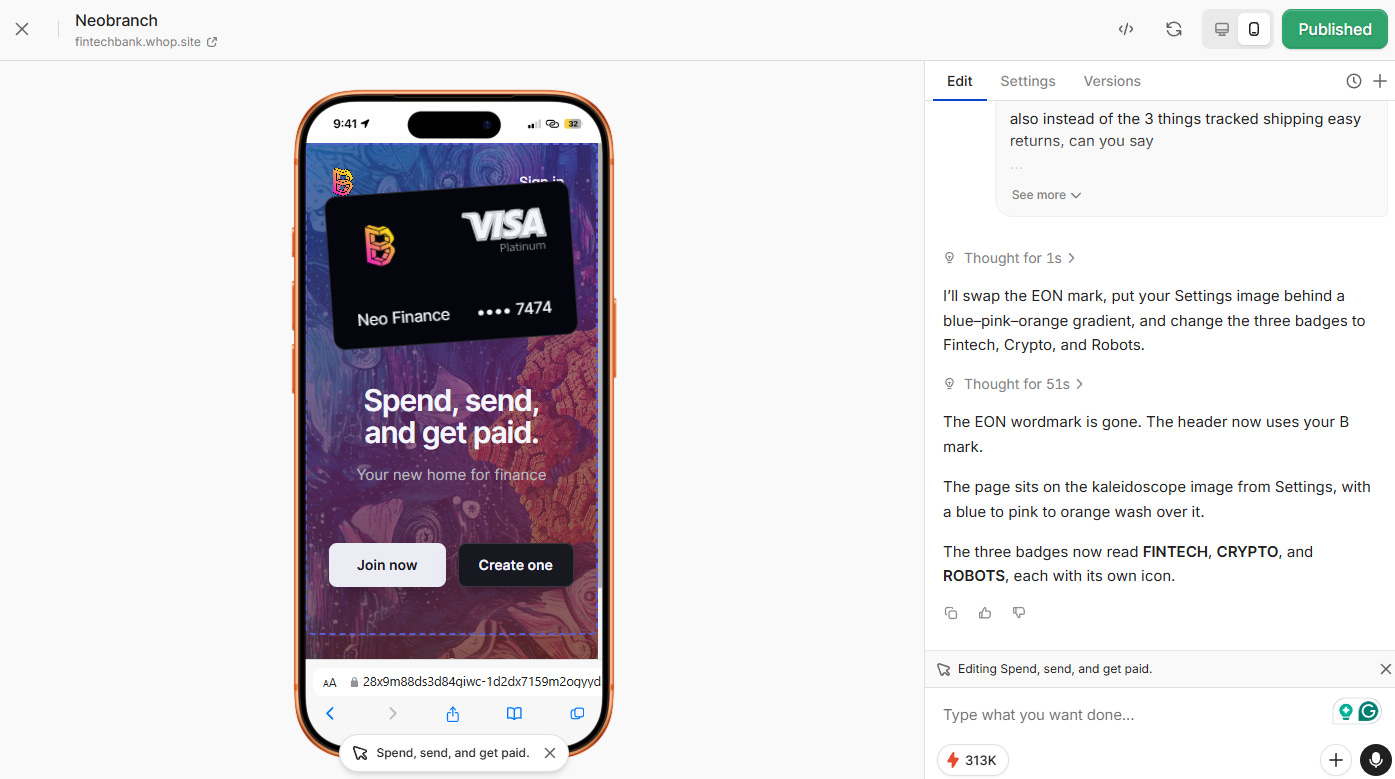
Above is the interface for our Neobranch, designed primarily through an AI model chat window. The customizations are about branding and marketing features, and frankly the build is a bit janky. I couldn’t get the screens to update the design on the placeholder website here, and the model was a bit slow. Also, Whop seems to be in the AI token reselling game in addition to the underlying template.
I am guessing this conversational interface extends Whop’s overall design philosophy of giving people simple tools — in this case, chat — to very quickly create a thing that has the attributes of a business. In this case, the claim is to give them something like a bank, which in reality is a massively regulated, complex, and risk-focused endeavor to run. There are many rules about what you can and cannot charge, how money has to be protected, and what it is that you can say about it.
Whop’s positioning is cool, but arguably dangerous. The best customer is probably someone like Mr. Beast, but I wouldn’t want to necessarily have his team run risk management and compliance on a B2B or payroll offering. But on the other hand, wouldn’t it be fun if Mr. Beast had a bank and just, did whatever? Like, a free burger with every new account, and some small change of winning a million dollars for every transaction that I push through my account.
And is that so different from Palmer Luckey and Erebor bank? Like, is it really, profoundly, all that different?