
GM Fintech Futurists,
Today, we highlight the below items.
Also notable are the drastic moves both in the US and UK to allow the trading of tokenized securities, to be covered in a later issue.
DIGITAL ASSETS: Beyond the Rate Trade — Circle’s Infrastructure Bet
ANALYSIS: The Fintech Blueprint AI & Robotics Report Q1 2026
CURATED UPDATES: Financial Institutions and Adoption; DeFi and Digital Assets; Blockchain Protocols; NFTs, DAOs and the Metaverse
To support this writing and access our full archive of newsletters, analyses, and guides to building in Fintech & DeFi, subscribe below (if you haven’t yet).
🤖🏦🧭 Our Ecosystem:
Generative Ventures | AI Research | Robot Money | Linkedin & Twitter | Sponsors
AI & Robotics Industry Encyclopedia:
In this 100+ page report, we collate all the meaningful companies across public equities, private equity, and digital assets related to the machine economy.
👉Learn more here
DIGITAL ASSETS: Beyond the Rate Trade — Circle’s Infrastructure Bet
Circle has had a busy week.
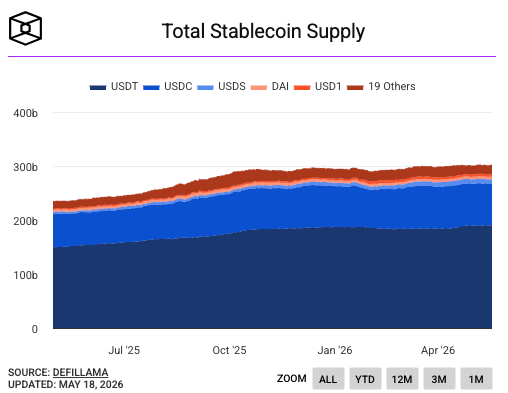
Alongside its Q1 2026 results — nearly $700 million in total revenue and reserve income, up 20% year-over-year, with USDC in circulation reaching $77 billion and onchain transaction volume hitting $21.5 trillion — the company dropped two significant product announcements and closed a $222 million token presale.
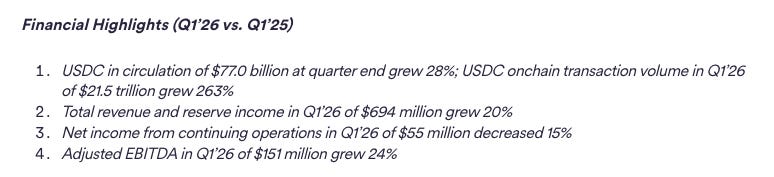
Circle has long carried the label of interest rate proxy: 99% of its 2024 revenue came from interest earned on USDC reserves, making the business acutely sensitive to rate cycles and leaving equity investors with little to price beyond spread income and USDC float growth. Arc, Circle Agent Stack, and the Payments Network are a concerted attempt to change that — to diversify the revenue base and re-rate the stock on infrastructure multiples rather than yield.
Probably most unusual is the following: Circle, a public company with traditional equity ownership, has raised $222 million in a presale for its new stablecoin-focused layer-1 blockchain, achieving a $3 billion fully diluted valuation.
There are financial instruments that go on the regular cap table, and then there are these tokens for a protocol. Notably, Base, the Coinbase Ethereum L2, still does not have a token. The fact that a multi-billion dollar public company was able to do this fundraise means that tokens have arrived on Wall Street.
The round was led by Andreessen Horowitz with a $75 million commitment, with BlackRock and Apollo also participating. The presale has multi-year lockups and repayment rights if key Arc network milestones are not achieved.
Circle holds 25% of the 10 billion token initial supply, with 60% allocated to network participants and 15% to a long-term reserve. The Arc mainnet is expected live in summer 2026, with the testnet having processed 244 million transactions as of early May.
ARC token utility remains in an exploratory phase. That means you don’t really need to design tokenomics to raise $200MM+ still. And if we are paying real attention, you don’t need $200MM to build a Layer 1 blockchain either.
Alongside Arc, Circle unveiled Circle Agent Stack — a developer toolkit for building AI agents that transact in USDC, comprising wallets, a marketplace, and a nanopayments layer capable of transfers as small as $0.000001.
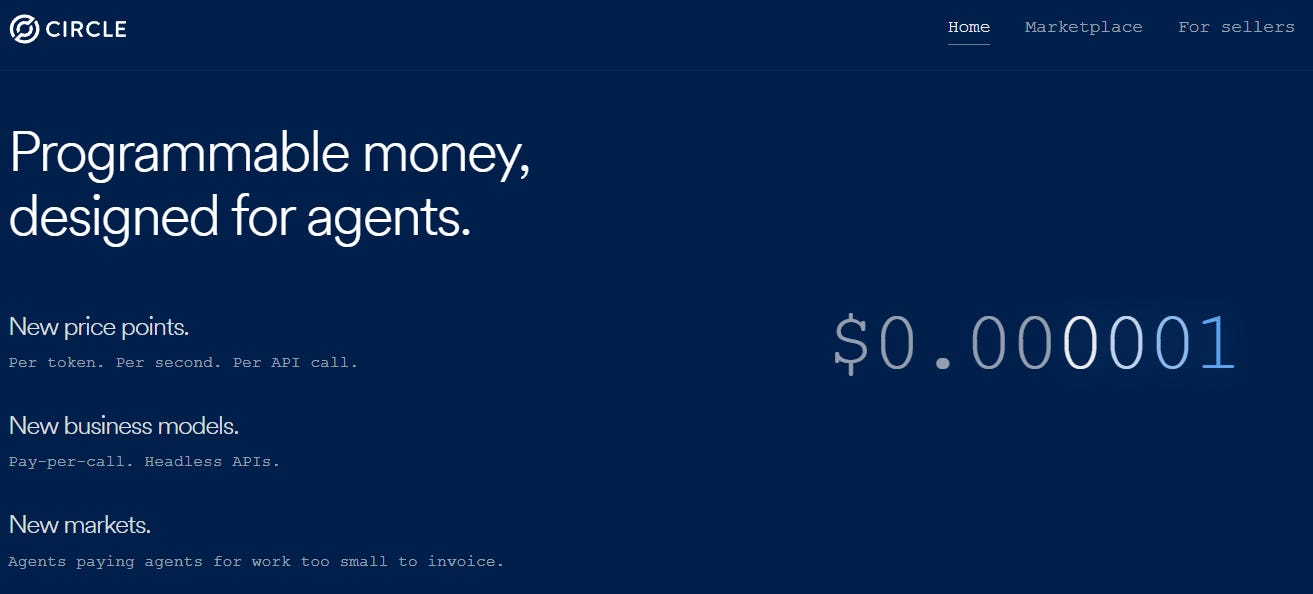
The company joins Stripe, Coinbase, Visa, Mastercard, Shopify, Fiserv, and Brex in the race to bank the robots.
Arc is a defensive play
Today, USDC runs across Ethereum, Solana, and dozens of other chains and wallets. Circle earns reserve income on all of it. The problem is how much of that income it actually keeps. Under the 2023 Collaboration Agreement with Coinbase (signed when the Centre Consortium was dissolved and Coinbase held significant negotiating leverage as Circle’s largest distributor) the reserve income is split in three steps.
Circle takes a small issuer fee off the top.
Each party then receives the reserve income proportional to USDC held in their own custodial products.
Whatever remains — Coinbase takes 50% of. The result is that Coinbase earns a cut of reserve income from USDC it has no custodial relationship with.
In 2024, that totalled $908 million paid to Coinbase out of $1.68 billion in gross revenue. The agreement auto-renews every three years and Circle has no unilateral right to exit it. Arc is, in part, an attempt to build infrastructure Circle actually owns and earns fees on directly.
Just to say this again: Coinbase has a 50% net haircut on effectively all Circle revenue, and there is no way out except through a clever backdoor.
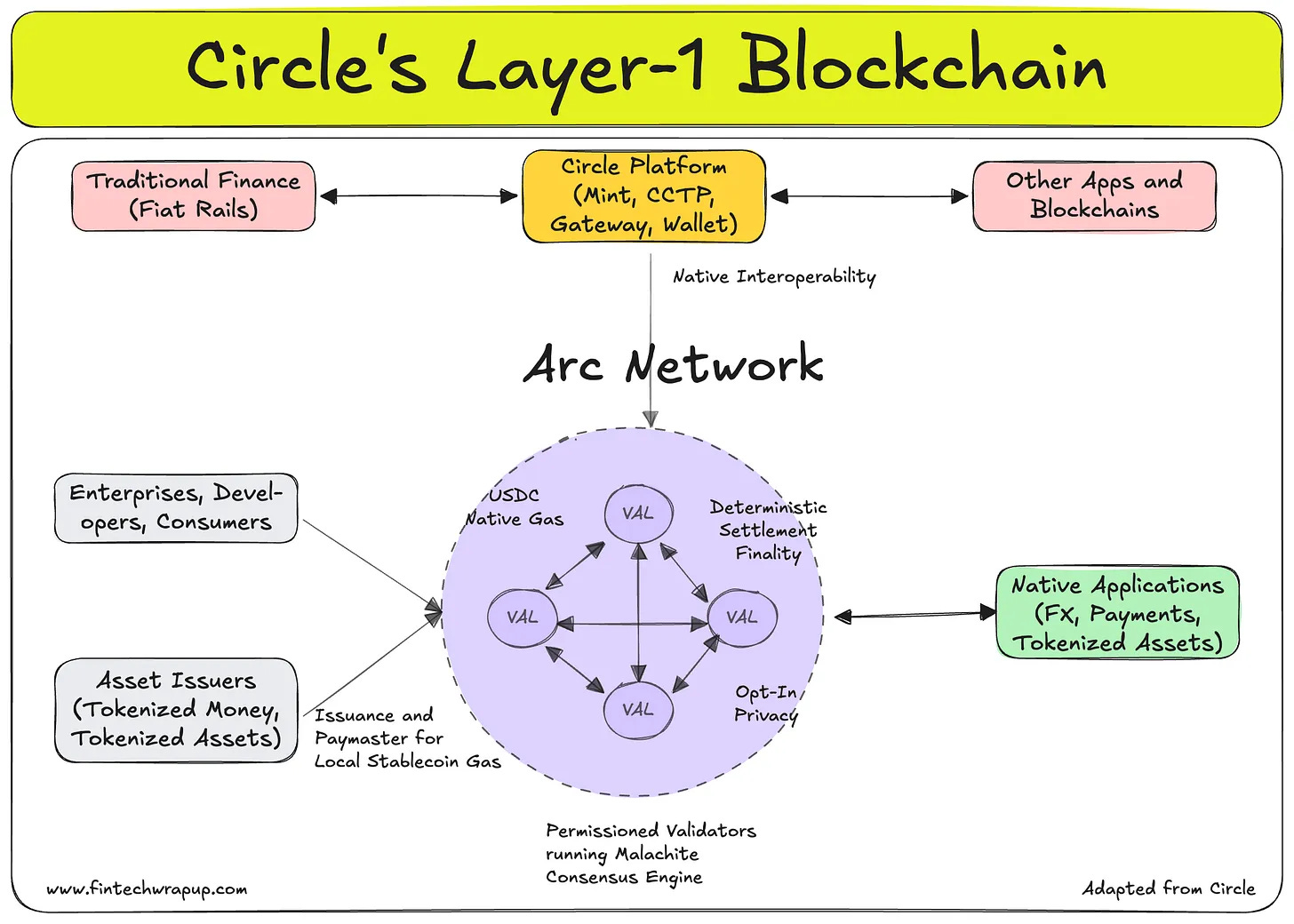
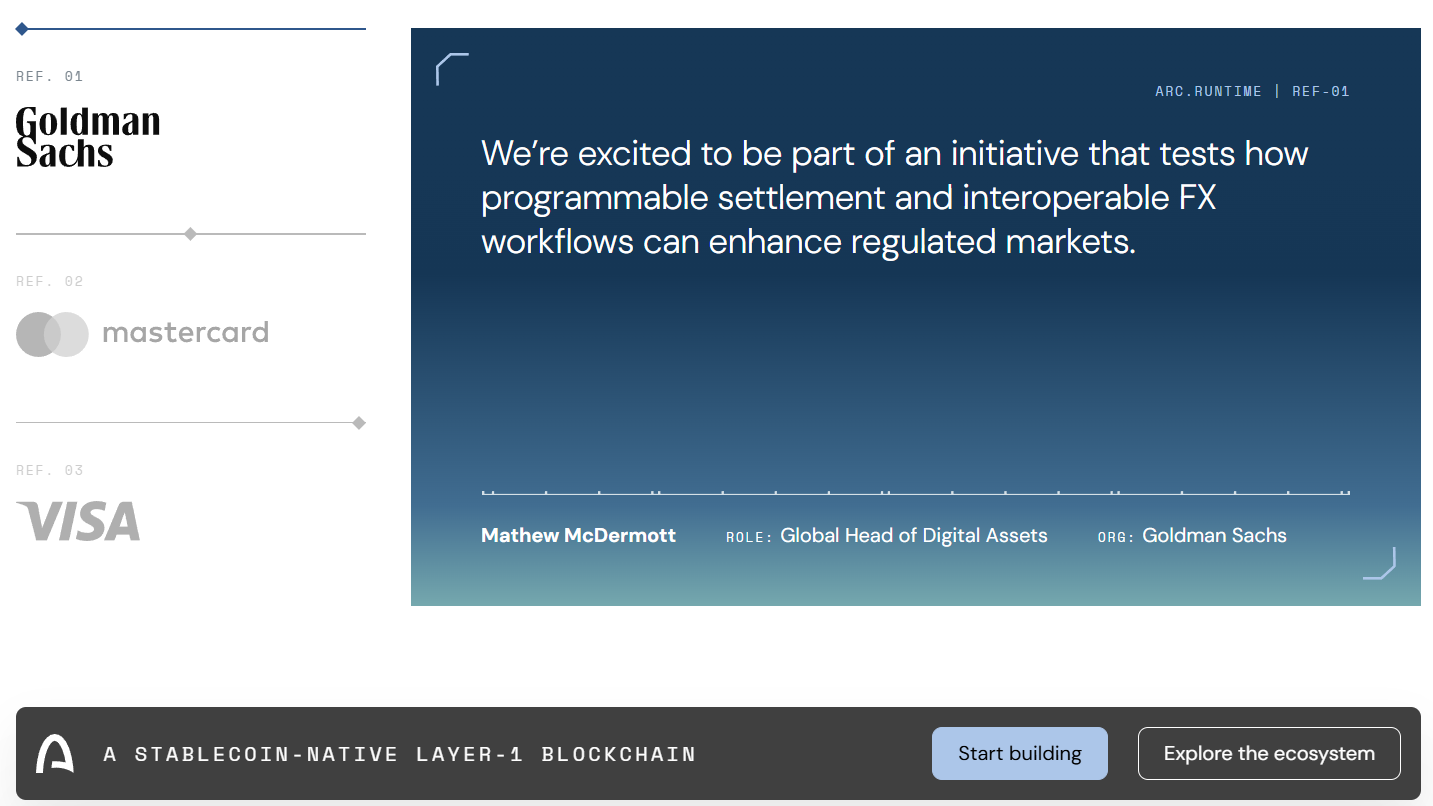
The pitch is straightforward: a layer-1 blockchain built specifically for stablecoin-native finance, with USDC as the gas token, sub-second finality, opt-in privacy, EVM compatibility, and quantum-resistant architecture. Settlement infrastructure for institutions that already move money for a living and a substitute for ACH, SWIFT, and correspondent banking. The testnet, which launched in October 2025, has already drawn over 100 institutional participants including BlackRock, Goldman Sachs, Visa, and State Street, and processed 244 million transactions.
To be fair, similar participants joined Tempo and the various AI payments and agentic protocols we covered in the past. That suggests a multi-polar world for rebuilding the rails.
The $3 billion fully diluted valuation attached to the presale is harder to square. ARC token utility remains in an exploratory phase. What investors are pricing is the option value of Circle owning the chain its stablecoin settles on, closing the vertical loop that currently leaks value to third parties. Whether that option is worth $3 billion is a question about transaction volume. Specifically, whether Circle can migrate enough of USDC’s $77 billion in circulation onto Arc to generate fee revenue that justifies the valuation.
The regulatory backdrop sharpens the urgency.
The GENIUS Act, signed into law in July 2025, explicitly creates a path for banks to issue their own payment stablecoins through subsidiaries, supervised by their existing federal regulators. JPMorgan and Bank of New York are already running tokenised deposit pilots. If regulated bank-issued dollar tokens reach scale, the need for a third-party stablecoin issuer like Circle narrows.
Arc does not solve that problem directly, but owning proprietary chain infrastructure creates network effects and switching costs. It is a hedge against everyone from Canton to Ripple to JPM’s Kinexys taking their cut, or consolidating vertically.
Circle Agent Stack is the offensive play
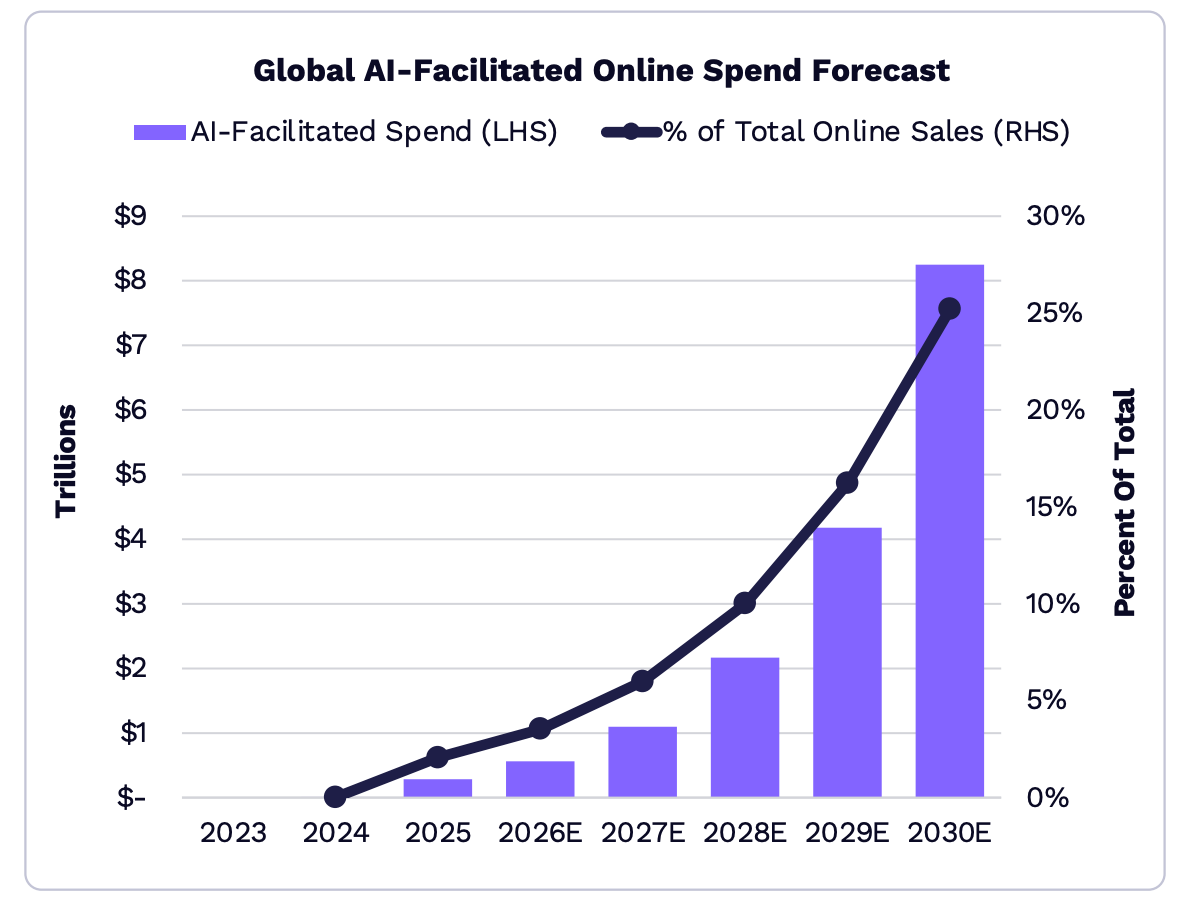
Agent Stack is a developer toolkit for building AI agents that transact in USDC — wallets, a marketplace, and a nanopayments layer capable of transfers as small as $0.000001. The thesis is that as AI agents take on more operational and financial work autonomously, they will need to transact at a scale and granularity that existing payment infrastructure cannot support.
As we say, Robot Money.
The nanopayments layer is the most interesting piece. Card networks, ACH, and SWIFT all carry fixed costs that make sub-cent transactions economically unviable. A USDC-native chain with programmable micropayments does not have that floor. An AI agent paying per API call, per second of compute, or per data query has no clean solution today.
We covered Ramp launching Agent Cards in March 2026. In short, it allows businesses to issue virtual cards for autonomous agent spending. Stripe, through its acquisition of Bridge in late 2024, has its own answer: agent-specific card issuing via Bridge, wallet infrastructure via Privy, and stablecoin payment acceptance across 32 markets. Where Ramp’s Agent Cards are built for corporate spend control, and Circle’s Agent Stack is built for USDC-native micropayments on Arc, Stripe is positioning itself as the full-stack layer (fiat, stablecoin, and wallet infrastructure under one API).
Circle vs Stripe
Where Circle has a structural advantage is in the asset itself.
USDC is the dominant regulated stablecoin, already the unit of account for a large portion of onchain activity. Stripe’s Bridge issues its own stablecoins through Open Issuance. USDH, one of Bridge’s flagship issuances, was sunset this week after failing to gain traction against $5 billion in USDC on Hyperliquid, with Coinbase stepping in as the official USDC treasury deployer. Building agent infrastructure on top of USDC means agents inherit existing liquidity and network depth from day one. That advantage is proving harder to replicate than it looks.'
As discussed, Stripe have also incubated Tempo, a layer-1 blockchain purpose-built for payments. Whereas Tempo is built for general payment settlement across any stablecoin, Arc is built specifically around USDC. Both are bets that the future of payments clears on purpose-built chains rather than general-purpose ones like Ethereum. The capital structure question is also worth noting. Circle raised $222 million for Arc at a $3 billion FDV from a presale. Stripe is private, profitable, and last valued at $70 billion — it can fund Tempo and Bridge expansion from its balance sheet without diluting into a token.
That is a meaningful difference in how each company can absorb the cost of building and subsidising a new chain ecosystem.
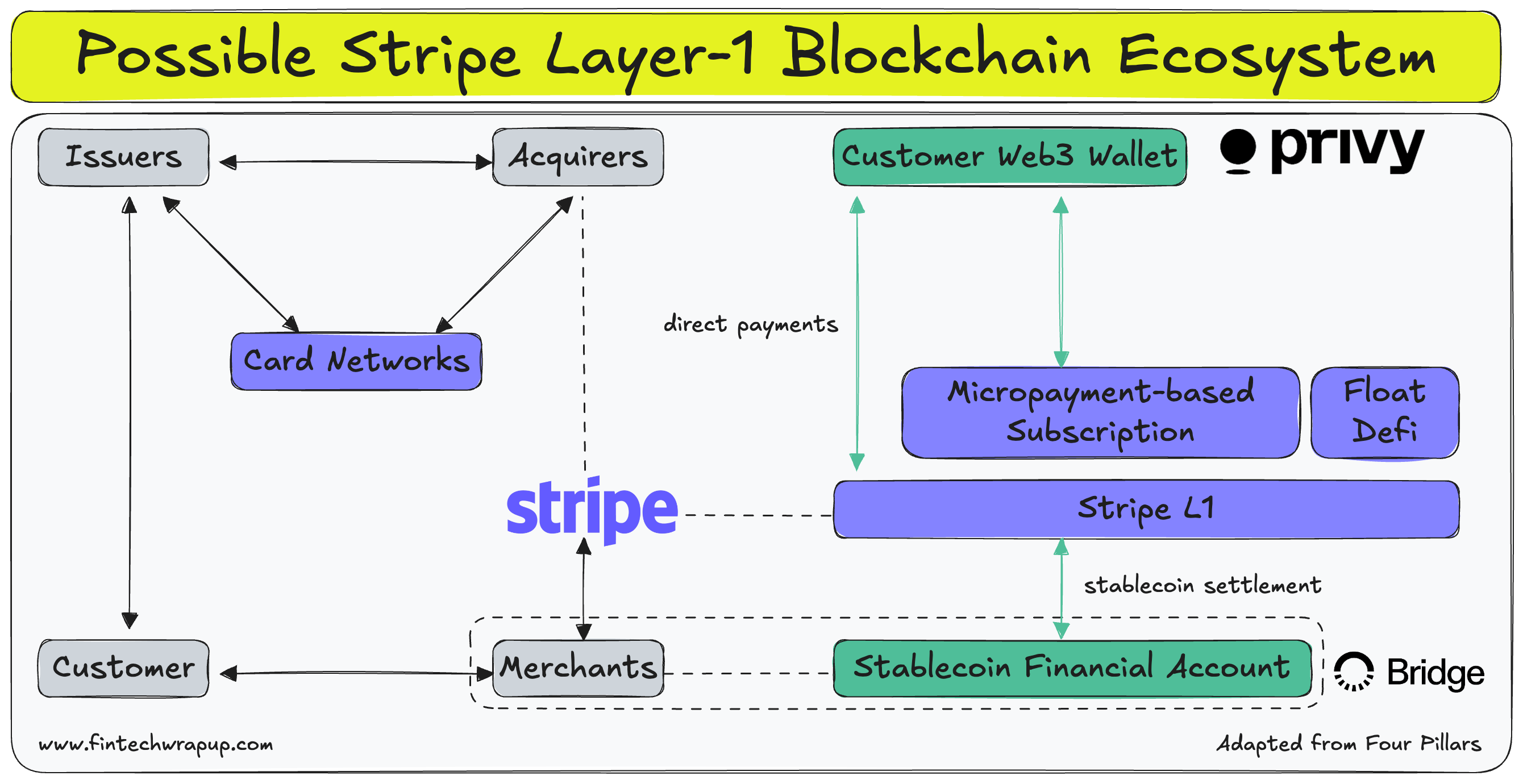
End of the day, the capabilities and inclinations of (1) a Payment Processor and (2) an issuer of a cash equivalent financial instrument are profoundly different. One knows distribution and has merchants and customers in its ecosystem. The other one has an asset in every exchange and crypto wallet. We think it will be a mistake to vertically integrate and get into expensive warfare.
The revenue math
Circle’s business today is simple: $77 billion of USDC in circulation, earning a reserve return rate of roughly 4.1%, of which a large portion flows to Coinbase under the distribution agreement. Full-year 2025 revenue was $2.75 billion.
Analysts are forecasting roughly $3.2 billion for 2026, implying around 15% growth — modest by the standards of a company that grew 64% last year, and reflecting two real headwinds: falling interest rates compressing reserve yield, and the GENIUS Act’s restrictions on how reserve income can be shared with distribution partners, putting the Coinbase arrangement under regulatory scrutiny.
The new products need to be understood against that backdrop. Circle guided to $150–170 million in non-reserve revenue for 2026, up from $110 million in 2025, but still less than 6% of total revenue. Arc transaction fees, Agent Stack developer revenue, and CPN fees are all early-stage. The re-rating thesis, from interest rate proxy to infrastructure platform, requires those lines to grow materially as a share of revenue, not just in absolute terms. At current trajectory, the narrative is still ahead of the numbers.
The stock reflects that tension. CRCL IPO’d at $31 in June 2025, briefly approached $300, and has since settled around $114. Following Q1 2026 results, JPMorgan raised its price target to $155, Needham to $150, and Deutsche Bank to $101. The consensus sits around $125–130, implying very cautious upside from current levels.
The Bull and The Bear
The bull case requires three things going right simultaneously:
USDC circulation grows fast enough to absorb falling reserve yields;
Arc generates meaningful fee revenue and partially displaces the Coinbase agreement;
Agent Stack captures early infrastructure position in agentic payments before Stripe outbuilds it.
If all three happen, Circle re-rates as a payments infrastructure company, where multiples are driven by transaction volume and network effects rather than interest rate cycles.
The bear case is simpler. Rates fall faster than circulation grows, the Coinbase agreement gets restructured in a way that reduces distribution without replacing volume, Arc fails to migrate meaningful USDC onto its chain, and Stripe or Ramp outbuilds Circle on agent infrastructure at lower cost.
The announcements are the right strategic moves, but right now they are bets, not yet businesses. Circle is asking investors to price the option value of all three paying off at once, while the core model faces genuine structural headwinds. That is not an unreasonable ask — just expensive at current levels.
👑Related Coverage👑


Analysis: The Fintech Blueprint AI & Robotics Report Q1 2026
This 121 page report maps 95 companies across AI infrastructure, foundation models, robotics, agents, and decentralized networks, with quarterly financial tracking from industrial foundations through end-state machine coordination. A material update on our initiation report last year.

For Premium subscribers, we will provide a download link at the bottom of this article. For Free subscribers, don’t hesitate to upgrade at around $100/year to access the report, or grab it here for a one time $149 price.
Curated Updates
Here are the rest of the updates hitting our radar.
Financial Institutions and Adoption
Hana Bank to acquire $670 million stake in Upbit operator Dunamu - CoinDesk
Minnesota signs law allowing banks, credit unions to offer crypto custody services - The Block
SEC’s innovation exemption for tokenized stocks to come as early as this week: Bloomberg - The Block
Gemini Stock Jumps on Revenue Rise, $100M Bitcoin Investment From Winklevoss Capital - Yahoo Finance
DeFi and Digital Assets
Hyperliquid Policy Arm Rejects Market Integrity Concerns Amid Oil Futures Surge - Decyrpt
Fasset raises $51m for stablecoin-powered digital banking - Finextra
Blockchain Protocols
HYPE pops 7%, beating bitcoin declines, as SpaceX pre-IPO lands on Hyperliquid - CoinDesk
BTCFi protocol Echo exploited, targeting eBTC market on Monad: onchain analysts - The Block
NFTs, DAOs and the Metaverse
Aave restores ether borrowing limits after $230 million exploit - CoinDesk
NFL All Day Stops Issuing NFTs as Dapper Labs Signals Future Plans With League - Decrypt
🚀 Level Up
Join our Premium community and receive all the Fintech and Web3 intelligence you need to level up your career. Get access to Long Takes, archives, and special reports.
Sponsor the Fintech Blueprint and reach over 200,000 professionals.
👉 Reach out here.Check out our AI newsletter, the Future Blueprint, 👉 here.
Read our Disclaimer here — this newsletter does not provide investment advice
Fintech Blueprint 🤖🏦🧭 is a reader-supported publication. To receive new posts and support my work, consider becoming a free or paid subscriber.
The Circle/Arc angle is a good reminder that stablecoin infrastructure is moving from product story to buyer-confidence story. For banks and fintech platforms, the question is not only "what can it do?" but "who owns the operational, compliance, and settlement risk when this scales?"
That gap between interest and confidence is exactly what I write about every Monday in Selling Fintech: https://sellingfintech.kit.com/e1ec3c973c
Sounds like ai generated voice recording.
To clean, could be more raw.
But very smooth.