
GM Fintech Futurists,
Today, we highlight the below items:
DIGITAL ASSETS: The Prime Broker Problem in Prediction Markets
ANALYSIS: The Annotated Stripe Letter
CURATED UPDATES: Financial Institutions and Adoption; DeFi and Digital Assets; Prediction Markets; Blockchain Protocols; NFTs, DAOs and the Metaverse
To support this writing and access our full archive of newsletters, analyses, and guides to building in Fintech & DeFi, subscribe below (if you haven’t yet).
🤖🏦🧭 Our Ecosystem:
Generative Ventures | AI Research | Robot Money | Linkedin & Twitter | Sponsors
🚀 Lex is actively meeting teams building machine-native financial companies. If that’s you, reach out here.
🦄 In partnership with InterPrivate, we launched a $200MM SPAC looking for targets in fintech, digital assets, and AI infrastructure. If you are a late-stage founder or have an idea to discuss, reply directly to this email.
DIGITAL ASSETS: Stock Tokens and Their Memes
Robinhood Chain launched this summer.
Heralded as a champion of Ethereum, it was an Arbitrum Orbit L2 for trading tokenized equities onchain. Stock tokens, they called it.
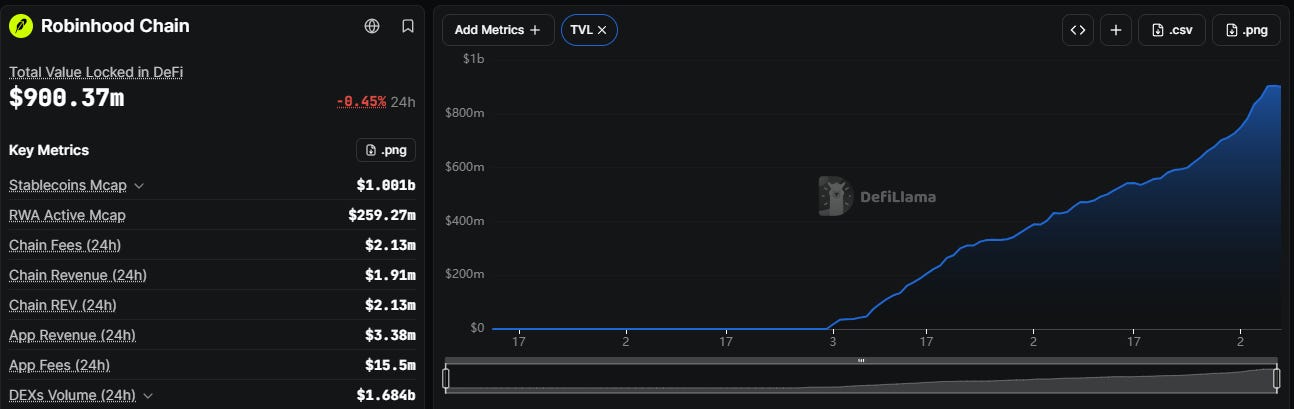
Two months later, DeFiLlama shows $900M in TVL, $1B in stablecoin marketcap, $1.7B in daily DEX volume, and $15.5M in daily application fees. Not a lot of that has come from people investing directly in stocks.
The dominant application is Pons, a Pump.fun-style token launchpad that ranks first across all of DeFi by 24-hour protocol revenue at $1.45M — ahead of GMGN and Uniswap across all 48 of its chains. Below is a chart showing 24 hour and 30 days revenues. As an aside, it’s either net interest income or transaction fees here.
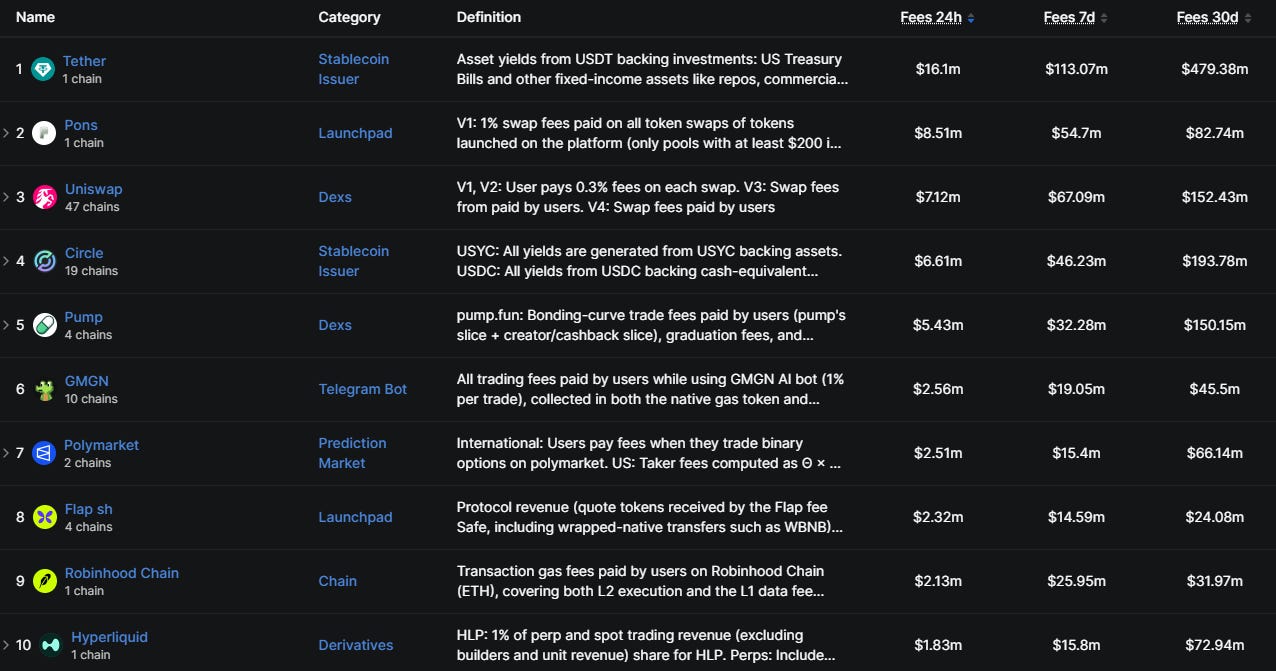
Pons collected $5MM+ in fees in a single day, more than the next three largest dapps combined, and has processed over $4.5B in cumulative volume since launch. On August 31 it minted 17,909 of the 27,802 tokens created on the network and took roughly 64% of all launchpad fees paid anywhere in crypto that day.
The mechanical difference from Solana’s meme economy is the quote asset. On Pump.fun, a new token trades against SOL. On Pons, the creator can pair it against a Robinhood Stock Token — a tokenized debt security issued by Robinhood Assets Jersey that tracks a listed share.
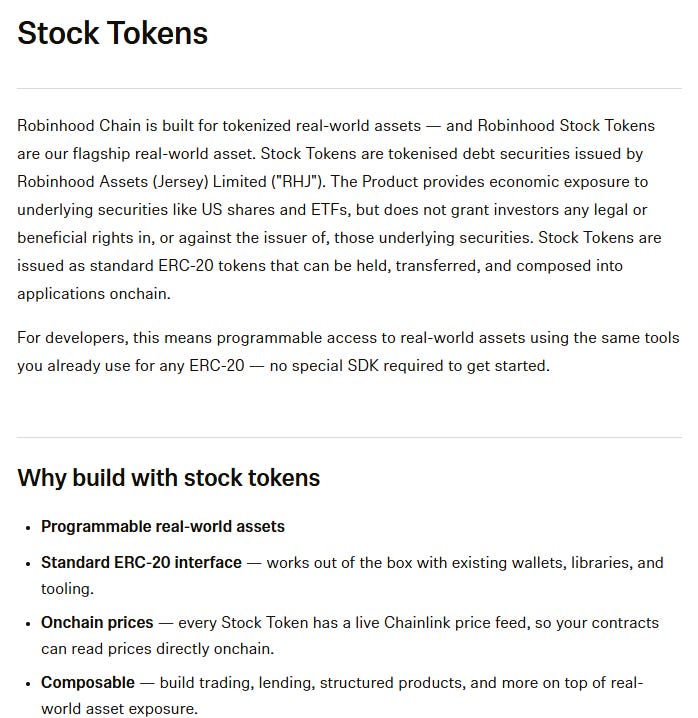
People have many feelings about whether such tokens should be synthetically created, and whether they take trading volume from price discovery on the “real” stocks. But those feelings don’t really matter right now, because the product is out and live.
A Pons launch begins on a bonding curve, and once it graduates, it moves into a Uniswap v4 pool holding the meme on one side and the stock token on the other.
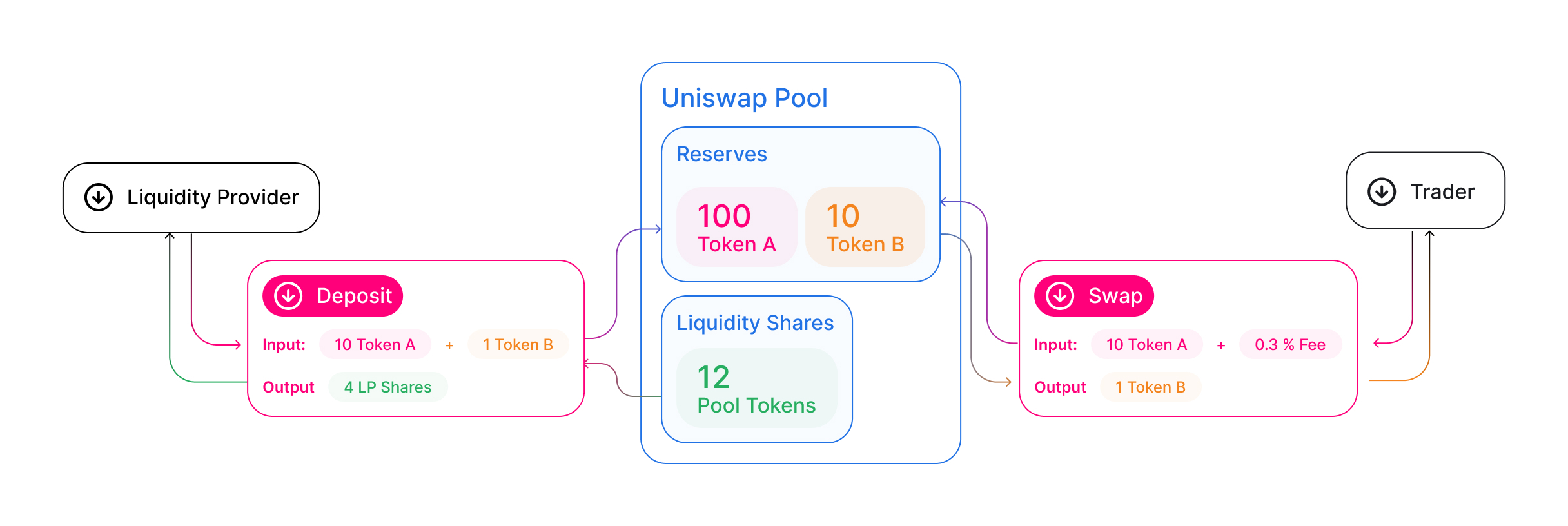
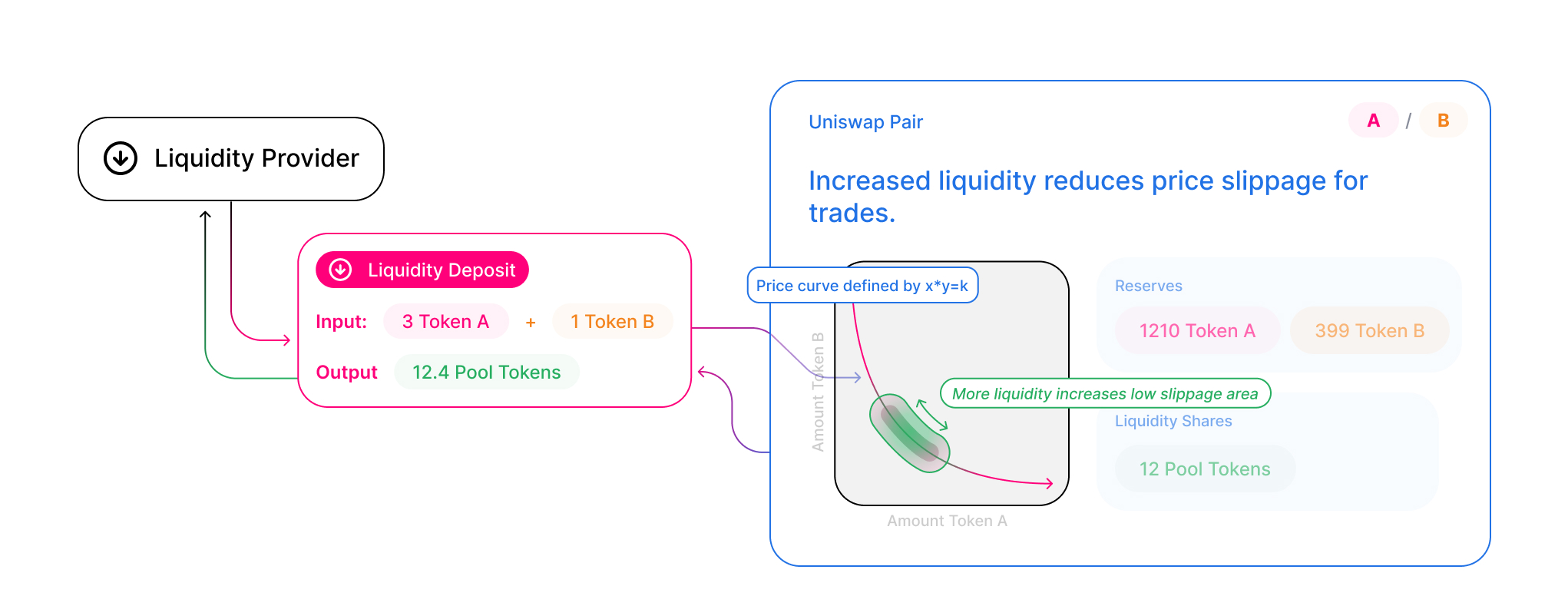
Every buyer of the meme is, structurally, a seller of the stock token into that pool: the equity exposure gets locked as the reserve that prices the joke. Pons reported over $111MM in RWA volume flowing through Robinhood Chain in 24 hours, and Dune data puts stock-paired memes at roughly 25% of all Stock Token trading volume on the network.
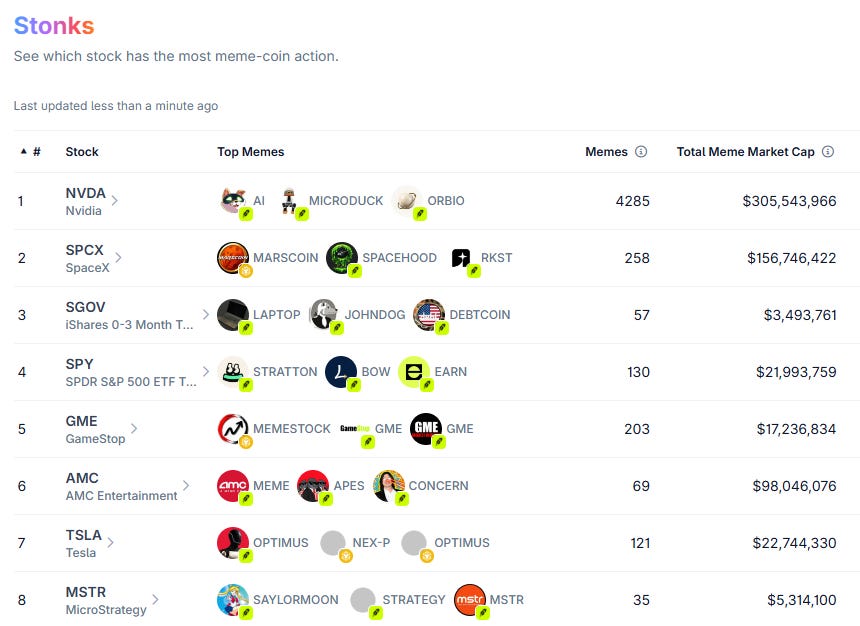
Above, you can see a few of the memes that are in a pool with a stock token.
Artificial Inu, paired against tokenized Nvidia (i.e., NVDA/AI), went from a $1.5MM market cap in early August to over $300MM by September 3. A token called BONER accumulated 31,198 of the 58,714 tokenized HIMS shares in existence (i.e., HIMS/BONER) and, with the NYSE closed over a weekend, pushed the wrapped stock to $132 against a real close of $28. Only one licensed partner can mint or burn Stock Tokens, and there is no arbitrage window fast enough to hold the two prices together. The real HIMS shares did not move.
We have seen this liquidity structure before.
Olympus DAO’s bonding program in 2021 sold OHM at a discount in exchange for LP tokens — pools that were half OHM and half ETH or DAI. The high-quality asset (ETH) went in, the protocol owned the liquidity, and OHM’s multi-billion-dollar market cap was denominated against a reserve it had itself absorbed.
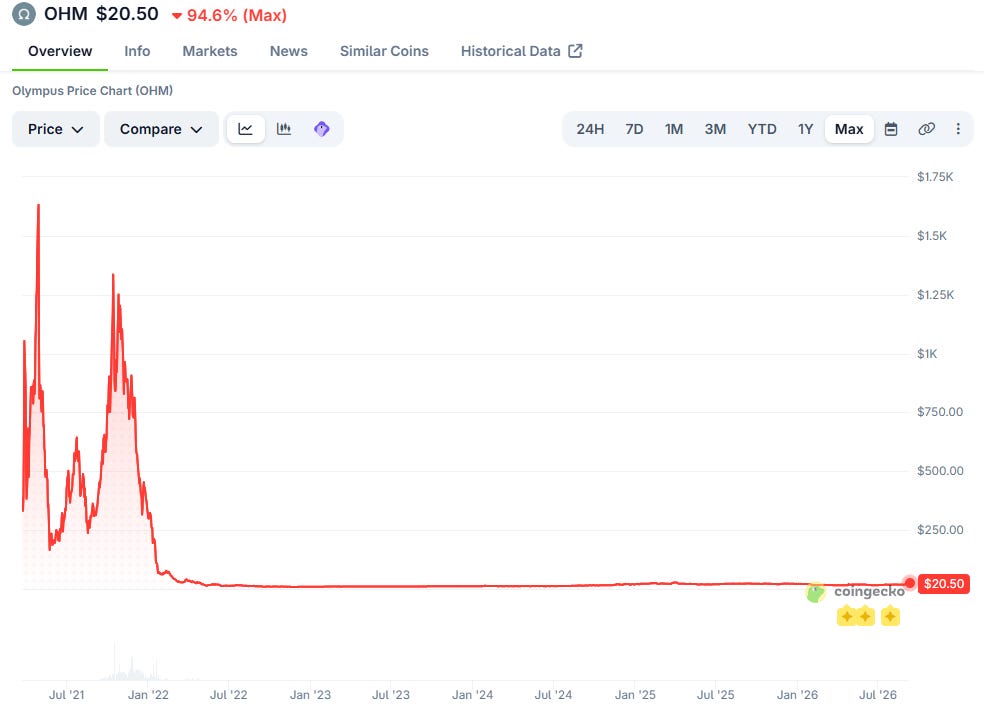
You were putting a good thing into a box next to a worthless thing, obfuscated by lots of financial jargon. The result is as expected once everyone realizes the emperor is wearing no clothes. A kind reading would say that the meme coin, OHM in the case of Olympus, is a pure attention asset with lots of volatility.
The volatility — for a trader — is an asset onto itself.
The Pons pairing runs this alchemy with tokenized equities as the collateral. A meme with no cash flow acquires a quoted price because a pool of real economic exposure sits on the other side. The trading “market cap” measures the last trade against that reserve, not liquid capital that could actually exit at this price. Perfect for pushing prices around.
The financial engineering is not new. What is new is that the asset in the pool is a security wrapper issued by the leading US brokerage.
The activity is good money for the service providers. Robinhood collects chain fees of $2.1MM a day, Uniswap hosts the pools, and 10% of net chain revenue flows back to the Arbitrum ecosystem — about $360K in July alone, or 35% of Arbitrum DAO revenue that month. Compared to Robinhood’s $960B of quarterly equities volume and $20B of crypto brokerage volume, the projected $80B of volume on its chain could be a revelation.
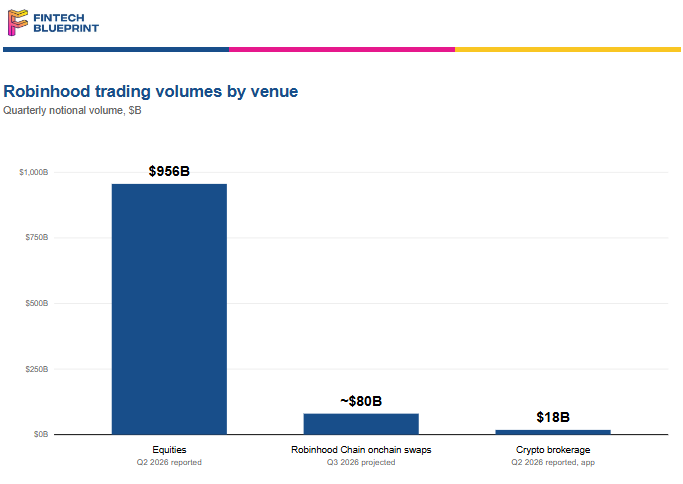
Whether this is a customer acquisition engine for tokenized equities, or a money-churning casino built in the shadow of the brokerage depends on what remains after the meme volume cools down.
👑Related Coverage👑


Analysis: The Annotated Stripe Letter
We examine Stripe’s $7B OpenRouter acquisition as the centerpiece of a roughly $10B push to vertically integrate the infrastructure of the machine economy. We argue that Stripe is using its enormous Web2 distribution to commercialize technologies pioneered across crypto and AI, assembling stablecoins, wallets, usage billing, payments, blockchain settlement, and now inference routing into one stack. OpenRouter gives Stripe control over a critical commodity layer—AI inference—whose economics increasingly depend on routing workloads across models based on price, performance, compute, and availability.
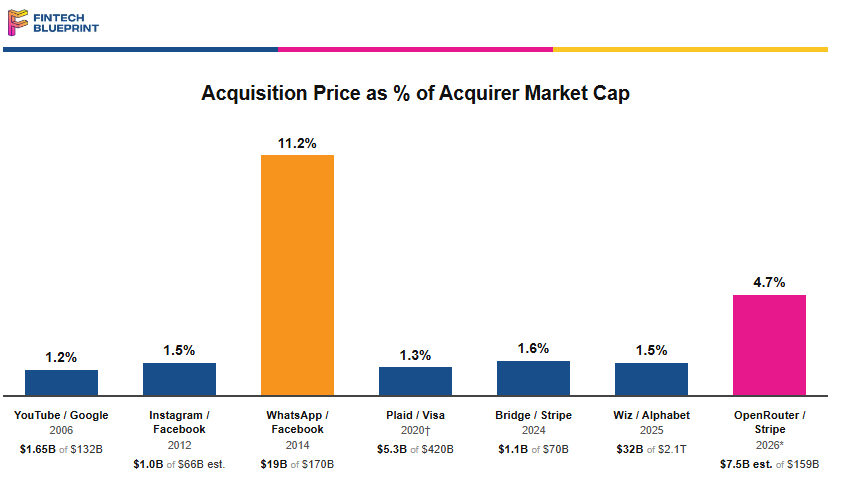
We conclude that Stripe is positioning itself as the economic operating system for AI companies and agents, but its expanding footprint also creates concentration risk and increasingly puts it in direct competition with Ramp.
Curated Updates
Here are the rest of the updates hitting our radar.
Financial Institutions and Adoption
Goldman Sachs, BofA Among 21 Banks Planning Joint Dollar Stablecoin Launch - Decrypt
Revolut Wins Conditional Approval From OCC for US Bank Charter - Bloomberg
London Stock Exchange partners with Kraken parent for tokenized UK stocks - Cointelegraph
Kraken parent Payward partners with SoFi on stablecoin, 24/7 settlement - Cointelegraph
DeFi and Digital Assets
Coinbase files to bring stock perpetuals to the US - crypto.news
Binance expands TradFi push with options on 1,000 US stocks, ETFs - Cointelegraph
Prediction Markets
Trump Jr.-linked 1789 Capital leads Polymarket's $1B raise at $21B valuation - Cointelegraph
Polymarket Launches Crypto Perpetual Futures With Up to 20x Leverage - Decrypt
New Jersey officials petition US Supreme Court over prediction markets -Cointelegraph
UK financial watchdog weighs lifting prediction markets ban - Cointelegraph
Blockchain Protocols
Cronos executes controversial blockchain rollback to recover crypto worth $111 million - CoinDesk
Liquid Hackers Return $270M in Bitcoin After Swiping $320 Million - Decrypt
Ethereum Foundation names 2 'must ship' EIPs for Hegotá upgrade - Cointelegraph
Solana to triple transaction size as apps get room for more complex trades - CoinDesk
NFTs, DAOs and the Metaverse
OpenSea Adds Solana NFT Trading Across OS2 - The Defiant
Arbitrum DAO reports $6.2 million in first-half income as Robinhood Chain adds new revenue stream - The Block
🚀 Level Up
Join our Premium community and receive all the Fintech and Web3 intelligence you need to level up your career. Get access to Long Takes, archives, and special reports.
Sponsor the Fintech Blueprint and reach over 200,000 professionals.
👉 Reach out here.Check out our AI newsletter, the Future Blueprint, 👉 here.
Read our Disclaimer here — this newsletter does not provide investment advice
Fintech Blueprint 🤖🏦🧭 is a reader-supported publication. To receive new posts and support my work, consider becoming a free or paid subscriber.