
Hi Fintech Futurists —
Earlier this month, UK challenger bank Monzo reported it was in talks for a $13B sale to digital incumbent Nubank. This would mark the first major exit for the string of UK challengers that emerged almost 10 years ago; and to another digital bank no less.
A few days later, negotiations with Nubank collapsed and the bank is now courting private equity giants CVC and Advent. This week we unpack Monzo’s recent performance, why it is pursuing an exit now, and why investors might be unwilling to pay a premium.
FINTECH: Monzo seeks exit at $13B to Nubank
ANALYSIS: Are Robotics IPOs just Memecoins in Disguise?
CURATED UPDATES: Paytech, Neobanks, Lending, Digital Investing
To support this writing and access our full archive of newsletters, analyses, and guides to building in Fintech & DeFi, subscribe below (if you haven’t yet).
Digital Investment & Banking Short Takes
Monzo seeks exit at $13B to Nubank
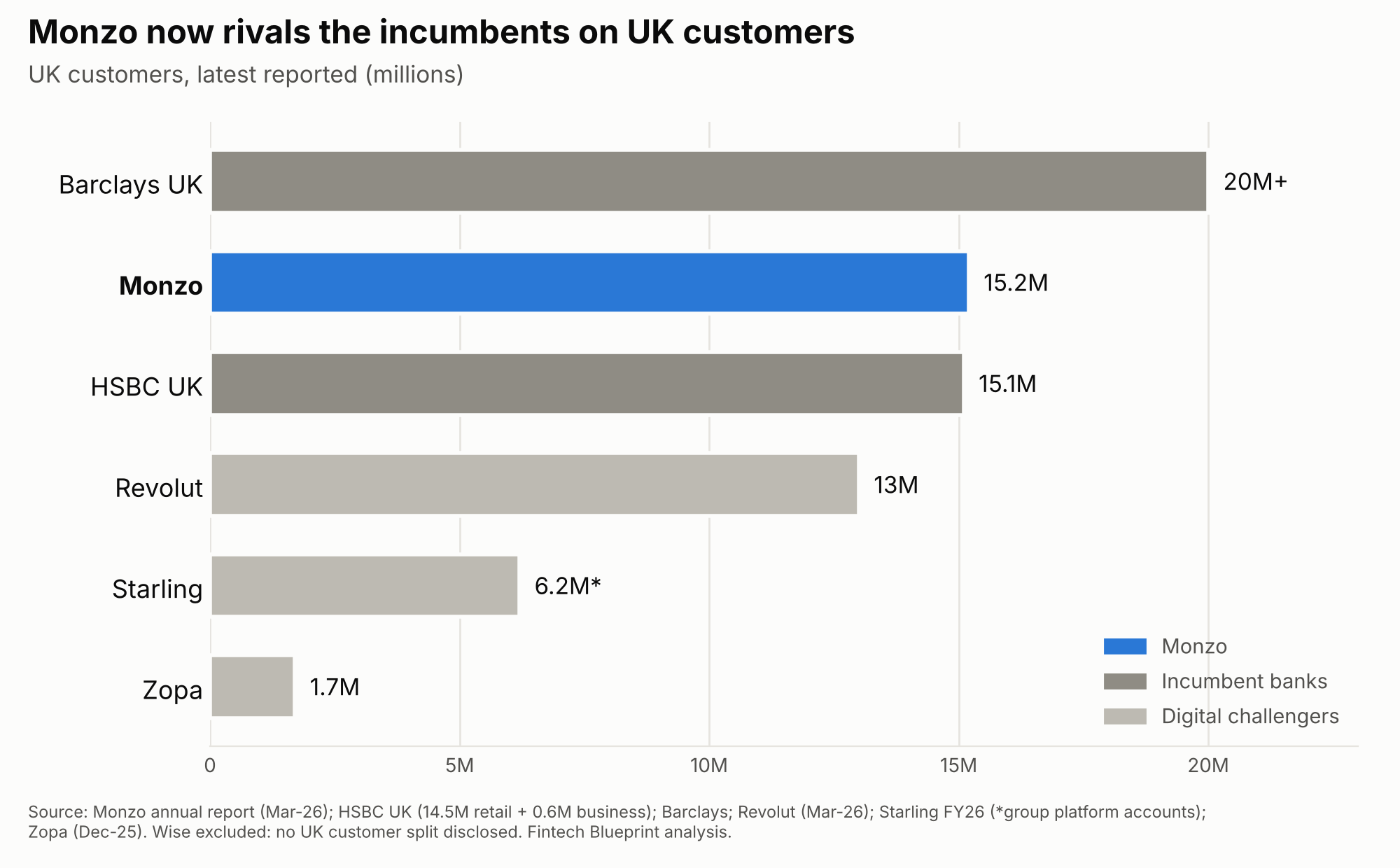
Monzo, founded in 2025, is one of the pioneers of digital banking in the UK. Today it boasts 15M users, on par with some local incumbents, and is consistently ahead of UK competitors on overall service quality. Almost half of users also claim to use it as their primary bank account.
This is reflected in a strong set of results last year:
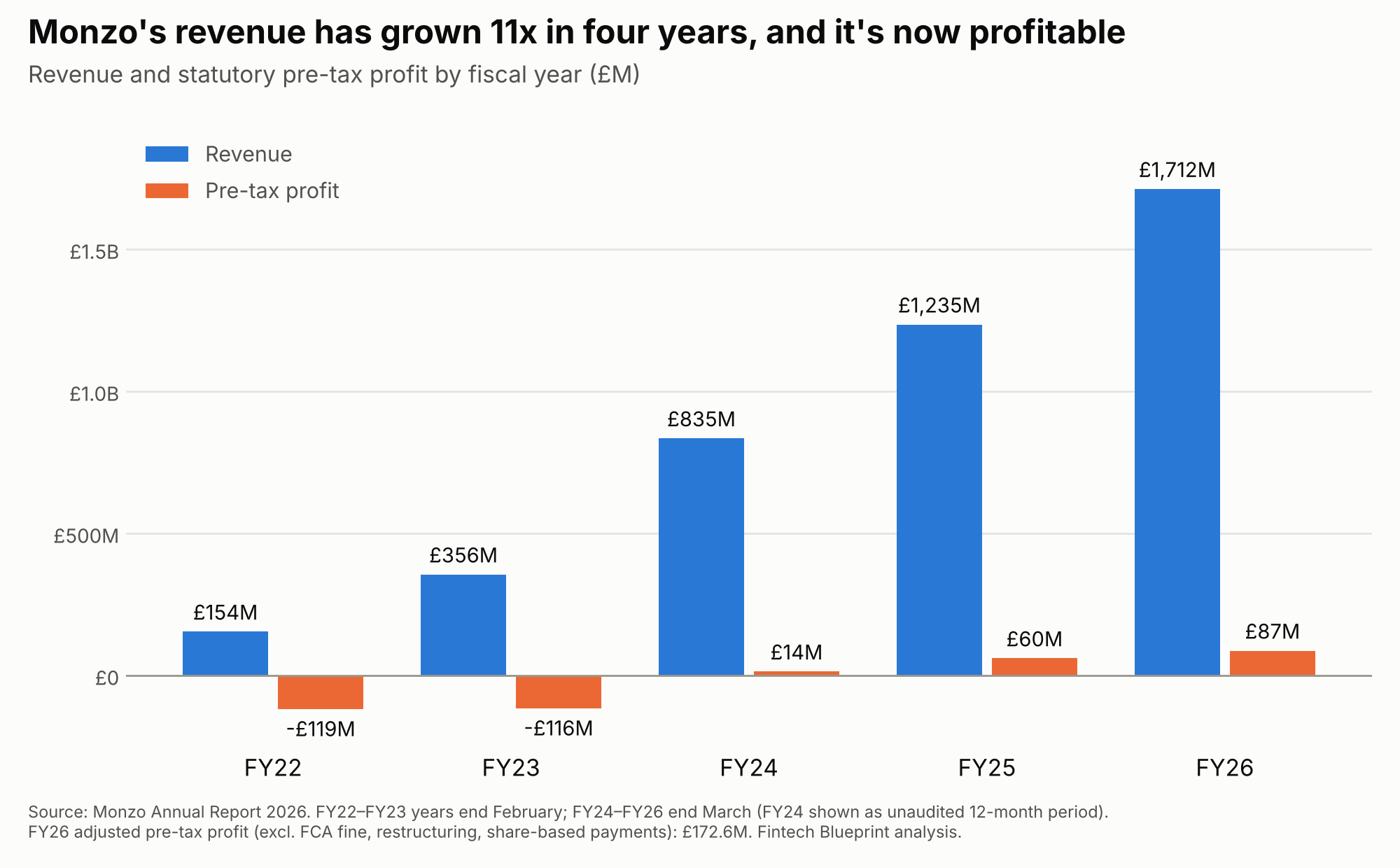
In the 12 months to March 2026, the bank grew revenue 39% YoY to £1.7B and customers are up 25% to 15.2M.
Across the UK, roughly 1 in 5 adults use the banking app. It’s also firmly profitable for a third consecutive year.
Pre-tax profit rose 44% to £87M, a sharp reversal from the £119M loss it posted in FY22.
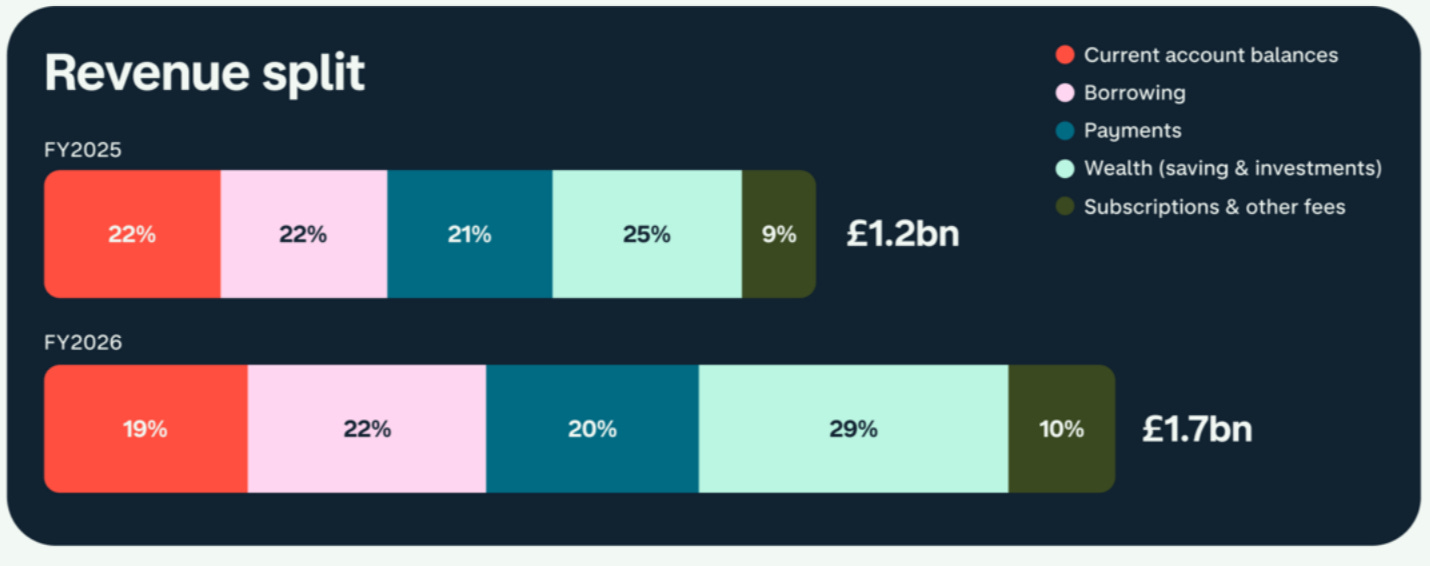
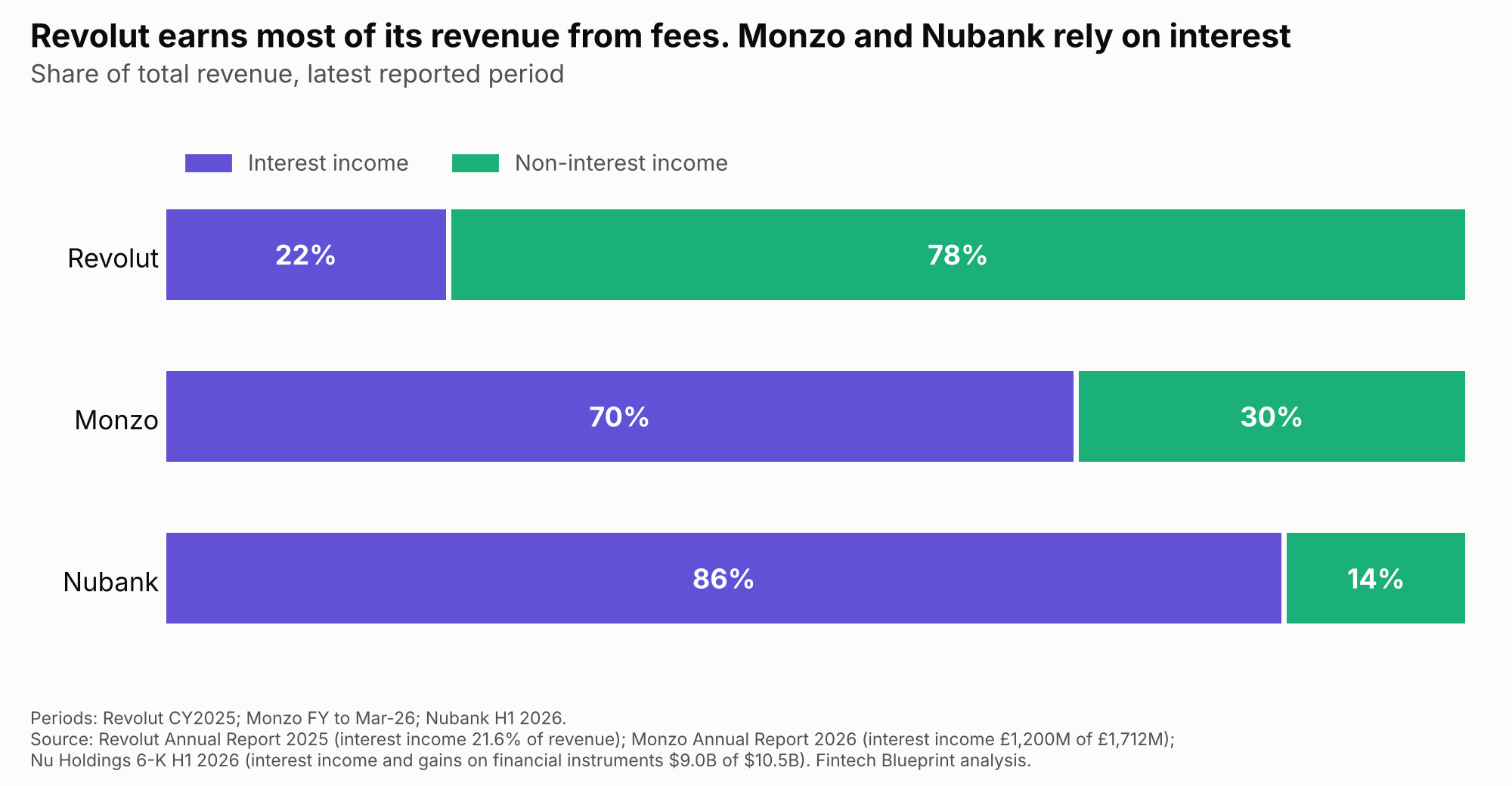
Revenue is made up heavily of interest income on deposits, lending, and treasury investments which accounts for 70% of total. The remaining 30% is fee income on payments (FX and interchange) and subscriptions. Growth has primarily been driven by deposits, which grew +55% to £25.7B. Monzo offers users up to 3.5% APY by passing part of the underlying interest back to users via its Savings product. This is reflected in the growing Wealth segment below.
Despite its performance, Monzo’s valuation has remained remarkably steady. It raised $500M at a $4.5B valuation in late 2021, near the peak of fintech VC funding. Its last employee share sale in last year nudged that to $5.9B. That’s a 31% gain in three years, while annual revenue grew from £154M to the current £1.7B.
Over the same period, competitor Revolut went from $33B in 2021 to $115B in a secondary sale this July, a 3.5x increase. That prices Revolut at roughly 19x its 2025 revenues vs. Monzo’s 3x revenues
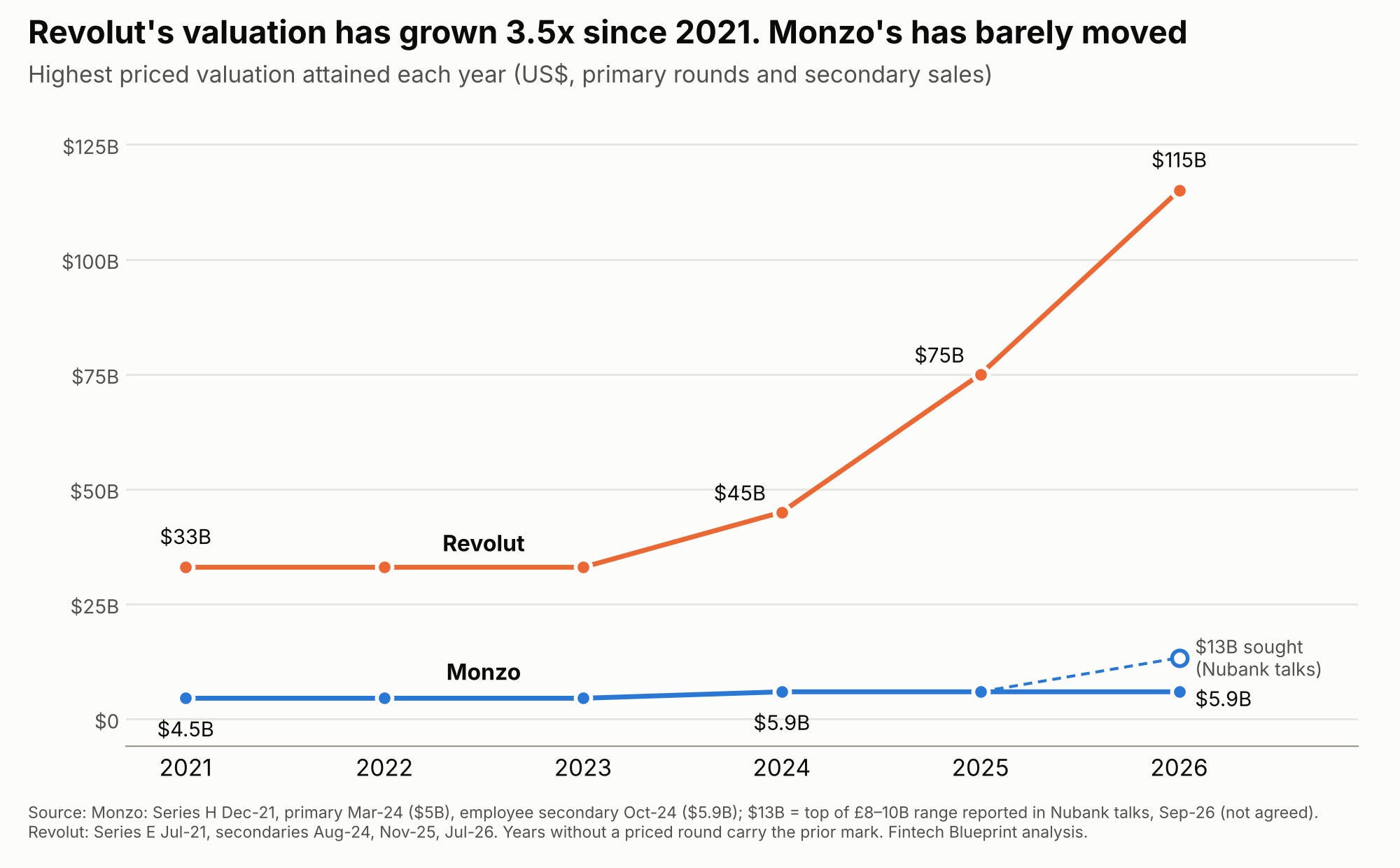
The latest Nubank acquisition talks were Monzo’s bet to close the gap, giving the Brazilian bank a major foothold in the UK. Monzo reportedly sought a punchy $13B valuation, or ~8x revenues. But Nubank’s shares fell 10% on the news and wiped $6.6B off its market cap. A few days later it confirmed it would not pursue a deal.
So why does a profitable, fast-growing bank with 15M customers trade at such a discount to its peers? In our view, fintech valuation often comes down to two things: how efficiently it uses its existing capital, and how quickly it can grow.
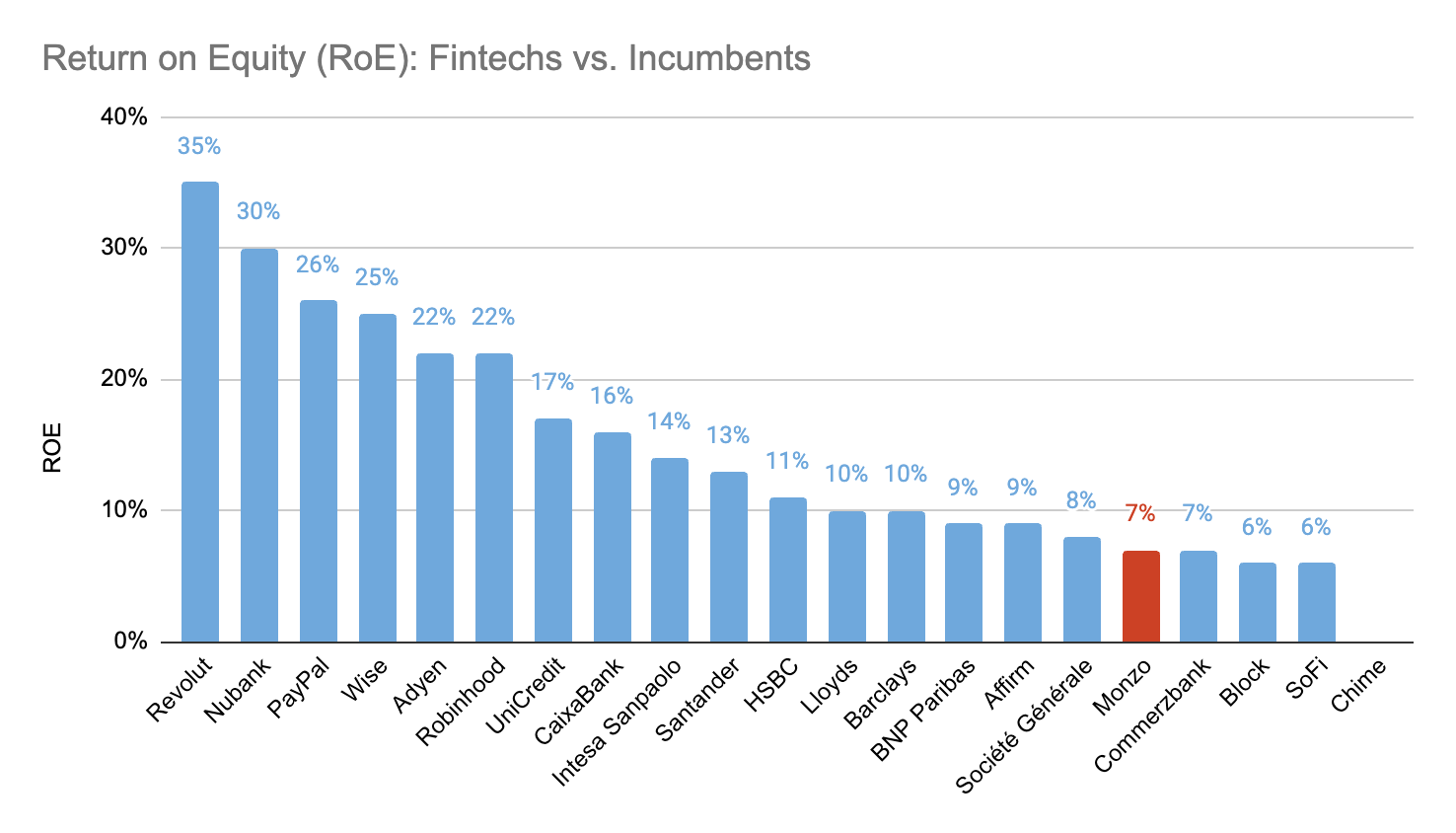
The first is measured by return on equity (ROE), which is how much profit a company makes for every dollar its shareholders have invested. Monzo sits at a rather low 7%, which is even below incumbents Lloyds and Barclays (each around 10%) and a fraction of Revolut’s at 35%.
This is likely due to Monzo’s banking-first strategy.
With a full UK banking license from 2017, the company built a business around deposits and lending, so 70% of its income is interest. Its first-ever acquisition of mortgage broker Habito, reinforces this direction of travel. This has paid off during a period when interest rates are high and has been a major driver behind the bank’s profitability.
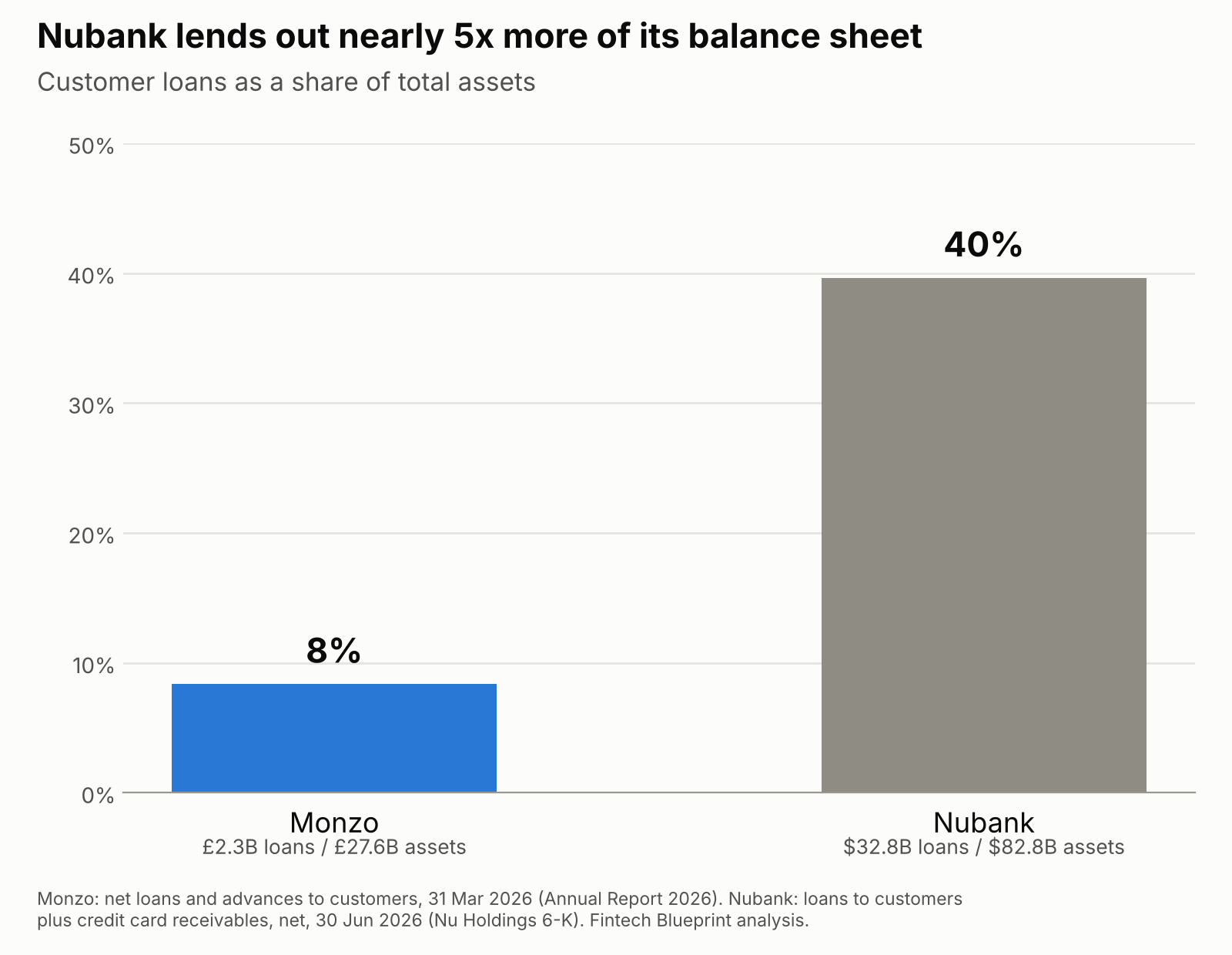
But to drive efficiency, Monzo needs to lend far more.
Today loans make up just 8% of its assets and the rest sits in cash and government bonds. Nubank shows what the model looks like when it’s pushed hard. Most of its revenue also comes from interest, but loans and credit cards make up 40% of its assets, much of it lent to underbanked consumers in Latin America. The result is a 30% ROE.
Meanwhile, Revolut’s revenue is 76% made up of fees on its exchange, trading, crypto, subscriptions and insurance businesses. It commands a 35% ROE.
Then there’s growth. Monzo is still growing fast, adding a record 3M customers last year, but its home market is getting crowded. Revolut secured its full UK banking licence in March and now has 13M UK customers it can try to convert into banking customers. Chase Bank, Zopa and most recently Wise have all launched everyday current accounts.
There is still ample room, but investors would be less jumpy if Monzo can repeat its playbook abroad. Earlier this year, the company exited the US and cut 50 jobs (source). It initially filed an application for a Banking Charter in 2020 but withdrew it a year later. This ultimately led to shake-ups at the leadership level with then-CEO TS Anil stepping down. The company’s focus is now on Europe. It recently received an EU banking licence from the Central Bank of Ireland and has started serving both Ireland and Spain.
The expansion is reportedly a big part of why Monzo is raising money now, but leaves the company in an awkward spot. Nubank walked away over price. Private equity firms CVC and Advent lack Nubank’s strategic reasons for a deal, so they are likely to be even more price-sensitive. Monzo is reportedly looking to sell a stake of up to 15%, and we expect it to come away with a lower valuation than it was hoping for.
That isn’t the end of the story.
Monzo has one of the most loyal customer bases in UK banking and a profitable business still growing close to 40% a year. If it can lift returns, by lending more of its deposits or growing fee income, and show its model works in Europe, a higher valuation should follow. Until then, the market is likely to keep pricing Monzo as a very good bank rather than a fintech.
👑 Related Coverage 👑


🤖🏦🧭 Our Ecosystem:
Generative Ventures | Robot Money | Linkedin & Twitter | Sponsors
🚀 Lex is actively meeting teams building machine-native financial companies. If that’s you, reach out here.
🦄 We run a $200MM SPAC looking for targets in fintech, digital assets, and AI infrastructure. If you are a late-stage founder or have an idea to discuss, reply directly to this email.
Analysis: Are Robotics IPOs just Memecoins in Disguise?
We examine whether robotics is following the AI investment blueprint, from components and training data to industrial and household applications. We estimate that robotics-related companies represent roughly $3.8 trillion in value, although most of that sits inside large technology and legacy industrial companies rather than pure-play robot makers.
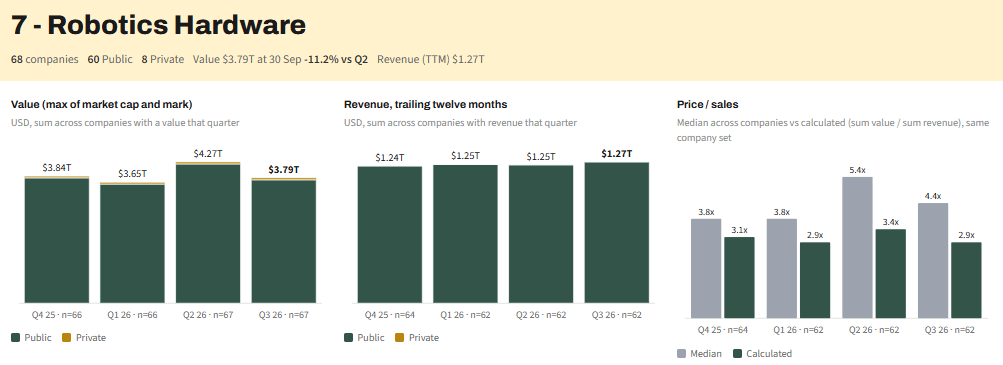
We argue that robotics valuations are being shaped as much by market structure, insider liquidity, lock-up expiries, and speculative positioning as by commercial fundamentals, making these companies part industrial chassis and part science-fiction meme equity.
Curated Updates
Here are the rest of the updates hitting our radar.
Paytech
⭐ Stripe challenges Circle with bank-backed Open USD stablecoin - The Banker
Meta’s Personal Agent Protocol Starts With Login, Not Payments - Datafloq
Rain Files 2026 OCC Trust Bank Charter - OneBullEx
Neobanks
⭐ Revolut’s Storonsky Says He’s Coming for JPMorgan’s US Crown - BBG
Palmer Luckey’s Erebor surges to more than $7bn in deposits - FT
Modern Treasury Applies to Establish National Trust Bank - Modern Treasury
Lending
Is An Agentic Bank Run Coming? - Apollo
Digital Investing
OKX joint venture files with SEC to launch tokenized trading platform - Reuters
Robinhood Gave AI Agents a Trading Account and a Credit Card - Yahoo Finance
🚀 Level Up
Join our Premium community and receive all the Fintech and Web3 intelligence you need to level up your career. Get access to Long Takes, archives, and special reports.
Sponsor the Fintech Blueprint and reach over 200,000 professionals.
👉 Reach out here.Check out our AI newsletter, the Future Blueprint, 👉 here.
Read our Disclaimer here — this newsletter does not provide investment advice
Monzo being firmly profitable for a third year, with 15M users and almost half using it as their primary account, makes the lack of a premium versus Revolut all the more interesting. Is the heavy reliance on interest income on deposits the main thing holding investors back?