

Hi Fintech Architects,
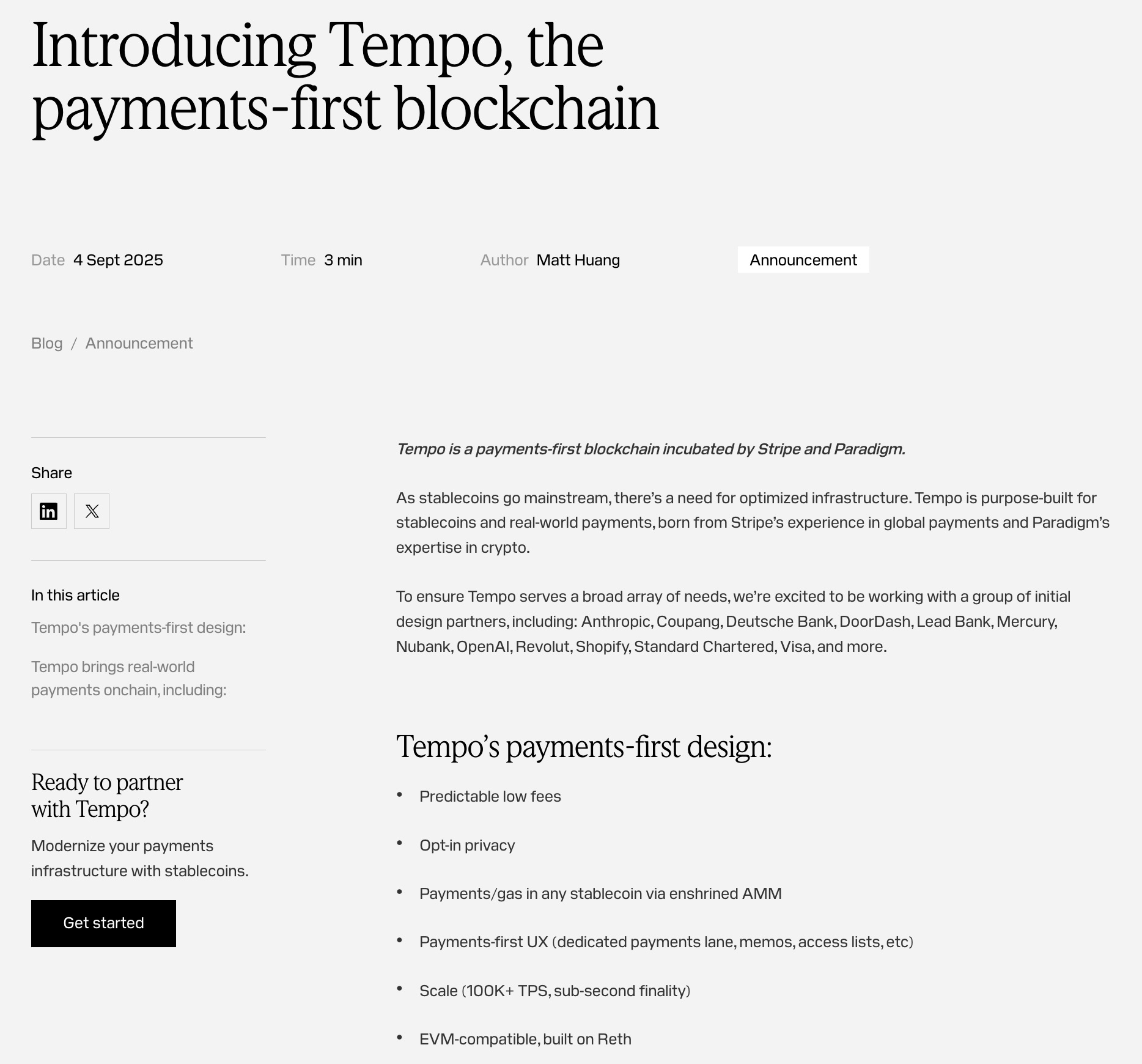
In this episode, Lex chats with Simon Taylor, who heads up market development at Tempo, the payments-native blockchain built by Stripe as a high-performance settlement layer for stablecoins and tokenized money. Simon is also the founder of Fintech Brain Food, one of the sector's most widely read newsletters. They discuss why there is no Fedwire for the internet, and why the next wave of on-chain volume is coming from enterprise money movers like Deel rather than crypto-native builders. Simon explains why tokenized deposits, stablecoins and TradFi settlement will converge on a single chain, why agentic commerce is still stuck in its WAP-phone era, and how the Machine Payments Protocol is being designed as an IETF-grade standard that can settle across Tempo, Stripe or any card network.
For those that want to subscribe to the podcast in your app of choice, you can now find us at Apple, Spotify, or on RSS. Or to support this writing and access our full archive of IPO primers, financial analyses, and guides to building in the Fintech & DeFi industries, see subscription options here.
Thanks for your time and attention,
Matt & Lex 🙌
Key notable takeaways:
The AI productivity gap is an operating-model gap, not a tooling gap. MIT found nine in ten companies get zero productivity gain from AI, while Ramp’s own data shows the heaviest users generate 2x higher revenue on 40% less capital. What separates them is four ingredients: AI evals as a cultural default, a shared library of skills (Ramp has 350+), non-engineers shipping production code (12% of Ramp’s human-initiated PRs), and treating AI fluency as the primary staff learning curve.
Agentic commerce is in its WAP-phone era. Nobody is actually paying for things with agents at any scale - Walmart’s ChatGPT checkout converts worse than its dotcom, Target has told customers they are 100% liable for anything an agent buys, and Walmart and Amazon block third-party agents outright as fraud. The real volume is in B2B finance teams automating PDF-invoice-to-payment flows through Ramp and Brex, which is where Machine Payments Protocol and x402 will first find product-market fit.
On-chain cash settlement is less than 0.1% done, and Tempo is being positioned as the missing Fedwire for the internet. The pitch is not a new L1 competing on TPS benchmarks - it is a settlement layer designed by payments veterans who understand that payments are all edge cases, with permissionless issuance combined with opt-in receive policies (TIP-20 upgrades on ERC-20, block/allow lists, embedded compliance) that let enterprises finally clear their RFP checklist.
Background
Simon Taylor has spent two decades inside the plumbing of financial services digitization. He started at 16 in the early 2000s, moving mainframe outputs onto the dotcom, and by 2010 was on the team that launched the second mobile banking app in the UK. He went on to work on real-time payments infrastructure, the SEPA rollout and Swift's ISO 20022 upgrades at Barclays, before co-founding 11:FS, the London fintech consultancy behind the "digital banking is only 1% finished" thesis, where he led the crypto and blockchain practice. Alongside 11:FS he built Fintech Brain Food into one of the sector's most influential weekly newsletters.
👑Related coverage👑


Topics:
Fintech, Stablecoins, Tokenization, DigitalAssets, Payments, Settlement, RWA, DeFi, TradFi, CapitalMarkets, AgenticCommerce, AgenticPayments, AIAgents, MachinePayments, Ethereum, Canton, Blockchain, Web3, Tempo, Stripe, Anthropic, Ramp, Brex, Deel
Timestamps
0’57: How do you ground-truth the digital world: Why AI ultimately runs on a digital asset substrate
5’46: The two-speed transformation: Why customer-facing tech is competitive and back-end plumbing is industry-led
9’47: Limit the blast radius: How JPMorgan, HSBC and Citi turned tokenized deposits into a client retention play
14’46: Finance is globalised, not global: Why Stripe built its own chain instead of stitching together every other one
18’21: There is no Fedwire for the internet: The missing global settlement layer Tempo is built for
21’18: On-chain cash settlement is less than 0.1% done: Why Tempo is where stablecoins and tokenized deposits converge
26’20: The WAP-phone era of agentic commerce: Why nobody is actually paying with agents yet
33’07: Everyone is your frenemy: Why Stripe and Coinbase both showed up to the agentic payments market
36’44: 9 in 10 companies get zero AI productivity gain: What separates the enterprises that don't
43’54: Harnesses and model routers: Where the durable value sits in the enterprise AI stack
46’05: The channels used to connect with Simon & learn more about Tempo & Fintech Brain food
Illustrated Transcript
Lex Sokolin:
Hi, everybody, and welcome to today’s conversation. I’m absolutely thrilled to have my friend Simon Taylor with us today. He heads up market development at Tempo. He is the founder of Fintech Brain Food, and of course one of the leaders in thinking about the fintech space. Simon, welcome to the conversation.
Simon Taylor:
Thanks for having me, Lex. Real pleasure to catch up with you, as always. Glad to be on the show.
Lex Sokolin:
My pleasure. So you’ve been covering innovation in financial services now for over a decade, and we are in kind of a weird moment where both the digital asset trend and the AI trend have really come to market. Which of these do you think are bigger? Which of these are more important?
Simon Taylor:
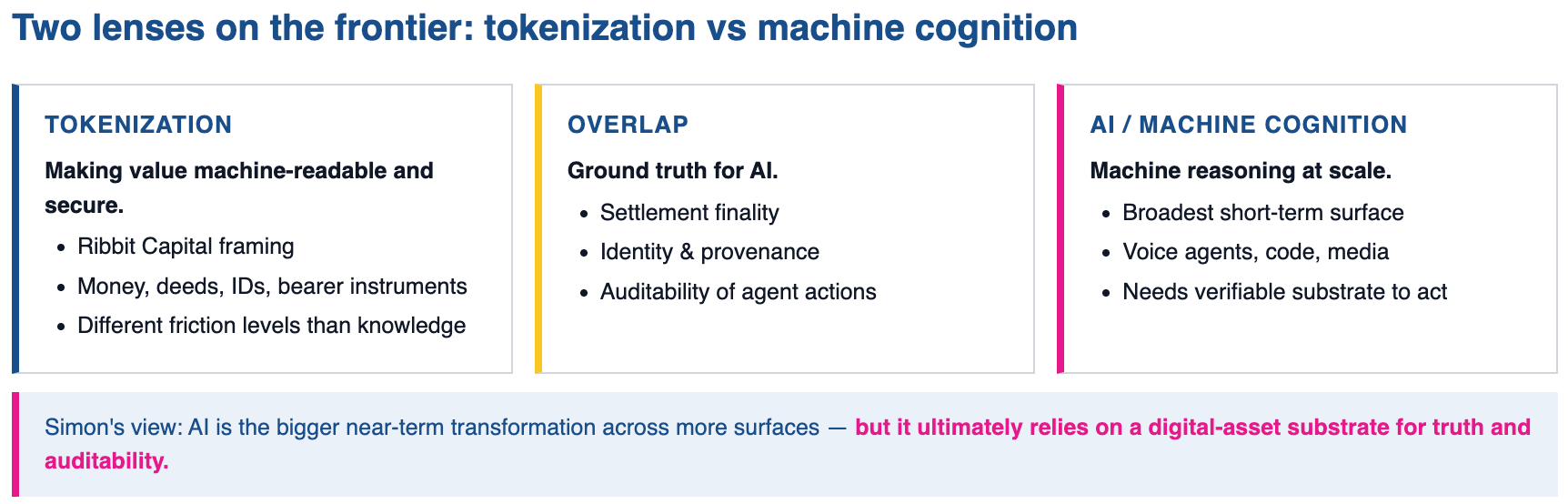
It depends who you ask. I would honestly say that whilst on the surface it appears the answer is obviously AI, I don’t think it’s that obvious. That said, if we have a longer conversation about it, my view is that it is the bigger transformation of the two because it touches everything.
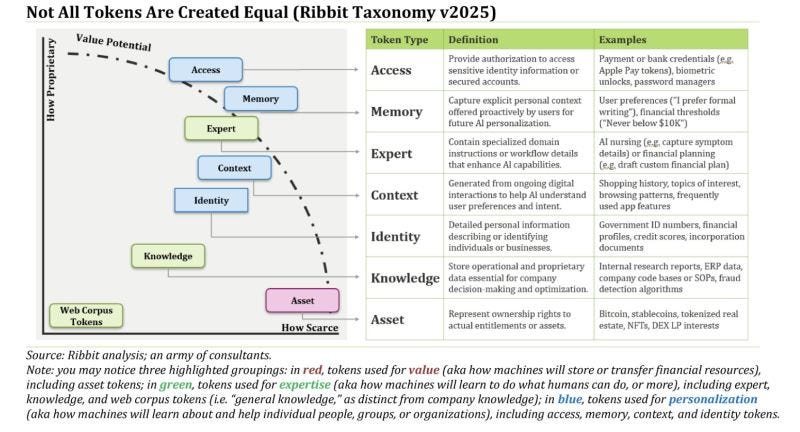
Digital assets and tokenization are an incredibly important substrate for anything to be machine readable. And I’m a big fan of the Ribbit Capital view that tokenization is the term we give to making something machine readable and secure, and that’s what digital assets do for things of varying levels of friction. There are some things that need less friction. Knowledge doesn’t need a massive amount of friction, with the exception of IP law and a few other bits and pieces. But the internet has proven that knowledge doesn’t have a lot of friction. Money and value should have some friction, because you don’t want anybody else to be able to copy your bank account and just copy-paste money. That has some broader implications. Or copy and paste the ownership deeds to your house.
So, I guess I’m one of those mid-wits who thinks these two things are complementary. But inevitably AI is the one that’s short-term more transformational across more surfaces.
Lex Sokolin:
It’s convenient that everything’s called tokens, isn’t it?
Simon Taylor:
Yeah. I once wrote that “token” might be the most infuriating word in the English language because it can mean literally anything. It is a standing word for something else.
Lex Sokolin:
Yeah, I think about it as a hyperlink in a way. With crypto for a while it was a hyperlink to financial instruments, and with intelligence and cognition it’s this unit of knowledge. It’s just gotten really messy, I think.
Simon Taylor:
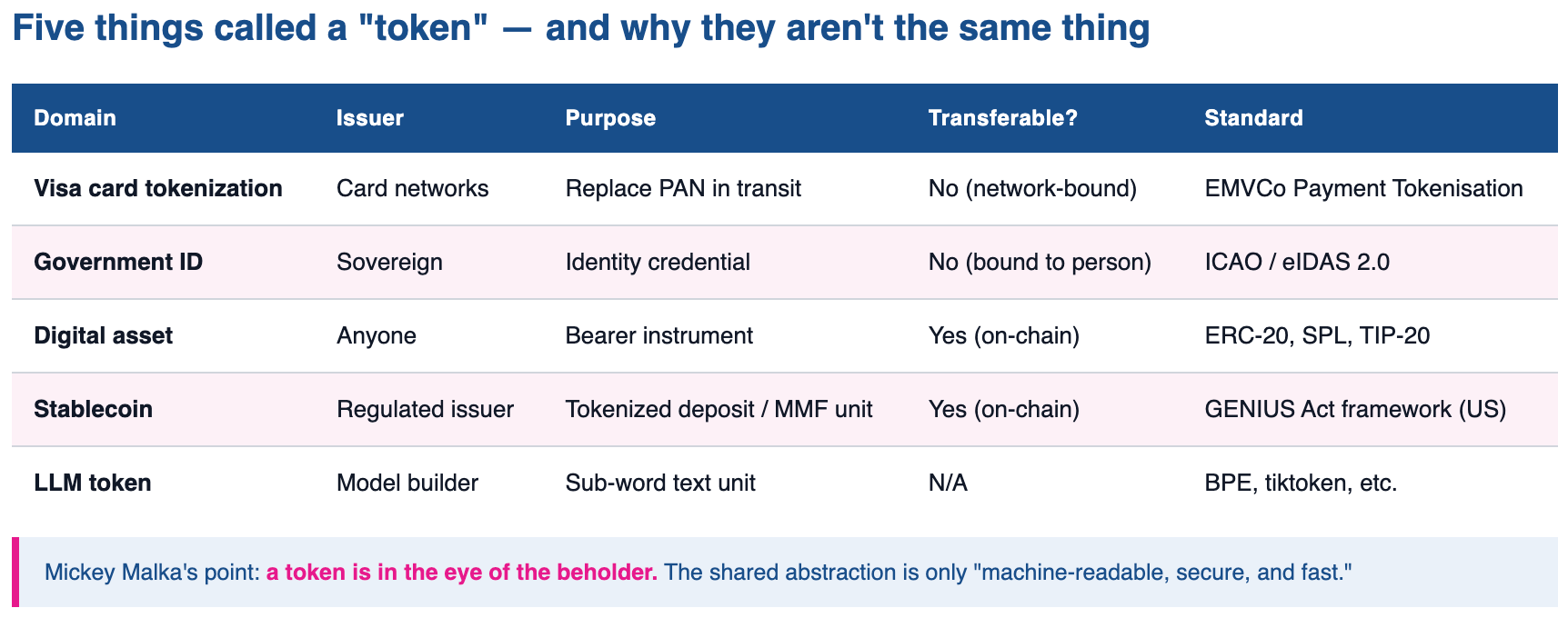
It has. I think the token paper by Ribbit was probably too smart for its own good in trying to map all of that out. And there’s a simple abstraction we need to understand tokenization. Mickey Malka put it really well recently. He said the way Visa thinks about tokenization of cards is different from the way government might think about the tokens for your passport or your documentation, is different from the way that somebody in digital assets or stablecoins does, which is different from how OpenAI thinks about it, which is different from countless others.
If you just remember, a token is in the eye of the beholder. They can do lots of different things. But stick to that - here’s a way to make it machine readable, secure, and fast - then you’ve kind of got a useful rubric to start to have a conversation. But to go back to your earlier point, AI isn’t that bigger, but it’s ultimately going to rely on a digital asset substrate for some sense of truth and auditability and accountability. When anything can be fabricated and duplicated, how do you know what the truth is? How do you ground-truth things in the digital world?
Lex Sokolin:
Yeah, and to go into science fiction land for a moment, I think with a very broad brush, if we painted it like there is this multi-decade trend of digitization and we are in its later innings now, and putting things into tokens is sort of uploading them. And so, you’re uploading money, you’re uploading intelligence bit by bit. We’ll talk about what it means, I think, to upload entire companies or employees as well.
But before we get into that and your work at Tempo, I’d love to get a sense of your trajectory through this financial services digitization evolution. Because bank transformation started a long time ago and looked quite different, and you’ve been plugged into it in various different ways through 11:FS and earlier. Can you talk about the nature of digital transformation of banks? What was it like when you started your career? How did banks and financial services think about technology? And then as the neobank wave came, what was their posture? And then here we are in crazy science fiction land — how do they think about it now?
Simon Taylor:
Yeah, I think they are an amorphous blob of many different personas within those organizations. But if I was to just be abstract - I’m old, and I started work at 16. So I’ve had a long old career, and at the very beginning of my career, in the early 2000s, literally 2000, I was taking things from a mainframe and trying to make those appear on the dotcom and vice versa.
So, there was this internet and dotcom thing, and that was a new customer service channel. And if you look at AI today, the base use case is voice agents for customer chat. That’s kind of where enterprises have started their quote-unquote digital transformation. You also see a lot of what we were doing back then was taking things that existed on a spreadsheet and turning that into software, making all of the mainframes update the spreadsheets internally with macros. Well, what are the AI agents doing today? They’re lifting data off of the spreadsheet and running internal processes and that sort of stuff. So, dotcom digital transformation, if you look at what it did, was quite similar to the digital transformation with AI.
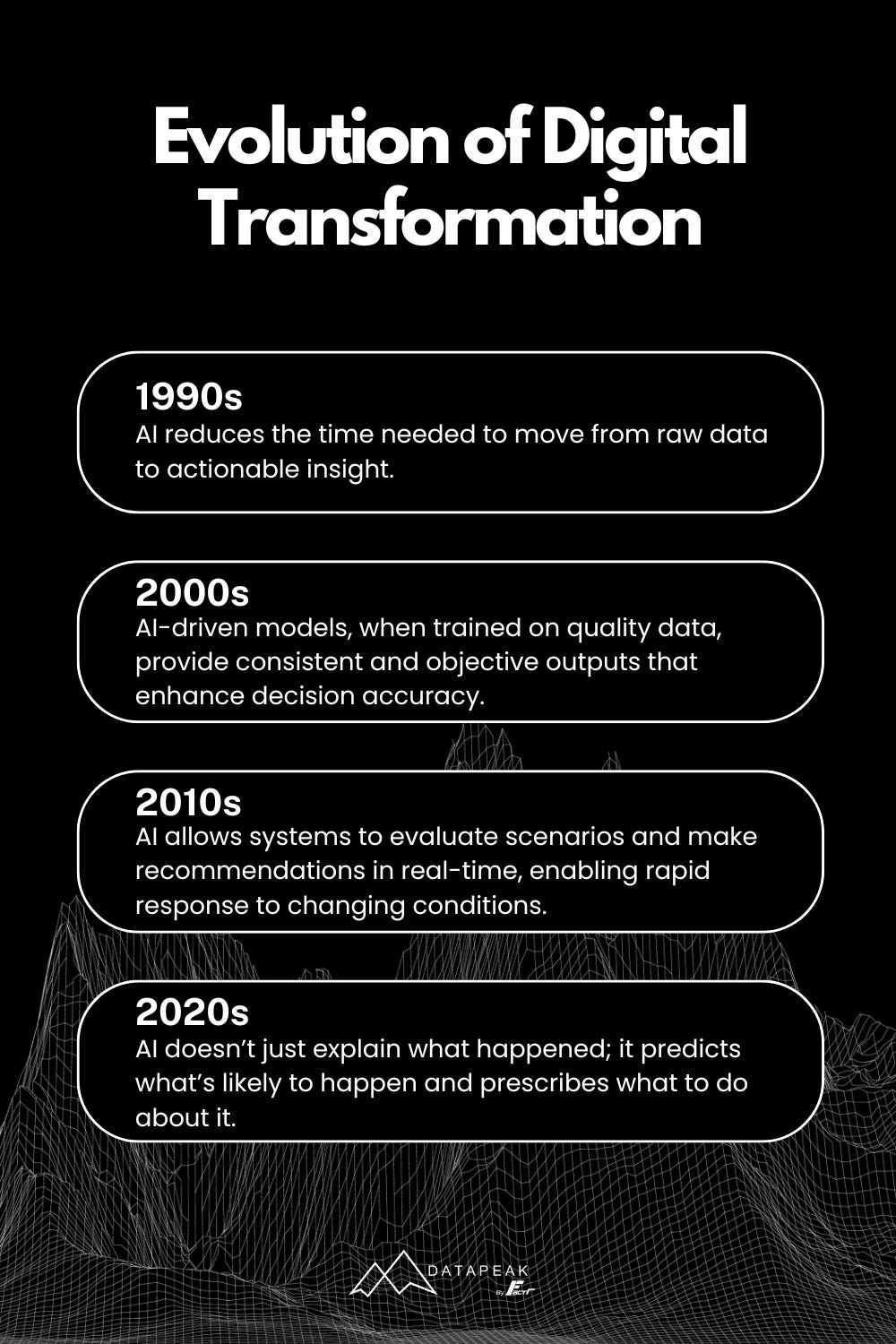
Wind the clock forward through to 2010, and I was involved in launching the second mobile banking app in the UK. The way we got that to market was by integrating a mobile app that was kind of designed and fleshed out already by a third party into the mainframe. So, we were integrating a mobile app to a mainframe, to a data source. And what were we doing? We were doing customer service. Here’s your balance, here’s your statement, blah, blah, blah. There was nothing transactional.
So, like dotcom, its customer service is where it starts. And with mobile then you got a little bit more into driving some of those interactions, and you built APIs to solve it. And then thereafter I got involved in Barclays setting up some of the real-time payment’s infrastructure. I was involved in the SEPA rollout, some Swift upgrades to ISO 20022, dealing more on the plumbing side. And that sort of digital transformation is always on. Some regulator comes along and says, hey, you have to do it, or there’s some big shift in the industry. Those things happen over seven-to-ten-year increments.
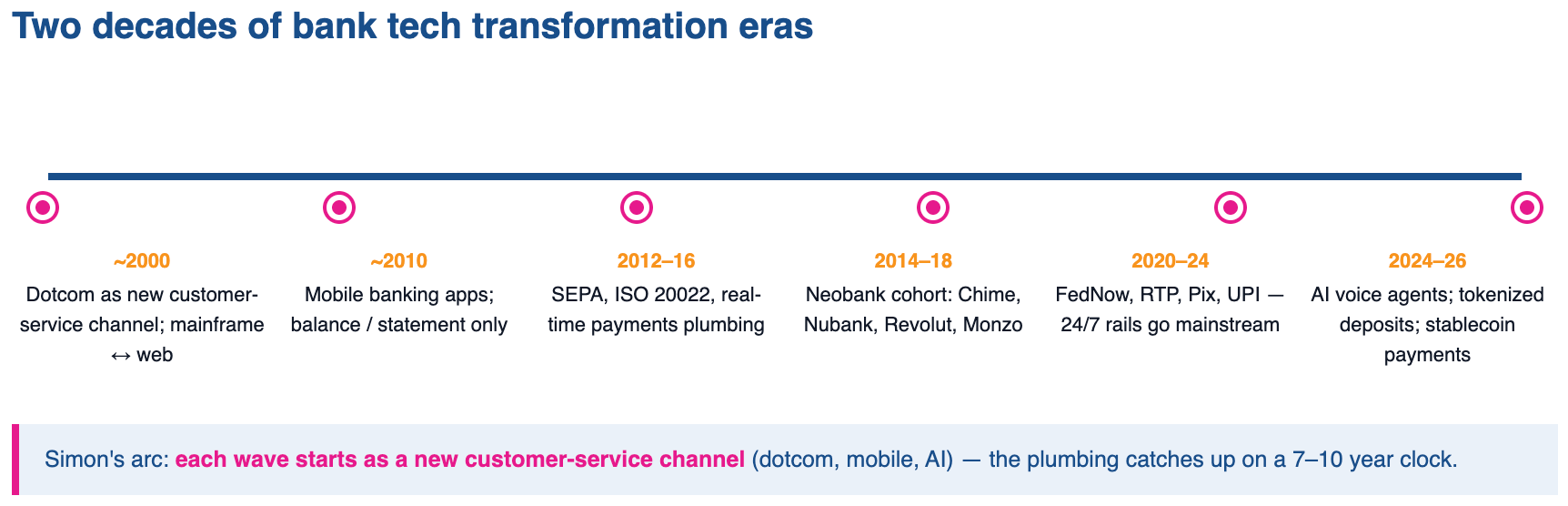
So, I think there’s this two-speed transformation in enterprise. One is: disruptive new technology comes in and new folks like the neobanks start to use it first — mobile with Capital One…sorry, web with Capital One, and then mobile with Chime and Nubank and Revolut. “Oh, we have to respond to this new form of customer service. We’ll do that too.” But second, these things are also happening at the back end in the plumbing, in the infrastructure, and we always have to do those.
So, where it impacts the customer, it tends to be more competitive. When it impacts the infrastructure, it tends to be driven by something broader and industry-led. And I think that’s happening with AI just as much.
Lex Sokolin:
That’s a really compelling way to set it up. The way I think about it is that it’s very hard to change the manufacturing, especially if it is a big cost for the company to go in and change up the core banking systems or the portfolio management systems. But the store, the distribution part — everybody wants to get ahead and get to the new audience because stores are great at selling. So, whether it’s a website or a mobile app or an AI agent, you can sell the same old products that you used to have in wherever people are going to shop now.
Did you see the sort of divide between things that are revenue generating versus things that are cost savings inside the different banks? Do they have different levels of urgency and appetite?
Simon Taylor:
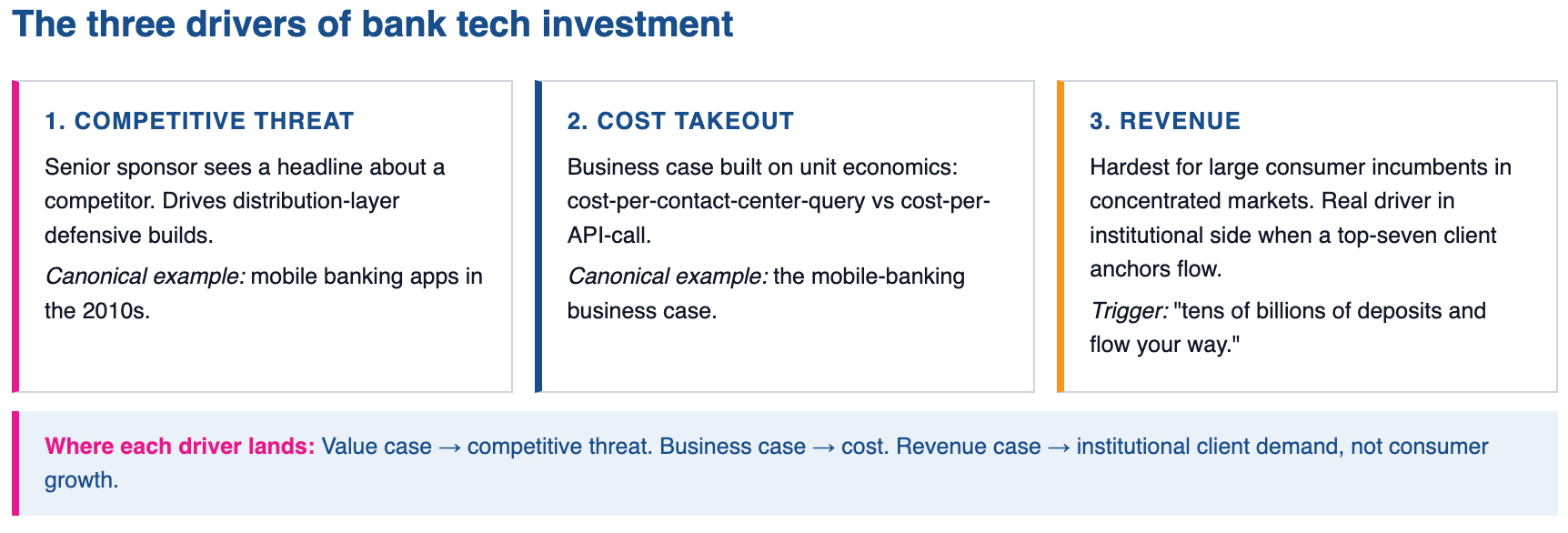
Yeah. Look, there are probably three main drivers. One: senior sponsor thinks we should do it because they saw a headline about a competitor and they experienced some form of competitive threat. And that’s probably what drove a lot of mobile, if we’re being honest. Two is cost takeout. And three is revenue.
The revenue one is hard for large incumbents, though, especially on the consumer franchise. Because if you’re one of the big four banks in a concentrated banking market, chances are you’re not going to grow that much bigger. And if you do, is it net positive? Have you already got the segment of the market that you want? So, revenue tends to come more from launching into new verticals, trying new product types, and frankly, letting the innovators prove the business model and copying them later. So, you’re quite happy with the competitors proving new dynamics. And so then maybe they prove that new dynamic, and you see mobile as a cost play.
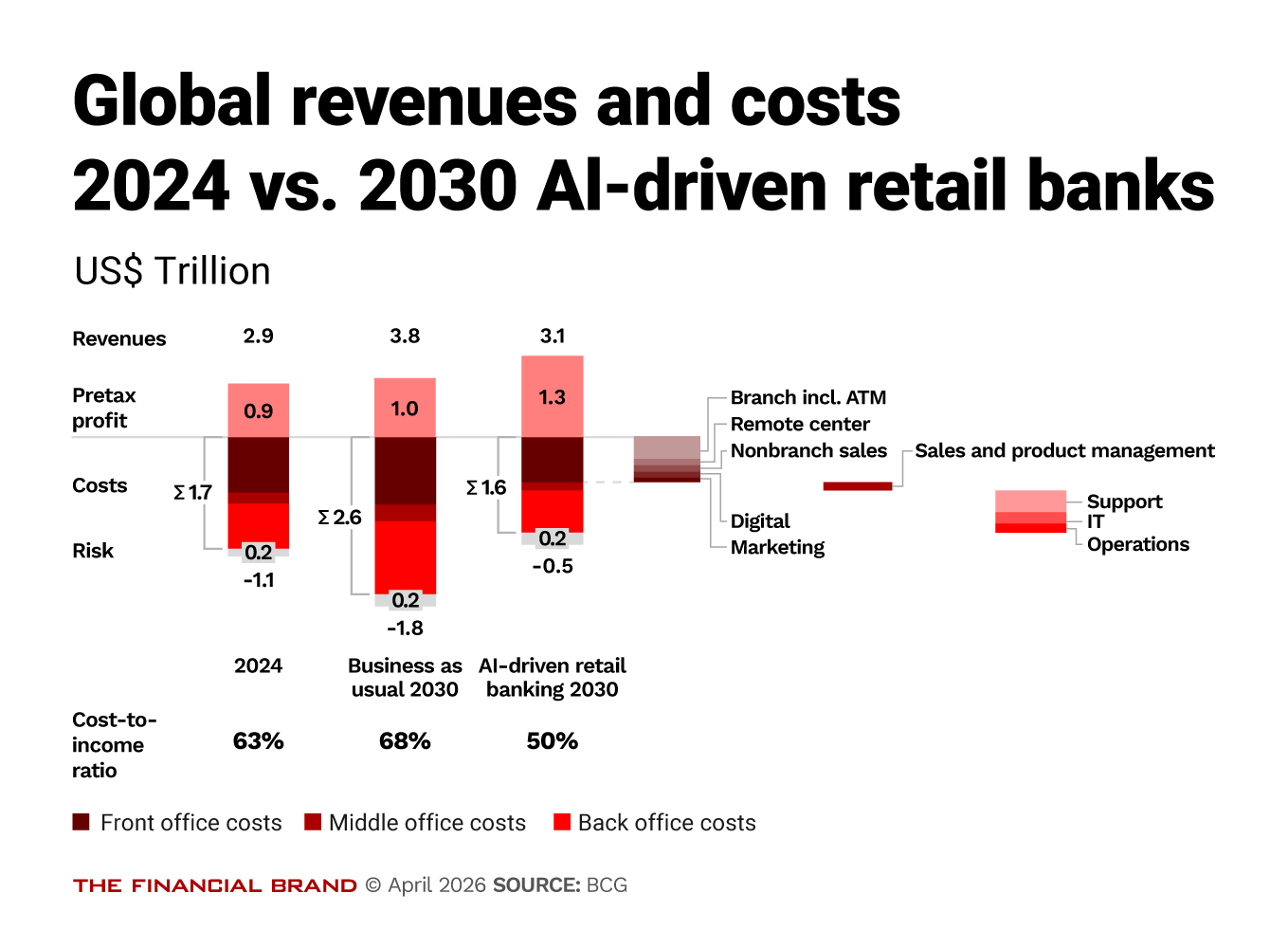
In fact, I remember the business cases for mobile were very much around: this is what it costs to deal with a query at the contact center, and this is what it costs for an API call to a mobile, and the differentiation between them. So, the business case is usually made on cost. The value case is usually made on competitive threat for an incumbent. But revenue is less likely, unless you’re more in the institutional bit of the bank and it comes with a big client. So, if you have one of the big seven asking for something, and they’re willing to move tens of billions of deposits and flow your way, then it’s a different conversation.
Lex Sokolin:
So, we’ve indirectly arrived at my next question, which is: let’s say you are Stripe and you have an enormous distribution footprint for web-two merchants and commerce on the internet. What is my industrial logic for Tempo and building out a dedicated digital asset or payment chain?
Simon Taylor:
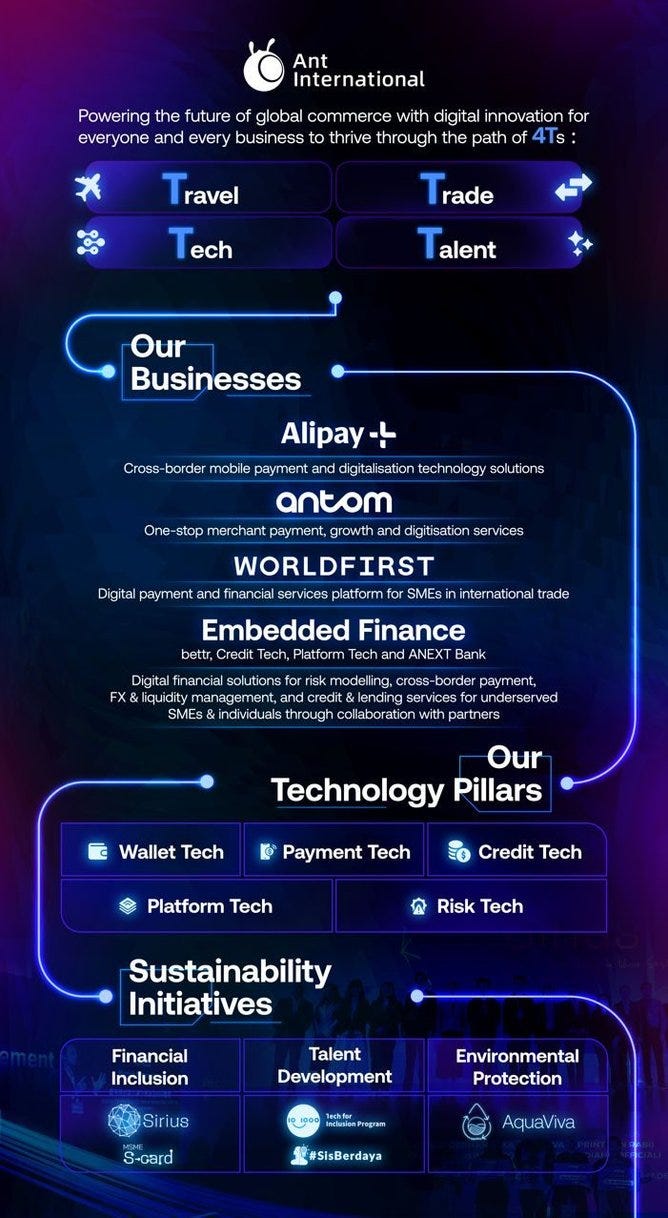
Kind of what I just said. If you speak to any of the folks that have built token services for their clients, it’s because a handful of very big clients said “do this or we won’t do business with you anymore.” I think the name that comes up most often is Ant Financial have been quite clear. With all of their supplier ecosystem: you will support digital assets or we will not do business with you. Which I think surprises some people. But if you go look closer at that business, it starts to make a lot more sense in retrospect.
So, there’s this handful, this small but important client subset that’s saying you’ve got to do this. But then you ask yourself the question, do I want to just YOLO into a stablecoin here on some unknown chain that’s in the public, or do I want to limit my blast radius a little bit? I probably want that “limit the blast radius” thing. And so that’s what JPMorgan did with Kinexys, and HSBC and Citi with their token services.
They said, well, let’s start internal only, and we’ll give you all of the benefits of instant 24/7 capability, but it’s still a deposit. So, we, the bank, don’t have deposit flight. And you, the client, have the benefit of 24/7. But you also benefit from the fact that your deposits are still parked here, so you get better FX rates, better rates on lending, whatever it is that’s part of that package for parking your deposits with us. Oh, and by the way, it’s not just dollars. We’ll do this in eight different currencies 24/7. And that’s a pretty good upgrade for some clients that have a lot of cross-border activity. To be able to do that in 65 markets with a single bank is useful. To be able to do that across the larger banks would be a lot more useful. And that’s what the Swift ledger is designed to enable — how do we orchestrate between Citi and HSBC and JPMorgan? Let’s just have this other ledger that acts as an orchestrator.
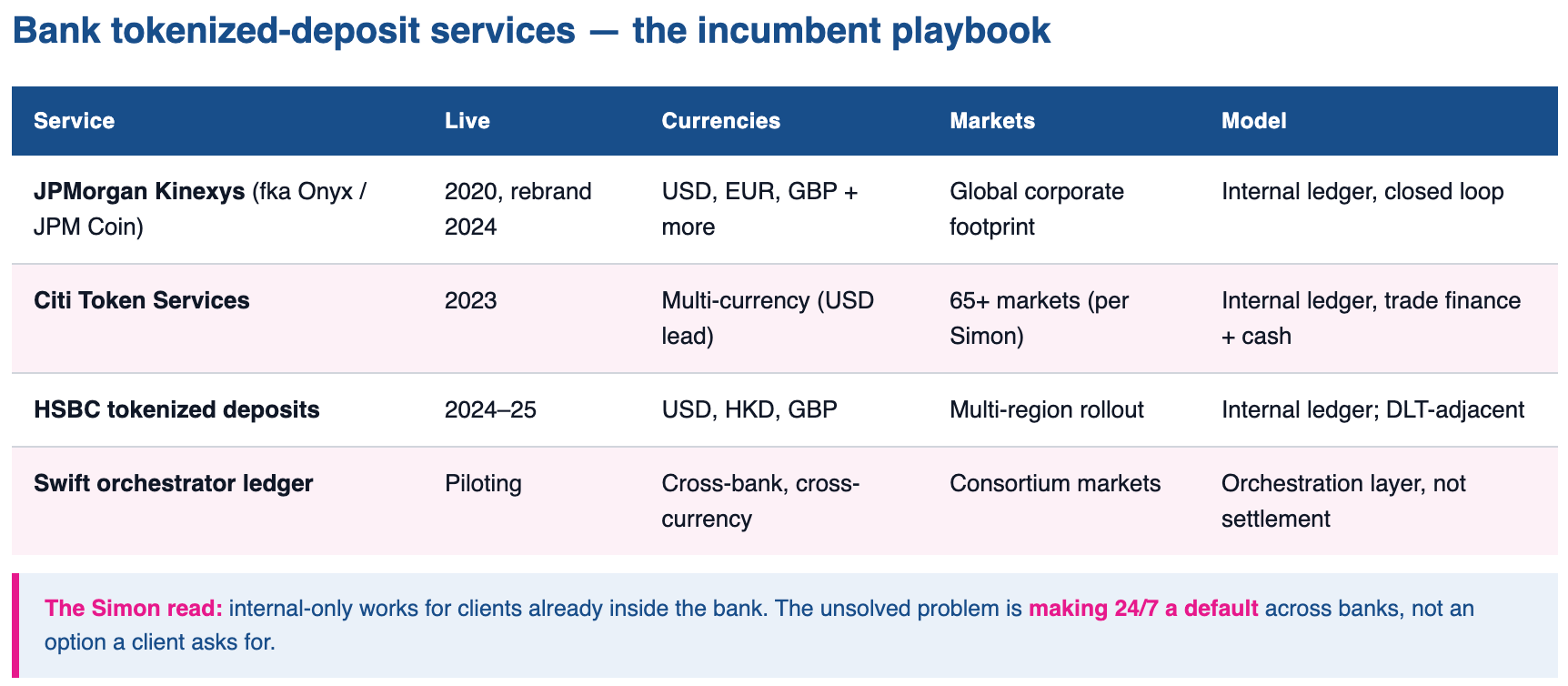
Ledger is probably a poor name for what Swift has built there. And again, if your whole universe is locked into those specific banks, then that can kind of work, and it’s live. The big problem is getting that beyond the clients that have asked for it. And I think this is where we’re stuck right now — how do you make 24/7 a default versus an option that a client has to ask for?
Lex Sokolin:
So, I like that you unconsciously or subconsciously answered that question on behalf of Swift. I’m asking it also about Stripe. So, for Stripe, as at this point an incumbent with existing merchant footprints and so on — how does the company think about it? Is this a manufacturing story, a distribution story, a savings or a revenue story? What is the DNA of why Tempo exists?
Simon Taylor:
I should disclose I work for Tempo, but I don’t work for Stripe. I wouldn’t want to say I’m speaking for them. But fundamentally, I think the listeners for some time have recognized that finance is globalized, it’s not global. You have to do the painstaking work of going market by market and building distribution in each single one of them.
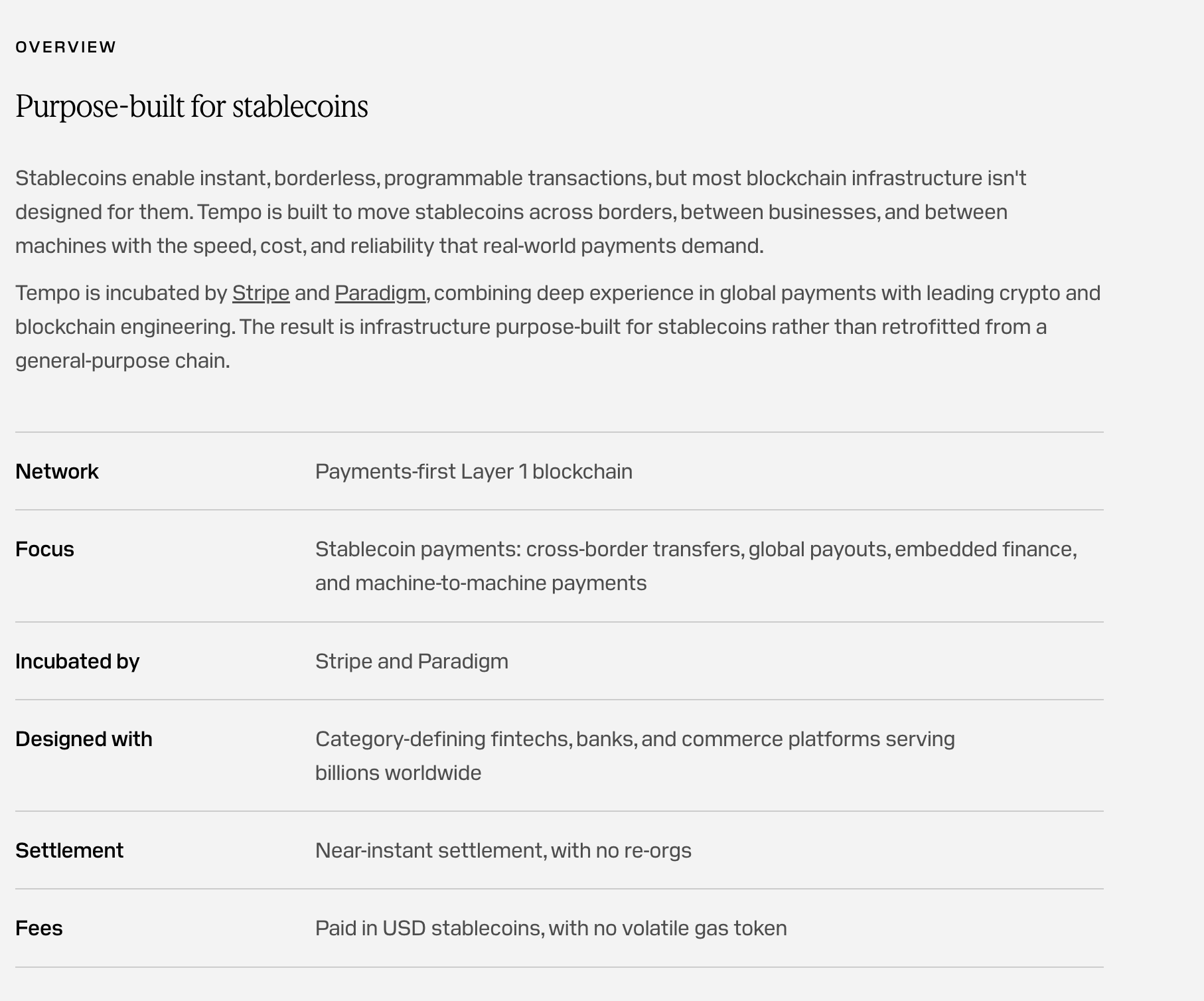
And when Patrick Collison called stablecoins superconductors for money, what he was really talking about is actually — Henri Stern of Privy, who put it best — stablecoins have this wonderful ability to be instant, 24/7, and global. They just have one problem: getting in and out of them is really hard. It’s a little bit like getting into orbit — it’s really painful to get there, but once you’re up there, you can move around the entire planet extremely quickly and with very low friction, and then you’ve got to get back down again.
So, Stripe with its distribution can distribute stablecoins kind of everywhere. But then you go look at it as a builder, as a company that’s obsessed with engineering, and you notice that there’s all of these little paper cuts with various different chains. You have to build your own account abstraction. You have to build embedded wallets. You have to pre-fund things. You have to deal with gas fee volatility. And you have some chains that don’t have five nines of uptime. And you have other chains that have a whole bunch of custom smart contract code that you need to build in a custom language that’s new to you, like Solana, to make it work the way everything else does. And so, this is why Bridge exists, and they do a good job with that.
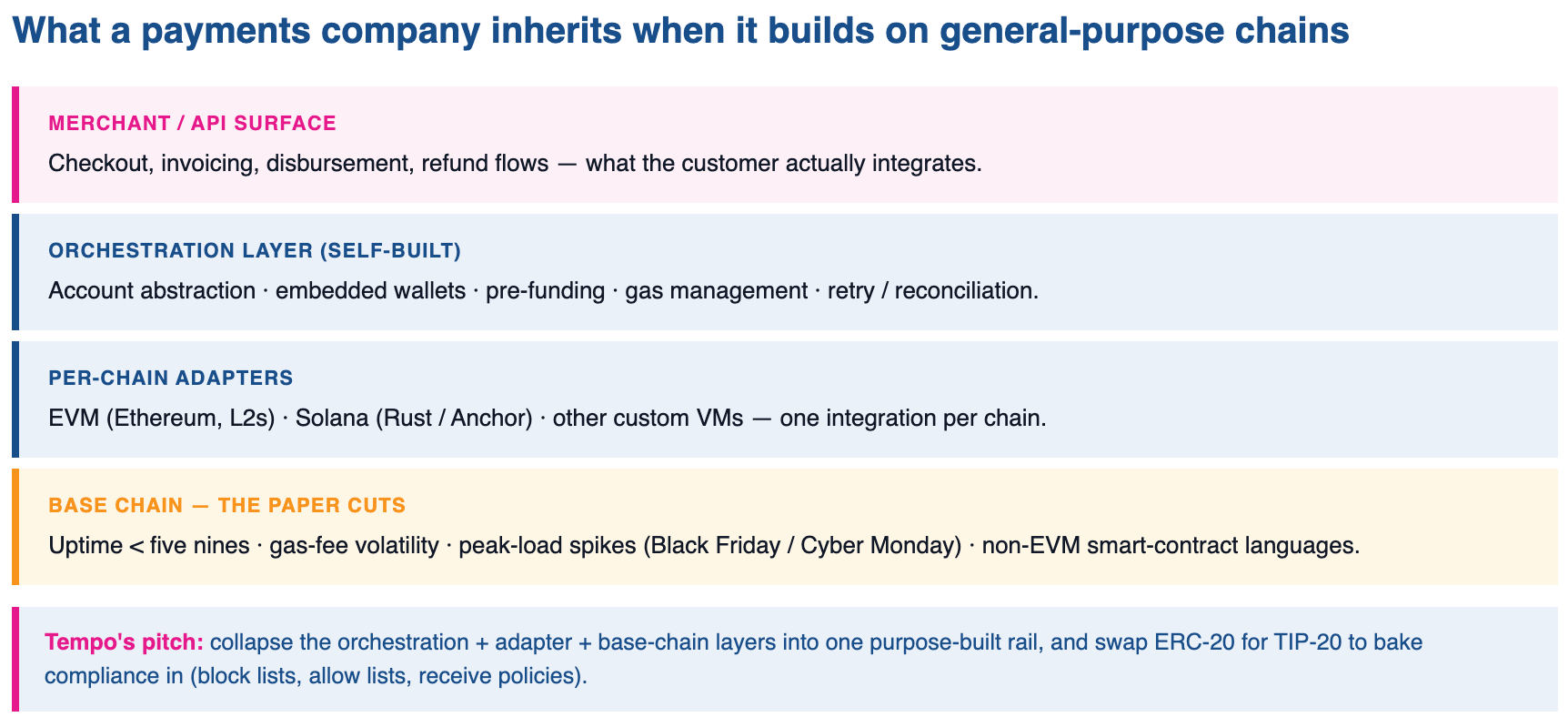
But really, if you look at it as a payments person and go, what would you want from a payment system? It needs to be incredibly reliable, incredibly fast, incredibly resilient. During Black Friday, Cyber Monday, during peak load — the transaction volumes are enormous and would break pretty much any other chain, and you’d see gas fees spiking. So you need an incredibly fast, performant, resilient chain. And that was the impetus behind Tempo — hence the name. Hence some of the features, like upgrading ERC-20 to TIP-20, to have the ability to bake in block lists and allow lists, to have the ability to also add your own compliance functionality in there if you want to.
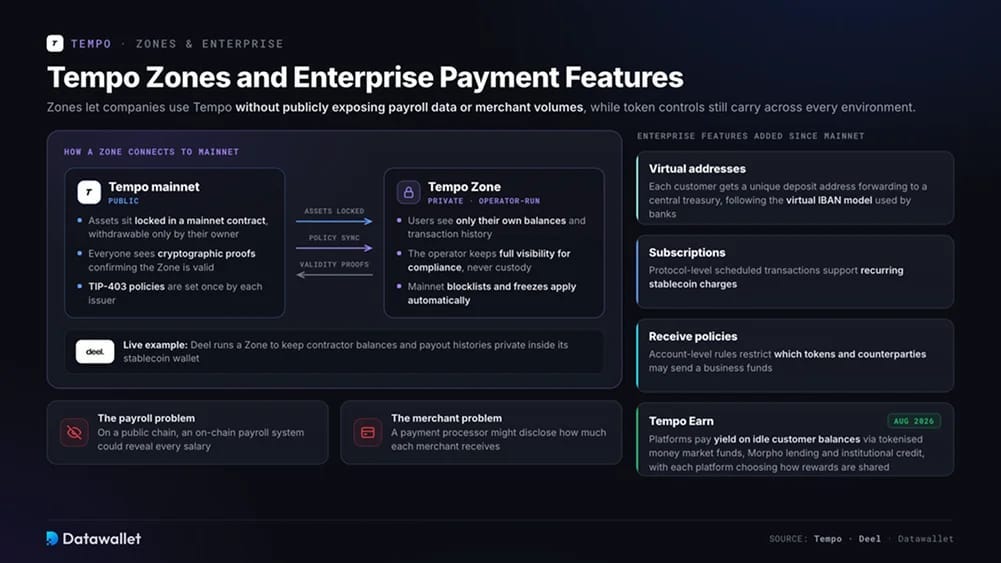
And so, what you have is a kind of best of both worlds. It is permissionless — anybody can create a token; anybody can create a wallet. Your adversaries can technically use it. But also, you can go on there and choose to have a receive policy that says, “I will never receive a token from a sanctioned wallet.” So serious grown-up enterprises look at that feature set and go, okay, so it’s finally ready for us. We can start to use this. All these things that we worried about in the RFP before start to go away. And Stripe looks at it and goes, okay, right now we don’t have to spend all of our time maintaining all of these different bits of connectivity to all of these different chains. If we just use this, our lives get a lot easier, our customers’ lives get a lot easier, and potentially our commercials improve too.
Lex Sokolin:
So, is something like Tempo a digital transformation moment for web-two payments fintech? Or is it a tool to get things done? Or is it the third-rail network that we’re going to see at scale as things grow up? What’s the ambition?
Simon Taylor:
So, it’s a little bit of all of those and none of them in that. Yeah, it’s obviously a tool. It’s obviously an upgrade on having to build infrastructure market by market, to have something outside the company that just runs independently of you and meets all of your requirements. But I actually think it’s something else. There is no Fedwire for the internet. There is no global settlement layer of the internet. And we have tried to build them, I think, in the past, for multiple assets, but they are so bogged down with what they were trying to achieve, they don’t actually work as a cash settlement chain. They don’t actually work if it’s pure settlement.
If you look at this as a payments pro and go, what do I want from settlement? I want it to be instant. I want it to be 24/7. But it also has to handle the thousands of edge cases that come along with settlement, and all of the weird compliance quirks. There’s an old friend of mine, Wade Arnold, runs a company called Moov — technically a competitor to Stripe — and he always said that payments are actually really easy. It’s like sending an email. The problem with payments is edge cases, and it’s all edge cases. There are so many tiny things that can go wrong that you won’t know until you try and build a payments business.
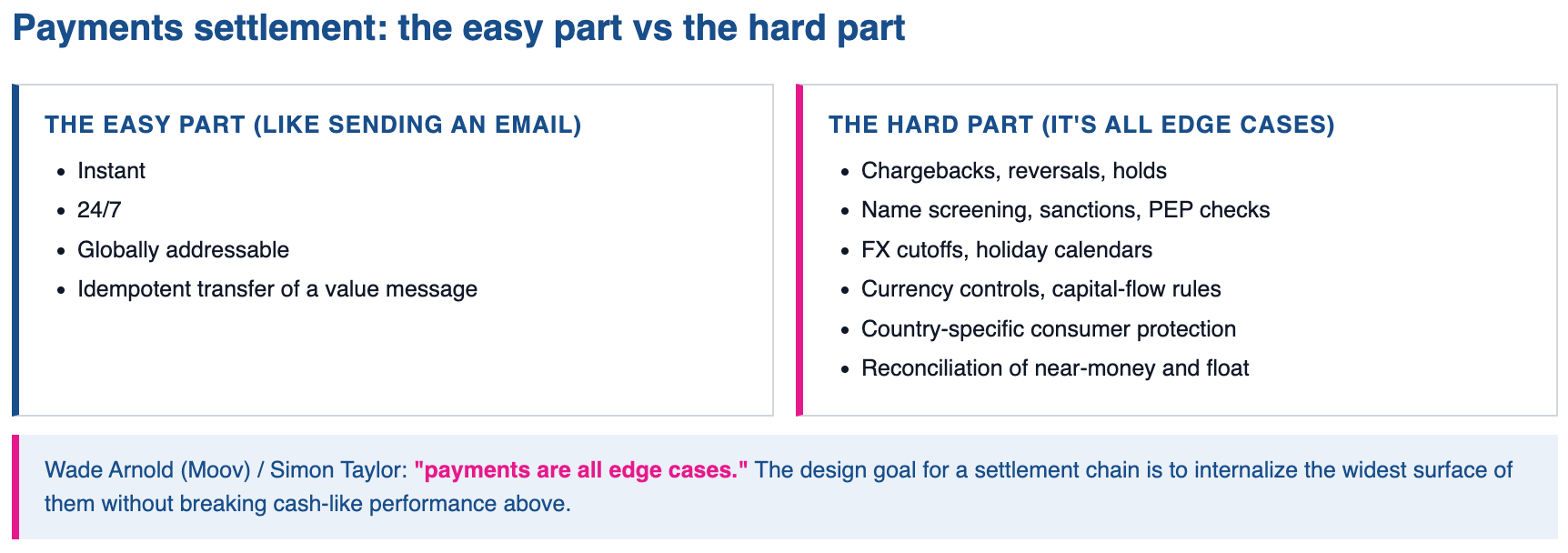
And I think this is really what we need — a settlement infrastructure that’s designed by people who have experienced the edge cases of payments and can go, well, this handles a broad set of those edge cases, and it’s extremely performant for settlement of cash-like transactions, regardless of what other economic activity is happening above that.
Lex Sokolin:
From the outside, there’s been sort of two stories, I think, about who the chain is for. I think there’s a lot of glue to the Ethereum and EVM ecosystem — nebulous glue, but glue nonetheless. But in terms of who it’s for, there’s, not a consortia, but let’s say the best web-two fintechs out there are with Stripe building and using. There’s an industry sector that has finally said, all right, let’s go all in on this. And that’s probably for commercial and market reasons.
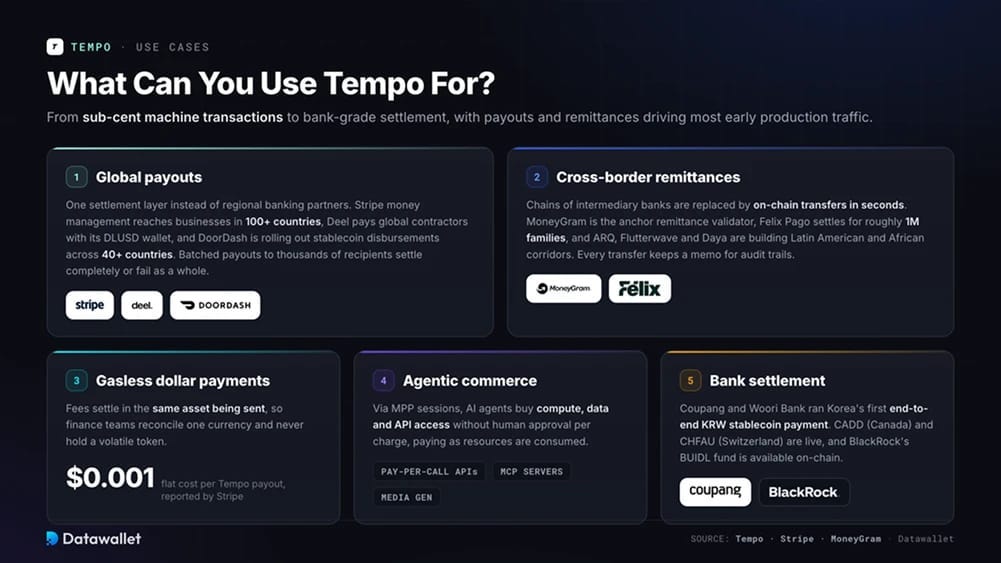
And then there is a second pocket of demand, and that pocket of demand is the AI agent story. Stripe is the payment processor for the hyperscalers and the big AI labs. So there’s kind of a natural crossover of saying, let’s create standards and protocols to preempt or to capture and be a good solution for a world where AIs are commercial agents on behalf of consumers, and people inside these LLMs doing things. So, are these the two main market segments that are in scope today, or is there more?
Simon Taylor:
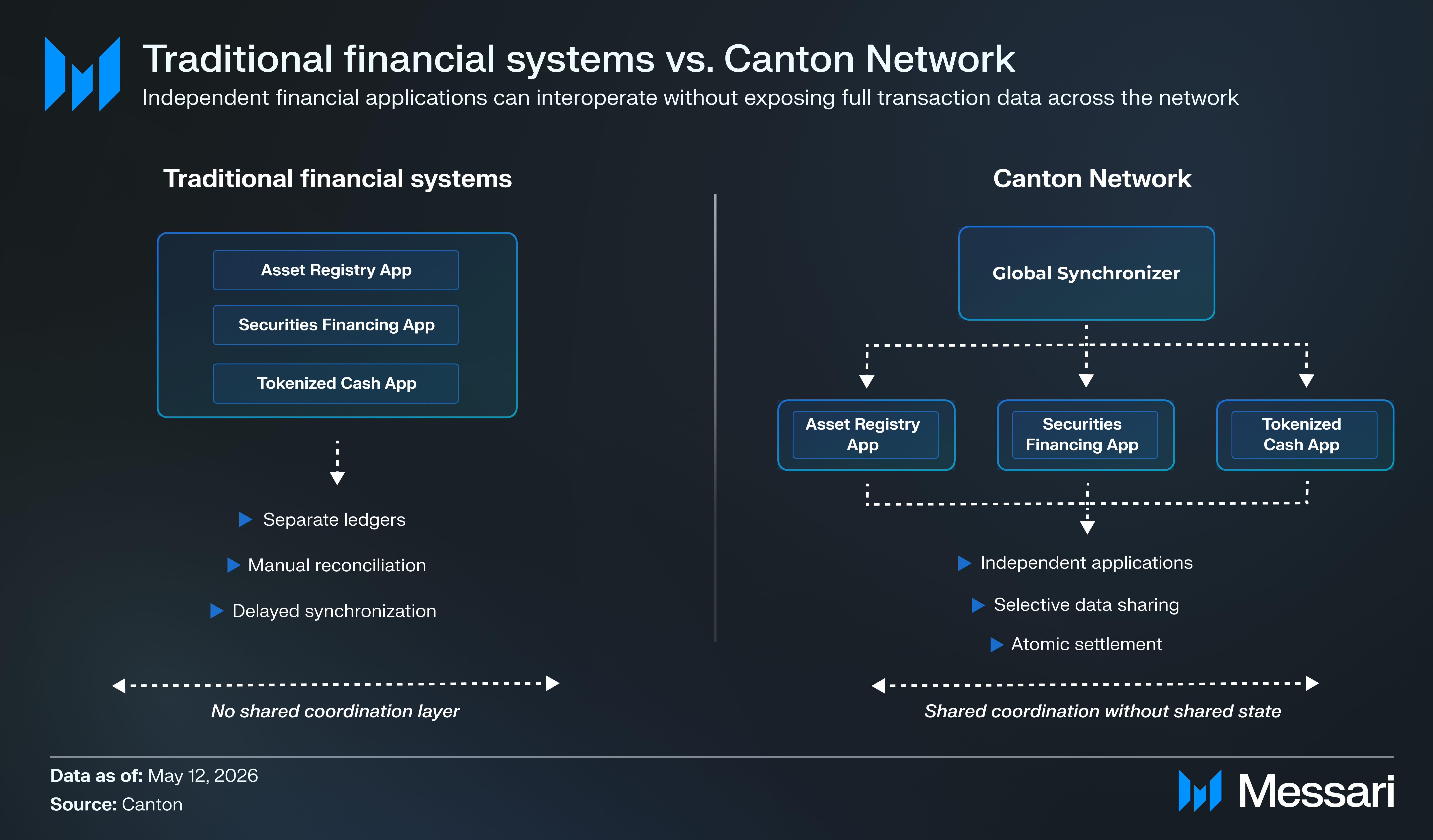
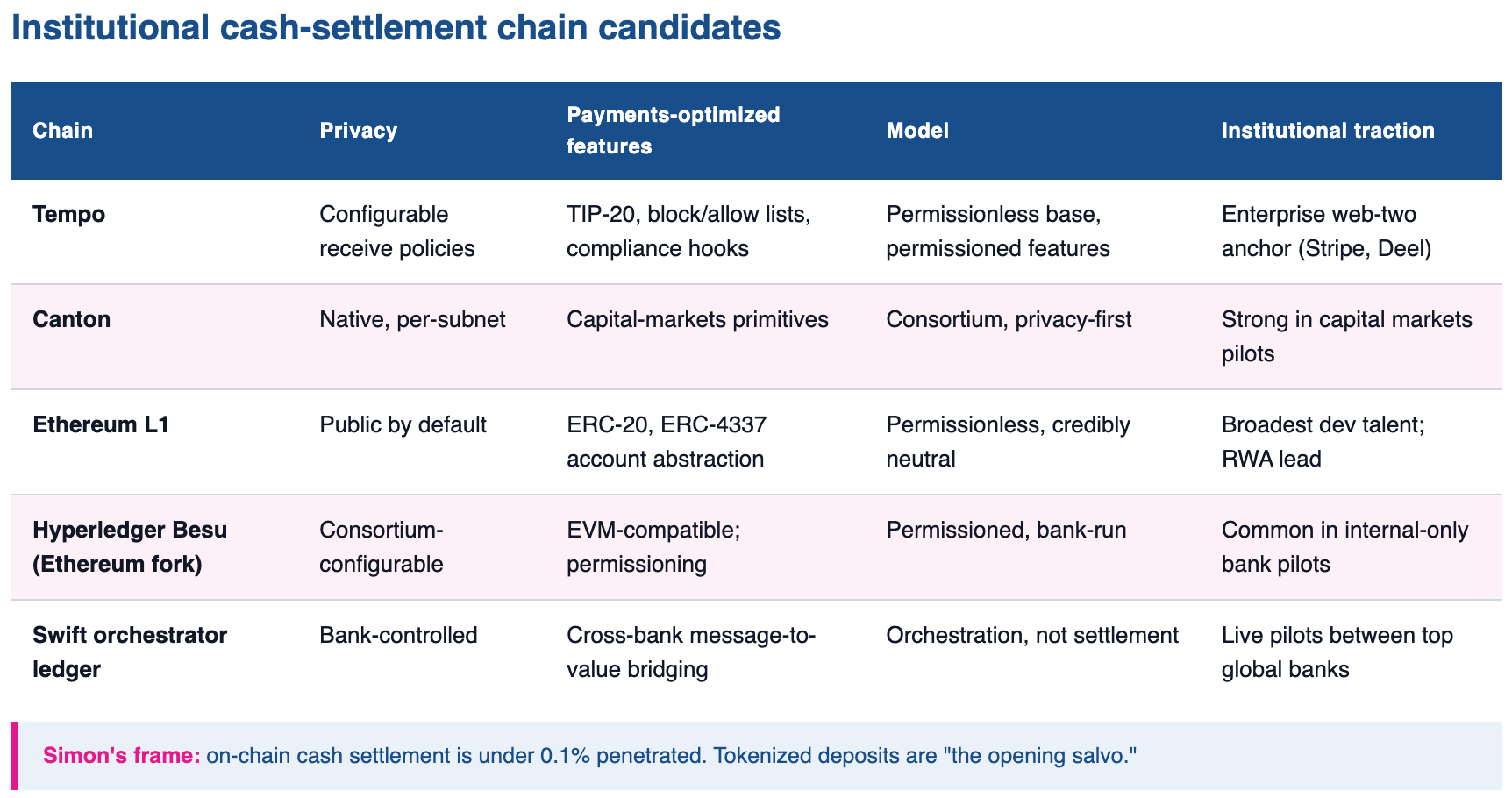
Yeah, there’s a third, which is TradFi. Well, actually there’s three — there’s startups. There’s several startups. You’d be surprised how many startups are like, “oh, Tempo, because I’m building from zero. I’m probably going to integrate with Stripe anyway. I might as well take this Tempo thing and just kind of get started that way.” I think there’s more work to do there to be startup-friendly, but you’re right to identify the squishy core here.
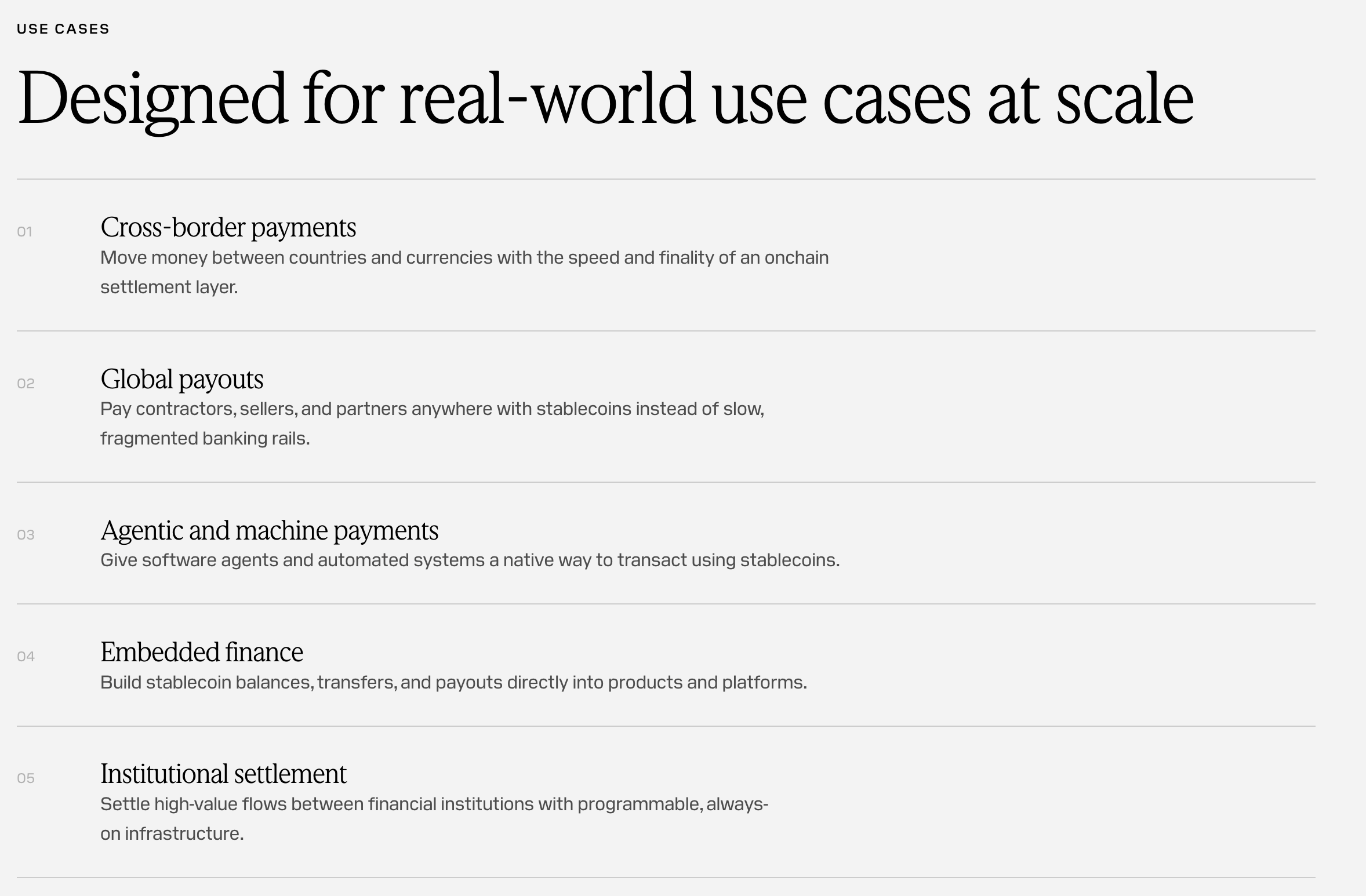
It’s the enterprise web2 companies. That’s the main focus. I think it’s also where the next wave of volume in stablecoins is coming from. And tokenized money, period, is not just scaled fintechs but any money mover — you know, like Deel is one of the biggest uses of Tempo, for instance. And they are naturally quite aligned to somebody like a Stripe, but they are multi-PSP. But Tempo makes a lot of sense for them because they live and breathe payments. A very high double-digit percentage of their revenue actually comes from payments. They care deeply about it. If you look inside most of these hyperscale companies, they all have a payments team that has gone deep into payments, has figured out how to get the most out of all of those thousands of edge cases I was talking about. And when you start talking to them about Tempo, they go, “oh, finally. This just makes so much sense. Thank you, guys. Where were you all this time?”
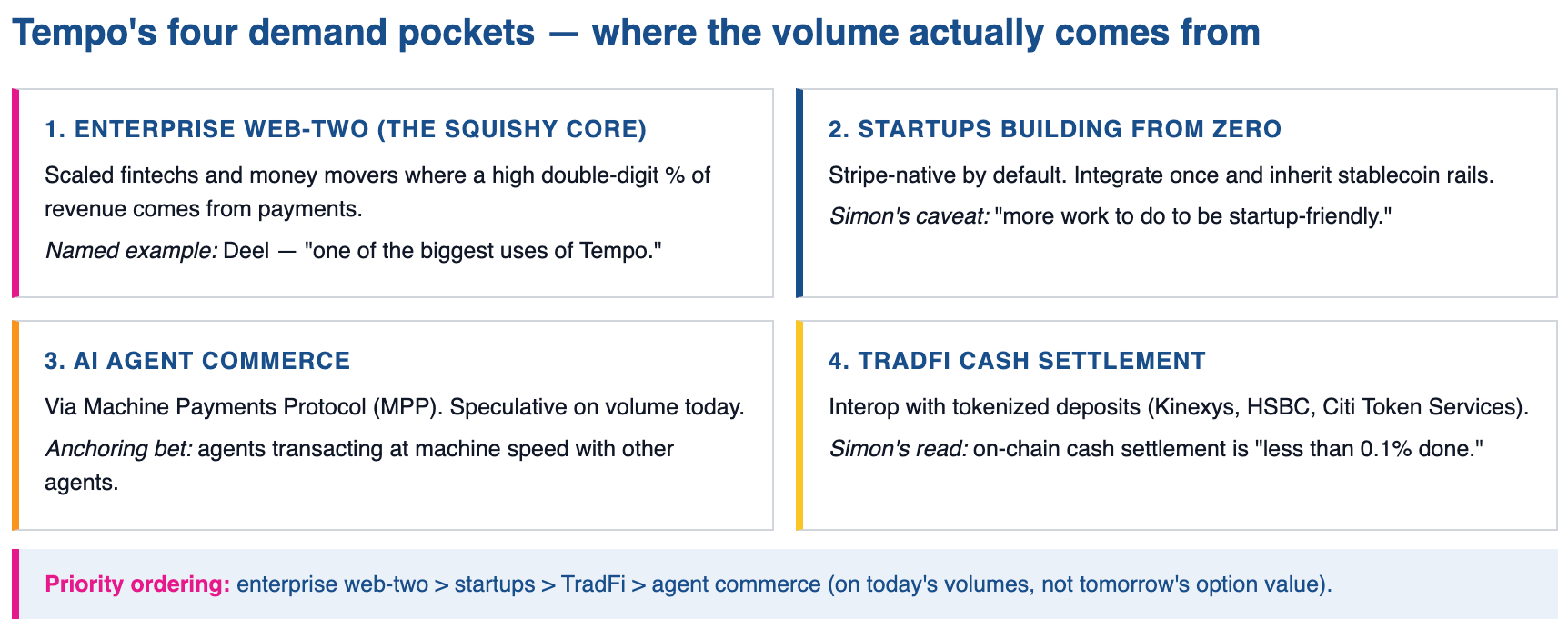
Then there’s the TradFi segment, which I think is really interesting. There’s a lot of momentum behind Canton. And they’ve done a really good job on the privacy narrative — you would say, versus an Ethereum, which has lots of competing privacy stories, Canton has one very clear one. They also talk the talk when it comes to capital markets, and I think they’ve done really well in some use cases and getting institutional adoption.
Then there’s Ethereum itself, which is tried and true and understood. A lot of institutions rightly start there because there’s a lot of developer talent that understands it, and there’s an entire ecosystem that exists around it. But there are a lot of trade-offs when it comes to actual cash settlement in financial institutions. So, what a lot of them do is they end up using a fork of Ethereum, something like Hyperledger Besu, and running their own version of that inside of a network. Maybe that’s not wrong, but it might not be right either.
And so, we’re finding — given we have quite a few folks on the team that come from TradFi backgrounds with deep payments experience — there’s a lot of R&D left to do. On-chain cash settlement is less than 0.1% done, and some of the early moves in tokenized deposits are just the early moves in the opening salvo. If you think about all of the settlement in all of TradFi — that, to me, is where I spend most of my time. It’s one area that I find endlessly fascinating.
And I think ultimately these things combine. Banks have their tokenized deposit services, and there’s a whole world of on-chain stablecoin payments for enterprises, and then there’s how all of that intersects. How does the stablecoin universe intersect with tokenized deposits? I think it does so on Tempo.
Lex Sokolin:
One of the difficulties is that cash can mean so many different things to different people. The capital markets people and the payments people are very, very different in terms of what they know and what they want. That’s always been, certainly at Consensys and in regards to Ethereum, a challenge. Even if you look at someone like a Coinbase — you look at their business, they’ve had a payment processing arm since the beginning, but trading is like all their revenue. So, I do think there’s a big hole in terms of pulling payments in and using stablecoins not just as cash sweep in a brokerage account but also as a payment’s mechanism. I do think there’s lots of blue ocean there.
If we bring the lens back to the sort of hype moment around the big AI labs and AI agents — there’s a really strong story which I had believed, and I still think I believe, that there’s a huge consumer behavior change where search is being replaced with people talking to their robots, and then the robots do things for you. And one of the things that they do is commerce on your behalf. And parts of that story came true — we all do talk to our robots and we give them tasks and they loop. It’s just like the macros in the Excel that you’re talking about. But parts of that story are taking a bit longer.
What is your view? And I guess, in part, Tempo’s view on where the AI agents are, whether they are doing commerce on-chain, whether they want stablecoins or cards — how do you think about that?
Simon Taylor:
Yeah, let me answer that in two parts, because there’s Simon’s view and then there’s Tempo’s view. And as you know, Simon’s view tends to be somewhat independent of whatever. But I think there’s a great deal of overlap between the two.
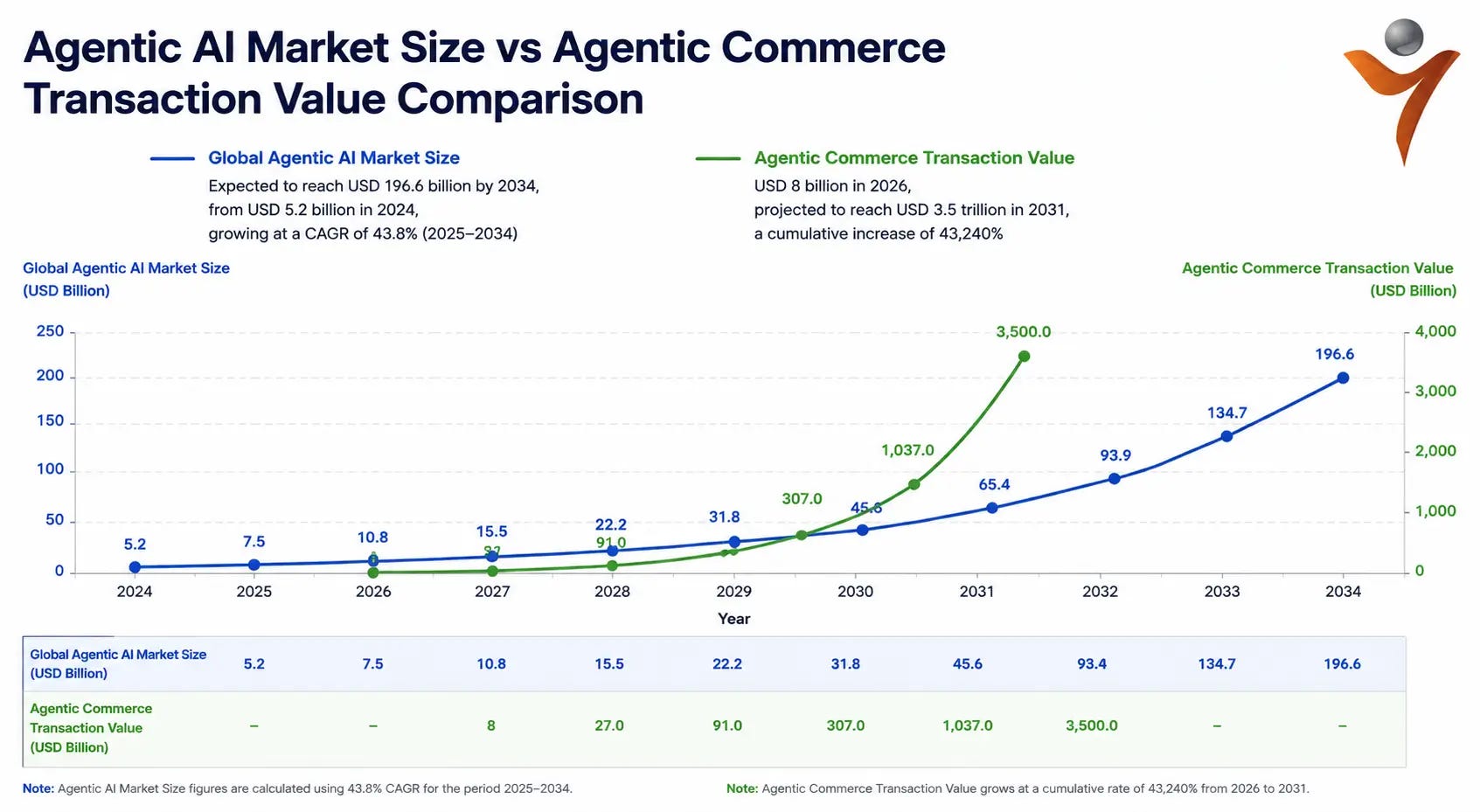
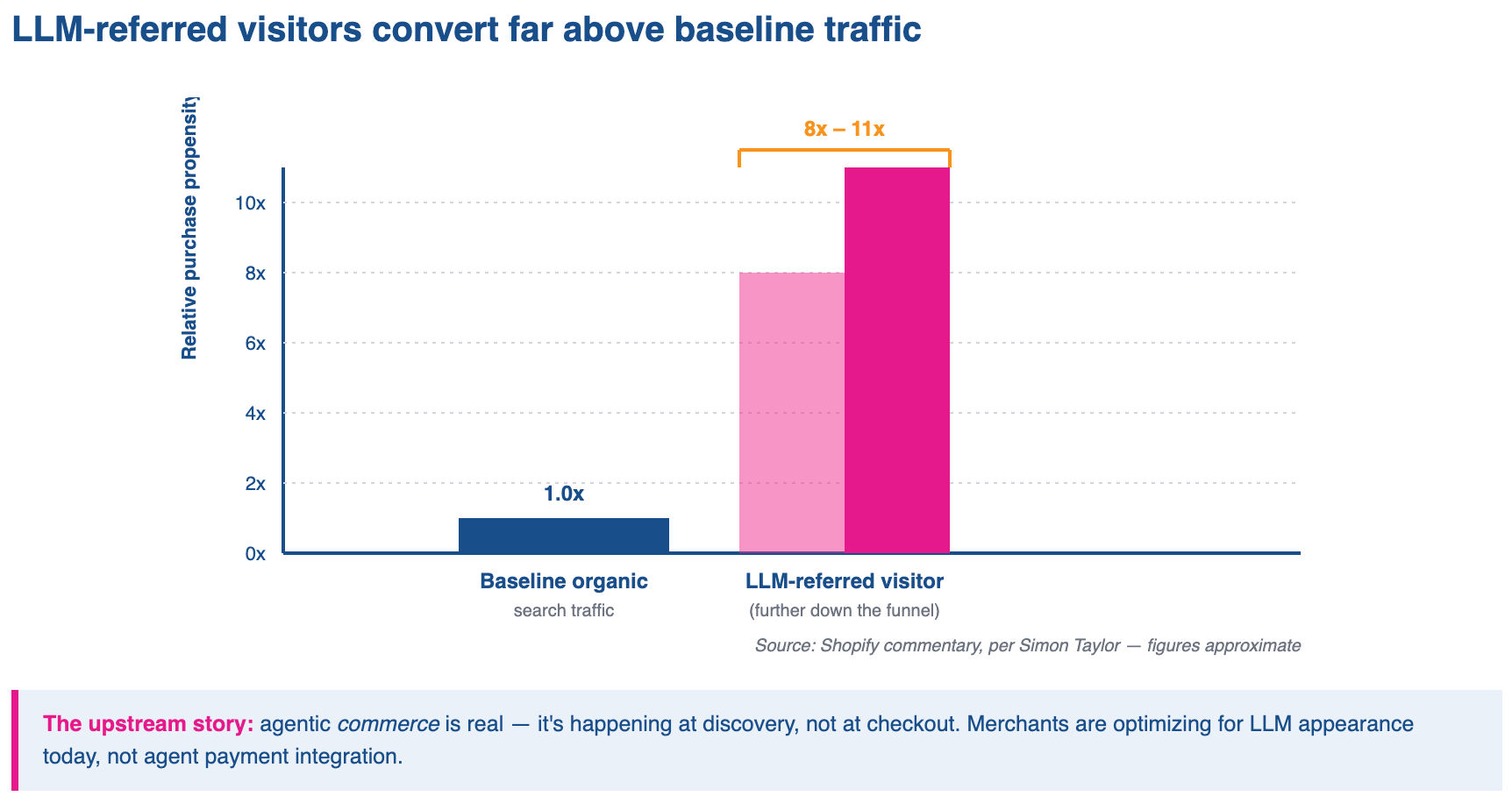
So, I have observed, as Simon, that the dirty little secret of agentic commerce is nobody’s paying for things with agents. All of the activity is upstream in search, exactly as you said, and discovery. And what most merchants are doing is trying to figure out how they appear better in search. Shopify and Adobe have some really good data about how much better that is converting, because somebody that lands from an LLM is further down the funnel. They’re not just starting their research — they’ve done their research, and their propensity to buy is anywhere between 8x and 11x higher, according to Shopify. Don’t quote me on those stats, but it was in that ballpark. So that’s really good. That’s technically commerce. It might not be payments, but it’s commerce. So that’s a useful signal.
Visa and Mastercard are only just starting to roll out their intelligent commerce and agentic commerce stacks, so it’s going to be a while before merchants even integrate this stuff. And who are they going to integrate it with? Target has said that anything your agent buys that you think you didn’t, you’re 100% liable for. And they’re not going to issue any support, any chargebacks or refunds. Walmart and Amazon both block third-party agents because they look like a threat. They look like fraud. So, how’s this thing supposed to pay if it can never get through to the checkout in the first place?
Walmart also tried integrating directly with OpenAI, and they bundled the checkout inside of ChatGPT, and they found that conversion was worse than on their dotcom. The checkout in the chatbot converts worse. That is not the future of consumer experience. So, we’re in this sort of WAP-phone era of commerce, where the form factor isn’t quite right for agents paying for things.
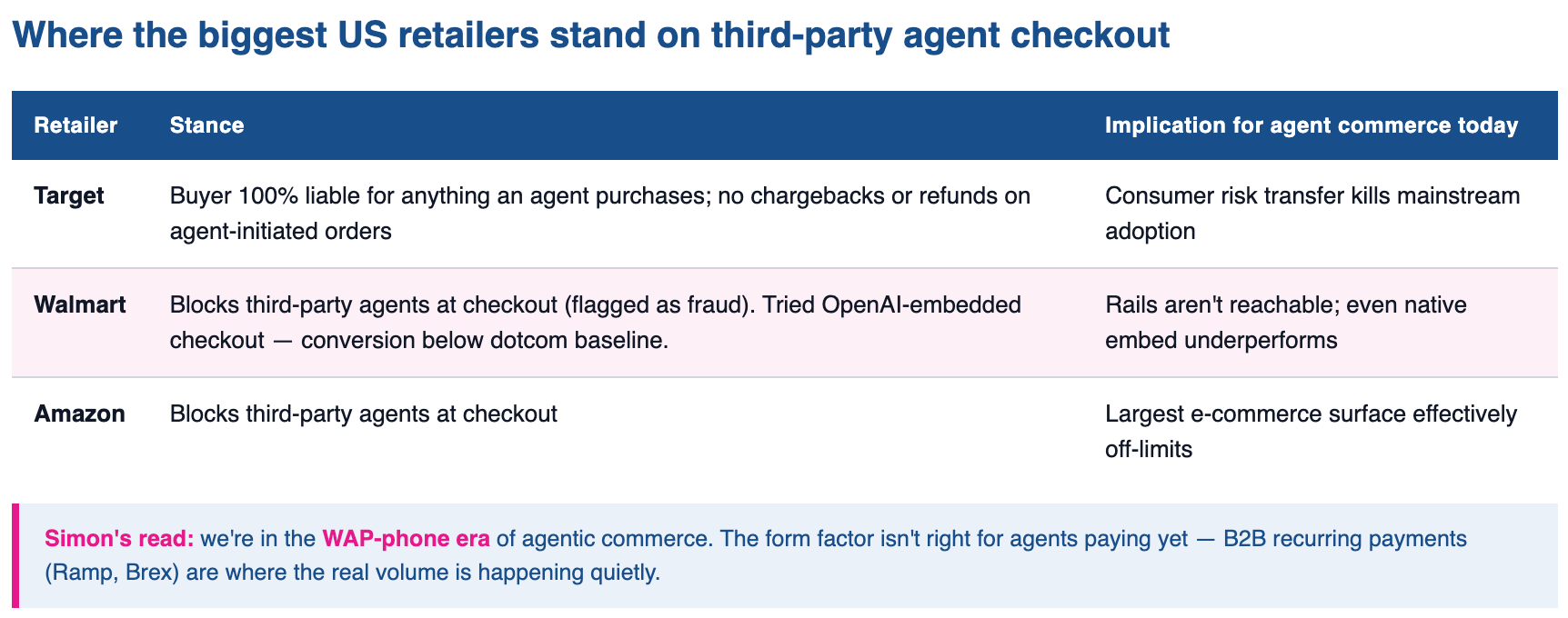
And so, we’re a little way off it on the consumer side. Where there’s a lot more activity is in B2B finance teams who have regular recurring payments, and will get a PDF landing into a mailbox that needs a payment to be made. Ramp supports that today. Brex has built that. There are startups that are supporting that, and that stuff is a lot more interesting. That’s where the volume is. That’s not really commerce, but it is generic payments. There’s stuff happening there that I don’t think gets anywhere near enough attention, and is really, really interesting.
But then — consumer-to-business, business-to-consumer, and then B2B — what about agent-to-agent, or agent-to-human, or all that sort of thing? Well, right now all of that is happening with cards. If you were going to give your Claude Code instance something, if you’re going to give your Codex instance something, you’d probably give them a virtual card. Even that volume is pretty low, but that’s happening. A card is a pretty good solution for an agent that needs to go buy a thing — but it can only buy that thing that works on cards today. I don’t need stablecoins for that.
Where this starts to change, and where Tempo comes into the picture, is with the Machine Payments Protocol. There’s something like 4 million emails a second on the internet. There is absolutely no way that any settlement ledger, let alone Tempo itself, can do 4 million transactions per second. The scale and speed you need for machines to be able to transact at machine speed is much, much higher and much, much more abstract. So MPP — Machine Payments Protocol — is an IETF-grade protocol that’s been fully submitted as a draft, to work the same way the internet does. And if adopted by the IETF, would work in any browser, anywhere, at any time. It doesn’t rely on distribution.
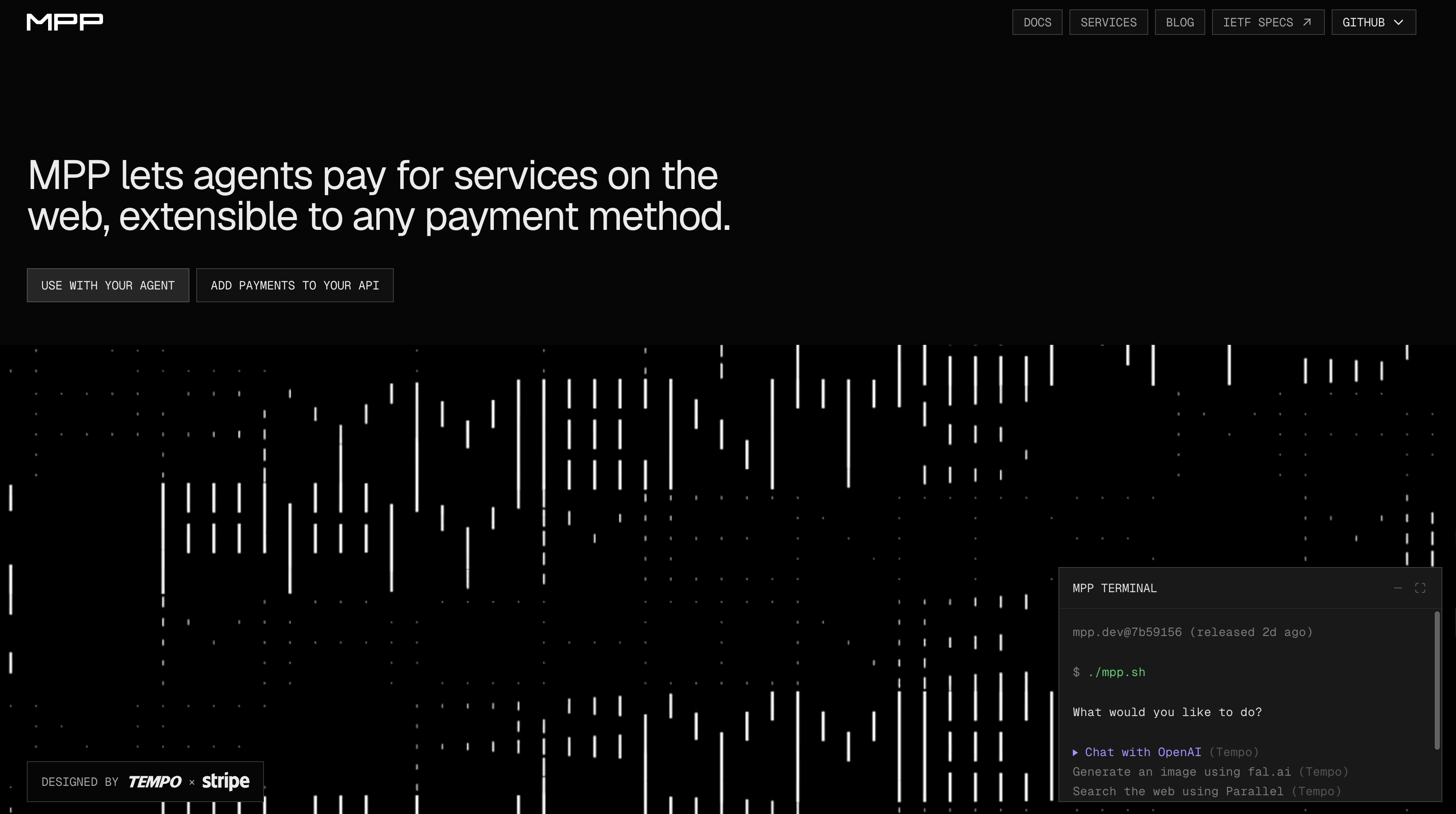
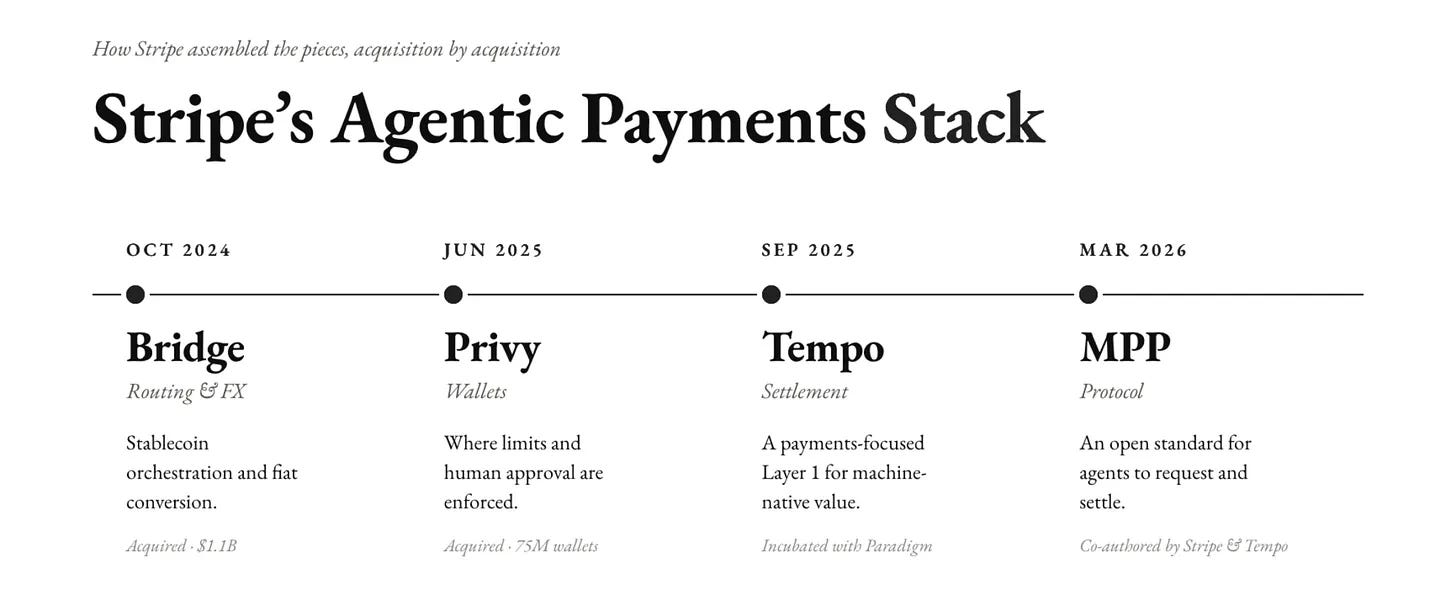
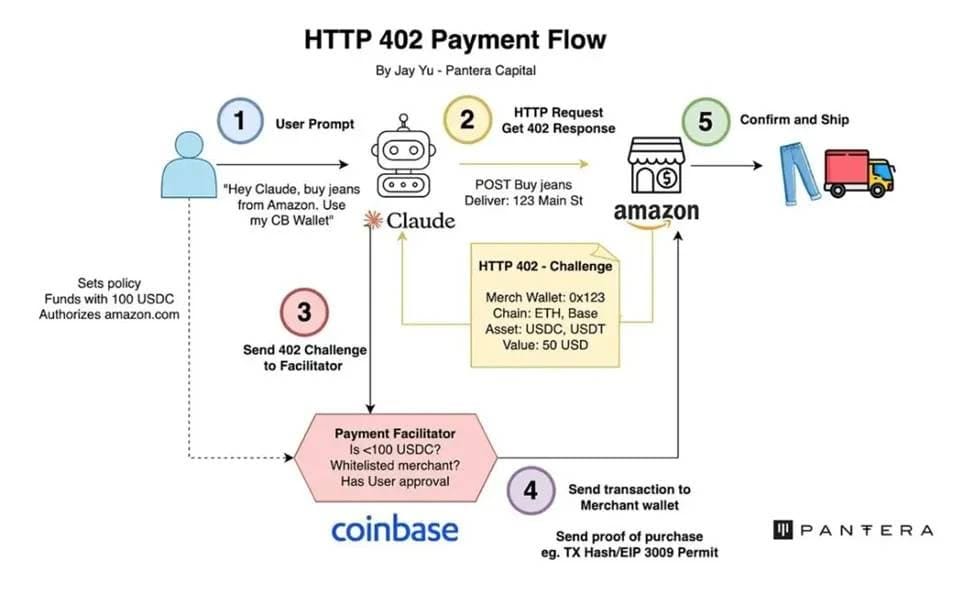
And what makes that so interesting to me is we intentionally built it so that you could settle Machine Payments Protocol transactions, yes, via Tempo with a stablecoin, but also via Stripe, but also via any Visa and Mastercard with any other PSP. And that’s really important, because if you look at the way originally x402 was built, it was designed to work with something called a facilitator. And that facilitator — the only one that was in town — was Coinbase. You could have other facilitators, but you had this reliance on this facilitator role. You make it much more neutral.
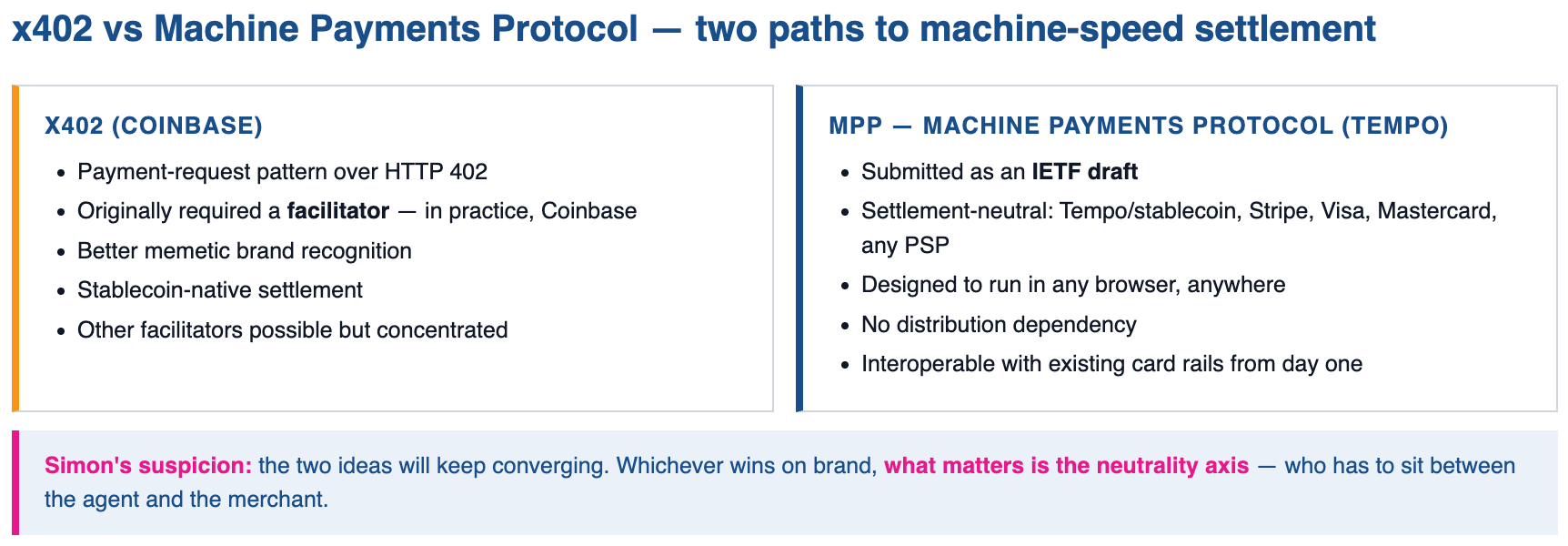
And my suspicion is these two ideas are going to continue to merge. x402 has a lot of memetic quality — it’s a better-known brand — but still, it sort of doesn’t matter which one of these things wins. You can imagine a world in which you need agents to transact at speed because of the nature in which they move, when they decide they need to go buy a thing. And when do agents have the agency to be able to go buy that thing? I don’t think anybody knows.
But if I zoom back out to why would somebody like a Stripe be interested in this — you can hypothesize that at some point in the future, it is at least plausible that agents will be buying things from other agents. You don’t know when that is, but AI has this annoying habit of going, it’s nothing, it’s nothing, it’s nothing — oh wait, SaaS apocalypse. Oh wait, DeepSeek version four is ten times cheaper than me. Oh wait, GLM 5.3 is here. It moves so incredibly quickly that you don’t want to get caught on the wrong side of that. And if anything, Stripe’s competitive advantage has always been the index toward what the developers are doing and what’s coming next. So you absolutely want to be on the front foot of that, even if there’s no volume today.
Lex Sokolin:
Yeah. What’s really bizarre to me, that I don’t think I’ve seen anywhere else before, is that you’ve got a market that everyone imagines — and, you know, as an investor, I imagine that market too, and we funded startups to go after that market. And then you’ve got Stripe and Coinbase both showing up to this market — you mentioned x402 and so on — and showing up in size, like billions of dollars of investment. And Stripe is a very different company from Coinbase, as well. So I wouldn’t have expected the two of them to be competitors in this way. But I also am surprised how quickly they’ve tried to gain ground here.
Simon Taylor:
Maybe. My understanding of the story — and I interviewed the guy behind x402 — is it started as a side project and it got popular. So that’s, I think, credit to the folks at Coinbase for getting behind something that showed promise and that was an interesting idea. They deserve all the credit in the world for doing that. But Stripe looks at it and goes, oh well, what if we did this? And sometimes it’s easier to build a thing than to try and change the thing that exists. So, you build a thing knowing full well that those things might need to merge, and you can have an open conversation too about those standards as they move forward.
So as an observer of those companies, I find them both fascinating. And my observation as somebody who spent a long time in global cash management and transaction banking — I’m going to Sibos this year. This is where all of the banks go to put their swords down and do business with each other. In financial services and in enterprise, when you reach scale, everyone’s your frenemy. You do business and compete with just about everybody around you, and companies of that scale have realized it.
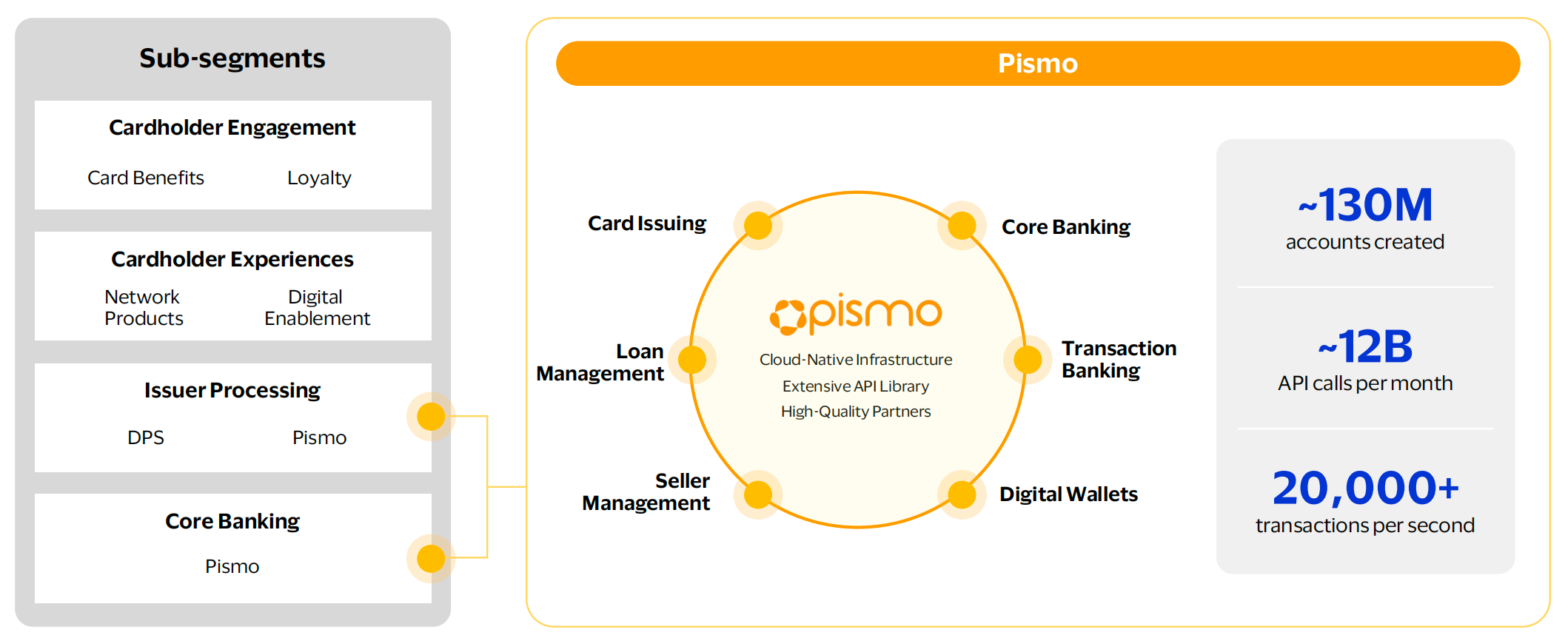
The master of this is Visa. Visa has Pismo, which is an issuer-processor business that competes with Marqeta and Galileo and FIS and some of their biggest partners. And Visa has always been very good at dealing with the uncomfortable frenemy situation. I think a lot of companies like Stripe and Coinbase are having to learn how to be that as they grow up into these $100 billion-plus market cap companies. That’s what you have to do. And then you have to start building things that are for the good of the industry, and you have to find places — Visa and Mastercard, for as much as they’re at each other’s throats, collaborate on standards unbelievably well, incredibly well, through EMVCo and others. So this is normal to me. It’s not surprising as much as it might appear so on the surface.
Lex Sokolin:
So one place we can take the fact pattern of the AI agents and commerce is that the idea that agents will do commerce on our behalf comes from the idea that the LLM is a chatbot where it’s a genie that exists to grant my wishes. It listens to me, it tells me things, it answers my searches, and like a search engine, it takes me to products which I buy. And it’s a very 2023, 2024 story. Things have shifted a lot, and the direction in which they’ve shifted is that actually these robots are extremely productive.
The thing they’re good at isn’t to be just a 1-to-1 counterparty to a person who’s got feelings and thoughts, but they are actually really good at the productive work. They’re generating film and media and text; now they’re generating code, arguably the most economic of all the things that they do. And increasingly they are turning into machine employees, and maybe entire parts of companies. You’ve recently published a report around how enterprises can integrate AI, and incorporate some of these best practices to actually build operating parts of the machinery of the business — which is a different way to think about it than “I’ve got this AI friend who does things for me.” Can you talk about that transition, that shift, what we’ve seen, and then maybe lay the groundwork for some of your conclusions?
Simon Taylor:
Anthropic has more than 500 enterprise customers that are in the $10 billion-plus region just in the US, and seven of the Fortune 10 that are spending at least a million a year on its products. And that goes back to March. So, imagine what that number is now. Outside of information technology, the fastest adoption comes from financial services.
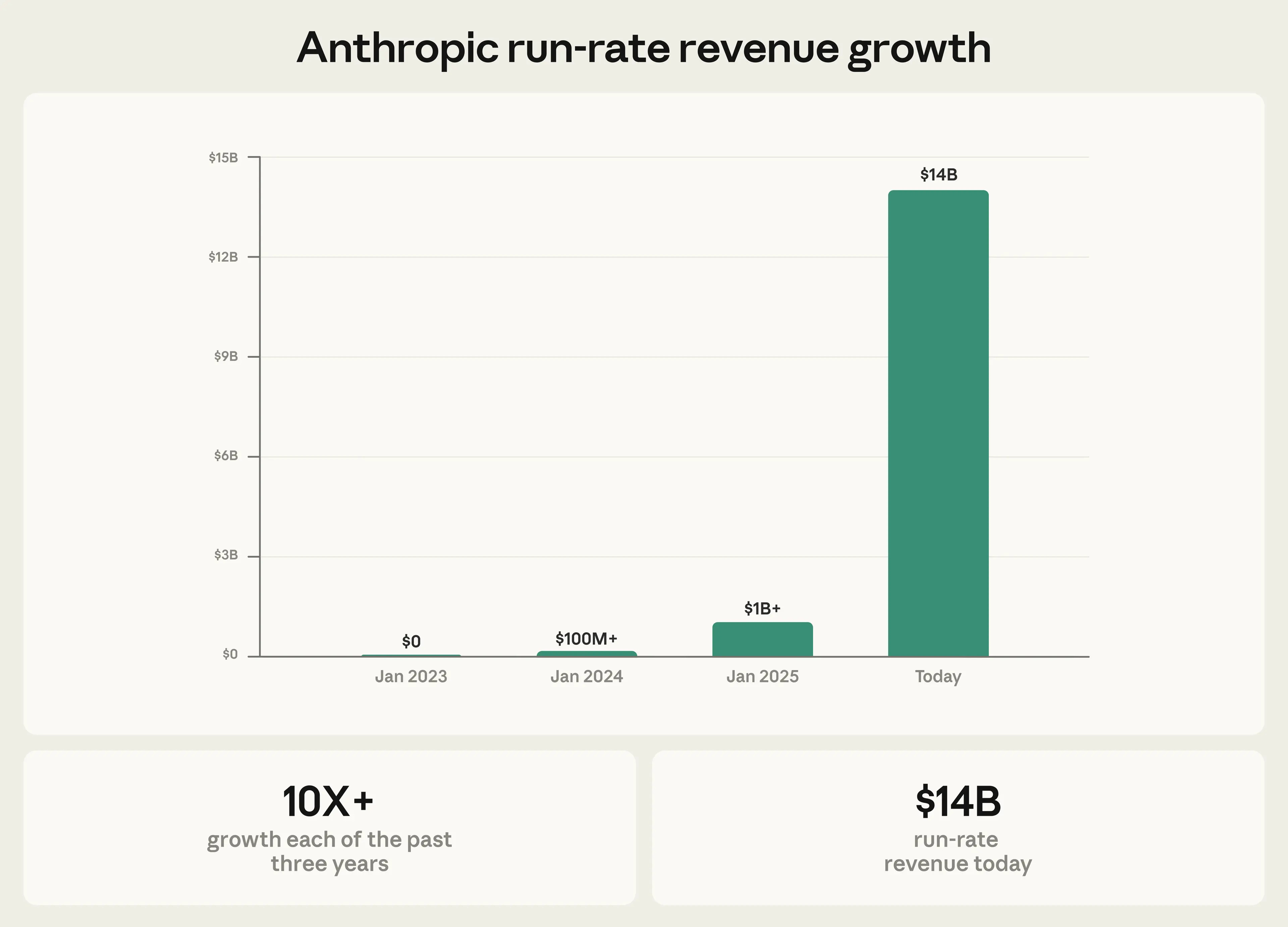
And there’s just one giant problem, which is the MIT survey of, I think, 6,000 executives said that while most companies use AI, nine out of ten are reporting zero productivity gain from it whatsoever. And you contrast that with data from Ramp that says companies that use AI more — so the MBA study, people were using on average 1.5 hours, but companies that use it much more and spend more on it have 2x higher revenue and require 40% less capital to scale their business. So, there’s something going on where there are some companies that can turn AI adoption into productivity, and then there’s most of them that can’t.
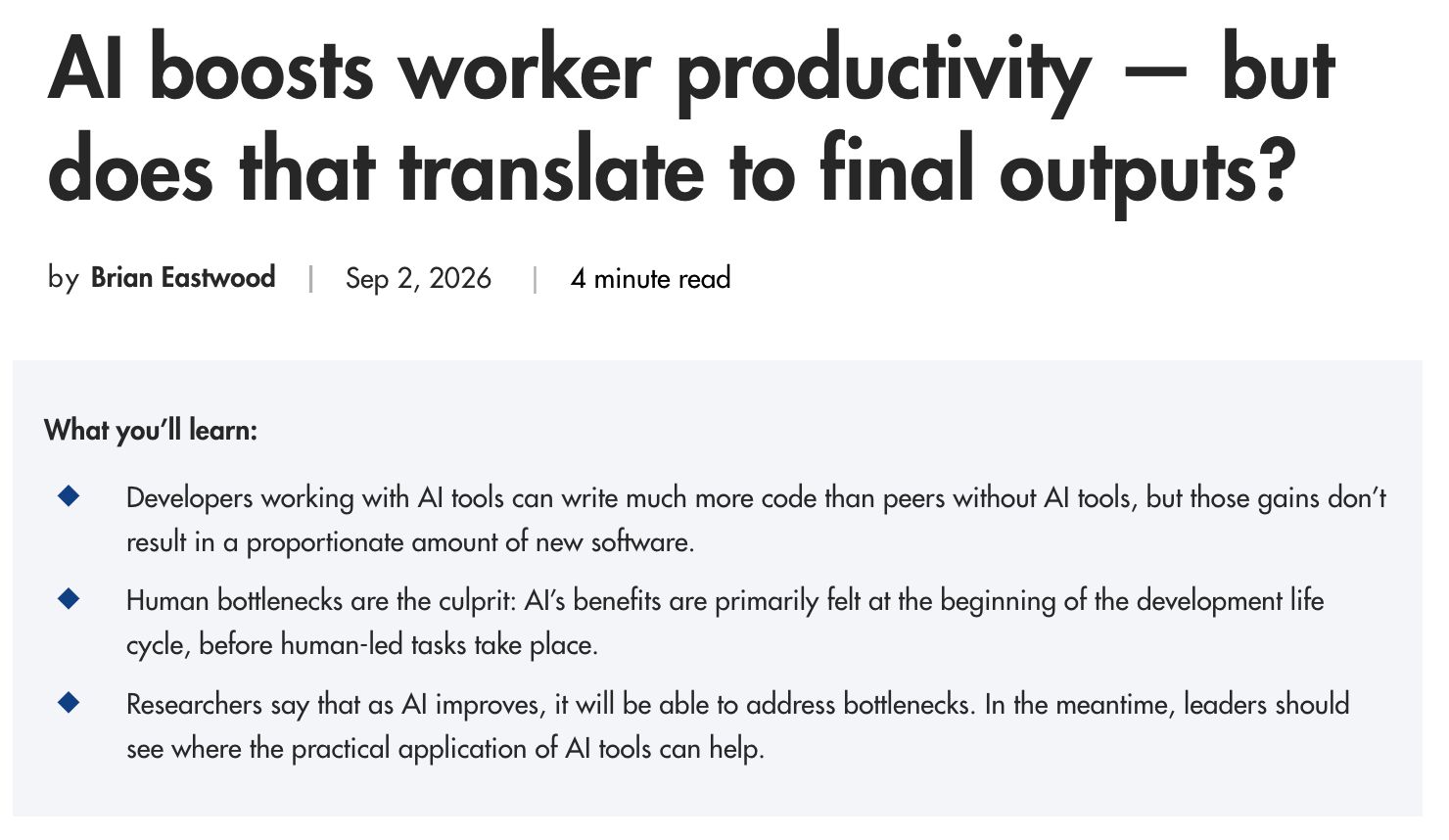
Based on those two data points, I was like, what’s going on here? So I went and had a look. It was really interesting. Ramp puts out a lot of blogs. Anthropic will tell you everything they’re doing across all of the podcasts. You can pull all of this information together.
Based on an interview with the head of product at Anthropic, they collapsed their product cadence from an average of about six months to somewhere between a day and a week, depending on how big the product is. And they have an internal feedback loop where they are constantly launching new products. There’s an always-on launch room where all research, previews, internal versions of the product are constantly updated. All of the user feedback comes in, and they have agents helping them parse that.
And they’ve found out that there’s a couple of things you need to do as a business to get productivity out of AI. Number one is you need AI evals as part of your culture. So think of this as like a micro-benchmark for engineering, or for research, or for legal, or for marketing, or for finance. You need to know that an output that came from AI was good, and you need another AI to be able to quickly measure that. That’s not something most organizations even know how to do. So their digital transformation with AI, if they’re not thinking in evals, is going to be limited. They can buy a product from Sierra, but they can’t understand how to see that productive benefit necessarily.
The other thing is you see all of these companies like Ramp and many others, they share skills. A skill is a little markdown file — a skill is a little file that teaches an LLM how to do a task. It’s like a really structured prompt. It could teach you how to do really good coding, or accounting, or marketing copy. Then you make a library of those, and you actually share them throughout the company.
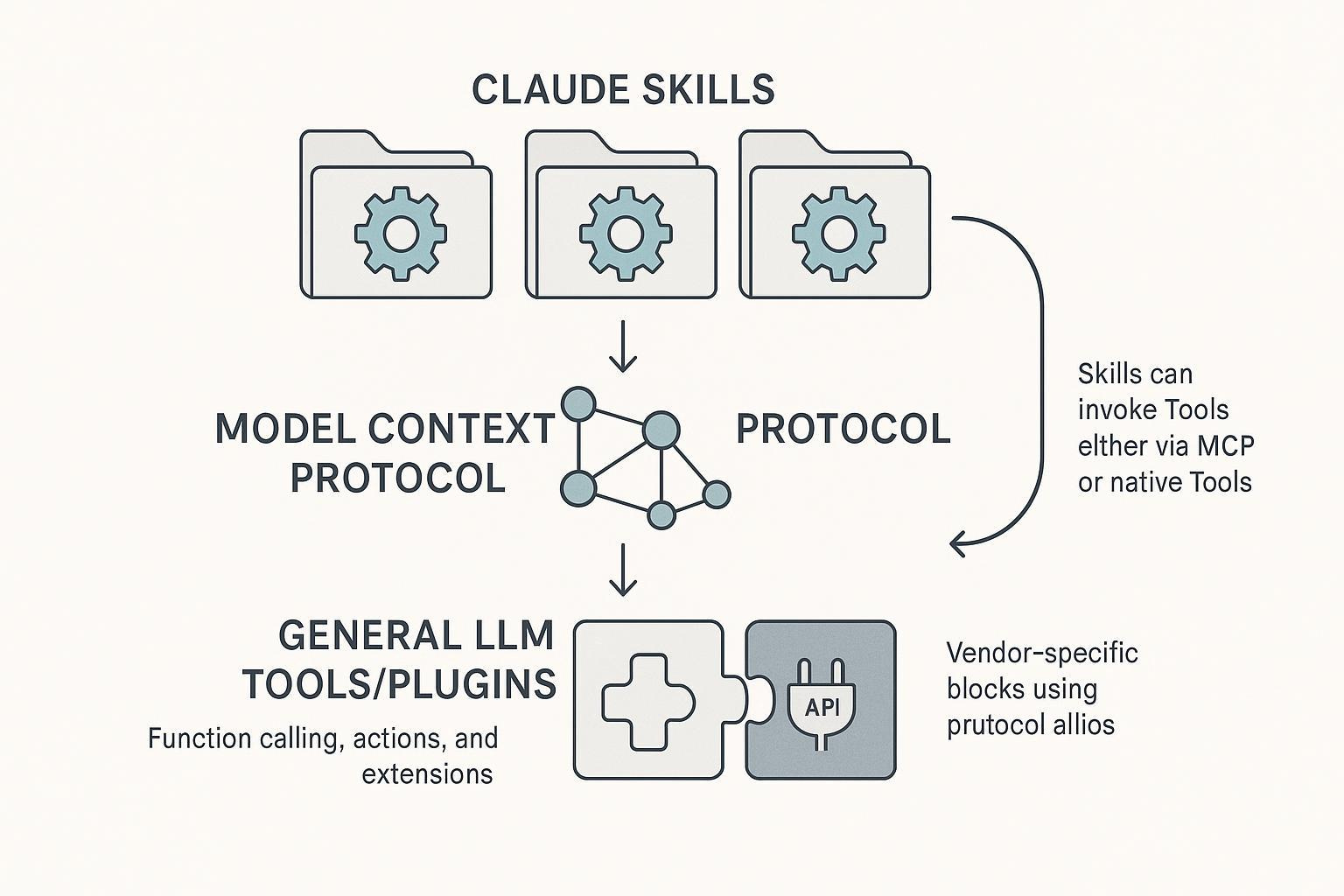
And then lastly, what you see as an output of this is that suddenly non-engineers start shipping production code. So sales and finance and ops teams build their own tools, instead of waiting for IT teams to get allocated and engineering teams to get allocated. So that’s really interesting.
In the whole report I talk about how Ramp has specifically benchmarked internal staff around their ability to do this stuff, how they built their own custom harness and wired it into all of their tools, and then some of the measurable results they saw. Just to throw some numbers at you: they’ve shared more than 350 skills across the company. Their harness has been built within less than three months. 84% of staff are using code and coding agents every single week. And 12% of all human-initiated pull requests come from non-engineers. Now, what does that do to your shipping velocity? What does that do to your ability to compete when more people can write code, and when the reviewing of the outputs is something that everybody who reviews things turns into a skill and an eval? I think that’s going to be really important.
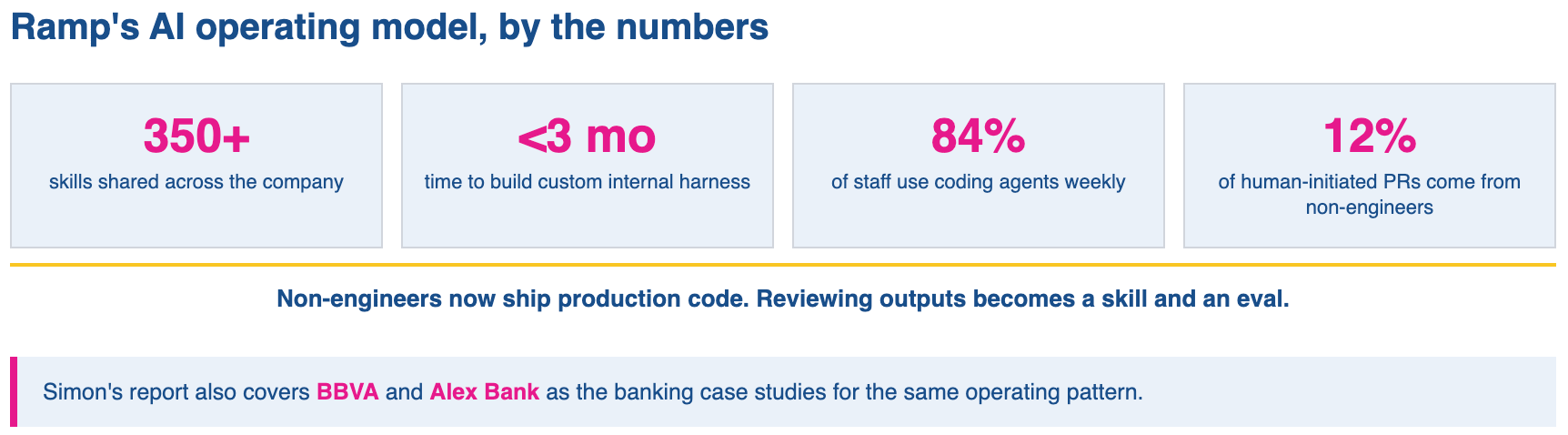
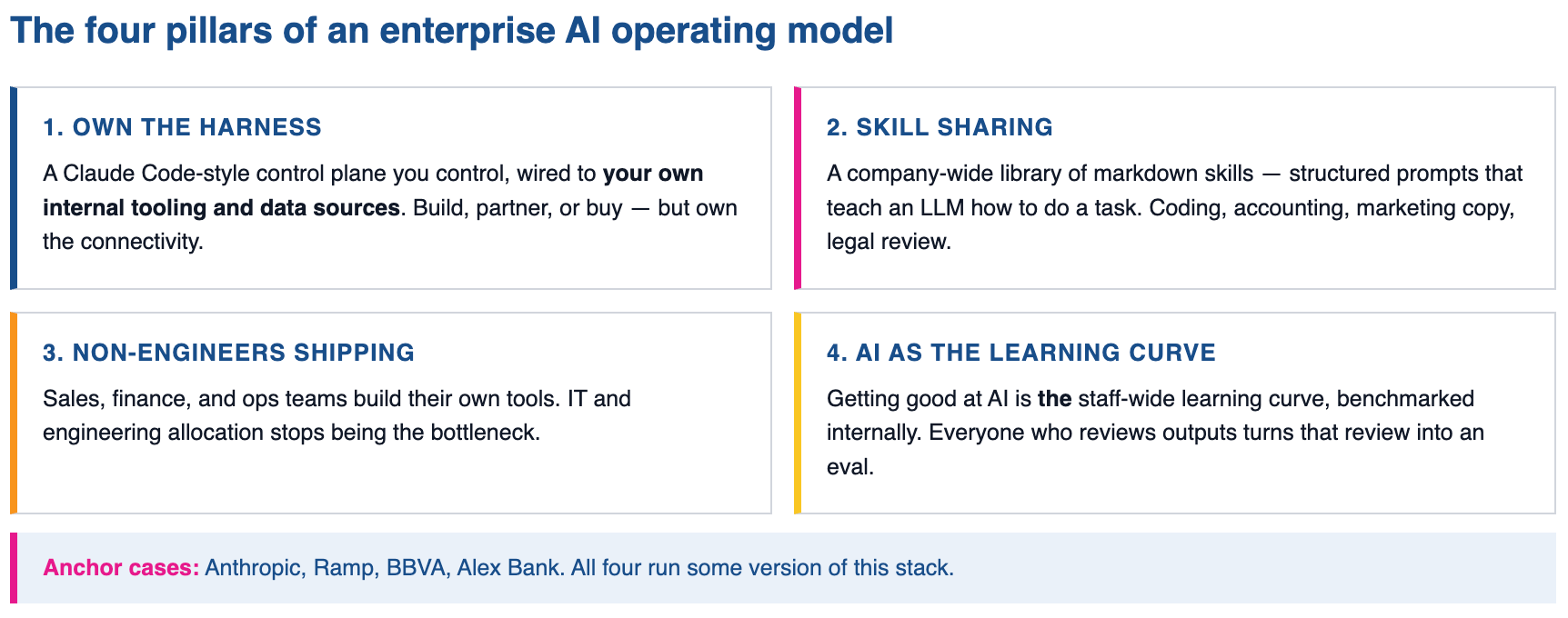
So, I cover multiple banks — BBVA and Alex Bank — in this report. But I think the conclusions for me were pretty — pretty can be summarized like this. You see that everybody that does this has their own custom implementation of a Claude Code-type of harness, or enterprise control plane. They’ve taken ownership of connectivity to all of their internal tooling and data sources. They’ve enabled skill sharing. They’ve enabled non-engineers to ship software. And they’ve treated getting good at AI as the key learning curve for all of their staff.
There’s a bunch of other things you can do around it, but if you take those four ideas — having control of your own data and how that talks to AI (number one); skill sharing; non-engineers shipping software; and AI as a learning curve — then you have the beginnings of an operating model where you can get value out of AI.
Lex Sokolin:
So, a couple of questions come up out of that. I think of the LLMs as sort of brain matter, like a toothpaste — you know, you squeeze it out from the toothpaste at your problem, and sometimes you fill up a little cup and sometimes it’s a whole bathtub of brain goo, at different rates, different flavors and so on. And then you’ve got the harness, which is, I think, just a hilarious image and word for it — but it’s sort of the skeleton on which you can add the brain goo and the muscles around it, the orchestration stuff and so on, to create an organism that resembles what you need. Some automata of your company, or your own workflows and so on.
And so I think there are these two directions. One is harnesses — people building harnesses. And one question is, are these things valuable as platforms, or are these things that each company should really be building for itself? We’ve seen the fashions turn so fast with harnesses — whether it’s Open Claude or Hermes, or before that it was Auto-GPT or AutoGen. Things are just churning through these fashions so quickly. But clearly the harness is important for something. Is that a place where you think there’s durable value?
Simon Taylor:
I think there’s durable value there. Whether you have to build it is questionable. I think you need one that you control. But whether you built it, I think, is a secondary concern.
Lex Sokolin:
The second place where I think a lot of people are spending money and attention is controlling the tubes of toothpaste. So, whether it’s OpenRouter or other companies that allow you to plug and play different models at different costs, there’s sort of like a router function that also connects to the harness. How do you think about — I mean, I’m mixing my biological metaphors — but all this goo coming together, is it yet another intermediate stage we’re going to blow through to something that’s still unknown? Or are we approaching the asymptote, and this is sort of the shape?
Simon Taylor:
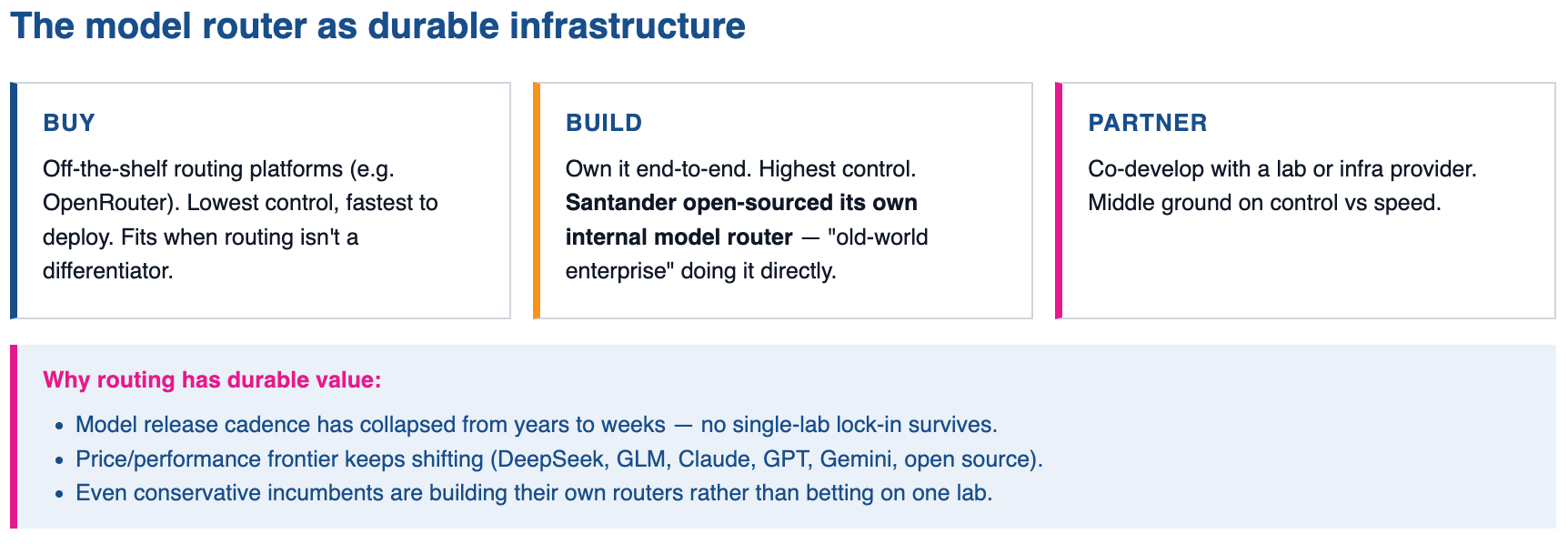
So it’s a buy-build-partner question. And that always depends more on you than the market. Like, if you can build it, do it. If not, then you probably want to partner and buy in. Those are your options. And all of those are good options depending on the level of commercial control you have over it.
But that routing function, I think, has durable value too. I can’t see a world in which there is just one model. The rate these things get upgraded and improved is just unlikely. There’s a view, maybe 2 or 3 years ago, where people were signing OpenAI enterprise deals for multiple years, and it made it easy because they were the Microsoft. They’ll just sign a deal with them, and they’ll provide everything, and they’ll do all the data governance, and everything’s easy. Now I look at Santander, who’s released open-source versions of their own internal model router. So, they have directly built it themselves. And that’s like an old-world enterprise by a lot of measures. So don’t be surprised if you get surprised. But I do think that’s very important.
Lex Sokolin:
Simon, thank you for a fascinating conversation. If our listeners want to check out the report or learn about you or about Tempo, where should they go?
Simon Taylor:
You can check out FintechBrainFood.com. It’s pinned near the top of the page. If you want to get hold of me, you can get me at simon@fintechbrainfood.com for all things related to my talking-head job. And Tempo is at tempo.xyz, and simon@tempo.xyz if you want to talk to us about better cash settlement for any type of payment flow.
Lex Sokolin:
Absolutely. I think everybody should go check out Brain Food. And thanks again for joining me today.
Simon Taylor:
Thanks, Lex.
Postscript
Sponsor the Fintech Blueprint and reach over 200,000 professionals. 👉 Reach out here.
Read our Disclaimer here — this newsletter does not provide investment advice
For access to all our premium content and archives, consider supporting us with a subscription.


