

Hi Fintech Architects,
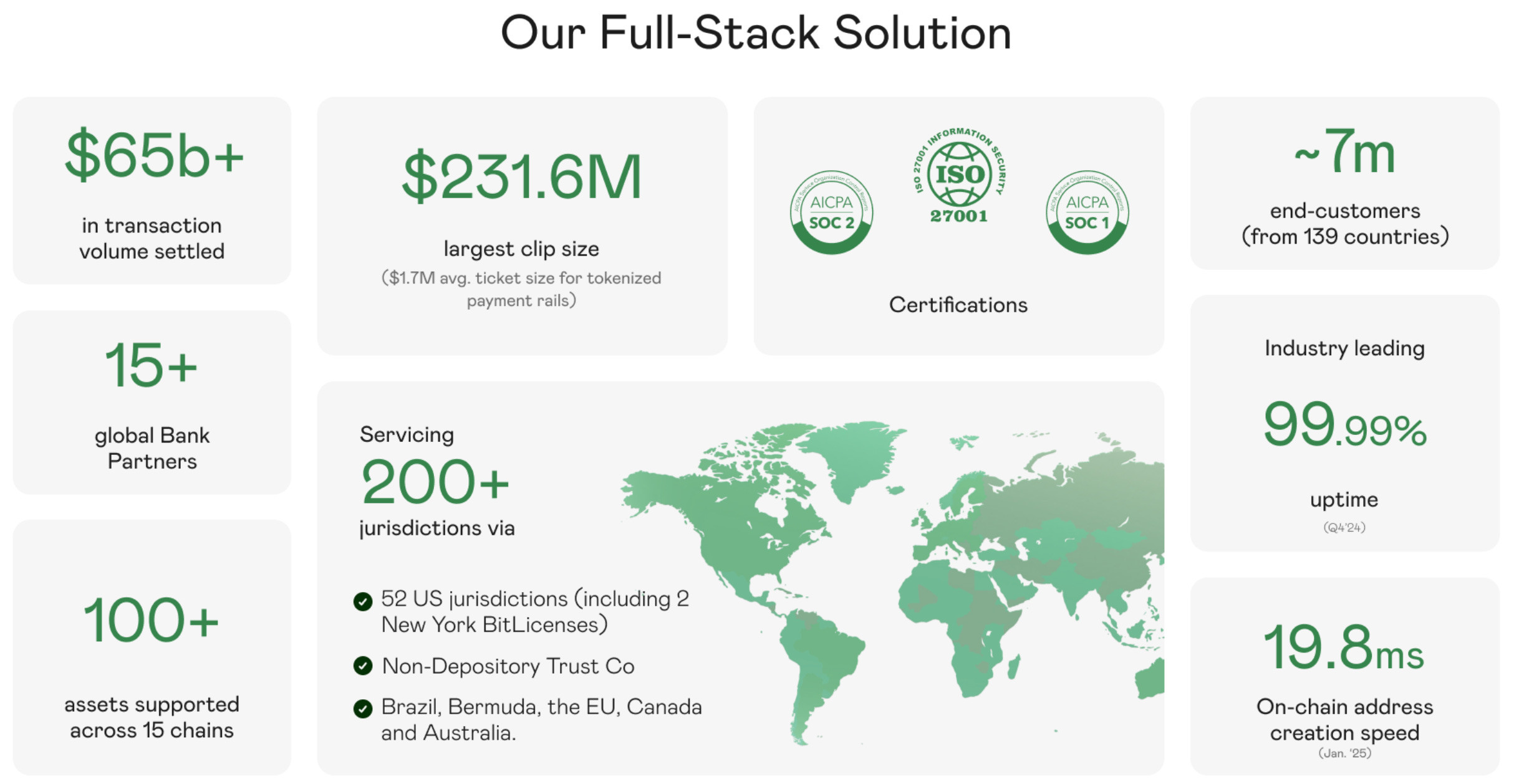
In this episode, Lex chats with Edward Woodford — Founder and CEO of zerohash, a crypto and stablecoin infrastructure platform that lets banks, brokers, and fintechs embed digital-asset trading, payments, and tokenization through a single API. Four years on from their last conversation, zerohash has settled over $65 billion in volume across 7 million customers, gone global under MiCA and EMI licensing in Europe, and onboarded institutions like Morgan Stanley.
They discuss the pivot from embedded crypto to pure-play B2B infrastructure, and why the product zerohash actually sells is trust — with licensing treated as a bar, not a goal — in a world where state actors are now the primary threat.
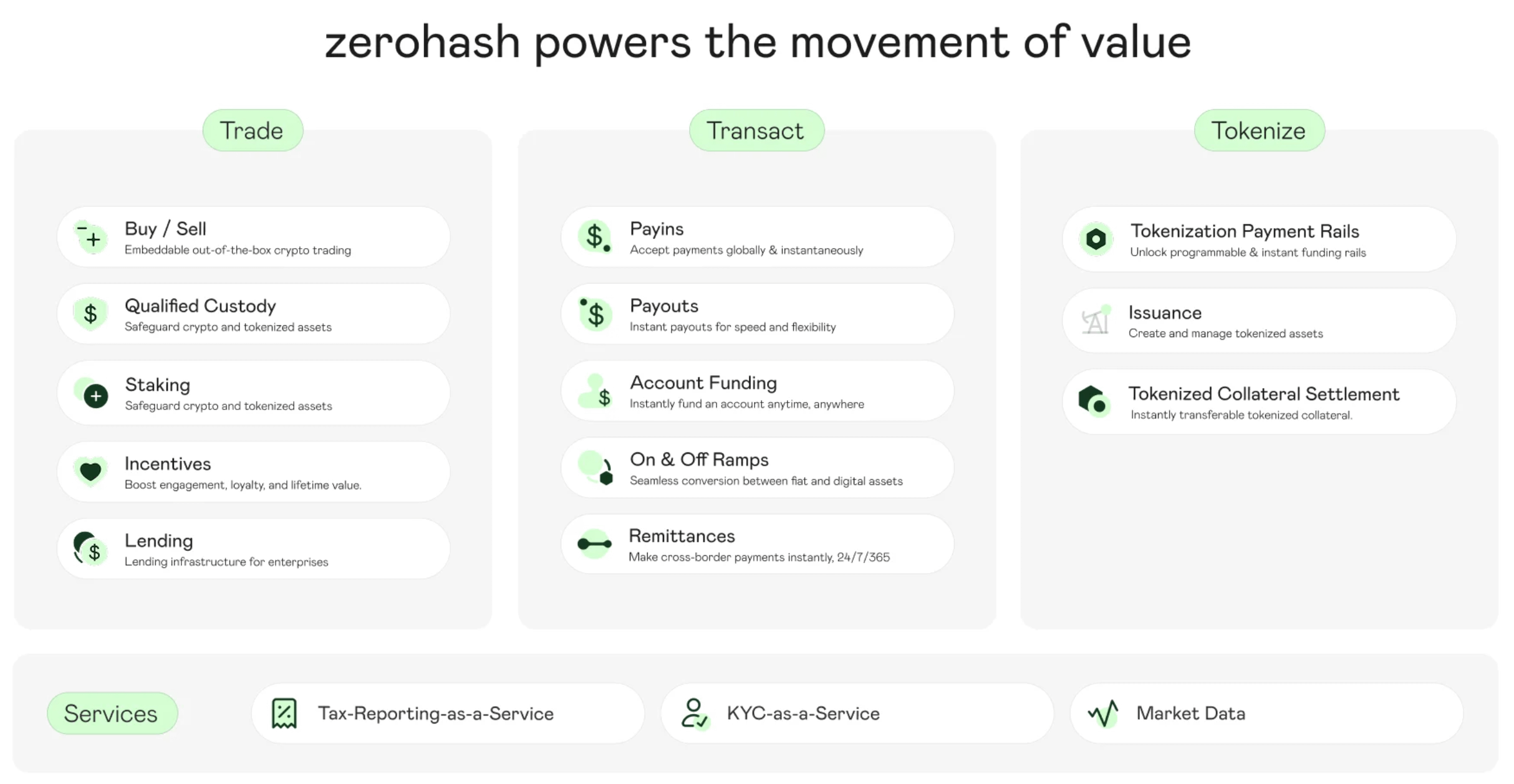
Edward breaks down the three core rails (Trade, Transact at roughly 70% of revenue, and Tokenization), and unpacks the emergence of "on-chain money" as a legally fragmented category — stablecoins under GENIUS, tokenized deposits, tokenized money-market funds, and CBDCs, each a distinct form of dollar created inside twelve months. They explore how velocity of money and just-in-time funding reshape SME payroll, why the new Auth product aims to be the open banking of stablecoins, and where the industry sits on an S-curve Edward insists is still nowhere near maturity.
Finally, they take a skeptical pass at the machine economy, landing on agent-to-knowledge payment — not consumer micropayments — as the durable intersection of stablecoins and AI, and on the convergence that will pull traditional and crypto-native payment firms into aggressive consolidation.
Preamble:
Four years ago, Edward was on the show with a very clear number. zerohash was processing 5% of all Ethereum transactions. This time he's on the show with quite a few other numbers over $65 billion settled 7 million customers, and Morgan Stanley building its E-Trade crypto offering on zerohash rails. That is a lot of growth, and I'm really excited for this conversation.
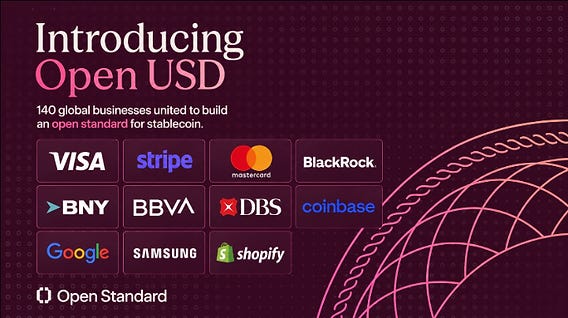
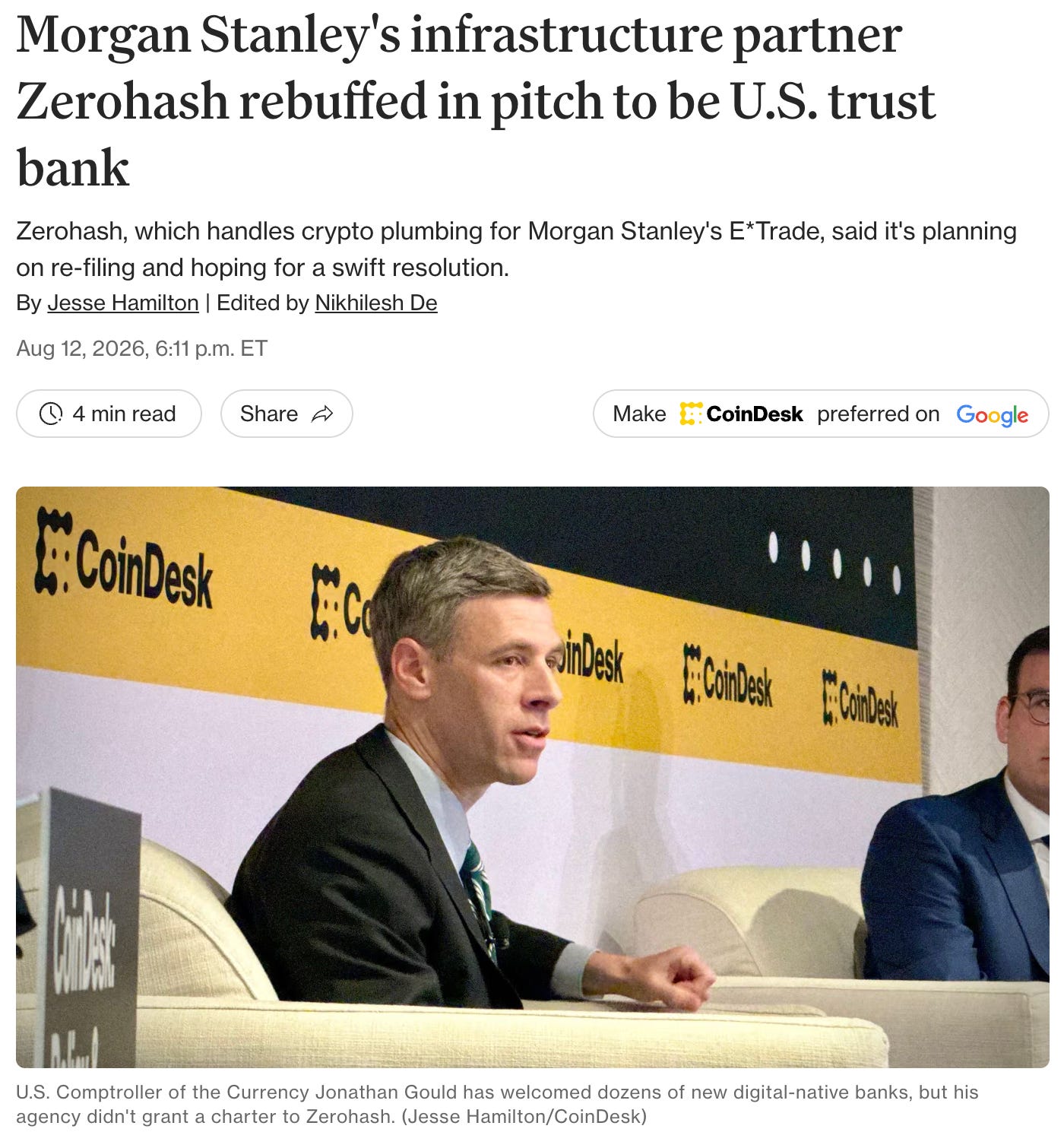
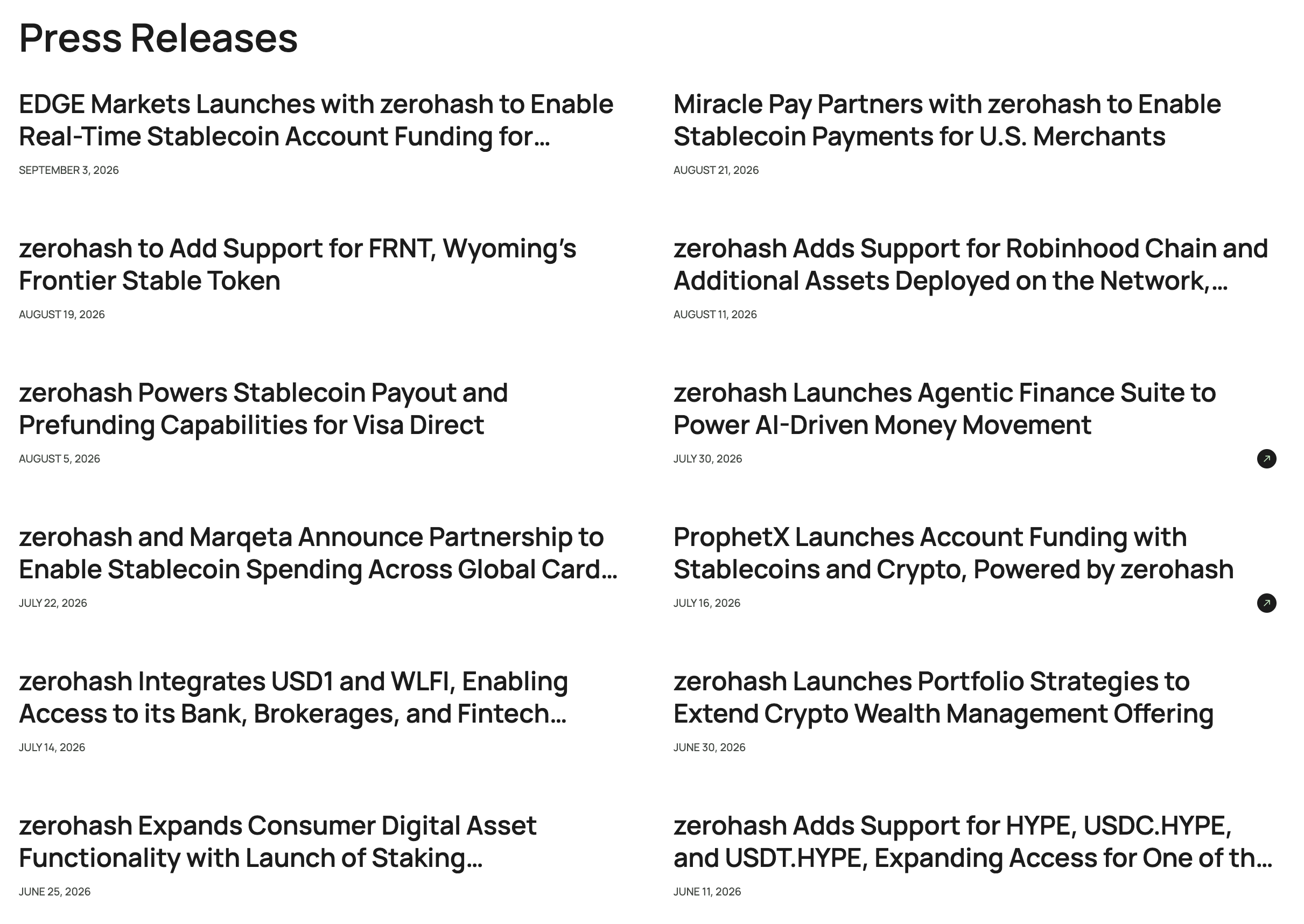
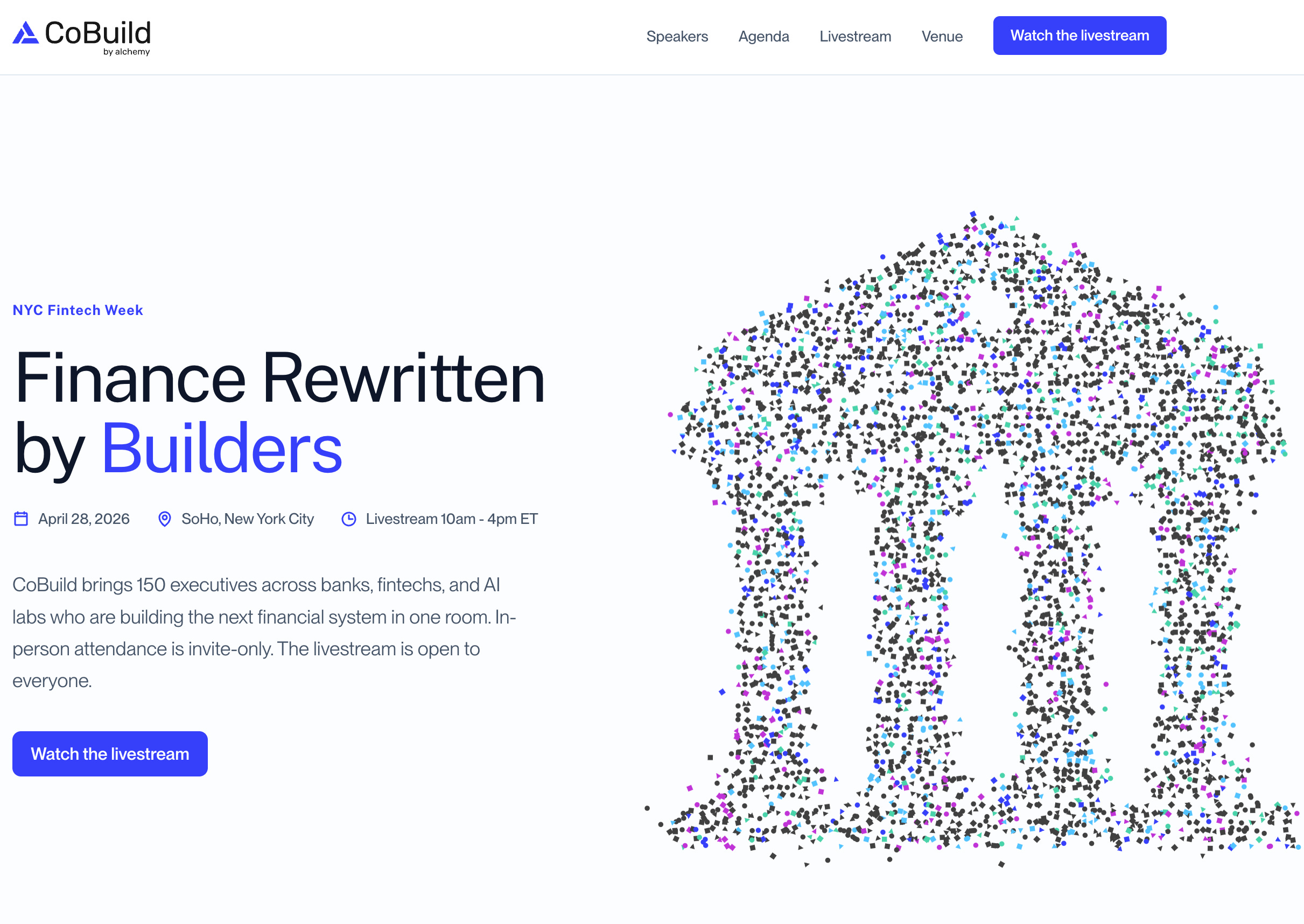
We recorded the podcast earlier in the year, and everything that Edward teased in his conversation has come to market. The E-Trade integration is live. The staking infrastructure has launched. The Treasury published the first proposed rules under the Genius Act, so you can see how those predictions came to market. Also, Stripe and Visa answered his M&A predictions with something even bigger: 140 Company Stablecoin Consortium.
So, all of this convergence is happening in new ways. There are three things I would tell you to pay attention to in the conversation.
First, that the product that large financial companies are buying isn't just technology or licensing, but actually trust risk transfer and doing that at large scale.
Second, that on chain money and crypto has become separately. Second, that on chain money or crypto has turned into legally distinct categories stablecoins, tokenized deposits, tokenized money market funds and each one has its own rulebook.
And finally, the absolutely incredible journey of sticking with a company for a long time and seeing it go from idea to product market fit to becoming a really important part of the industry structure.
With that, I hope you enjoy the conversation.
For those that want to subscribe to the podcast in your app of choice, you can now find us at Apple, Spotify, or on RSS. Or to support this writing and access our full archive of IPO primers, financial analyses, and guides to building in the Fintech & DeFi industries, see subscription options here.
Thanks for your time and attention,
Matt & Lex 🙌
Key notable takeaways:
Trust is the product; licensing is just table stakes. Edward’s sharpest framing is that “licensing is a bar, not the goal” - getting licensed actually opens you to new risks to manage at scale. For an FI like Morgan Stanley, whose crypto revenue is trivial next to tens of billions in quarterly profit, the deciding factor isn’t upside but de-risked entry: FIPS/government-grade compliance, an eight-year clean track record, and a threat model that now treats state actors as the primary adversary.
“On-chain money” has fractured into distinct legal categories in under a year. Post-GENIUS and MiCA, stablecoins (backed 100% by short-term government debt) are now legally separate from tokenized bank deposits (e.g. JPMorgan), tokenized money-market funds, and CBDCs - each a different form of dollar. Edward predicts this taxonomy keeps multiplying, and treats the resulting complexity, including cross-chain stablecoin interoperability, as a widening moat rather than a nuisance.
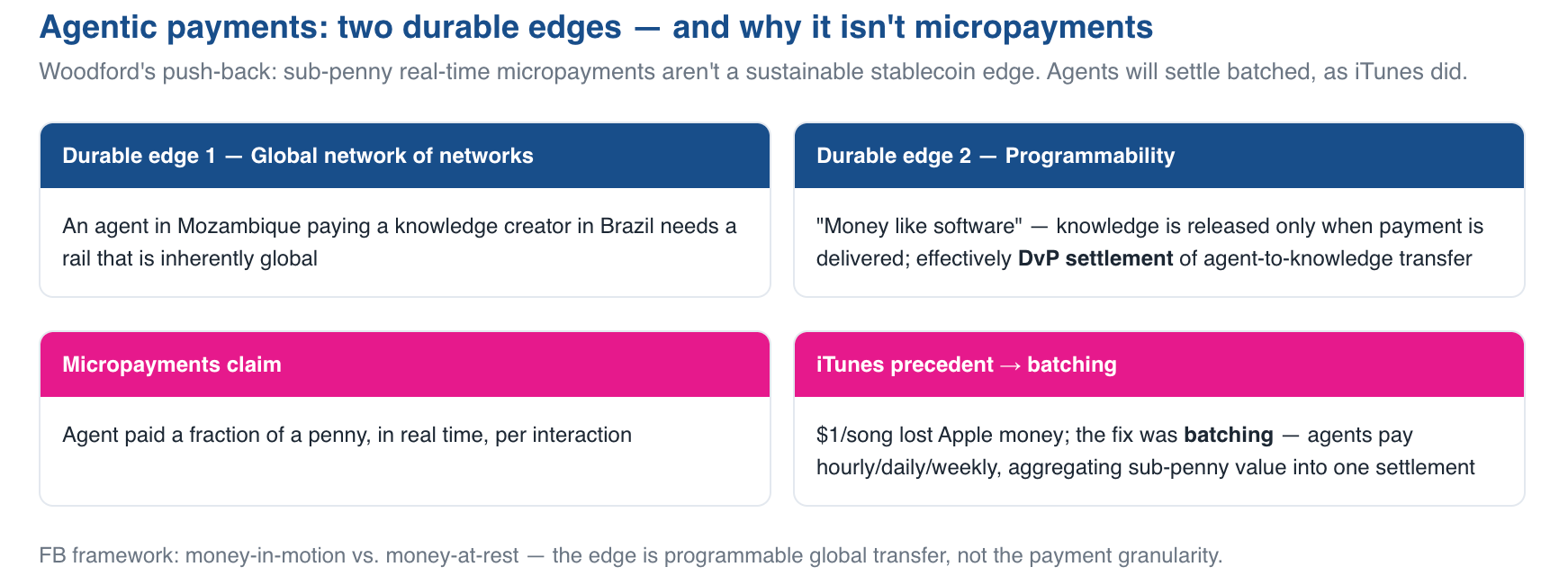
The real AI-stablecoin use case is agent-to-knowledge payment, not micropayments. Edward pushes back on the popular “sub-penny real-time micropayments” narrative - invoking iTunes, where payments got batched rather than charged per song. The durable edge, he argues, is a globally programmable rail where an agent in Mozambique can settle with a content creator in Brazil, with knowledge released on a DvP basis as payment clears. Sub-penny amounts get aggregated into daily or weekly batches.
Background
Edward Woodford earned a First Class BA in Philosophy, Politics and Economics from the University of Warwick, followed by a Master of Finance from MIT. He began his career on the traditional side of markets, working as a research analyst and gaining early exposure to trading, risk, and financial regulation. In 2015 he co-founded Seed CX, a US-based, CFTC-registered derivatives execution venue focused on alternative commodities - an experience he credits with teaching him the complexities of building regulated infrastructure around emerging technology (the derivatives execution business was later sold to tastytrade).
By 2017, seeing that enterprises needed cleaner infrastructure to touch digital assets, he pivoted Seed CX's settlement and custody technology into a standalone B2B "crypto-as-a-service" platform - zerohash.
👑Related coverage👑


Topics:
Stablecoins, EmbeddedFinance, Tokenization, DigitalAssets, Payments, GENIUSAct, MiCA, AgenticPayments, DeFi, RWA, Web3, Fintech, zerohash, MorganStanley, Gusto, Stripe, Circle, Tether, Plaid, Mastercard
Timestamps
2’54: From 5% of Ethereum to $65 billion settled: four years of scaling without trading off trust
6’19: The everything app comes full circle: from embedded crypto to one infrastructure engine
11’29: Interoperability as the value prop: bridging USDC across ETH, Polygon, and Canton
16’06: Build, buy, or rent: how zerohash wins the decision inside a firm with billions in profit
18’47: Stablecoins are good, crypto is bad: the market's false divide and why zerohash rejects it
26’18: Auth, the open banking of stablecoins: killing the two questions that break usability
29’55: The next 24 months of consolidation: will Circle, Tether, and zerohash buy the traditional players?
37’22: The Fortune 500 is barely penetrated: what usability and distribution unlock next
41’10: Agent-to-knowledge transfer: the real intersection of stablecoins and AI, beyond the sneaker purchase
46’41: The channels used to connect with Edward & learn more about zerohash
Illustrated Transcript
Lex Sokolin
Hi everybody, and welcome to today's conversation. I'm so pleased to have with us again Edward Woodford, who is the founder and CEO of zerohash. zerohash is one of the original companies focused on embedded crypto and digital asset infrastructure and has been a fantastic success, so I'm really excited to learn more about how the last few years have gone and generally catch up with Edward. So, with that, welcome to the conversation.
Edward Woodford
Thank you. Four years by the calendar, but crypto stablecoin years are like dog years. So maybe like speaking 21 years ago.
Lex Sokolin
It's been 200 years.
Edward Woodford
Yes, exactly.
Lex Sokolin
Some fun facts about last time we talked. The key number you had come in with was that zerohash was processing 5% of all Ethereum transactions. That was an amazing number. And I think now zerohash has had over $65 billion in volume settled and over 7 million customers over these four years. So you've been pretty busy. Tell us what you've been up to. What's happened.
Edward Woodford
So, a lot has obviously shifted, from both a macro perspective and just a general perspective. Look, the business has got bigger, which is a good thing. We've always tried to not make a trade-off between scaling and trust. And so, what we've really seen is some of the largest FIs come to zerohash and build on zerohash — great groups like Morgan Stanley and others that will be announced shortly. And we've become a more global business since we last chatted. So, we are now licensed in Europe under both a MiCA and EMI licensing framework. And so, there's been all of that natural evolution. I also like to talk about the macro-opportunity.
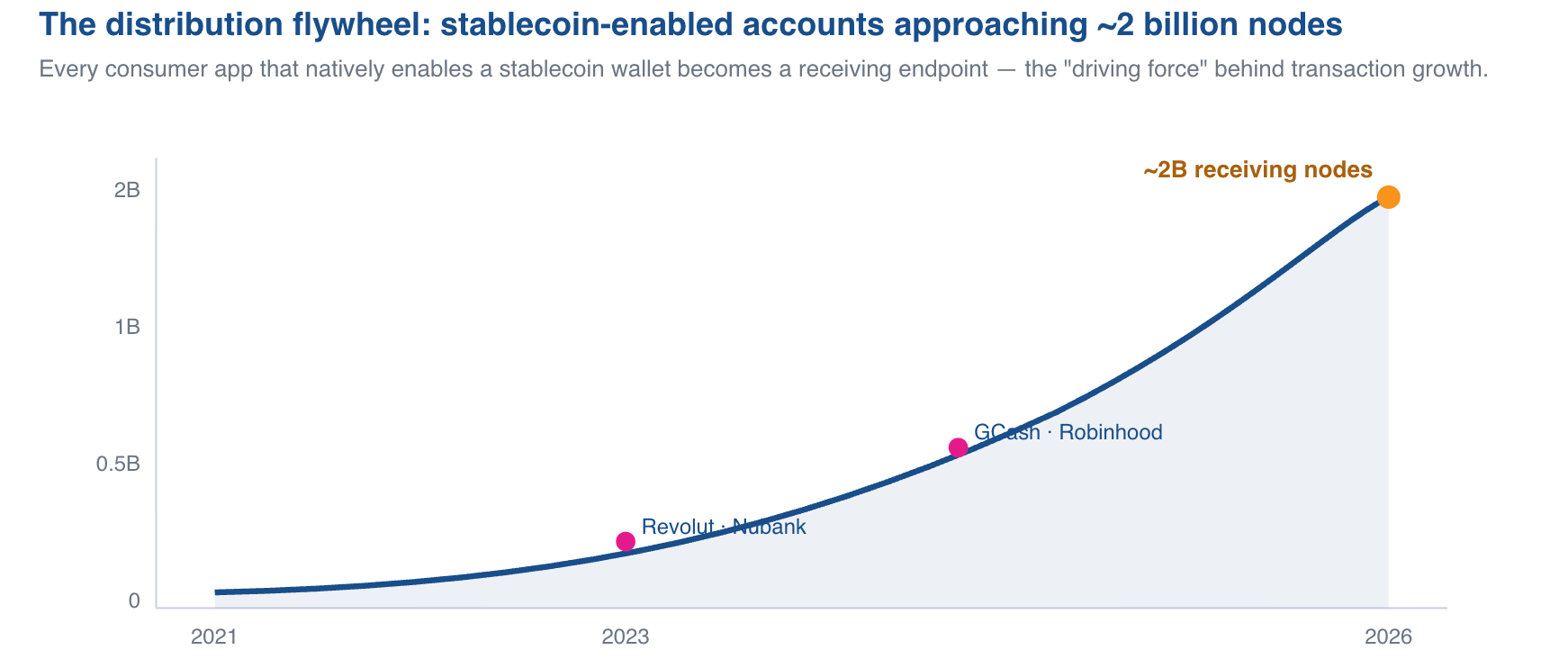
So obviously there's been a lot of regulatory clarity that's been provided and a lot of opportunity that has enabled groups to enter the space for the first time. But then also the distribution of the technology has scaled. We use this analogy; this metric of how many stablecoin-enabled accounts are there globally. So, we're basically adding up how many people have a Revolut account that has a stablecoin wallet naturally enabled, GCash, Robinhood, Nubank, and obviously that evolution has scaled tremendously, which for a business like ours, which is a transactional business, having all of those endpoints that have now been naturally created creates a driving force in terms of being able to drive more and more use cases and applications. And so, we now power things like account funding in stablecoins, instant funding, payouts globally. So, there's been a lot of evolution across the landscape. And there's definitely been a rising tide. And I think we've risen faster than the tide. That's always our goal. It's a great place to be.
Lex Sokolin
Let's revisit the foundations. If we rewind back maybe five years or even longer now, there was this idea of embedding finance in lots of different applications and lots of different websites, and there were different kinds of finance that you could embed. You could embed a bank account; you could embed a traditional brokerage or a custodian account. And I remember some of the early positioning for zerohash was, how do you embed crypto trading into an application. And I think at the time, there was a lot of growth in things like on- and off-ramps. And MoonPay had a big round. So, it was a bit muddy in the market overall, because people didn't really know what it is that they wanted to embed, and there's been this huge evolution in both the blockchain side and embedded finance. So, can you talk a little bit about what the core of the business was at its founding, and then what has that evolved to over time?
Edward Woodford
Yeah, it's certainly interesting. We've definitely come to some degree full circle with this concept of the everything application that we now see. And so, whether that be being able to do payments within the same application through stablecoins, or whether that be embedded crypto as part of an investment or rewards product, we've certainly seen that drive. And I think that's certainly been helpful for us because we provide that gateway for traditional FIs to offer crypto and stablecoin infrastructure. If you take a step back to when we founded the business in 2017, we started the business to be primarily a B2B business and not a B2C business. But really the consumer was an institution. We very quickly realized that if our thesis was that this was a technology that was going to be everywhere, there were certainly going to be some new entrants to the space, with creative destruction leading to new companies. And we've certainly seen that with groups like Coinbase. But were we best positioned to be that kind of new entrant, or were we best positioned to bridge the opportunity for traditional enterprise FIs into the space? And so, we very quickly realized that we wanted to move into a pure-play infrastructure business.
And so we switched gears, within 12 months of launching the business. And obviously we've gone through a number of different cycles and we've been able to grow and scale. There's been lots of, I would say, shiny things in the space. And they continue to be shiny things. And I always say to our team, let's not be a magpie. And what I mean by that is, let's not just go to the shiny thing and try and pick those things up, whether it be, for example, NFTs, or the stablecoin sandwich that was in vogue for a long time. And these things go through trends. And ultimately, you've got to say, does this have long-term staying power? Is this fundamentally better than what we have today? And is there a huge opportunity? And so that's how we built the business. And you've seen some of these ups and downs over the last four years since we last chatted in that way.
Lex Sokolin
So, when you think about the core pillars, not the shiny bits, but the main core pillars, what are they and how are they structured?
Edward Woodford
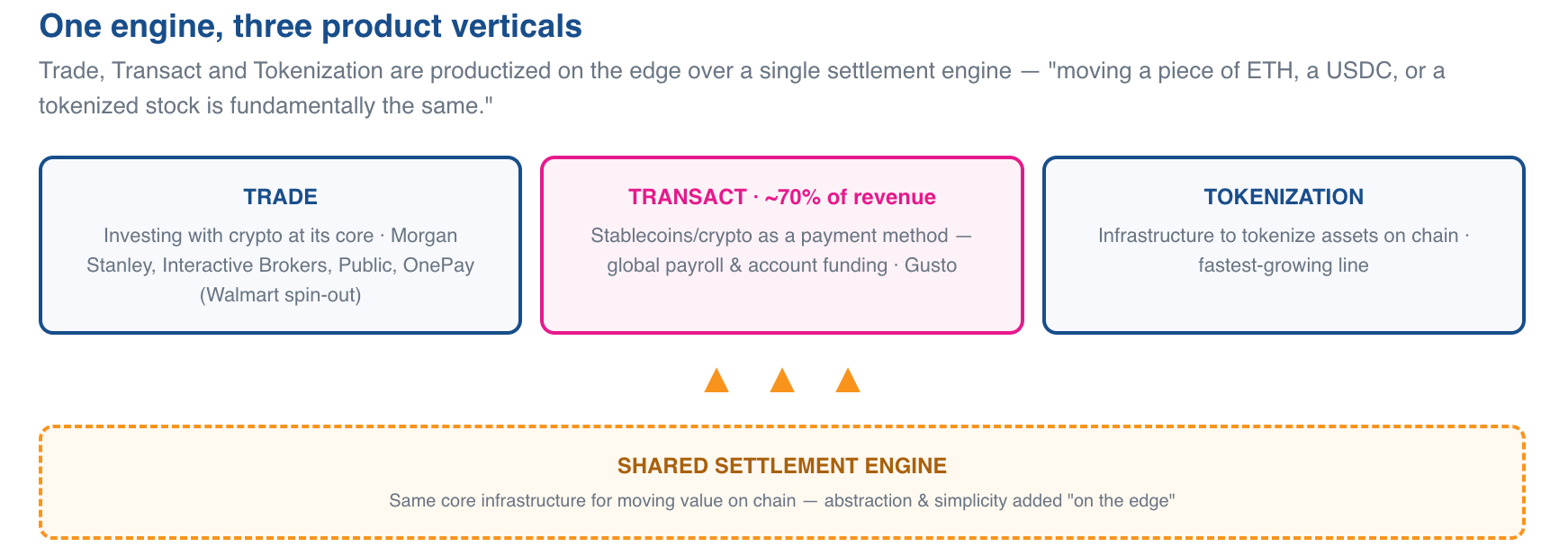
Yeah. So fundamentally we're a technology business that believes that blockchains will help rewire the way that value moves globally, and we really productize that into three core product verticals that crisscross many customer segments. And increasingly, our customers are using one or more of these products. So, the first product that we offer is what we call our Trade product, which is effectively an investing product with crypto at its core. So, this is where we've seen, for example, Morgan Stanley, Interactive Brokers, Public, OnePay, which is a Walmart spin-out, all offer crypto trading as part of a native application and experience through zerohash. The second is what we call our Transact business, which is actually our largest business, accounts for close to 70% of our revenue. And this is effectively leveraging stablecoins and crypto as a payment method. And here we power groups like Gusto in terms of two-sided marketplaces offering payouts globally. We can talk more about how we think they will intersect with agents.
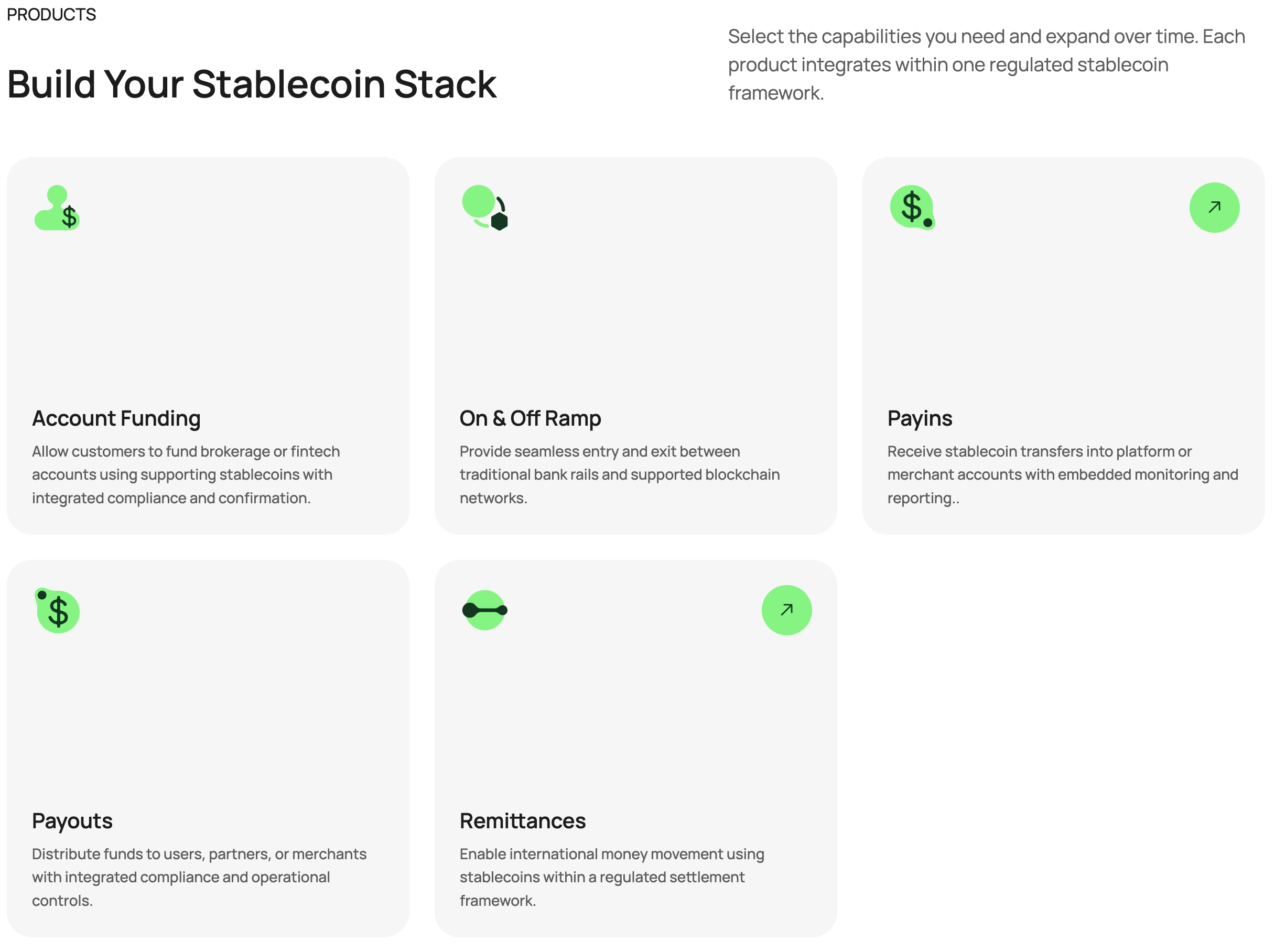
But effectively in terms of payroll today, payroll to humans, that is a huge and growing part of our business. And then as well, what we call account funding, enabling people to leverage stablecoins to fund an account, whether that be a gaming account or a brokerage account, or an FX account, through our infrastructure. And then finally is tokenization, where we offer infrastructure to allow groups to tokenize things on the blockchain. Now, the commonality of all of those things is this is technology, and this is moving value. And at its core, it's the same infrastructure. Enabling a piece of Ethereum to move on chain is fundamentally the same as moving a piece of USDC on Ethereum, as well as moving a piece of tokenized stock on the Ethereum blockchain. It's fundamentally the same, but what we've been really good at, and have continued to do over the last four years, is effectively productize on the edge to make it really simple. But at its core, it's the same fundamental engine across all three of those product stacks.
And like I mentioned, our payments business is largest by some significant size. But we're seeing huge growth in our tokenization business as more and more companies look to come on chain and to leverage blockchain as a mechanism of value transfer.
Lex Sokolin
So, I want to go into some of the client names you mentioned. But before that I want to double-click on the infrastructure you're talking about. A lot of that is tech, but a lot of that is also a regulatory footprint, an attempt to navigate very different requirements in lots of different places under very different political regimes. At a high level, how much of the product is the regulatory chassis versus tech? And then the follow-up to that is, how has it changed over time?
Edward Woodford
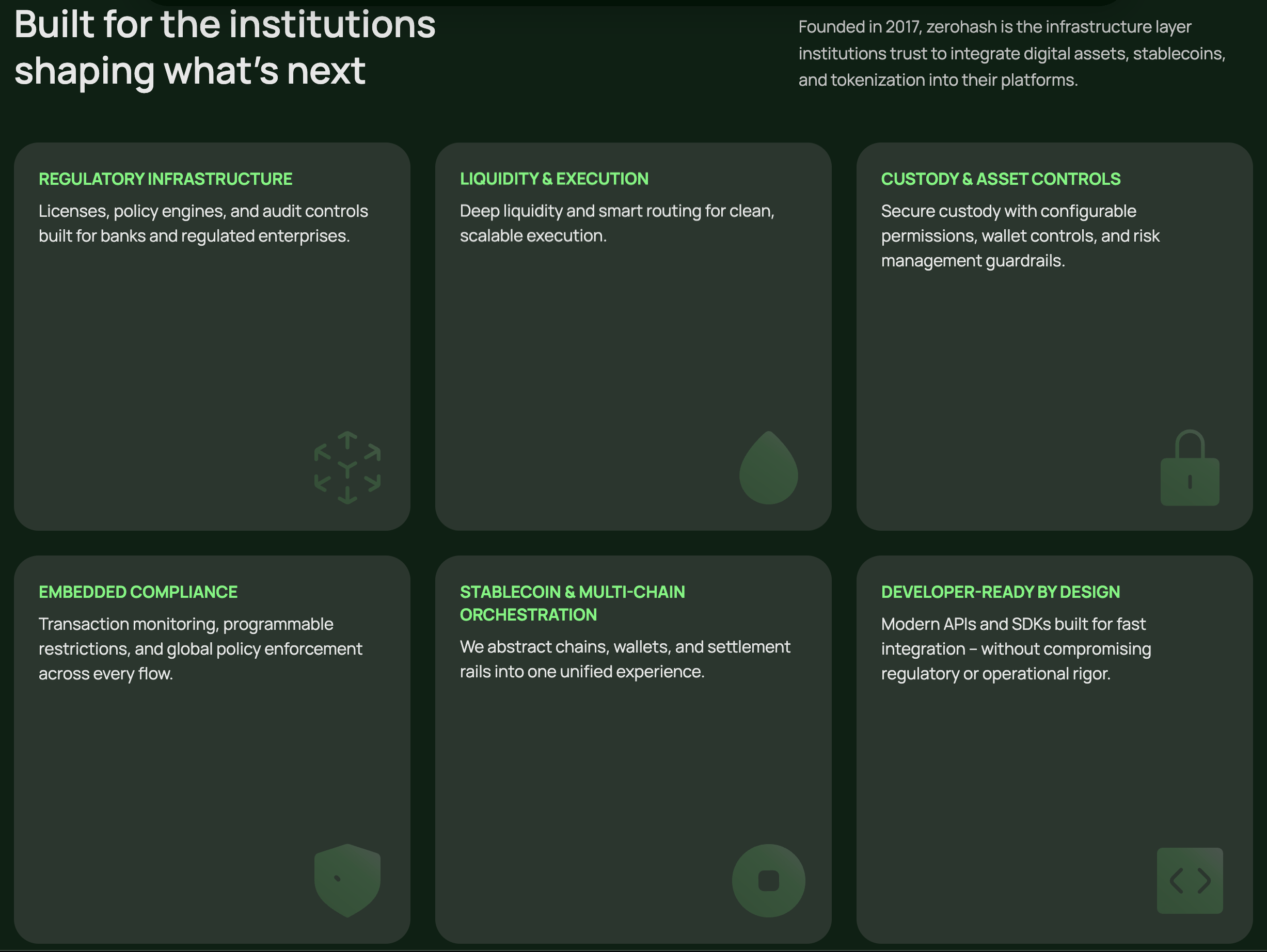
Yeah. Great question. If you look at it, the two legs of the stool are different. I'm not enough of a car guy to use an analogy of the chassis, but the fundamental building blocks that we offer are effectively trust and technology. And within trust, part of that is our regulatory licensing stack, which is certainly a part of the puzzle. It is incredibly complex. It adapts, it evolves, and to do it at scale is complex. But I think we talk less about the pure-play regulatory infrastructure because, long term, regulation in the US, for example — the barrier there has decreased, I would say. I think that's a fair statement to make. But the licensing construct, which I think most people get wrong: licensing is a bar, it's not the goal. And so, getting licensed actually opens you up to a lot of other risks in terms of actually being able to manage and monitor this at scale. The core product that we sell is trust. And within that, part of that is the licensing.
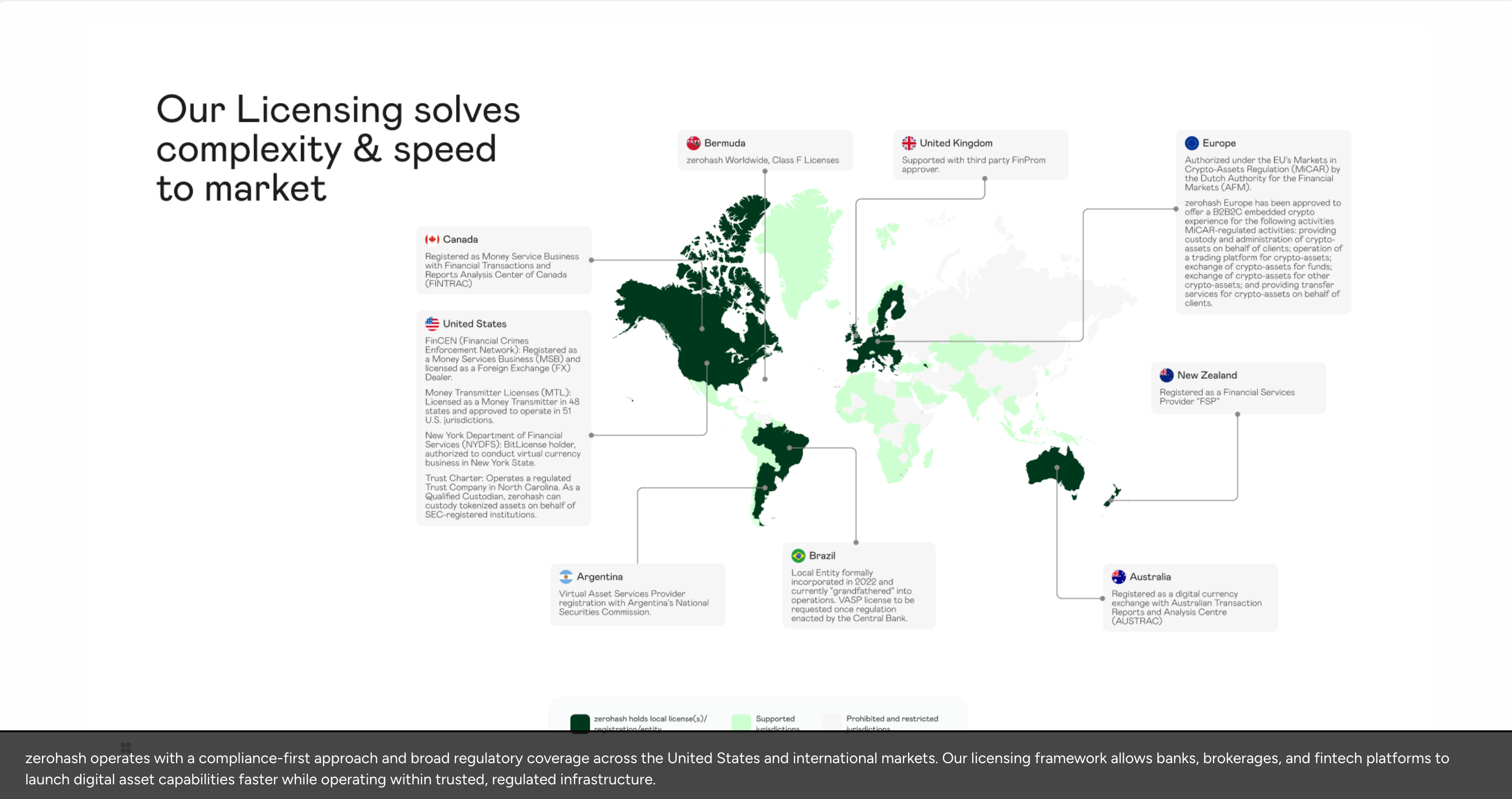
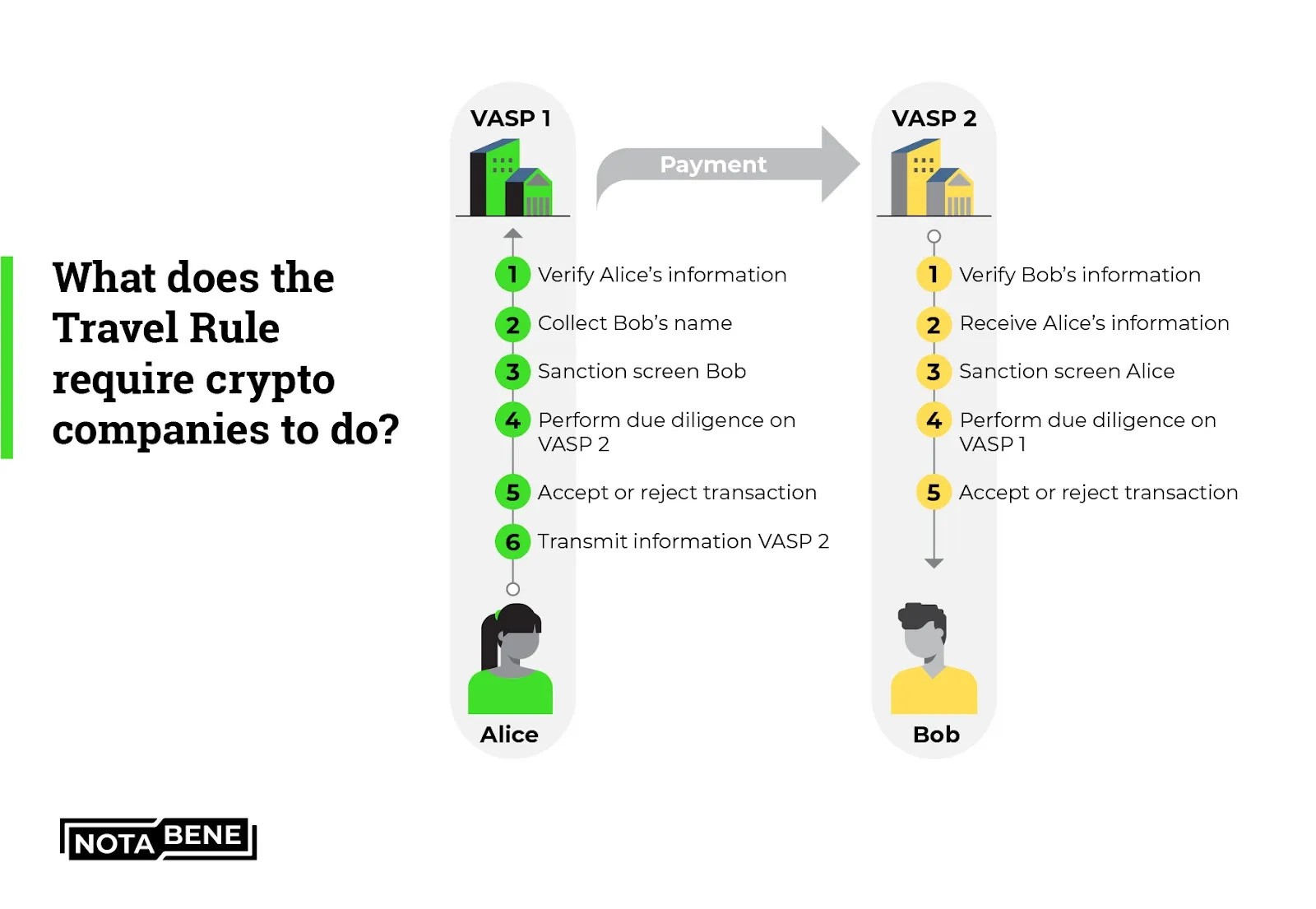
But a lot of that also is our trust from a cybersecurity perspective, the impeccable track record that we've maintained for eight years, the fact that everything that we build and do is FIPS compliant, which is effectively governmental grade, because the threat actors at this point have also become more sophisticated since we last spoke.
And we're talking about state actors as the biggest threat actor to this space. There's been a lot of global movement in terms of regulatory agencies now implementing blacklisting of specific addresses on chain. The travel rule has now become implemented since we last spoke. So, there's a lot of complexity beyond just the licensing construct. It's a holistic view of trust and ensuring that ultimately FIs and enterprises are looking at this to say, look, we need to experiment, we need to drive this forward. But even in the best-case scenario, when we're talking to a group like Morgan Stanley, which generates tens of billions of dollars of profit a quarter, you're talking to them about a quantum with crypto that is obviously a lot less, at least initially. And so the biggest risk factor for these FIs is not really the revenue opportunity. It's the risk factor of entering the space and doing it right. And that's really what we offer on the trust layer. And then obviously the technology is a huge part of what we offer.
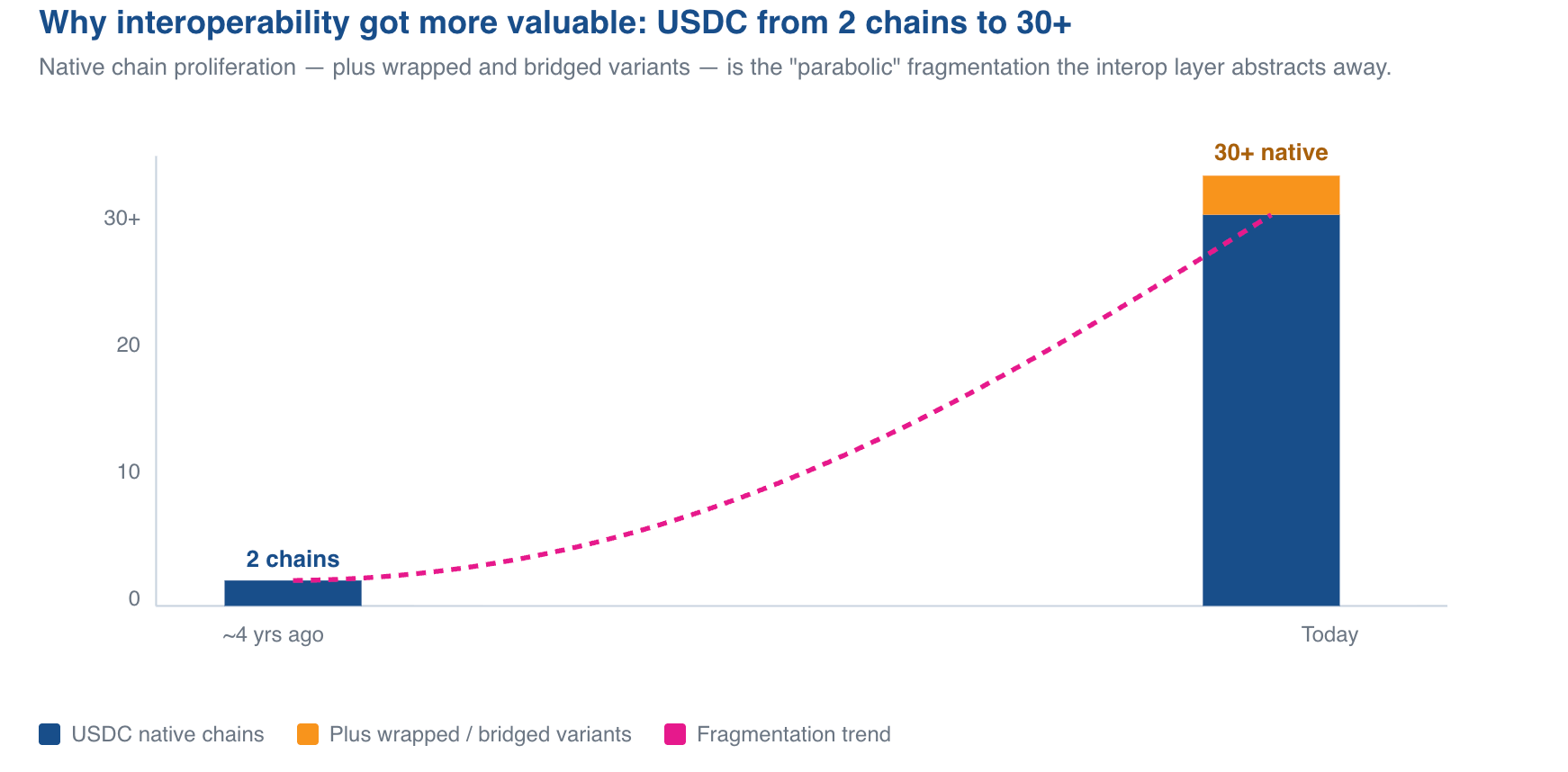
I would say actually the bulk of what we offer. And I say this a lot: blockchains are like Tamagotchis. They live, they breathe and they change. And that's a little flippant. But what I mean by that is that fundamentally, some Tamagotchis live and some Tamagotchis die. Look at the number of blockchains that have been created and now have material size. You can look at Solana versus four years ago, Base versus four years ago. And so, what you're charging towards continuously is evolving and is continuously changing. And not only the number of chains, the number of assets has continued to evolve and change. And if you look at, for example, USDC four years ago, USDC I think was on two blockchains. It's now on 30-plus blockchains natively, let alone the concept of wrapped or, for example, bridged USDC that now exists. And so, the complexity factor from a technology perspective has massively increased. And it is moving at an incredible pace. And so, our offering on the technology side is one, we allow you to effectively innovate without having to deal with this continuously evolving technology. But two, the technology question has become incredibly more complex. And so the importance of what we offer around, for example, the interoperability of stablecoins has become very meaningful — i.e. being able to bridge between USDC on ETH to USDC on, for example, Polygon or USDC on Canton.
And so, I'd say the technology value proposition that we offer has actually increased meaningfully, because the technical evolution of this space has gone parabolic. And the fragmentation from a technology perspective has increased. And so, our value prop there has increased as well.
Lex Sokolin
Let's then double-click on a Morgan Stanley, or any of the other companies that you mentioned. What is it that they're getting and why are they partnering with you? Certainly, if you've got a couple of billion in profit, you can try and build a bunch of stuff yourself. What's the build versus buy versus rent decision in those firms, and how were you able to persuade them?
Edward Woodford
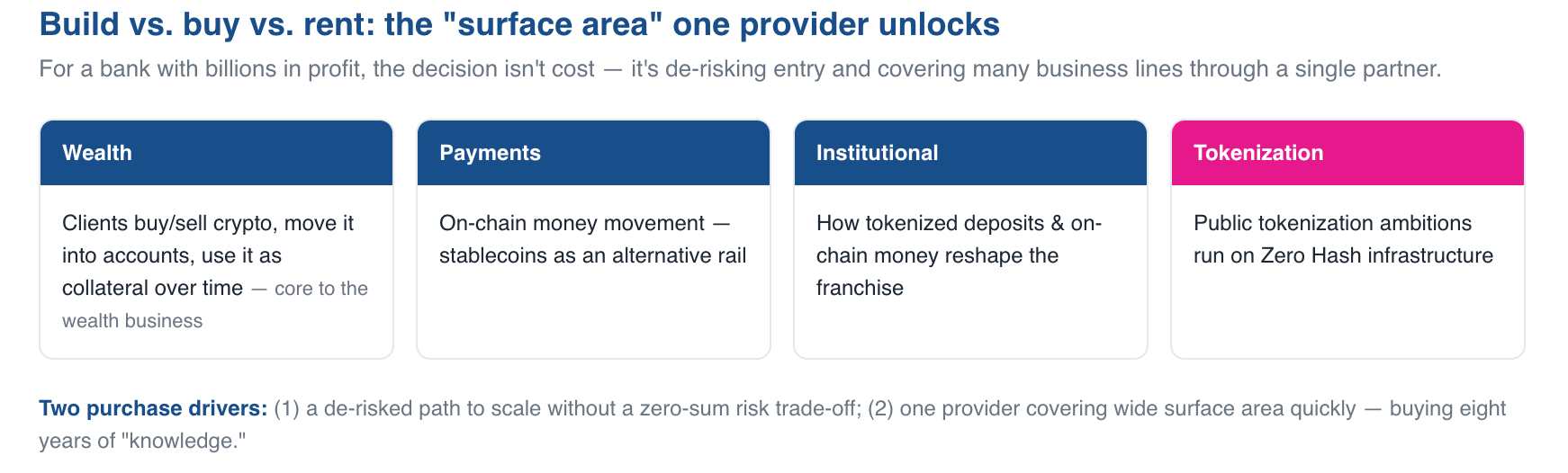
Ultimately, I think there are two core factors. One is, like I mentioned, trust. Trust is a huge part of this. Large financial institutions and enterprises make decisions based on risk. And so being able to show that you are a very de-risked solution that can allow them to scale and innovate without trading off in effectively a zero-sum construct — risk is incredibly important. That's the first piece. The second piece is we give a lot of surface area to partners to be able to innovate across the holistic part of all of their businesses. And what I mean by that is we allow, for example, Morgan Stanley wealth clients to now buy and sell crypto, to move crypto into those accounts, and to use that crypto effectively as collateral as well over time. And so that is a really important part of the Morgan Stanley wealth business. You then look at other parts of their business, their payments business or their institutional business. And they've been public that they are looking at, for example, tokenization. We provide tokenization infrastructure. They're looking at how on-chain money changes their business, whether that be stablecoins or tokenized deposits.
That is also a really important piece. So, we give them an ability to cover a lot of surface area very quickly and to innovate. And that's really important for these financial institutions that want one provider to give them a lot of leverage very quickly. And so those are the two key areas. And what we do is complex. And what we do is complex at scale. And also, we've learned a lot of lessons over the last eight years. And so that's what groups are buying. They're buying that knowledge. They're buying that ability to move quickly without trading off risk. And that's what we offer as a business at its core.
Lex Sokolin
Great. So, you mentioned that the largest part of the business is now payments and stablecoins. And one of the strange things, at least from my vantage point, is the emergence of stablecoins as these special categories of tokens. And that's been now enshrined in policy. And people are talking about them as if they're very different from all the other tokenization that you've mentioned before. Can you talk about the evolution of that use case, and also what's changed in the counterparties? How is Gusto now thinking about payments and distributions that they weren't before? Why are they thinking about crypto dollars? There's something there that's different in the water. And I'm curious if you saw it develop through the customer conversations.
Edward Woodford
It's interesting to look back. Four years ago, I don't think we were describing ourselves as a crypto and stablecoin business. In some ways, we were slow to start describing ourselves in that way because we just viewed it as, hey, these are cryptographic assets. And we viewed this very much as a pure-play technology play. A piece of Ethereum is no different to a meme coin built on the Ethereum blockchain, or a dollar on the blockchain. We were probably a little slow to draw this distinction. And it's interesting, because during the more challenging period under the SEC, where obviously crypto was under attack, I think what drove that distinction was, in part, businesses that purely played in the stablecoin space saying, well, look, stablecoins are good, crypto is bad.
And fundamentally, I don't think you can draw that distinction. And ultimately, they rely on each other. If a stablecoin is being moved on the Ethereum blockchain, fundamentally you are buying a piece of Ethereum every time you move that asset or do anything on that blockchain. But it was this distinction that was created, I think, in the market, in part to draw the distinction between the mess that we saw with FTX, the mess that we saw with the SEC, and businesses saying, we're going to call the path and just be very narrow. Now, for a long time, that was actually seen as a weakness and a dig against zerohash. People said, well, they do a lot of crypto. Actually, what we're saying is that it's a huge advantage, because every business that uses us for crypto is using us for stablecoins at this point. So maybe even taking a step back — like four years ago, we wouldn't draw that distinction between stables and crypto.
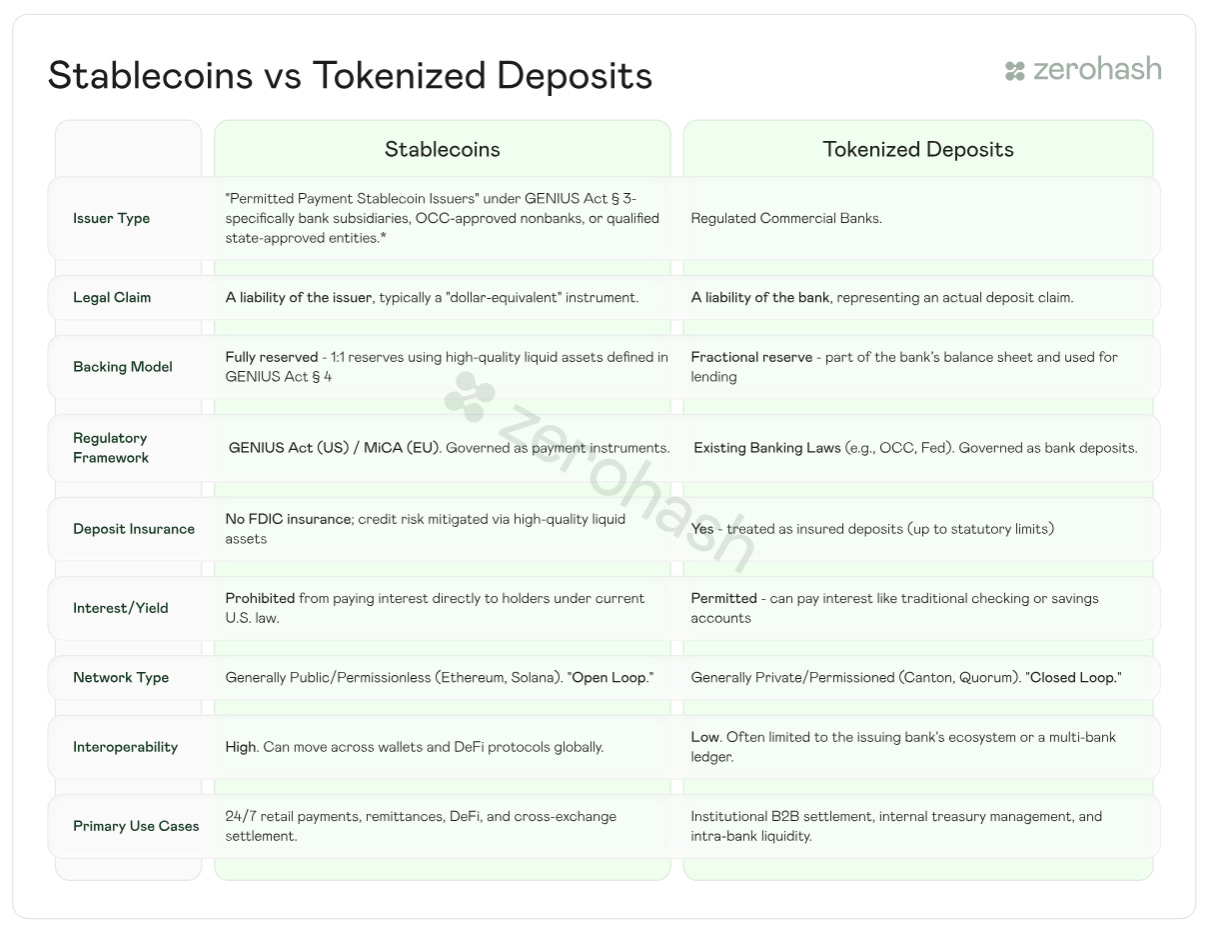
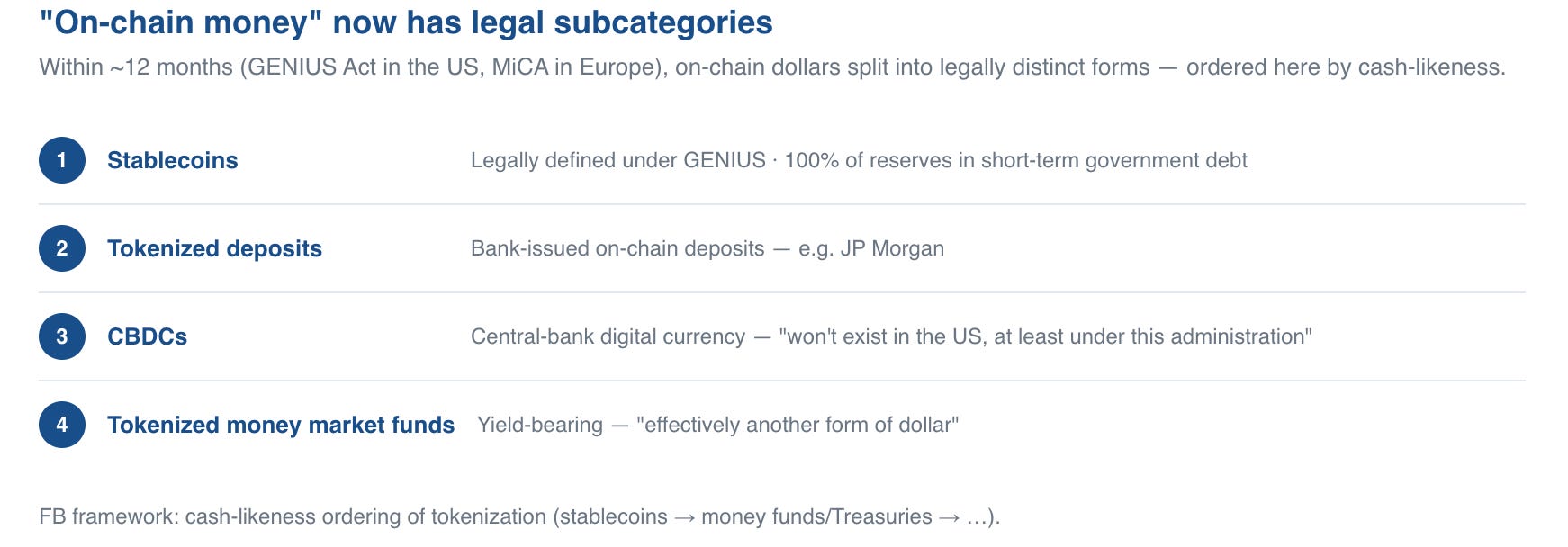
And as a pure-play technologist, we kind of viewed them as the same. But they are definitely different in terms of how the market perceived them. And now actually they're distinct from a regulatory perspective. And so stablecoins now under GENIUS are a defined asset, with 100% of those assets to be held in short-term government debt. So, one of the things that we are drawing a distinction between is actually pure-play crypto assets and what we're calling on-chain money, because I think if we touch base in four years' time, there's actually going to be all of these subcategories within on-chain money. And on-chain money, just to simplify it, let's just say it's on-chain dollars. So now you live in a world where we have stablecoins, which are legally distinct, legally defined under GENIUS, which are distinct from, for example, on-chain tokenized deposits such as what JP Morgan has done. And then again, you can distinguish that from, for example, CBDCs, which obviously won't exist in the US, at least under this administration.
And then you can also distinguish it again from, for example, tokenized money market funds, which are effectively another form of dollar. So, we talk about complexity. On-chain money now has these legal distinctions that have been created within the last 12 months because of the laws that have been created in Europe under MiCA and because of the GENIUS Act here in the US. And so that distinction certainly now exists. So maybe to go to the second part of your question — how do companies like Gusto, how do two-sided marketplaces think about stablecoins globally, and what's changed? Well, one is they look at the law and they look at what's being created and the comfort around it. That certainly changed the conversation. I'd say the biggest piece that's shifted is, again, going back to this metric of stablecoin-enabled accounts, and we released a 2026 momentum report that I think is actually one of the best pieces that's been created in terms of the metrics that really matter. And so, what's happened is we now have 2 billion nodes globally that can receive stablecoins, whether the customer knows it or not.
And so, we've moved from this being a niche money movement - I need to create a cryptographic wallet, it feels a little complex, it feels a little different - to now, hey, I can move stablecoins. A freelancer in the Philippines that wants to be paid via Gusto can effectively do an account-to-account transfer. They can say, I want to move my dollars from Gusto to my GCash account. Again, the experience is abstracted away from the chain. It's abstracted away in terms of the asset. It's just an account-to-account movement, because the ability to receive those stablecoins has massively increased. And so that Filipino freelancer can now receive that stablecoin, or in theory, over time, other forms of on-chain money. And that can either be kept as a store of value — you can then issue cards against it, where you're seeing a huge dynamic evolve — or for example it could be automatically converted into local currency and spent in that form. That's what's changed. In the last four years you've seen a massive evolution.
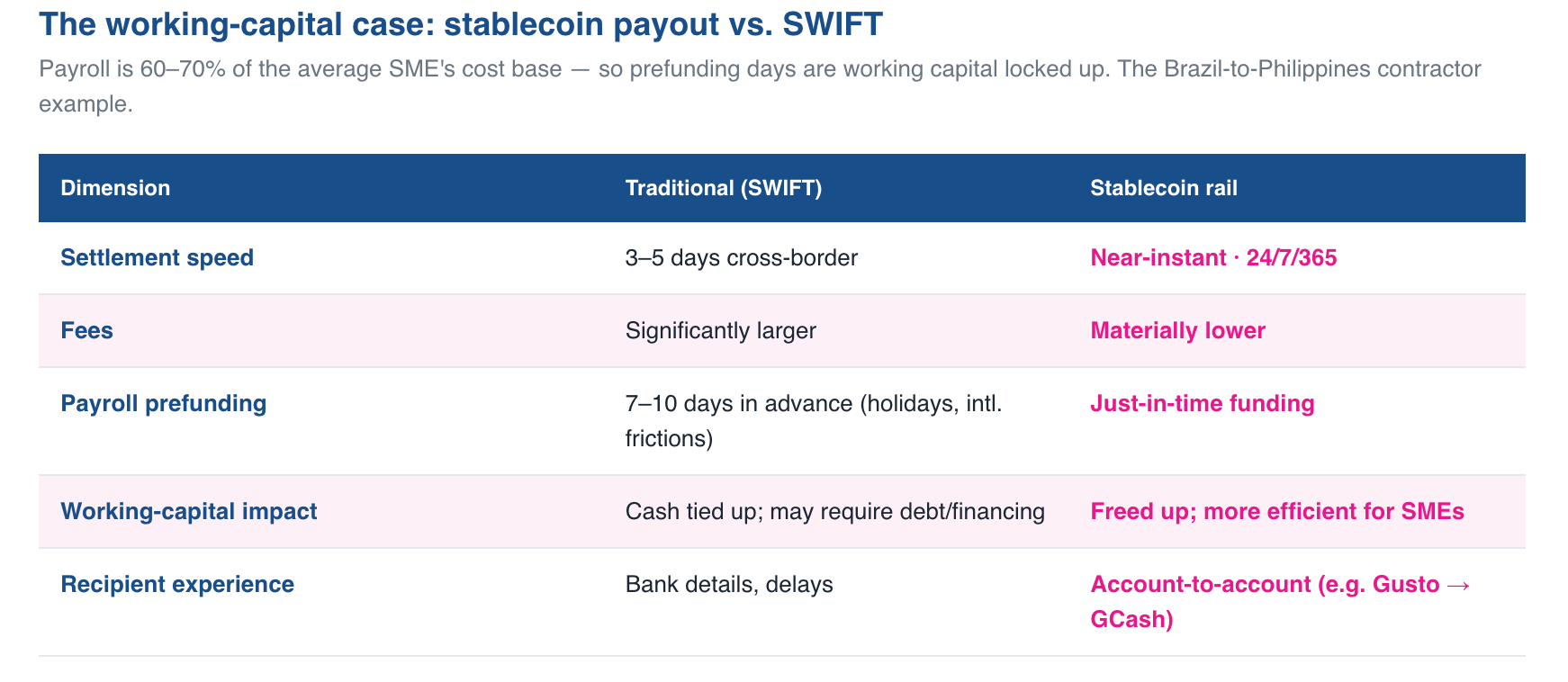
I think the technology question and the technology evolution is actually massively misunderstood and massively underappreciated in this space, as well as obviously the regulatory shifts that we've seen. But at its core, just philosophically, why is Gusto interested in this? It's really, what does on-chain money solve for their customers, both the SMEs that the power as well as the freelancers and contractors globally? And ultimately, we're talking about velocity of money — velocity of money mattering, and velocity of money both in speed, 24/7, 365, and global. And that's why these groups are doing this. So, playing this out: if you're a freelancer in the Philippines, you can receive your funds instantly, whereas if you move it, for example, across SWIFT, it could take three, four or five days and the fees are significantly larger. Equally, if you're an SMB and you need to fund your payroll — for SMEs, the largest cost factor is payroll. It's 60 to 70% on average of your total costs. And if you need to fund six, seven days in advance because of banking holidays or because of other frictions that exist in the banking system, especially internationally —
For example, I'm a Brazilian company paying a contractor in the Philippines. I may need to prefund that balance 7 to 10 days in advance. And with stablecoins, you can effectively do just-in-time funding in order to meet the payroll requirement. And that has a massive impact for SMEs. You're not having to take debt; you're not having to take other forms of financing. Your working capital is much more efficient, which in small businesses is incredibly important. So that's fundamentally what's shifted: an appreciation of it, a safety and soundness over these assets. But most importantly, just a technical distribution factor. Those three pieces combined has unlocked use cases, such as the Gusto use case that we power, to exist.
Lex Sokolin
Do you think the end consumer, the end user, even knows what's going on? Do they care? In a lot of cases it's — you mentioned the stablecoin sandwich, where it's on-ramp, move around and then off-ramp — but there are plenty of apps now where the end user ends up holding an on-chain dollar and the UI just abstracts it away. Are we in a place where people across the world, especially in the global South, they know it's an on-chain dollar, and they've been dealing with Bitcoin and XRP and all this other stuff, so they're like, oh, it's great to have a dollar version of this? Or is it just a number on a screen, and it doesn't really matter as long as you can spend it?
Edward Woodford
I think it's increasingly the latter. And maybe I'll share with you a little bit more in terms of how we're thinking about that. So yes, certainly, once it wants the tokenized on-chain dollar, effectively it's abstracted away. The usability — we've seen a huge amount of innovation in terms of abstraction around seed phrases, recovery, social logins. So, I think at rest, a lot of these complexities around chains and assets have been abstracted away. And that's a very real factor. If you tell a user, hey, this is USDC on XYZ chain, and then there's another asset, USDC on another chain, that is complex for the user. That is abstracted away, increasingly, in terms of the interfaces that are being created and just the innovation around holding these stablecoins at rest. Where we're spending a huge amount of time — and a product that we released this year, which is what we call Auth, which is effectively the open banking of stablecoins — is the ability to abstract away those complexities of on-chain money movement tied to money in motion.
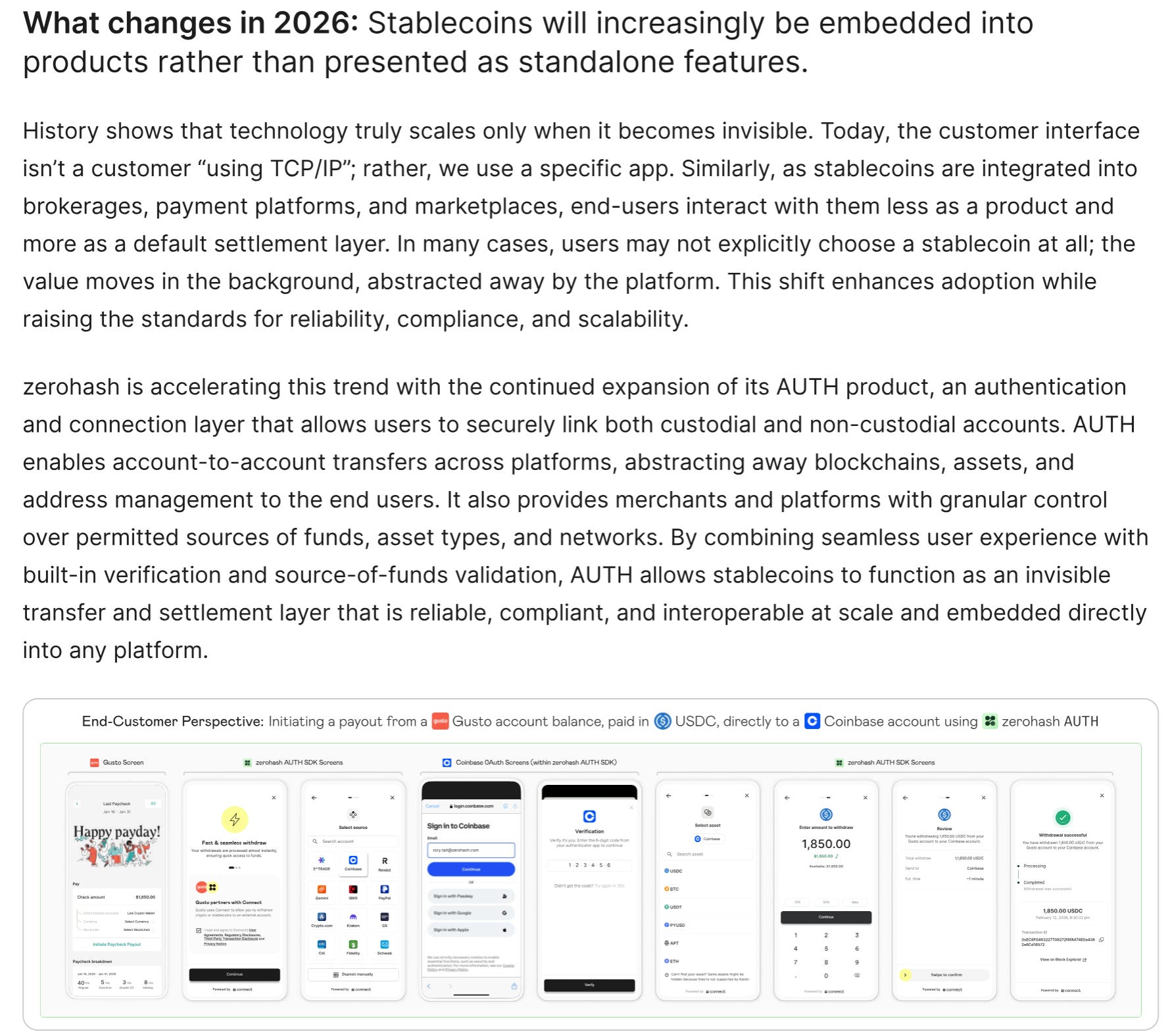
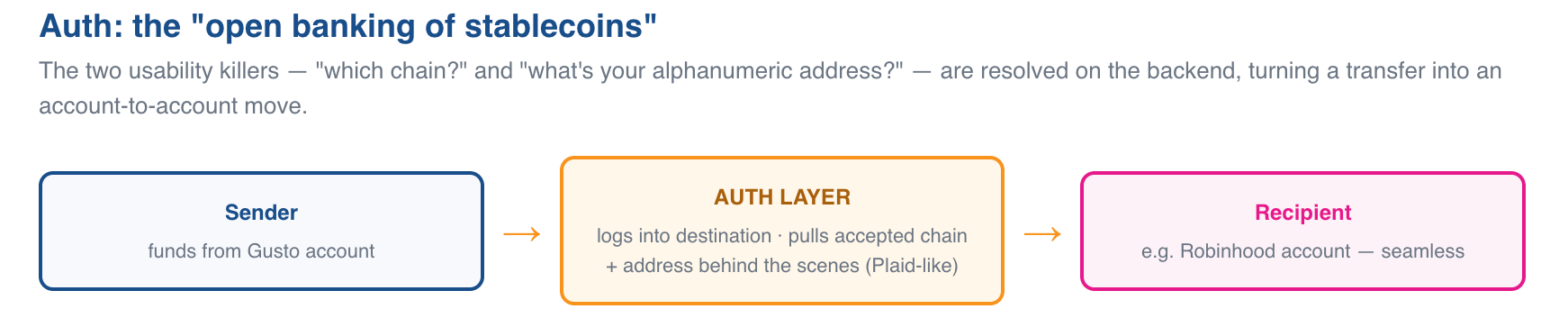
And what I mean by that is, hey Lex, I want to sponsor your podcast right now. The complexity of using stablecoins to do that would be quite high, in the sense of the user friction — I would even say, well, Lex, what stablecoin, what chain do you want it on? And what is your alphanumeric address? Those two big questions are a massive fall-off in terms of usability. Now, what's really important to remember is that we've seen a massive increase in stablecoin on-chain money movement despite this friction existing, which to me shows that there's a huge value proposition. And so, when the usability challenge is solved, you're going to expect a massive increase in terms of on-chain money movement. But let me move to talk more about what this Auth product does. What it does is it effectively allows me, as a user, to not have to think about the chain that I'm sending on and the asset that I'm sending. And so, you're abstracting this completely away.
So, it's more of an account-to-account movement. And so, again, from the Gusto use case, it's effectively I'm funding from my Gusto account, I log in to my, say, my Robinhood account, and effectively what we're doing on the backend is we're pulling, okay, what chains does Robinhood accept? What is the alphanumeric address? We automatically pull that in from behind the scenes, a very Plaid-like experience. And the money moves. And so, from the customer experience perspective it's seamless. It's an account-to-account movement. And so, we're scaling that product. We've launched that. We're embedding that across all of our use cases. And to me that is one of the biggest unlocks over the next 12 months — solving a usability challenge that will drive more and more on-chain money movement. So, to answer your question explicitly, we're pretty close at rest. And in motion, I think we have the solution.
Lex Sokolin
Yeah. It's interesting. You mentioned it's hard to put down a string of characters for your address. I would put forward that it's a lot easier to give you an address than it is to fill out my SWIFT information, an IBAN number, an account number and routing number, and the address of my bank — by a lot. So, I think that user experience is actually a lot less friction than the last time you used a Fiserv interface or a Worldpay interface and had to move money.
Edward Woodford
I don't disagree on that point. But I think that certainly there's a trust factor, right? Because obviously moving money on chain is irreversible. So, there's a concern around copying alphanumeric addresses. Also, there's just a learning experience. There's a friction in terms of, wow, this looks very scary, this looks very — in inverted commas — very crypto. And I think that's where you're overcoming — whether or not it is more simple or not, you're overcoming other challenges. It's a trust factor. It's an education curve. That's part of what you're solving for as well.
Lex Sokolin
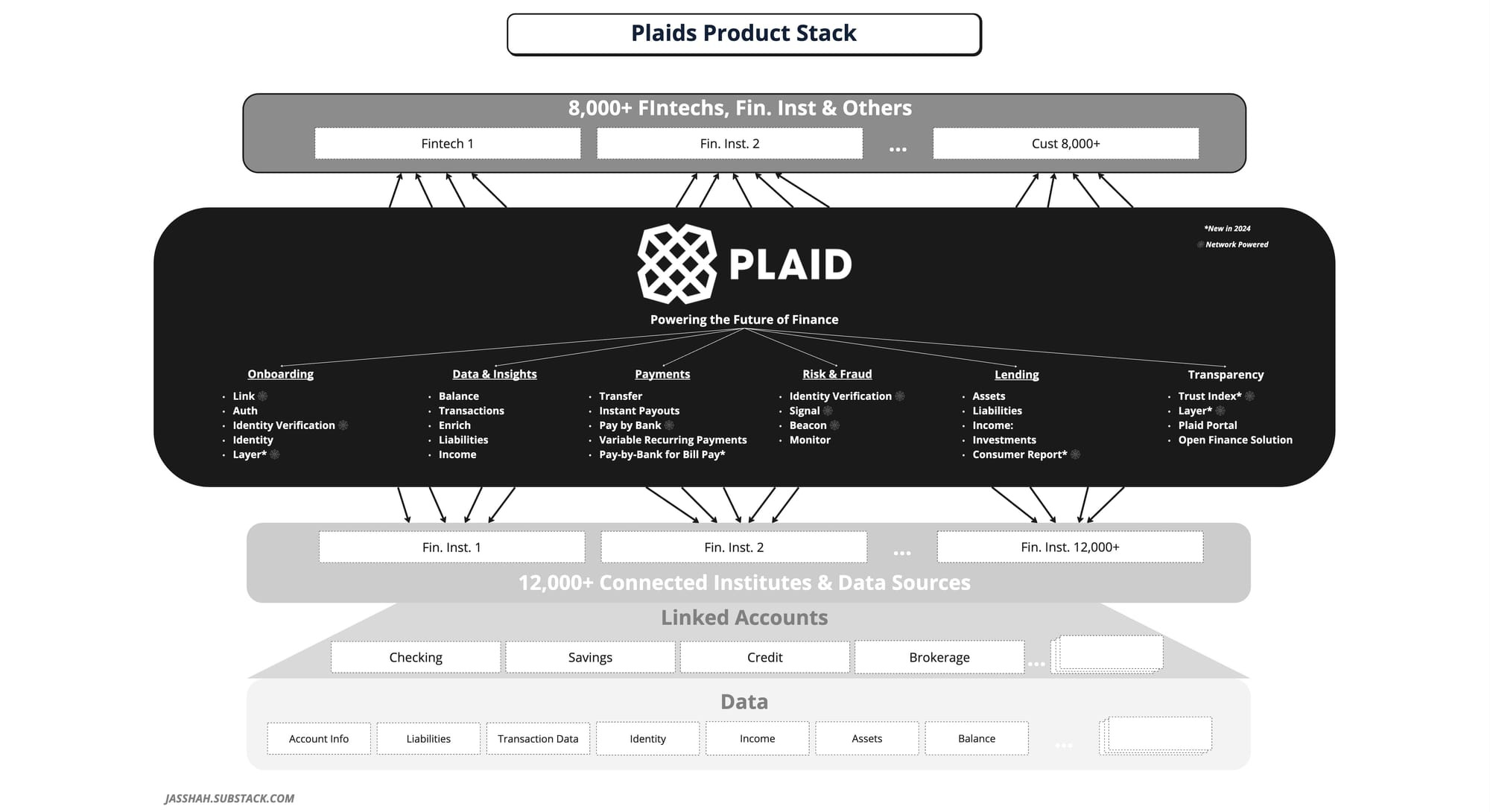
Yeah, absolutely. We should replace wallet addresses with a series of emojis and smiley faces, and I think that'll solve it. My address will be cat, cat, unicorn, robot. That'll be fine. The other thing that stuck out of what you said is you compared yourself to Plaid, which is really interesting. Plaid and data aggregation are some of the first — I mean, not the first, but the second-generation embedded finance stuff — and the limitation of those companies still to this day with our existing banking system is that they're read-only. Whether it's through screen scraping or APIs, the only thing you can do is look. You can look, but you can't touch. You can't, at least yet, through a third-party connection, move this money from Bank of America to Fidelity. But with blockchain-based systems, you definitely can.
And we're in this transition period where the on-chain financial system is still much smaller than the traditional one, but it is just so much more performant, because you can read, write, and own, to steal a phrase. I wonder if at some point Plaid will be acquiring you? Will you be acquiring Plaid? Because at the end of the day, we're trying to solve the same thing for a customer, which is the customer controls their assets. How do you see web2 fintech and web3 fintech that's going after similar use cases — partnering, converging, or working together?
Edward Woodford
I mean, we're seeing this convergence already. If you look at the traditional payment partners that we service today, we service groups like Stripe and Shift4 and Nuvei and groups like that, and many more. And groups like Worldpay. And that's across a whole set of use cases and applications. In terms of the Plaid analogy, I was using the analogy primarily around the authentication product that we've built.
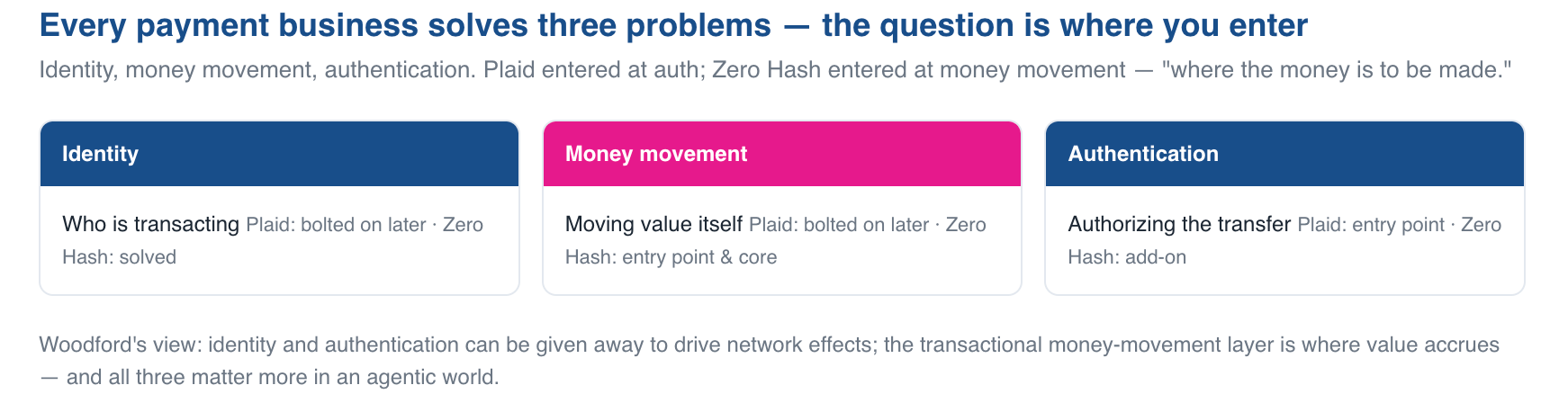
But you're absolutely right in terms of the ability to move assets in a way that is, again, abstracted. I think ultimately, when you look at any payment business, whether it be building for today or building for tomorrow, effectively you're trying to solve three key problems. One is identity. The other is money movement. And the final one is authentication. And obviously Plaid started coming at this from the authentication piece. And then they've tried to bolt on identity, and then they've tried to bolt on money movement. But ultimately it does what all payment businesses are trying to solve for, especially when you think about the agentic world that we're moving into. Increasingly, those three problems become increasingly important — or those three opportunities become much bigger opportunities. zerohash really came at this from a money movement question, and we've solved the identity question as well. And then also the authentication question is an add-on piece that we've built as well. I do ultimately think that the money is to be made in a transactional business.
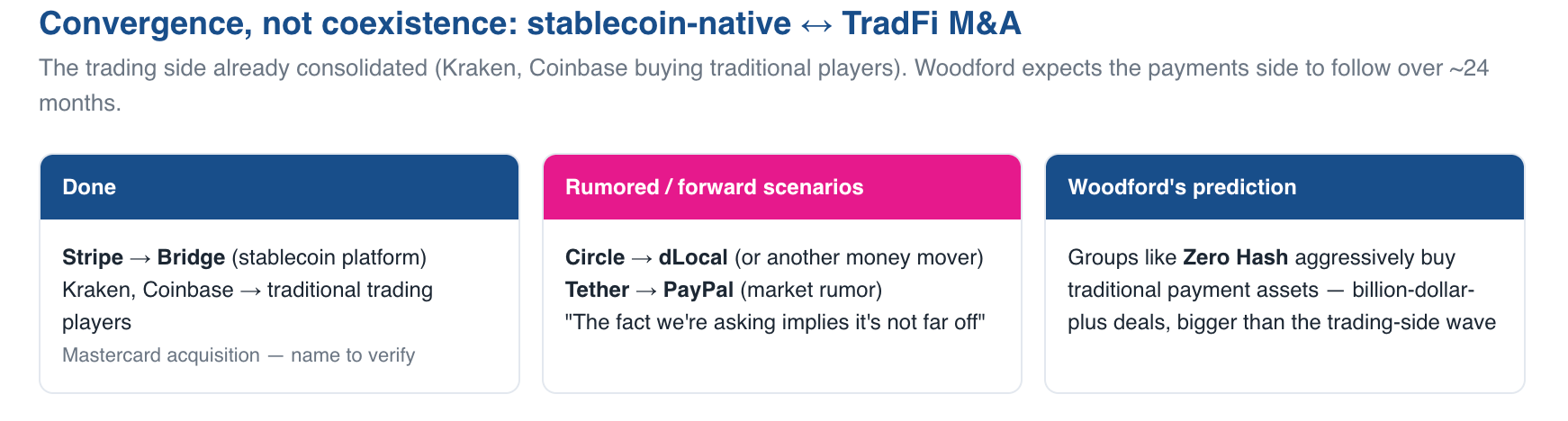
In terms of the money movement, we can effectively give our authentication layer and identity layer away, in terms of driving network effects. Look, the reality is that we've seen massive convergence, particularly in the trading space. So, you look at, for example, Kraken buying very traditional players, Coinbase again buying very traditional players. I think we're going to enter, over the next 24 months, massive consolidation and movements from both sides. So, what I mean by that is, it would not surprise me if Circle were to make a big play for a traditional money mover, whether that be a group like dLocal or others — that is a very clear opportunity that can exist. Equally, it will not surprise me — and I think you could apply the same thing to Tether — right, you saw the rumors, should Tether buy PayPal? I mean, just the fact that we're asking that question implies that we're not too far away from something like that happening. So, I do anticipate a more stablecoin-native business, like a Tether, like a Circle, acquiring increasingly more traditional assets in the space.
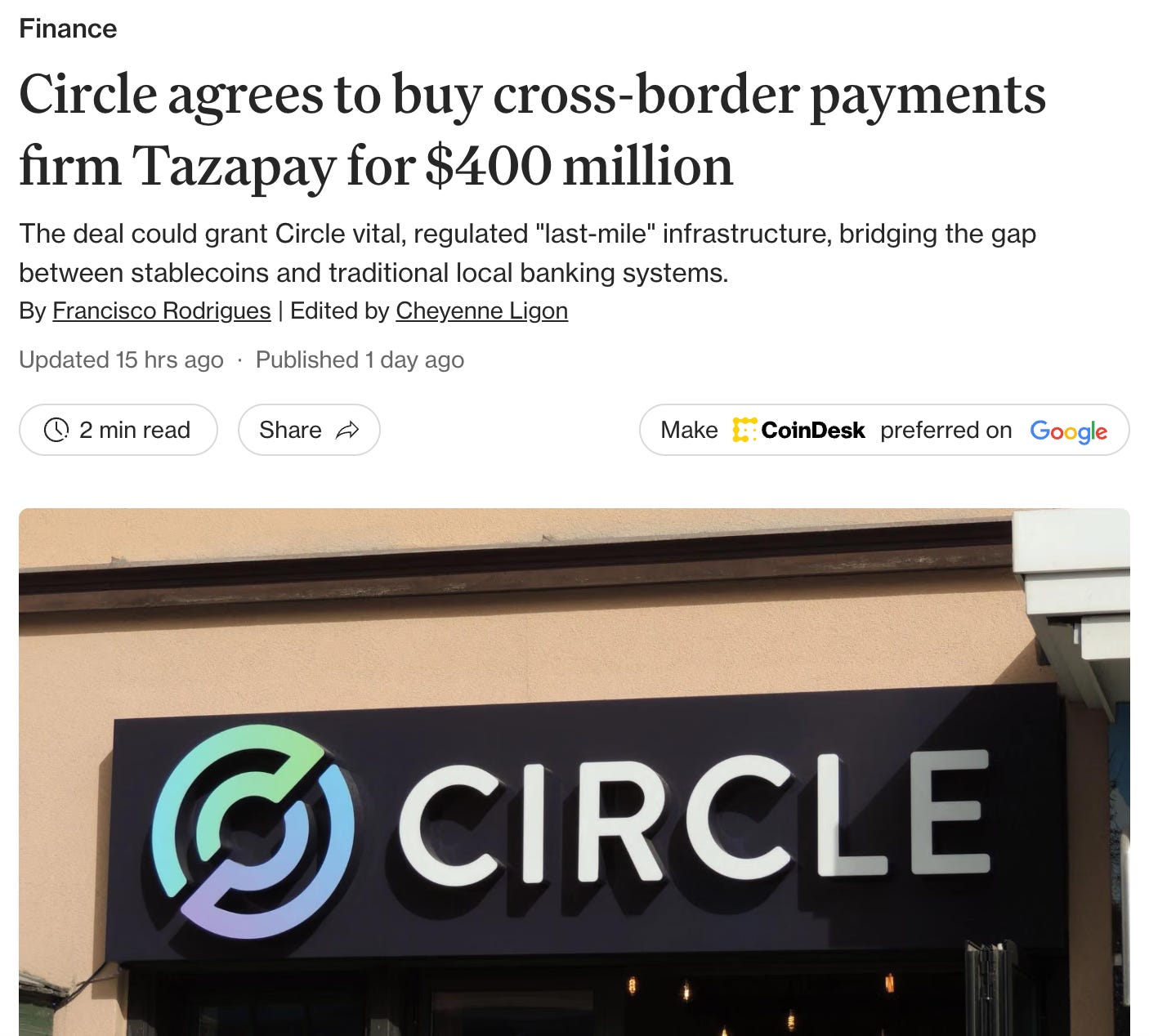
Equally, you're going to see companies like zerohash buy more traditional assets in the payment space, because again, these two things are not going to coexist, they're going to converge. We're already seeing that stablecoins are just a very powerful alternative payment method that solves a lot of applications and use cases. And so naturally these things should not sit side by side. They are going to converge. And so, 100%, you are going to see a convergence. And I think it's going to be even bigger than what we see on the trading side, where you've seen very large acquisitions, billion-dollar-plus. You've already started to see that with Stripe, right — Stripe bought Bridge, and Mastercard bought BVNK. And I think now you're actually going to see a lot more groups like us be very aggressive, moving in and acquiring assets in the traditional space to provide a more holistic solution to our customers.
Lex Sokolin
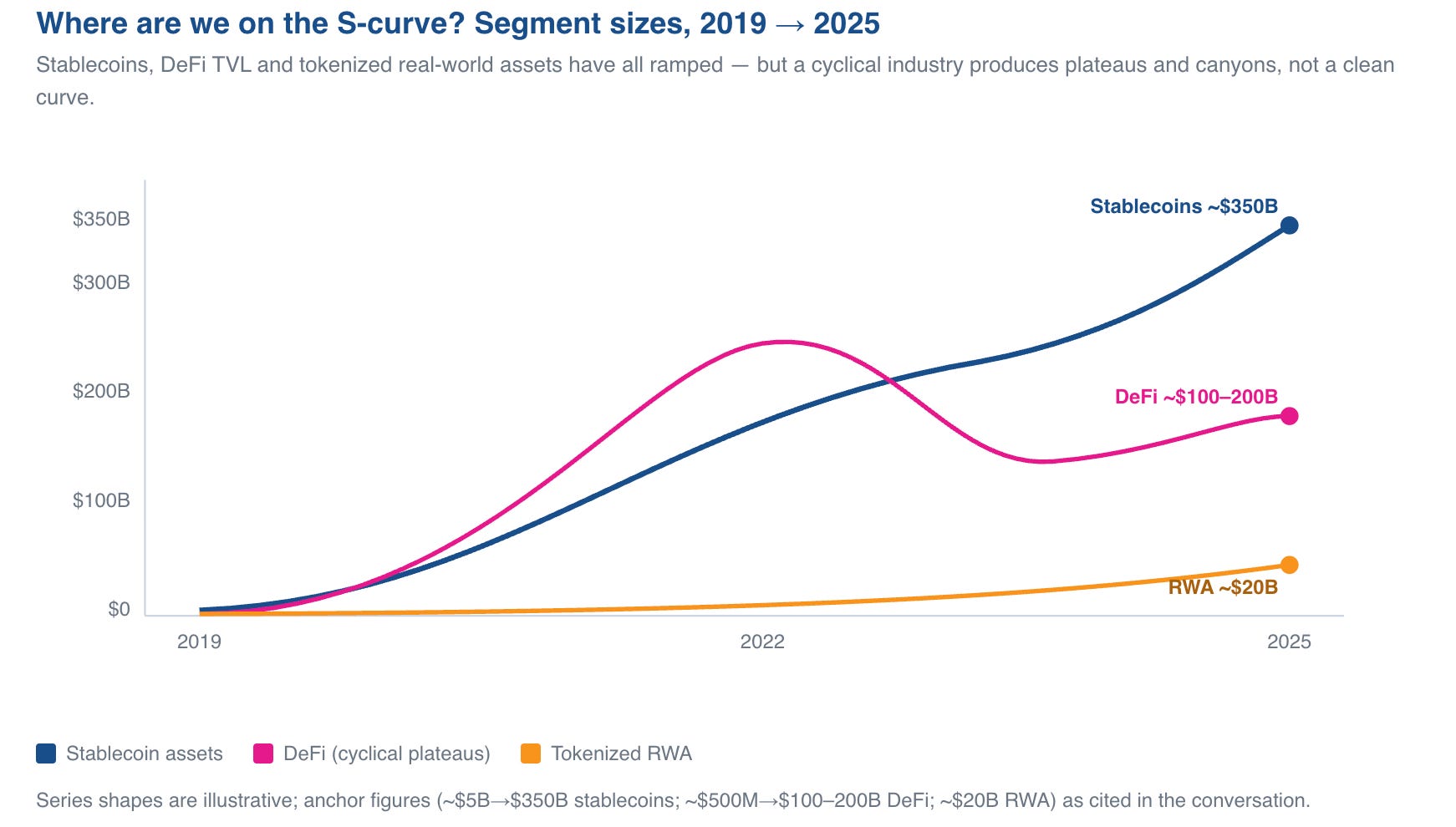
So, when I think about that, I also think about the adoption curve, and it usually follows an S-curve shape, where in the beginning nobody believes you, and then things start to accelerate and go exponentially high and really fast, and at some point, you get to penetration of a market and it starts to level off. And crypto is very frustrating because it's such a cyclical industry. And a lot of the cyclicality comes from either macroeconomic and geopolitical risk, or it comes from, let's say, behavior from individuals that is able to blow up the entire industry every couple of years. So rather than something closer to the fundamentals of, oh, this is a better way to pay people because there's less funding for a small business — it's hard to tell where we are on this S-curve. Because in 2021 or 2019, you could say, look, we're about to go up this ramp, with DeFi at 500 million and stablecoins at 5 billion. We're going to go up this ramp. And here we are with 350 billion on the other side in stablecoin assets, and, depending on the day, decentralized finance between 100 and 200 billion.
And these much larger volumes coming in — real-world assets and tokenized assets now in the 20 billion range. So, there are lots of curves up. But at the same time, because you constantly have these bear markets, you also have these plateaus and canyons in terms of adoption. And so, from where you sit, where are we in the S-curve? Is it going to be, in four years if that's how long it takes us to talk again — are we going to be sitting here and it's 5 trillion of stables, or are we sort of at a local maximum, like this is where we're going to hang out for a while? How do you think about that?
Edward Woodford
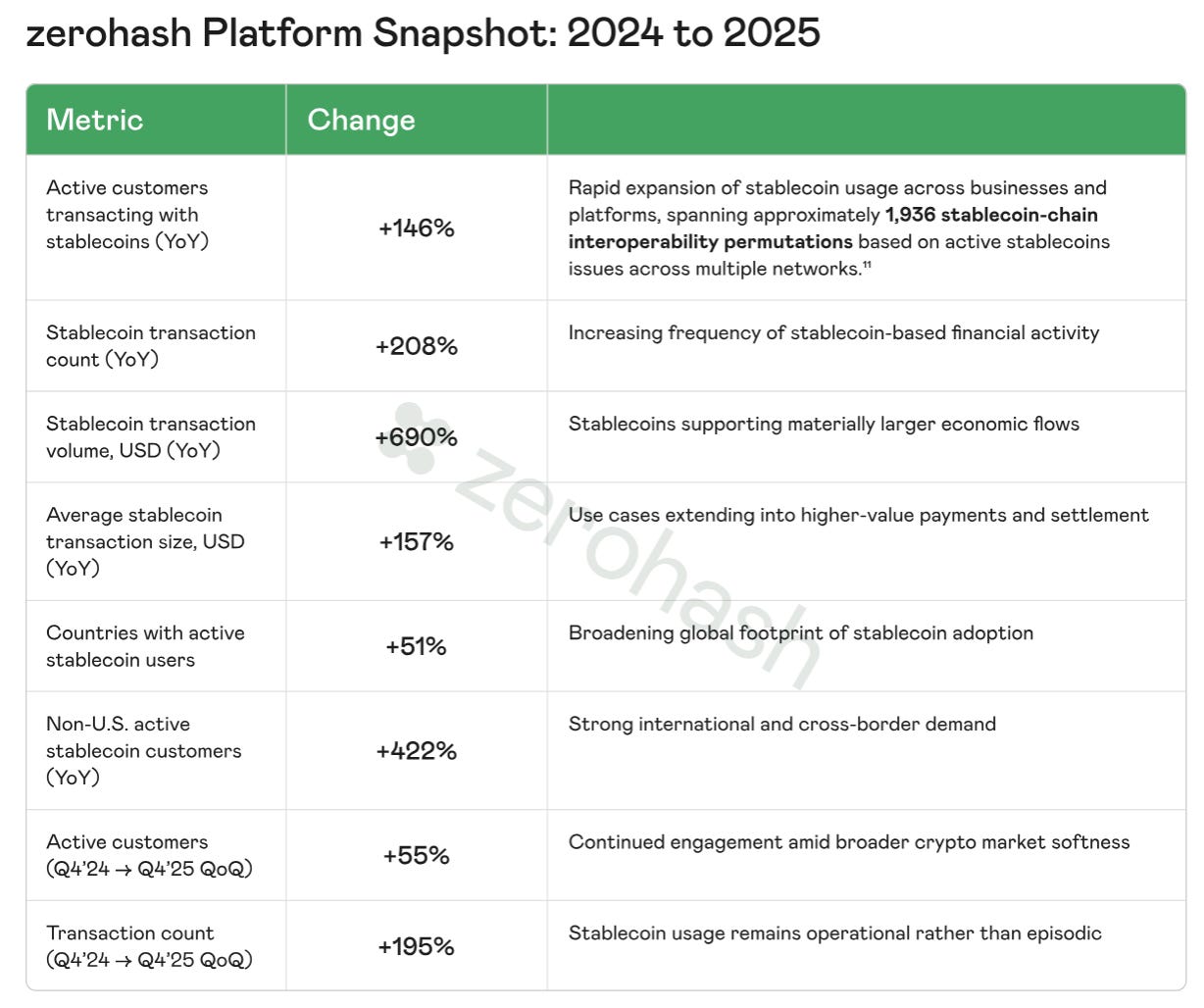
So, I think we're still incredibly early. I think we're nowhere near the maturity phase of the S-curve. Nowhere near. And the reason for that is because of some of the frictions that I spoke about and the analogs that it creates. So, where we are today in the S-curve is — you can use different stats, but let me use some zerohash stats — our stablecoin volume last year grew 690% year on year.
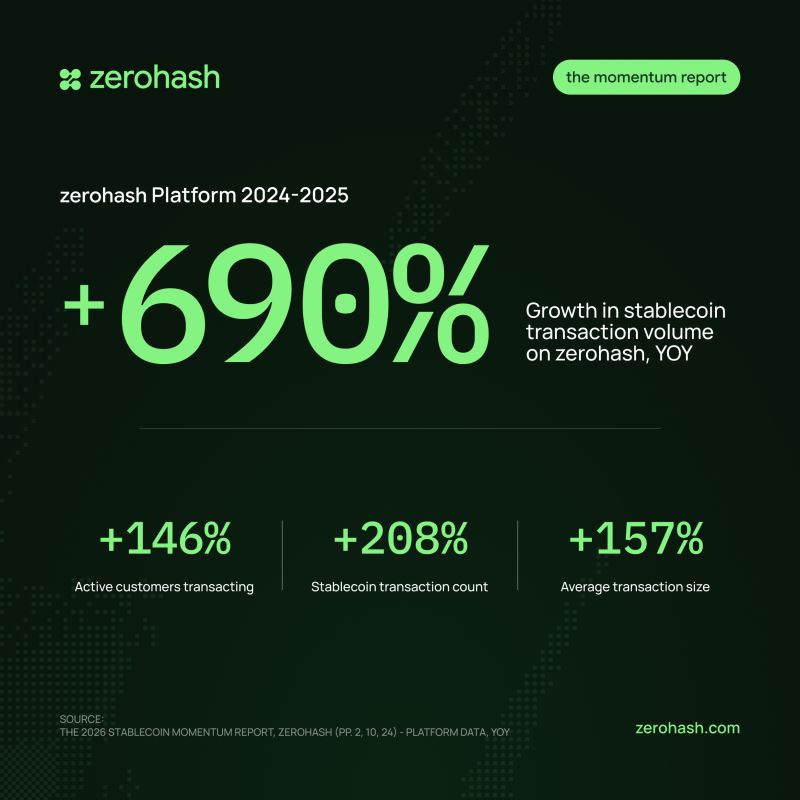
We expect a similar sort of growth trajectory this year. That is very meaningful. We saw a 157% increase in average transaction size, which I think shows again an increase in enterprise and institutional participation, but also just a trust factor and moving in larger size on chain. So I think we're still very early. We saw some big problems, but the big opportunity — you can say, okay, this space has more volume than Mastercard and Visa. And then people always say, well, if you take out trading volume, that doesn't matter. Well, I always push back and say, look, money movement is money movement, whether that be for trading or not. And frankly, if I move money for an Interactive Brokers customer to fund a trade on a Sunday because they want to do something on a prediction market, or because they want to do something based on the Japanese markets that have already opened — that is money movement. That counts.
We need to think of this more broadly than just pure-play I'm-swiping-my-credit-card. So, I think that's really important. There are obviously some big unlocks. The big unlock that I mentioned is through usability, but also distribution. And so, we're going to have some very meaningful announcements over the next two or three weeks that will make the friction to even integrate this rail just seem very small. And so, again, you've got to overcome that first step in the adoption cycle. If you look at the Fortune 500, it's very under-penetrated. If you look at the number of people that have interacted with stablecoins, we're very under-penetrated in terms of what this could be from an alternative payment method perspective. So, I think we're incredibly early, and what will drive us to go up the S-curve is solving this usability challenge, and equally solving this distribution challenge. But also, look, GENIUS passed but it takes 12 months — the rules haven't even been finalized.
So, I truly believe that every bank is going to enable stablecoins as an alternative payment method. I don't think they're going to hold stablecoins on balance sheet — I doubt it, because frankly, holding a deposit is a much better business for the bank. It's a much better store of value for customers in the sense that it's FDIC insured. But the rules aren't even implemented, and there's going to be a lag time. So, there are all these considerations of lags. There was the law that was passed in the US. We're still not at the rulemaking-being-finalized stage. Then big FIs and enterprises need to look at those rules, think about how it impacts their business, and then adopt. So, we're still so early. I think we're nowhere near the maturation phase. Nowhere near.
Lex Sokolin
That's fantastic. 5 trillion it is. So then, one of the stories that people tell us — and let's land on this question — is around the machine economy and AI agents. And I've been very vocal about this as a place of growth for crypto rails, but let's take a skeptical view towards this question. I think a lot of people, whether it's Stripe or Coinbase, are telling the story that the robots are coming, they're going to be using stablecoins at huge scale, and that's where a lot of the demand is going to come from. Number one, do you believe that story as well? Do you see it? But then, more critically, is there any evidence yet? Do we have any spiky demand, maybe across your client footprint, where you're starting to see much more automated types of use — where this infrastructure is more fit for use than the Visa network or the traditional rails?
Edward Woodford
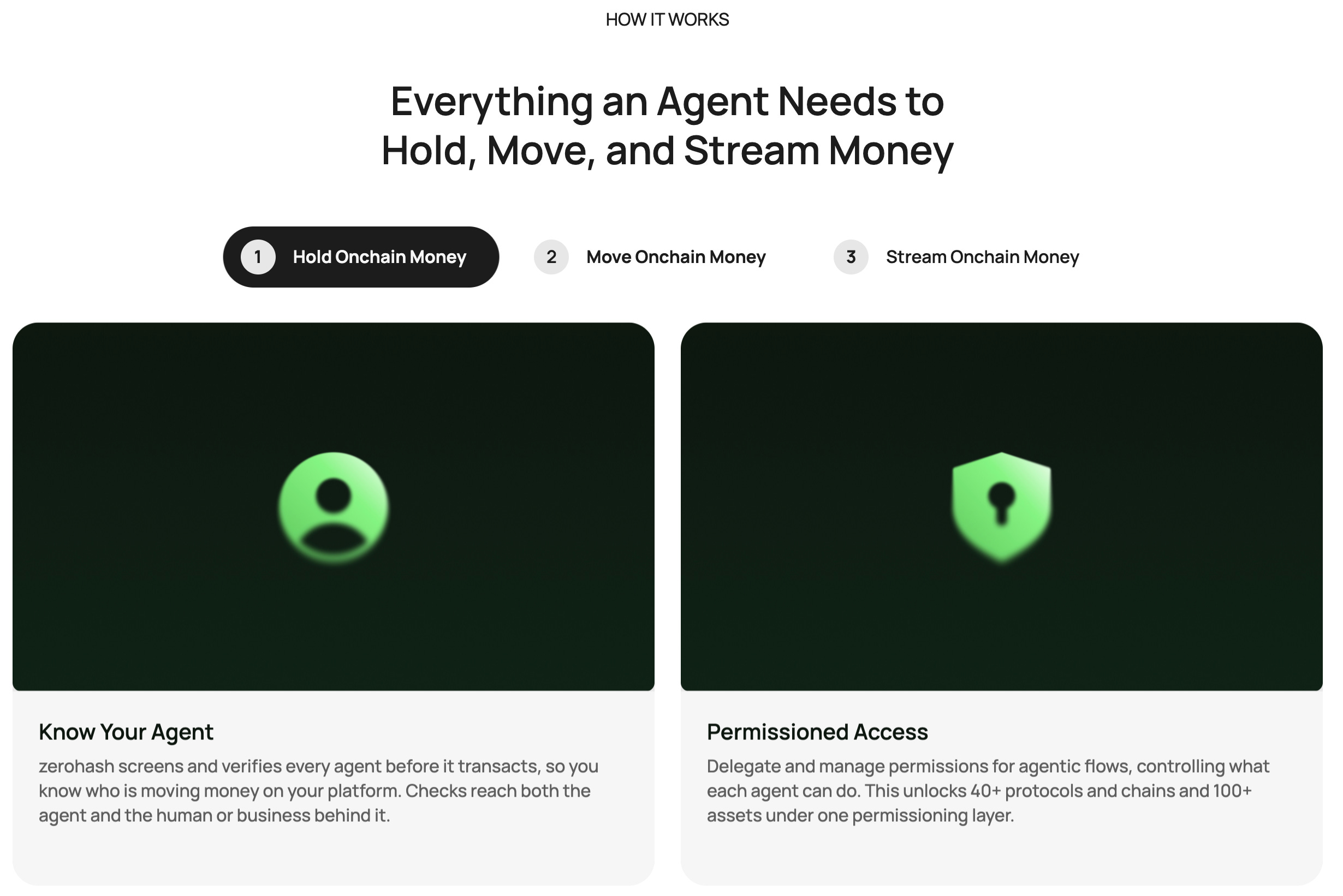
Great question. I think this is one of my pet peeves in the space — a lot of people talk at a high level, or they're talking about POCs. At zerohash, we talk in terms of actual use cases and actual applications. And look, we live and breathe the space, but we're by no means acolytes. Do I believe that other payment methods will exist, other money movements will exist? 100%, in the same way that when you look at communications, there are still other forms of communications even when the electrification of markets and communications existed. So, this isn't a binary construct. And I think, going back to the point of trust, it's always about having a healthy level of skepticism and applying that, and actually solving the issues that lead to skepticism. So that's more of a general point in terms of how we think about building businesses and building trust. If you look at the agentic space — and I've spoken about this recently at the Alchemy event, and I spoke with the founder of x402 and a bunch of other folks on this topic — I truly believe the stablecoin intersect with AI is around agent-to-knowledge transfer.
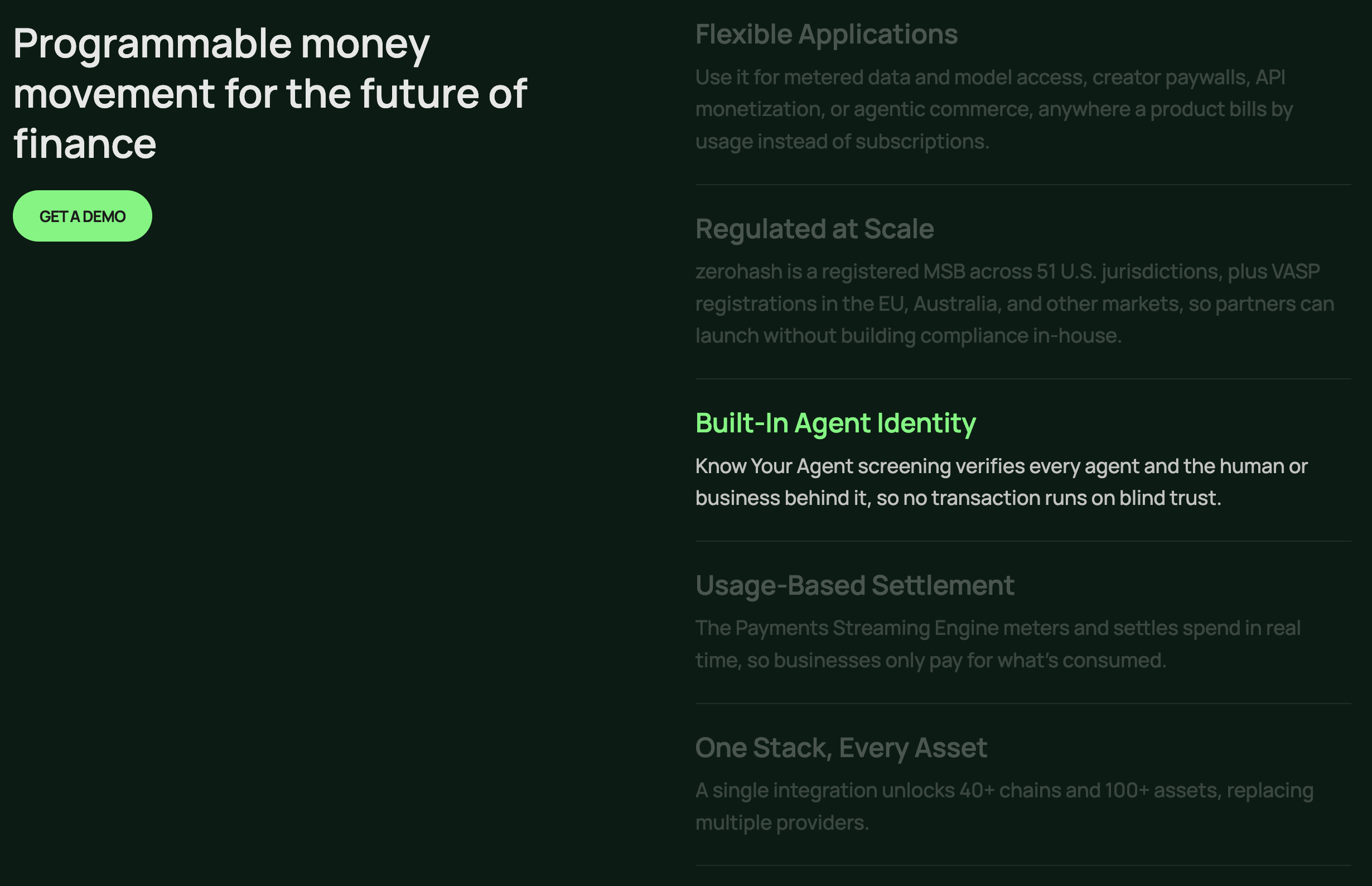
And what I mean by that is, the way that the internet is evolving is going to fundamentally shift. In the sense of, today, when you search on the web, the knowledge bank or the creator gets paid based on the click, the ad, the referral link. That is fundamentally changing, in a world where the content creator that the LLM has pulled from is not going to get paid in the same way. And so, I do believe in a world where things are going to become more fragmented, and the way that content creators have to be paid has to shift. And so, what I see the world moving increasingly towards is, if you have billions of agents and billions of content or knowledge creators, how do those two systems interact? And I do believe that one of the only ways to do that is with a payment rail that is global, because you're going to have an agent from somebody in Mozambique pulling from a content creator in Brazil. So, the importance of global money movement is important. Then, secondly, the big value proposition of stablecoins is the ability to make money like software, making it programmable, in the sense of the knowledge is only transferred to the agent when the money is delivered, and then the knowledge effectively DvP settles.
Now that is a little bit pie in the sky, but that is where I see the opportunity existing and the overlap being incredibly real, because that is where stablecoins have an unparalleled ability to serve the agentic world, which is global and programmable. In terms of what we are seeing from clients today, we are having conversations with the largest providers of web infrastructure, looking at this in a very material way. And we're much more focused on the money movement piece between agent to agent or agent to knowledge creator, than, for example, me being able to use my stablecoin balance to buy a pair of sneakers. We're still early, but that is where, to your point about what is real, it's those value propositions and coming back to where is value created, where is it uniquely positioned. So, where I push back, for example, recently on this panel — somebody on the panel was saying, you know what stablecoins solve for is micropayments; micropayments are unbelievable for agent commerce.
And I said, well, let's hold on. When we look at iTunes, for example — actually, when iTunes started, it was a dollar a song. Actually, Apple lost money on that. But what they did was, it's called — they just batched the payments. Most people don't come and just pay for one thing. They don't just buy one thing. And so, batching exists. And so, in stablecoin world, this concept that an agent needs to be paid a fraction of a penny in real time — I just don't subscribe to. I think that the agent will pay on a weekly or daily or an hourly basis, and that is where you will aggregate these individual sub-penny or penny amounts of value transfer into a batched payment. So, again, it comes back to what is the value proposition, and really lean into those value propositions. I'm very happy for people to be trying to think about batching, this concept of micropayments.
I just think that that's not a long-term sustainable edge — that is unique to stablecoins. This global network of networks coupled with the programmability; that's the sustainable edge. So that's why we're spending time with clients and with prospects around those two key value propositions. But again, we're early. But the compression in that cycle is enormous. If you look at the evolution of the models, just the scale at which they're scaling, the importance of the ability to move value in the same way, I think, is equally as important.
Lex Sokolin
The conviction you have about the future is one I share, and also, I think it draws a straight line from the founding of the company to where the future is going to be. So, congratulations again on all the success. Excited to hear about the announcement that you're talking about. If our listeners want to learn more about you or about zerohash, where should they go?
Edward Woodford
Follow us on X, just zerohash on X, or on LinkedIn, or feel free to contact us at contact@zerohash.com. We'd love to hear from you.
Lex Sokolin
Fantastic. Thank you so much for joining me today.
Edward Woodford
Thank you, Lex.
Postscript
Sponsor the Fintech Blueprint and reach over 200,000 professionals. 👉 Reach out here.
Read our Disclaimer here — this newsletter does not provide investment advice
For access to all our premium content and archives, consider supporting us with a subscription.


