

Hi Fintech Architects,
In this episode, Lex chats with Steven Schwartz, CEO and co-founder of Whop, the Brooklyn-based marketplace where almost 100,000 people earn money each month selling software, education, communities, physical goods and clipping campaigns through a single API-first stack.
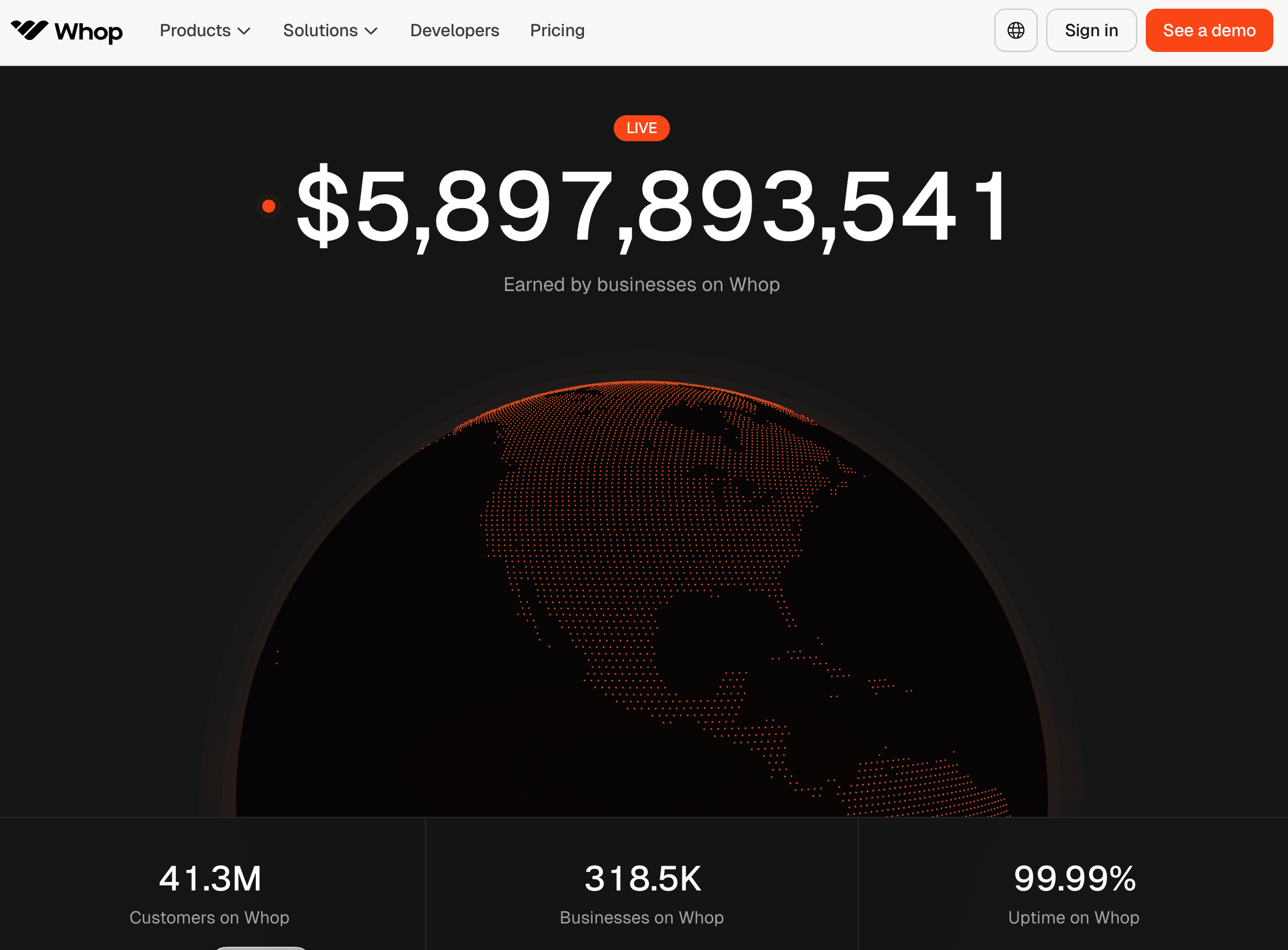
Lex and Steven discuss how Whop went from a license-check tool for a handful of Mac and Windows apps to a global commerce platform settling nearly $500M a month in top-of-funnel income to users, and why Tether’s $200M investment at a $1.6B valuation makes stablecoins the only unifying rail capable of paying earners in Morocco, Nigeria, Vietnam or El Salvador the same way as earners in Brooklyn.
Steven explains why Whop treats customer acquisition — not payments or user management — as the real wedge against Stripe and Shopify, why the platform now has more agent users than human users, and how an API that lets an LLM spin up an LLC, a storefront and a running ad campaign in one prompt reframes what “starting a business” means. They explore the trajectory from a billion earners to a public listing, and whether a creator-economy fintech can meaningfully invite its own users onto the cap table.
For those that want to subscribe to the podcast in your app of choice, you can now find us at Apple, Spotify, or on RSS. Or to support this writing and access our full archive of IPO primers, financial analyses, and guides to building in the Fintech & DeFi industries, see subscription options here.
Thanks for your time and attention,
Matt & Lex 🙌
Events Since Recording:
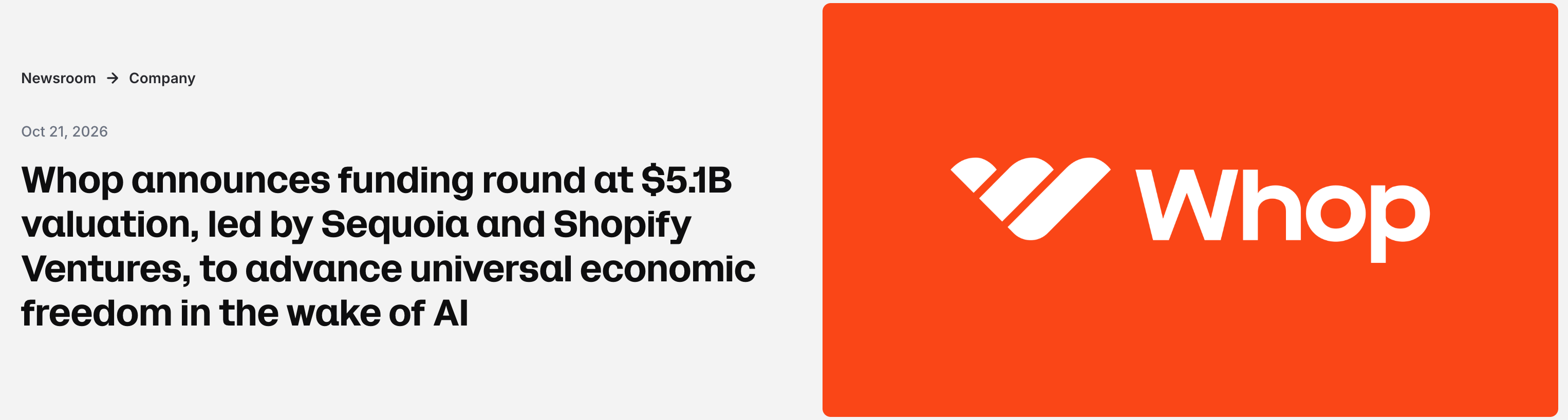
Recorded September 2026. In the weeks after this conversation, Whop closed a $200M Series D at a $5.1B valuation — a 3.2× markup on the $1.6B Tether round discussed in the episode — led by Sequoia Capital and Shopify Ventures, with Tether retaining its February stake. The company also shipped three products that directly extend the thesis Steven lays out below: Whop CLI (July 2026), which makes the full API agent-callable and is already handling 350,000 calls a day; Business Blueprints, which has spun up 21,000 ready-to-sell businesses in six weeks; and Economic Intelligence, a revenue-share decision engine. Steven’s claim that “I can tell my Claude right now to go spin up a business” was, as it turns out, roadmap.
Key notable takeaways:
Whop’s wedge is customer acquisition, not payments. Payments, user management and hosting are table stakes already solved by Stripe, Shopify and Discord. What sellers actually struggle with is their next incremental customer — and Whop’s take rate (3% on direct sales, 30% on Discover-sourced sales) only makes sense when read against that top-of-funnel claim.
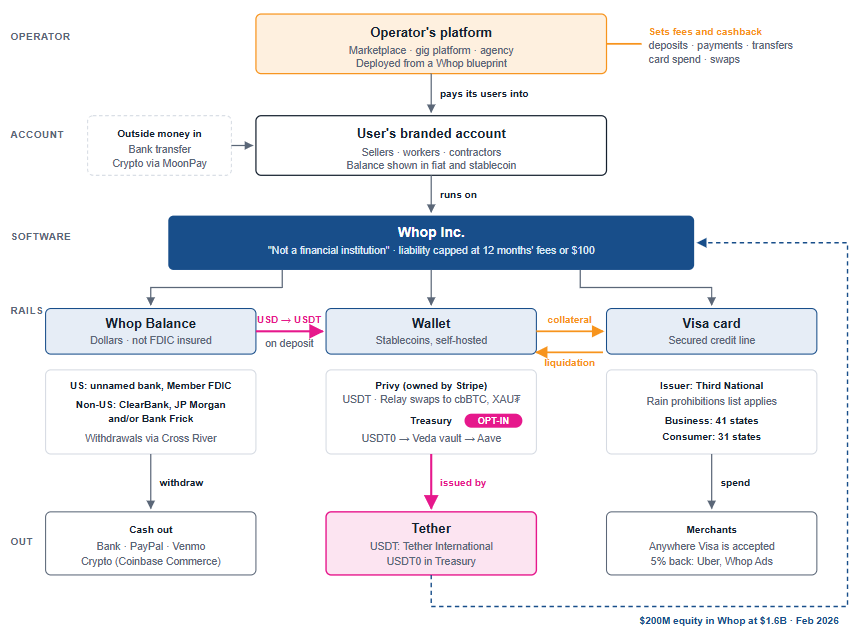
Tether’s $200M isn’t a crypto bet, it’s a global payouts bet. Whop services more countries than Shopify, Stripe, Square or Cash App because stablecoins are the only rail that works equivalently in Morocco, Nigeria, Vietnam and the US. Card-spend, DeFi access and local off-ramps all come “for free” once the balance is USDT; a bank-rail version of Whop can’t exist.
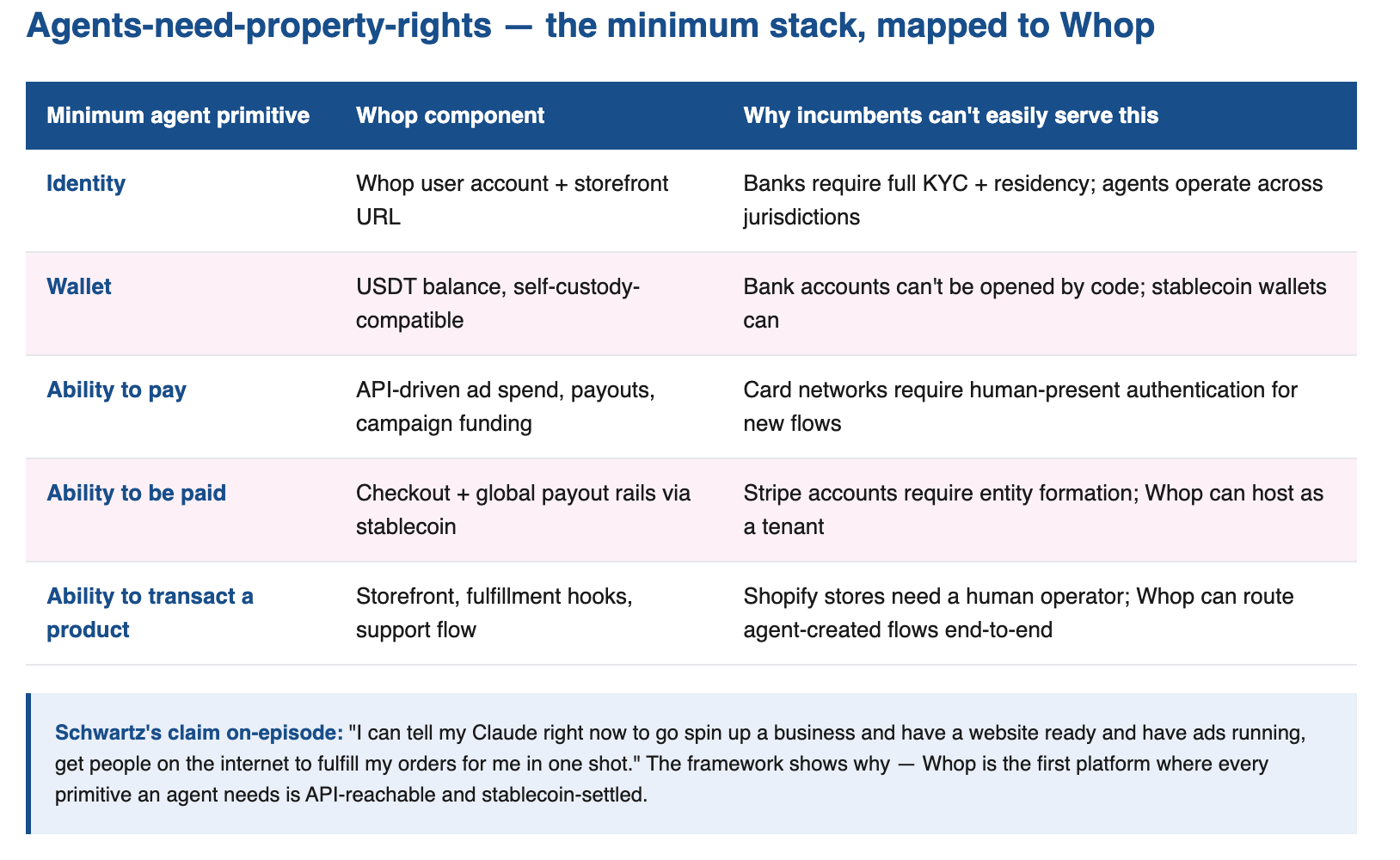
Whop has more agent users than human users. On-platform traffic now skews toward LLMs, and Schwartz’s claim that he can tell a Claude instance to spin up a business “in one shot” is the product spec, not a demo. The strategic position is explicit: don’t play the model game, be the stack those models call out to.
Background
Steven Schwartz grew up chronically online. He taught himself to build with Lego Mindstorms before moving on to video and iOS development, and by the time he was 13 he was taking paid iOS contracts posted in public Facebook groups. One of those posts came from Cameron Zoub, a kid his own age looking for a developer; the two of them have been building together ever since.
Through their teens they ran a rolling portfolio of internet businesses — iOS apps, sneaker reselling, buying and selling from China on eBay and Amazon, agency services, a secret texting app, an app that helped homeless people get paid, and a Discord-and-Facebook-group software bazaar paid for in Bitcoin as early as 2014. None of them exceeded a thousand customers, and that’s exactly what shaped the Whop thesis: a sustainable internet income doesn’t need power-law scale, just infrastructure that treats the first ten customers as seriously as the millionth. Whop, which they launched together with developer Jack Sharkey in 2021, is a direct extension of that lived playbook.
👑Related coverage👑


Topics:
Fintech, Stablecoins, Payments, Marketplace, DeFi, Web3, Crypto, Tether, USDT, AgenticAI, AIAgents, LLMs, DigitalAssets, Whop, Hyperliquid, Robinhood, Stripe, Shopify
Timestamps
1’03: A Playbook for the Post-Cubicle Economy: Why Whop Wants to End the 9-to-5
3’44: A Decade of Side Projects Before Whop: How Two 13-Year-Olds Found Each Other on Facebook
8’31: Everyone Is a Builder: Why the Creator vs. Consumer Divide Doesn’t Hold
12’09: The Damaged Perception of Success: What Social Media Took From Builders
14’57: Facebook Groups, Discord, and Bitcoin: Selling Software Before Whop Was a Website
18’02: Abstracting Away the Boring Stuff: What Whop Took Off Every Builder’s Plate
20’04: Top-of-Funnel Income-as-a-Product: Why Whop Isn’t a Normal Fintech
22’44: Amazon Is for Search, Whop Is for Discovery: The Next Era of Entrepreneurship
25’22: $1.5M a Day in Physical Goods Is the Smallest Segment: Whop’s SKU Explosion
29’03: $500M a Month in Earner Income: The Hiring Bar That Kept Up
31’33: 200M From Tether to Pay Earners in 241 Countries: Whop’s Stablecoin Bet
36’37: Crypto Overcomplicates, Stablecoins Just Work: The Customer-Journey Case
39’27: More Agent Users Than Human Users: Whop’s AI Traffic Mix
44’05: From 100,000 Earners to a Billion: The Home-Run Case for Whop
46’32: The channels used to connect with Steven & learn more about Whop
Illustrated Transcript
Lex Sokolin:
Hi everybody, and welcome to today’s conversation. I’m super excited to have with us Stephen Schwartz, who is the co-founder and CEO of Whop. Whop is an incredibly quickly growing marketplace for businesses and has transitioned into a really compelling fintech and crypto-based infrastructure. And so I’m really excited to tell the story with Stephen’s help. Stephen, welcome to the conversation.
Stephen Schwartz:
Thank you so much for having me on.
Lex Sokolin:
Just to lay the groundwork, what kind of company is Whop?
Stephen Schwartz:
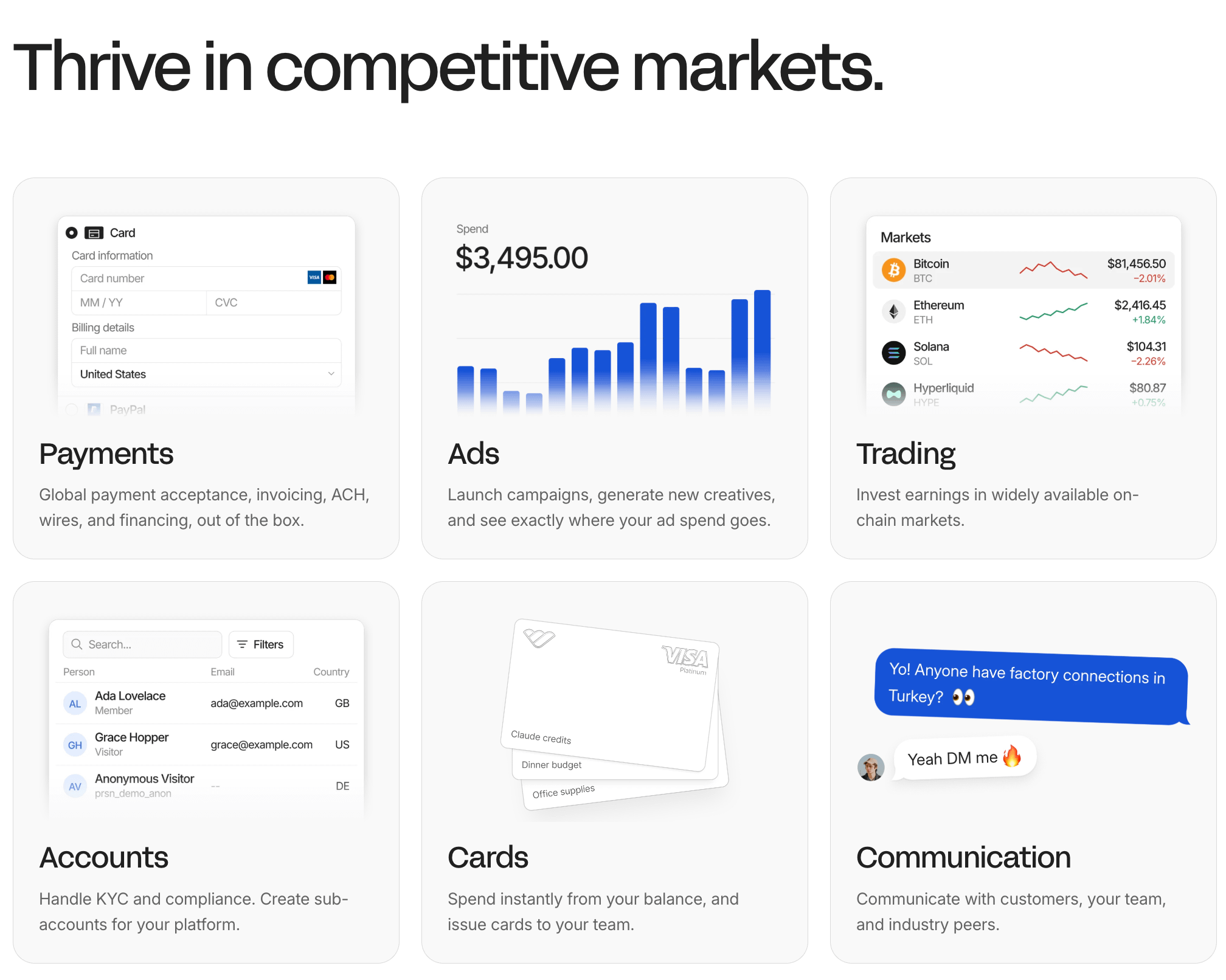
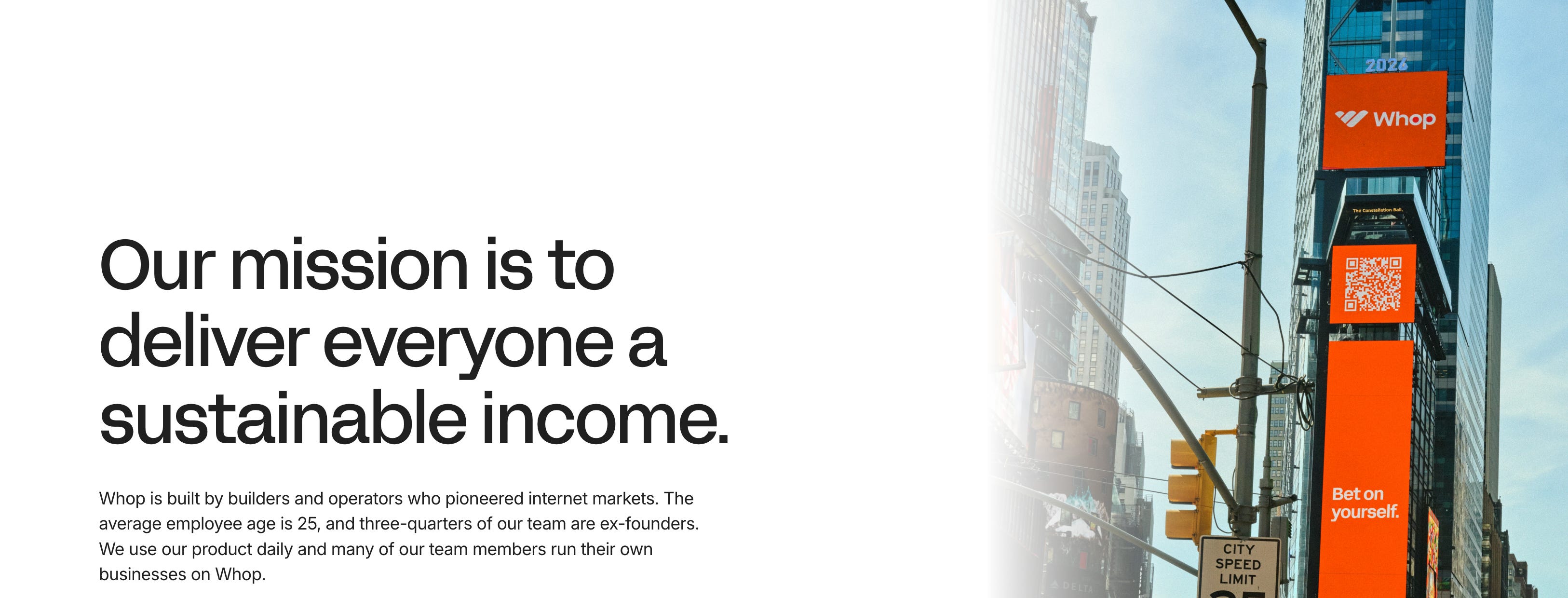
Whop is a very mission-oriented company, I would say. And our mission is to deliver everyone a sustainable income. And it’s actually very important to us that we do achieve that mission. So you can call Whop a lot of different things, but most importantly, we are on a mission to deliver everyone a sustainable income, and we’re very serious about that.
Lex Sokolin:
How did you come into this mission? What motivates you to make this a reality?
Stephen Schwartz:
Well, I think if you look at where the world is headed and you look at what people are doing with their time today compared to what they were doing with their time ten years ago or 20 years ago — work takes up most of people’s waking day. That means that when people look at their last 40 years of life, they’re 60 years old. They’re going to have spent maybe the majority of their entire life working, definitely the majority of their waking day working.
And my whole life story is one that involves pursuit of a lot of different alternative ways to do work and to make money than what the traditional path has made clear to people. The inspiration comes from my entire childhood of doing that with friends that I met on the internet, and we figured out ways that we could make an income in ways we could spend our time that weren’t behind a cubicle, weren’t in a 9-to-5 job.
And I think that now the whole world is realizing that they don’t need to be in consulting. They don’t need to be in a standard 9-to-5 job set that was cast upon the whole world for the last almost 5,000 years. So that’s the inspiration behind Whop. And I think what motivates me is we figured out a very clear playbook that is somewhat nebulous on what to do on the internet that’s productive, and how to make a business for yourself, how to make an alternative stream of income that’s actually sustainable. And we just want to bring that playbook to the entire world.
Lex Sokolin:
In your mind, when you use the words “work” and “job,” what do you mean by a 9-to-5 in a cubicle? What do you mean by doing work on the internet? Can you tell me more deeply how you characterize these things? And how do they make you feel?
Stephen Schwartz:
I’m lucky because both of them make me feel excited and fun and like I’m doing something that I actually like to do. But I think that the word “work” literally means effort that you put in to do a task or a job. And the word “job” implies that you’re making money from the effort that you’re exerting. And most people have a negative connotation with that.
Like I said earlier, when you look at the vast majority of people, they’re not going to be like, “Oh, I love my work.” You get to do really cool things. You get to broadcast content messaging and find really interesting alpha and bring it to a huge amount of people. And that’s probably really satisfying. But most people can’t say that they love what they do. And I think that’s a real problem considering how much time is spent working or doing jobs. So the word “work” and the word “job” mean something very different, I believe, to me — and I would also imagine to you — than to most people in the world. And I think that’s an issue.
Lex Sokolin:
You mentioned a bit about growing up on the internet. What do you mean by that? And give us a flavor of what the internet tasted like for you. What was in there?
Stephen Schwartz:
Growing up on the internet, to me, means spending most of your waking day on the internet. And in my case, that was largely because I was obsessed with programming. And before I was obsessed with programming, I was obsessed with making movies and videos and building out these — I think it was called Lego Mindstorms. I really loved how you could make something with your hands and give it to other people and they could get some value out of it. It was just a super addicting feeling.

But when I had a problem or a question, I would just go down these long crazy rabbit holes and try to discover how to do something better. And this is before all the AI craze. So growing up on the internet to me was learning everything I learned on the internet, meeting a large base of my friends on the internet, via Facebook, via Skype, later via Discord, and all of the things that maybe people would traditionally do in a school setting. I feel as though I accomplished on the internet.
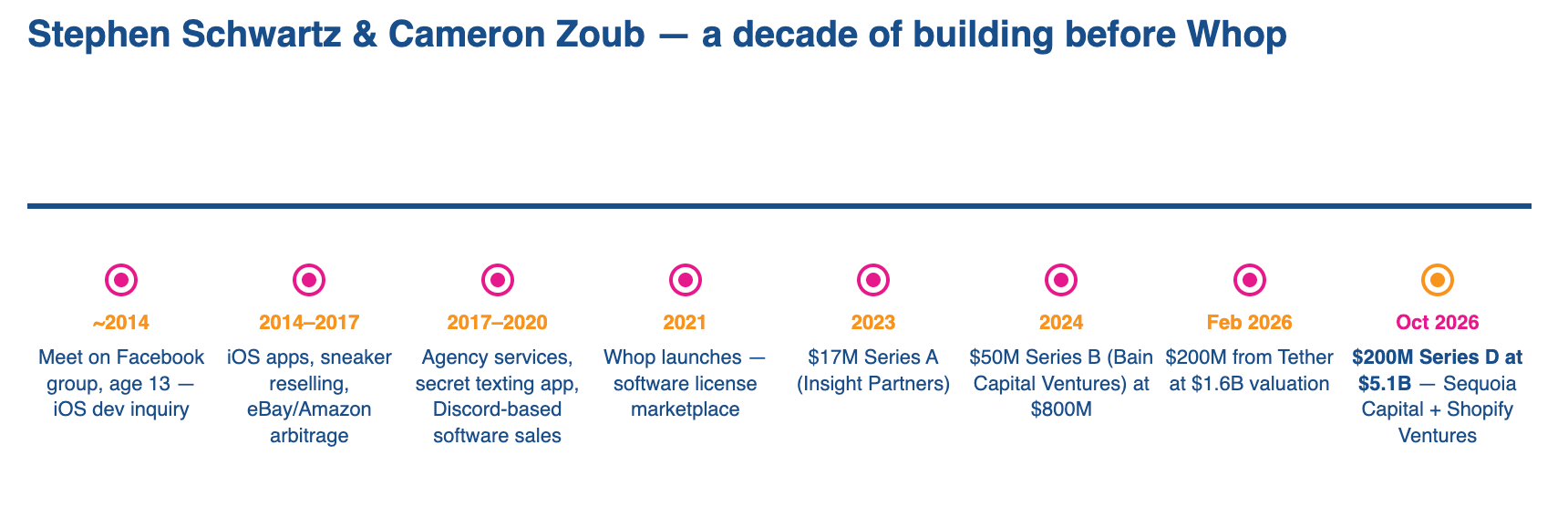
I met my co-founder, Cameron, who I work with today to build Whop, when we were 13 years old on Facebook. We met because he was looking for an iOS developer, and I was an iOS developer at the time, and I responded to one of his inquiries on a public Facebook group. It kicked off a now longer-than-a-decade relationship of us building these little projects together and us finding ways to make an extra amount of money.
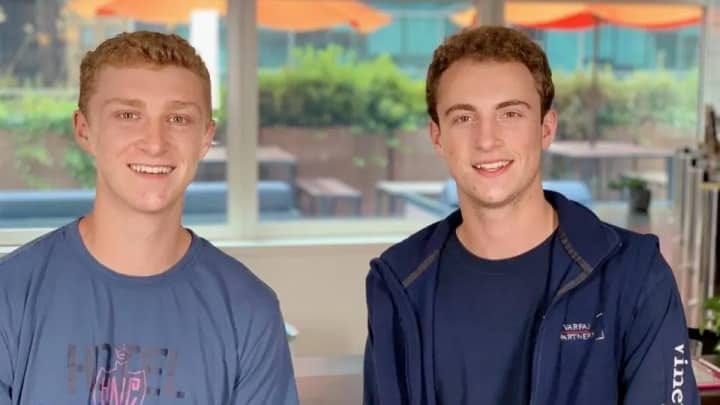
But the money thing — it’s not about the money for us. And it even wasn’t in a very early setting, because Cameron, for example, dropped out of high school when he was a sophomore and he had more money than he knew what to do with. He didn’t go out and buy watches or just live on a big farm. He was literally the same exact person and still chronically online and trying to learn as much as he could, trying to meet as many people as he could, and ultimately trying to build product for these random people in different communities throughout the internet. So growing up online is being infinitely curious and understanding that the possibilities of what you can do are quite infinite.
Lex Sokolin:
This is a bit of a leading question, so I apologize in advance. You touched on this a little bit with the word “building.” But right now, and certainly over the last ten years, if not twenty, there’s the creator and then there’s the audience. There’s the builder of product, and then there are the consumers. There’s a segmentation between a group of people who see being online as a way to express their creativity — and then in order to do that, that sort of presupposes a consumer, an audience, somebody who’s on the receiving end of that.
When you’re talking about being internet-native, how do you think about that divide? Is that real? Is that generational? Is it cultural? Are there people who are just wired to make and people who are wired to consume? Or does it depend on how you grew up and your assumptions about what you can do? Can you open this topic up a little bit?
Stephen Schwartz:
I think that there’s actually a turning point in one’s life where you have a brief window where you have no responsibility. You have a lot of time on your hands, and you can use that time and try to set yourself up for a future that is that of building. I think that window and that time inflection point is a lot later than people think. And honestly, it’s a moment where you decide that you’ve given up on that — when you can’t do it anymore.
I fundamentally believe that everybody is a builder and everybody can create things that are useful, and everybody has a streak of creativity that is slightly unique to themselves. And I think if we don’t believe that, then we have a very pessimistic view on the world. The reality is there’s a lot of people in this world. If we put everyone’s brains together and expect people to be creative and have the ingenuity that everyone, I think, deep down does know that they have, I think the world would be in a drastically more interesting place.
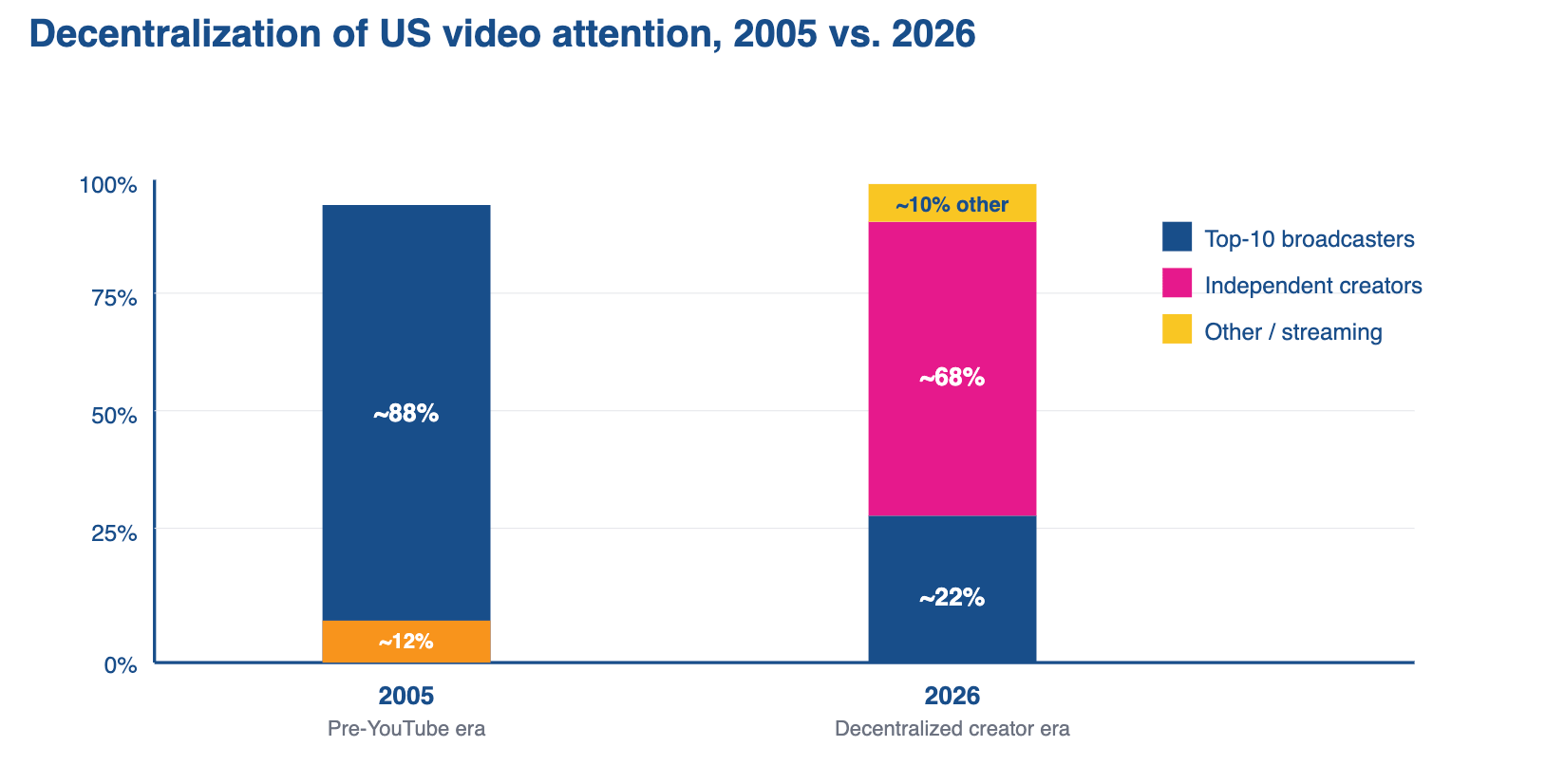
You’re obviously seeing that with a lot of the content creation on broader social media and how much decentralization has happened of what used to be a limited amount of beacons — entertainers and news sources and whatever traditional institution that was responsible for driving value to mainstream, basic consumers has been so decentralized. The only reason that is possible is because it is true how many people can actually be creative and make things useful for other people.
So to answer your question, it doesn’t have anything to do with internet-native. I think everyone is fundamentally a creator and can absolutely build with their ingenuity and creativity. The internet is just a fact of life now. Everybody, for the most part in the Western world at least, has access to internet some way or the other.
Maybe another way to look at this is: when I was growing up, I was kind of the last generation to be straddling no internet and internet. After me, everybody’s gotten the phone when they’re even 7 or 8 years old, and that wasn’t the case for even my generation. The iPhone came out when I was ten or maybe nine. That’s a very big moment where it went from being internet-native as a forward-looking concept — you’re on the cutting edge — to very standard, basic. Everybody’s on the internet. And now that everybody’s on the internet, everybody has this phenomenal toolset at their disposal, and there’s virtually no excuse to not create something for someone else on the internet, given how many people are out there and how much ingenuity everybody does really have deep down.
Lex Sokolin:
You’re absolutely right on the potential. And then we look at outcomes, and you have these huge power-law outcomes where you’ve got MrBeast and then a million people with five views on their videos. So is the idea that no matter the odds, it’s always worth taking the shot?
Part of why I wanted to go in this direction is to say — this is the audience for whom you build the company. I want to get a sense of the type of customer that you’re targeting and your intuition for the customer, but also the empathy of how hard it really is to beat the odds.
Stephen Schwartz:
Well, I think people have this damaged perception of success in some ways because of all the social media. In a lot of ways, huge blessing and huge curse at the same time. If you look at someone like MrBeast, Jimmy — he’s done home-run, out-of-this-world successful for what he wants to do. And people tend to compare that to someone else that has only, as you said, five viewers or five subscribers.
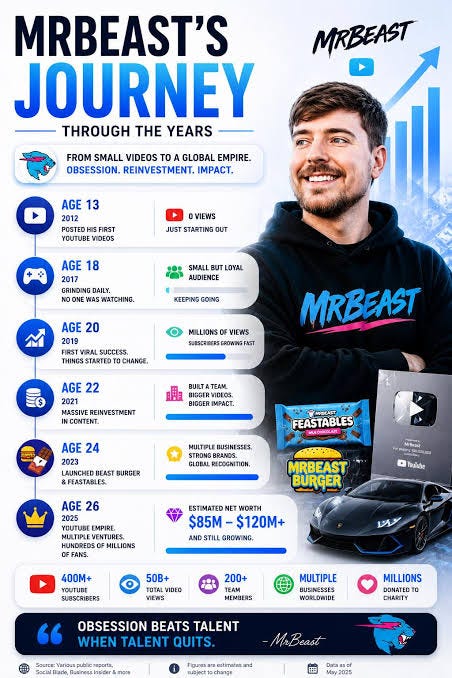
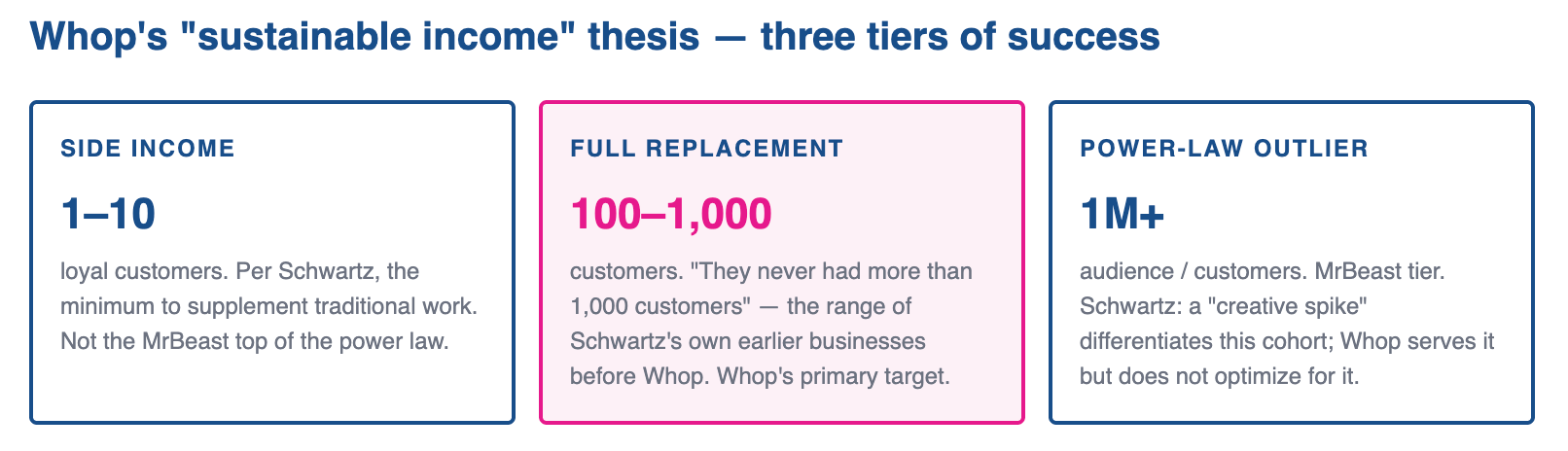
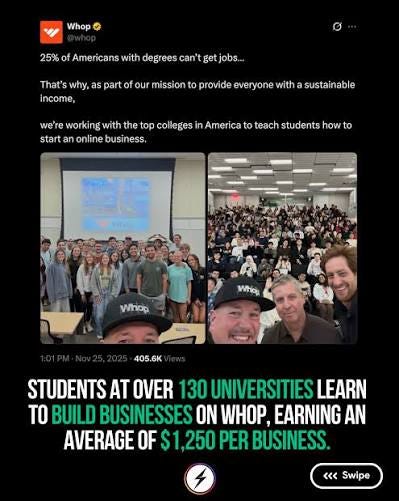
But the reality is that you don’t need a billion people to be a customer or a viewer or a fan. If you want to be successful — the story of at least all of our businesses that we built, Cameron and I, when we were growing up — they never had more than 1,000 customers. Even 500 or 100 customers would actually be quite a bit. When we look at the future of what sustainable income means, you really don’t even need more than ten customers if you want to build a business that’s going to sustain you to supplement and replace your traditional work.
So the customers that we are focused on and serving — you can look at the MrBeasts of the world, the power-law extreme successful examples. But you can also look at the smaller ones. And there’s not a huge difference other than the amount of time that they’re spending and the consistency. There’s a creative spark and creative spike that probably delineates between someone that’s going to have that level of power-law outcome versus someone that’s going to have five, ten, 20 customers.
But at the end of the day, our mission is to deliver everyone a sustainable income. That means a little bit different things to different people. One way to look at it is: “Oh, that’s not even close to successful.” The other way to look at it is they’re actually both very, very successful. Someone that has five very loyal followers and subscribers is actually in a pretty great place. And I don’t think that they hear that enough. It’s a reminder that you don’t need to get a billion followers or subscribers overnight, and even starting with five is going to grow to 15, which is going to grow to 30. If you keep engaging, it’s going to grow to 60. And you either cap it at 60 or you keep going. That’s how I’ve seen this stuff come to work.
Lex Sokolin:
And when you compare it to people doing things that they don’t want to do with their time, that’s certainly a lot more compelling. So this is the dream and the mission. What was the first iteration of Whop like? What’s the first version of the company that you put together?
Stephen Schwartz:
Yeah. So the first version of Whop was a website that helped me and my co-founder sell our own software. We were the sole sellers of the market. That was because we were traditionally going to Facebook groups and making posts that were like, “Hey everyone, we have this software available. If anybody wants to buy it, shoot us an email or send us a DM.” And then we did it in Discord and we were doing quite well, despite the fact that it was very difficult to buy the software. You had to send an email or you had to send a message. You had to broker a deal, you had to pay us in Bitcoin. And there were a lot of people selling software — it wasn’t just us.
We built the website just for us originally, and people would have to continue selling manually in the forums. Really quickly people saw the website and they’re like, “Yo, can we sell on the platform as well? It looks like a great alternative to all of these really unstructured forums throughout the internet.” We let that happen, and very quickly people really liked Whop.
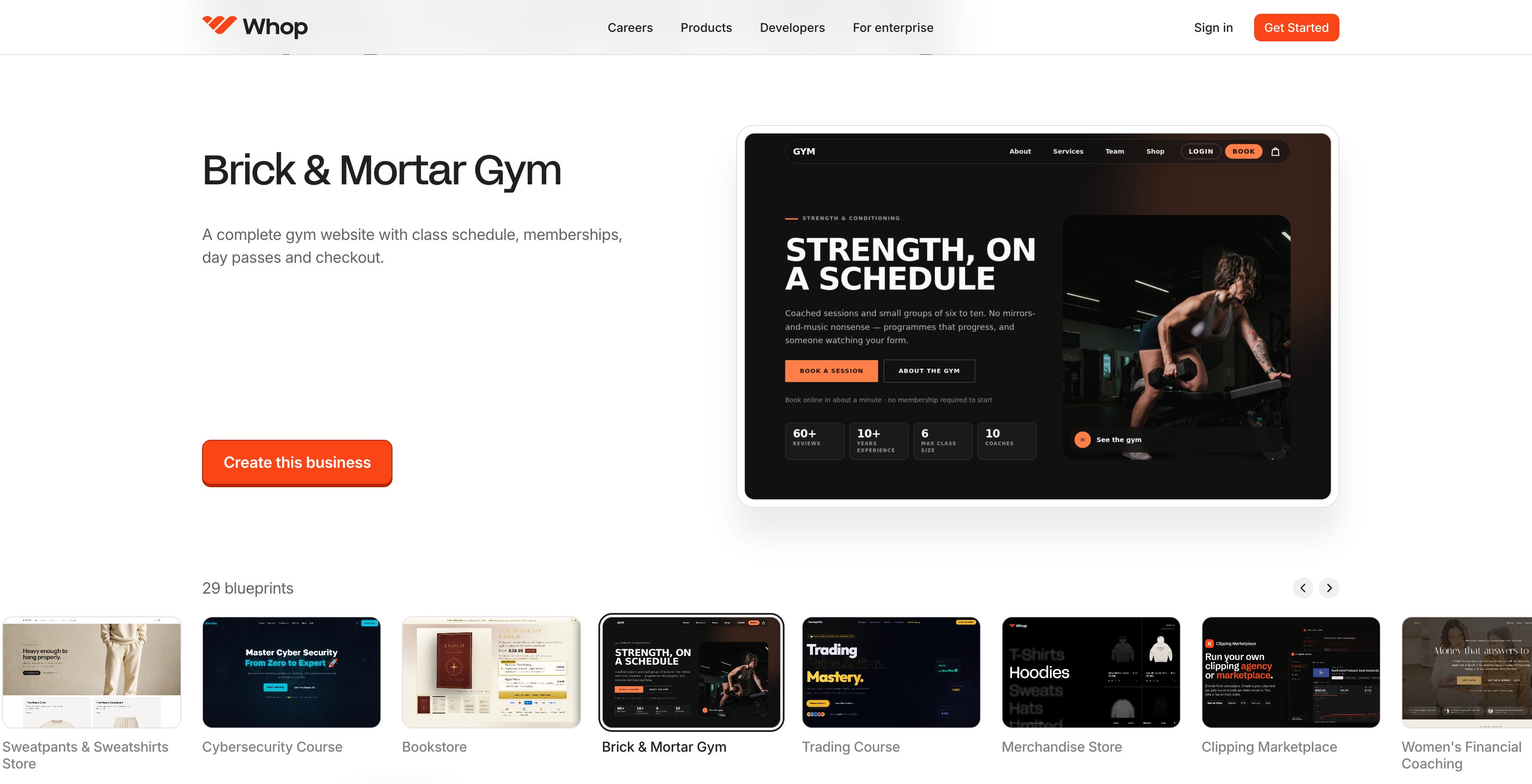
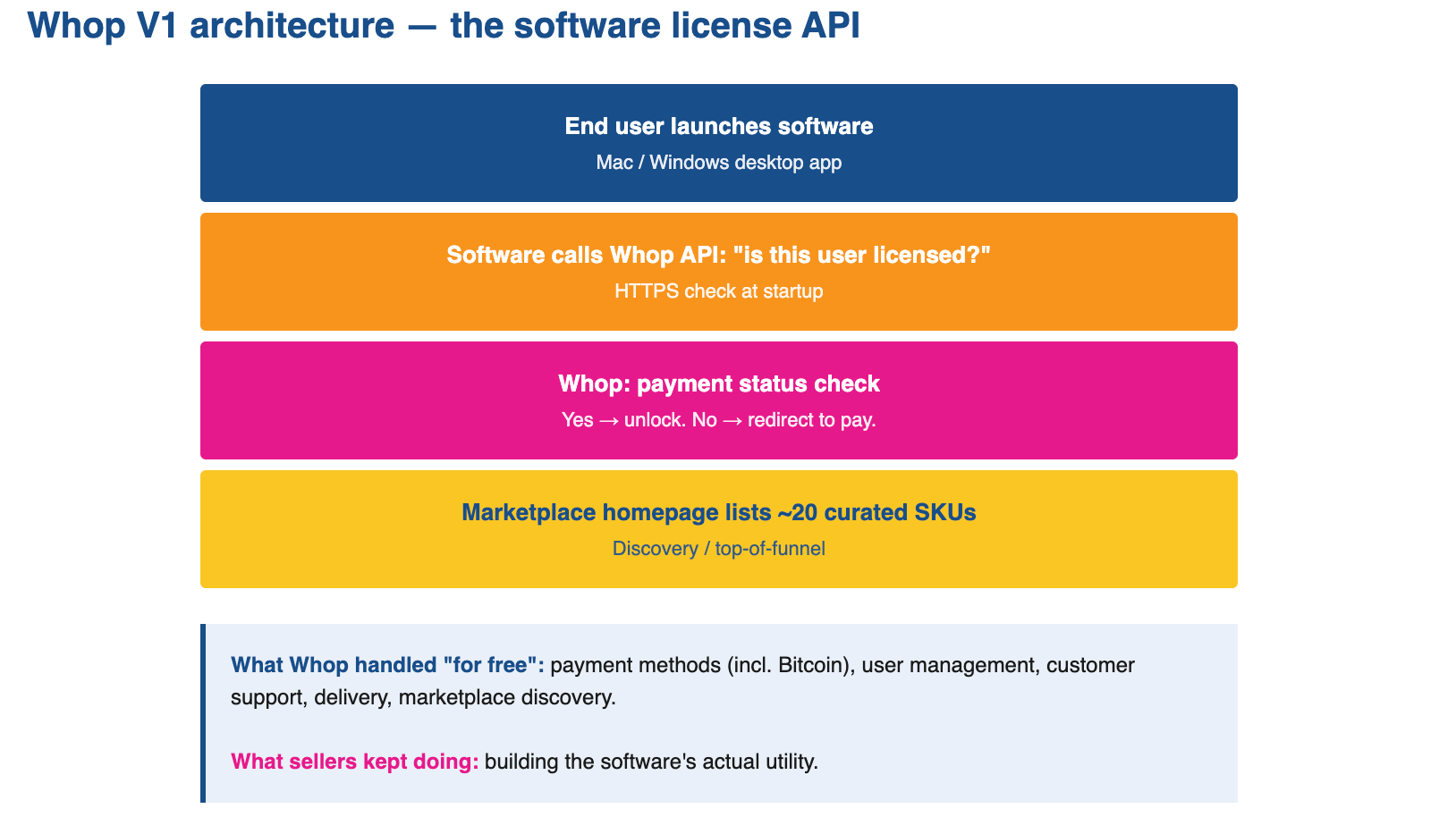
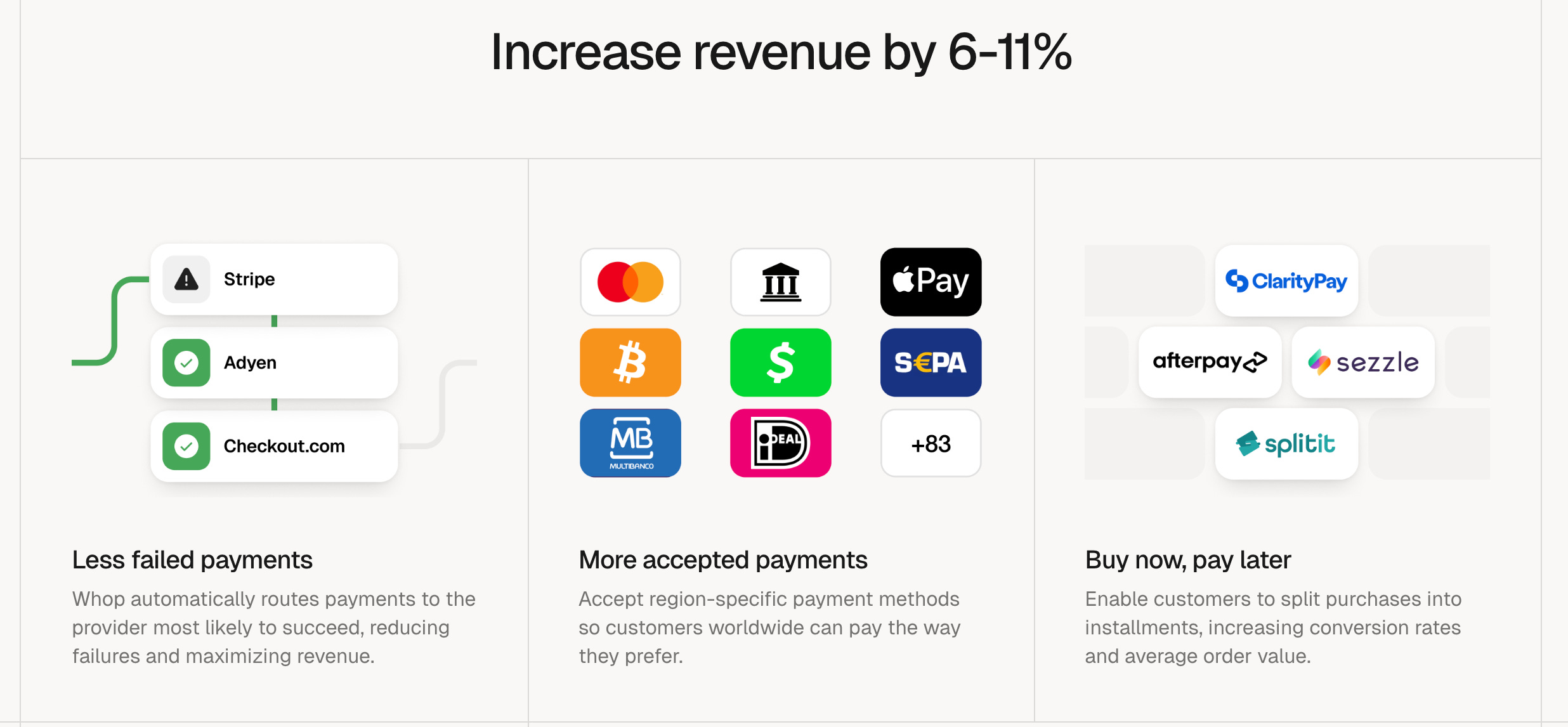
So originally it was just for the software SKU. You could come to Whop and plug up to our API and sell your software. You wouldn’t have to worry about the fulfillment. You wouldn’t have to worry about finding customers. You wouldn’t have to worry about juggling all of the different payment methods. And people have really loved that. So we started in just software — imagine very niche desktop software, kind of like what Steam does for gaming. But we were focused on Mac and Windows desktop applications. That was the first version of Whop.
Very quickly the sellers simply asked if they could sell a way broader set of SKUs. The infrastructure for running these businesses on the internet doesn’t tend to vary as much as people would imagine. When Cameron and I were growing up, we hopped from selling iOS apps to buying and selling things from China on eBay and Amazon. We built agency services. We built an app that helped homeless people get paid. We built a secret texting app, we built marketplaces, and we built so many different businesses. And every time the common denominators and recipe were very similar.
I think that’s the story of Whop. We first launched as a way for us to sell software, which panned out to a lot of people wanting to sell software. And then beyond that, people using our platform to sell and build businesses around a lot of different SKUs.
Lex Sokolin:
When you were selling local software for Macs and you were trying to get others to integrate your solutions into them, what were you offering and how were they integrating? If you were doing payments or user management, does that mean that you were the platform and they were building on top of you? Or did they pull modules down from what you were doing and integrate them? What was the structure?
Stephen Schwartz:
In V1, you would go and select from a predefined list of software that we supported, and the software would have integrated our API in that when some user is logging in to the software, it would hit our API and say, “Is this user supposed to be able to use my software right now?” And if the answer was yes, it would let them through. If the answer was no, then it would direct them to pay. That was the extent of the process if you’re selling software.
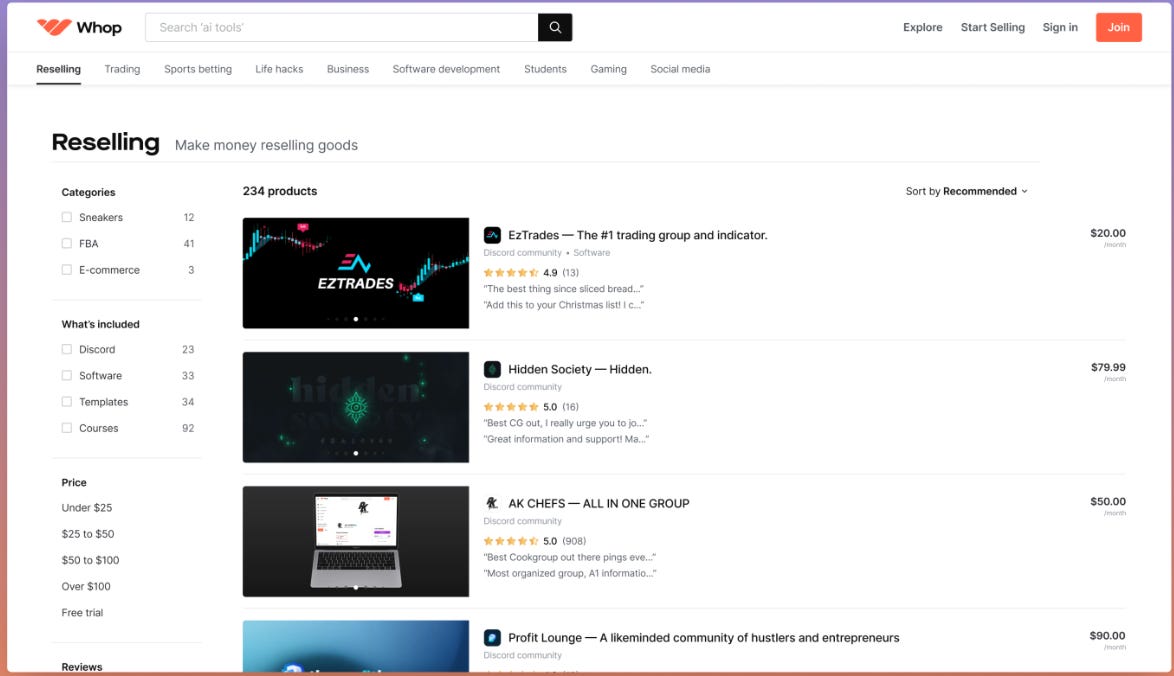
It was very simple to get up and running. There wasn’t any other modules. It was very simple: is this person paying? If not, get them to pay and bring them to a marketplace — that was the homepage of our website that listed all the software out. And because we did a great job keeping all these SKUs tight and consistent, and there weren’t that many SKUs, we were able to drive a lot of demand to Whop. People really liked that.
So at first it wasn’t very heavy integration, but it was a very critical piece of the integration. Most of the work that people were doing building this software was focused on the utility of the software, and then we would handle a lot of the boring stuff that people didn’t really want to have to deal with if you’re creating and building a tool. So anything that’s getting customers, accepting payments, delivery of the actual software, customer support around the software — all of the things that we had to do for every single one of the businesses we ever started, we abstracted away and made it so that people could just focus on what they’re really good at and where the creativity lies.
Lex Sokolin:
That’s really interesting. So people didn’t know how to do user management and permissions and integrate payment processing. That’s also quite different from distribution and getting people customers, which I assume you did through marketing acquisition. What kind of developers and builders would come to the site in the beginning? What was their profile?
Stephen Schwartz:
The people that came to the site in the beginning — it’s not that they didn’t know how to do user management or set up payment processing, it’s that it was a lot easier to set it up on Whop. The customer acquisition part of it, I think, is a consistent theme in our company’s history. There’s already 5,000 different banks and neobanks, and everybody seems to have a way to accept payments. Those are all very commoditized products, we think.
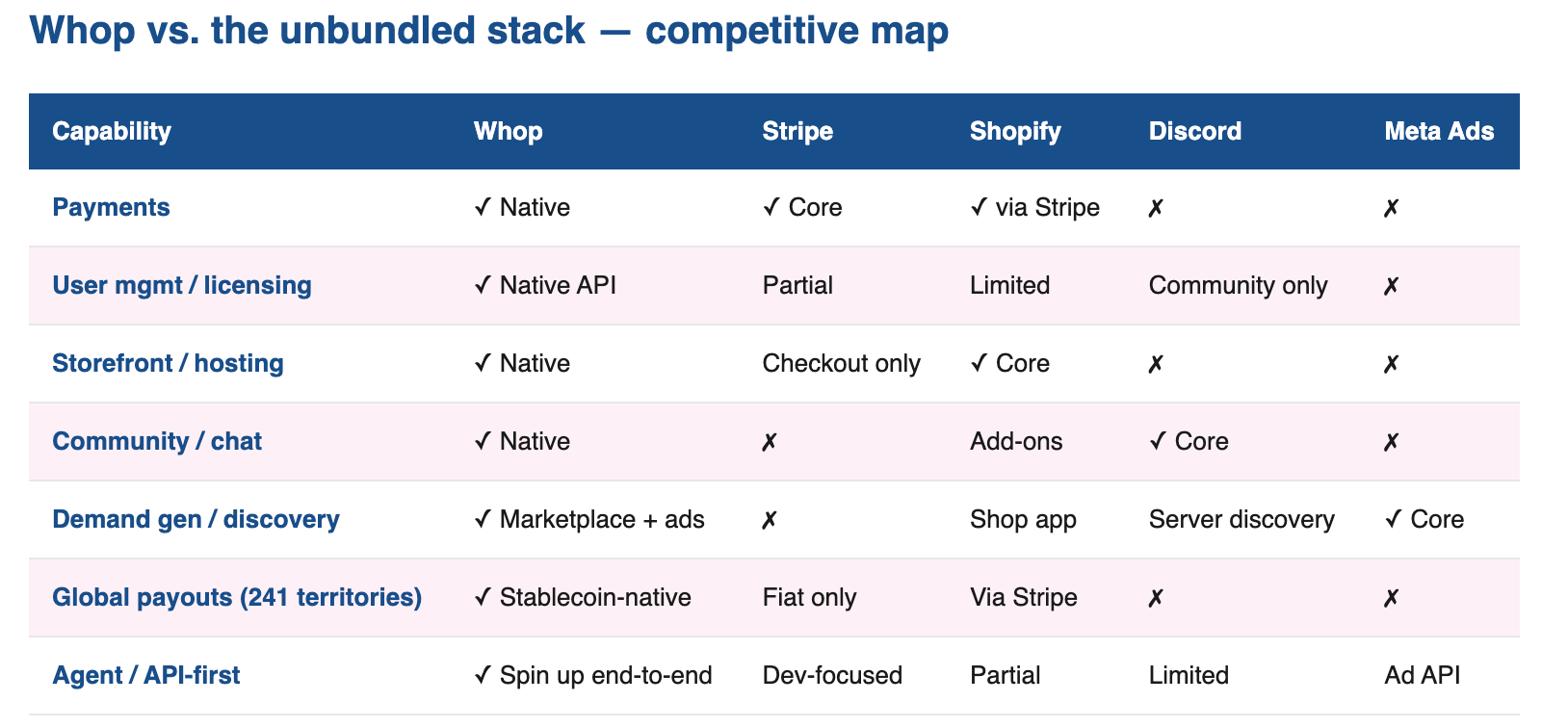
But a lot of the through-line of Whop and the wedge that we’ve had in our history has been around getting your next incremental customer, or getting your first customer. Better yet, it’s not that people can’t figure out how to set up the payments or set up the user management. Those are very table stakes. There’s a level of ease, but the real goal of Whop is to make sure that people don’t have to even worry about getting their next customer.
If you look at our mission and making sure that everyone has an income that’s sustainable, then you start to look at Whop slightly differently than a normal financial product, because we are actually bringing top-of-funnel income to our user base, and that is very important to us. So it’s not that payment processing and user management — people don’t know how to set that up. It’s just that they don’t want to have to go through the craziness to set that up.
It’s much easier on Whop. And of course you get customers, and that is a very different value prop than what is available at the time. When we first launched Whop, the people that were coming on to Whop were busy developers, lean teams, single-person, two-person teams. And that’s obviously exploded over the last couple of years in how many people want to build companies and particularly want to keep their team very lean and tight. And that’s who Whop is for.
Lex Sokolin:
On the customer side, there’s kind of an inherent selection problem. If it’s part of your responsibility to bring demand and attention and distribution to the apps that are using your platform — sort of like mini apps in your operating system — you have to make sure that there are good apps and that people like them and that there’s built-in demand. But on the other hand, I’m sure you also want to help anyone and everyone that’s out there to use Whop and integrate it. How do you deal with that trade-off? In the early days, did you have to filter? How did you navigate that?
Stephen Schwartz:
Yeah, it’s a good question, and it’s certainly a huge part of our history is dealing with this problem. We started with a very limited set of SKUs that you could sell on the platform. It wasn’t even as broad as software. It was hyper-specific around, I think, 20 different types of software. When it was that focused, it was quite easy to make sure that the end customer and the balance of ensuring that the buyers have a great experience was pretty easy.
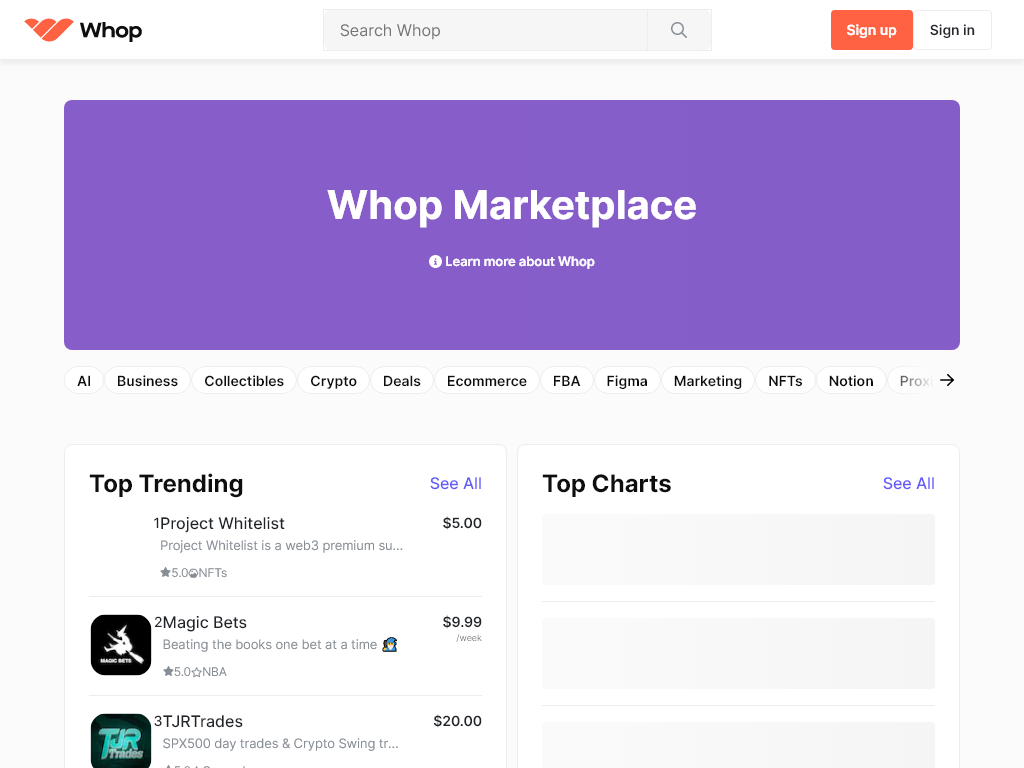
What has happened since then is, in the broader world, an explosion of different cool ideas that are very difficult to over-categorize and properly SKU out to the level that we used to have. What we try to do now is keep our principle of making sure that people can get customers, but we don’t necessarily know what the next trend is going to be. These fads are happening so fast as to what the mainstream consumer demand looks like.
Instead of trying to put all these different random products on our homepage, we let sellers on our platform run ads. The ads are tightly integrated with all the payments. They’re tightly integrated with all the user management. It makes it very easy to test out ideas as a seller, without converting our buyer base and showing people things that they may not want to buy. If you go on Amazon, the first thing you’re likely going to do is search, because you probably know what you want. Amazon is focused on bringing all the commoditized products fast, cheap, and reliably.
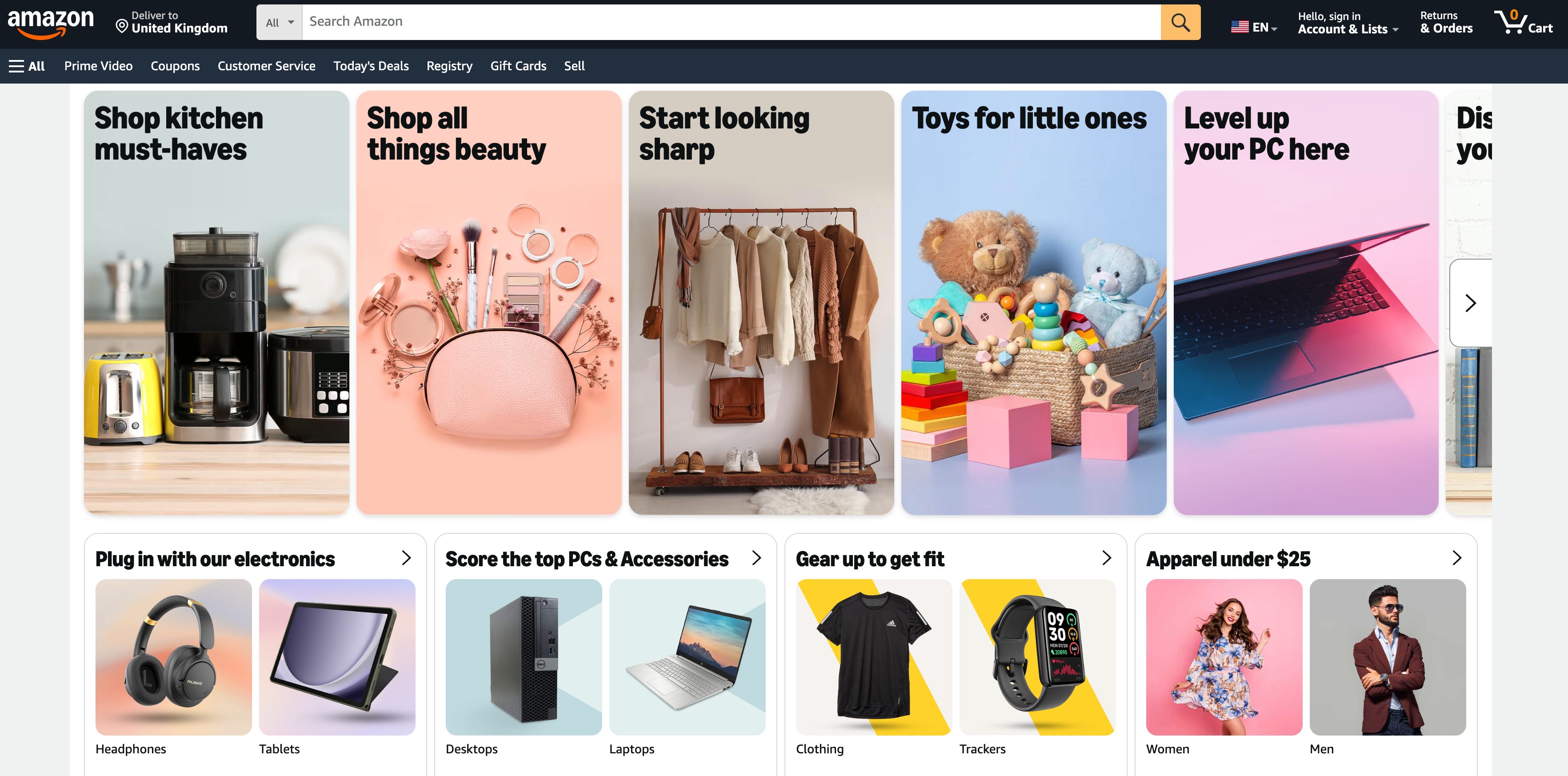
But in this next era of entrepreneurship and what people are interested in buying, you kind of have to get told what you could buy. That only happens when you have a creative seller, creative entrepreneur, creative business owner essentially run an ad, either literally or figuratively, as to what they’re offering. And maybe people buy it and maybe people don’t. That’s our shift of thinking as to how we think about balance between our buyers and sellers.
Lex Sokolin:
Okay. So my next question is about traction. Especially as you went through this transition, which kind of customer segments and use cases started to get more and more popular, and where did you decide to lean in?
Stephen Schwartz:
You can look at any given period of time throughout the last five years of the internet as having a “meta” — that was where all of the up-and-coming entrepreneurs gravitated towards. When we were starting, that was this desktop software that I was talking about earlier. It was during Covid, and people wanted tools — quirky tools to either track inventory on Amazon because things were supply-shocked. They wanted ways to get shoes before they sold out. They wanted ways to analyze markets and trade and all of the stuff people were doing during Covid. The meta at that time was all focused around software.
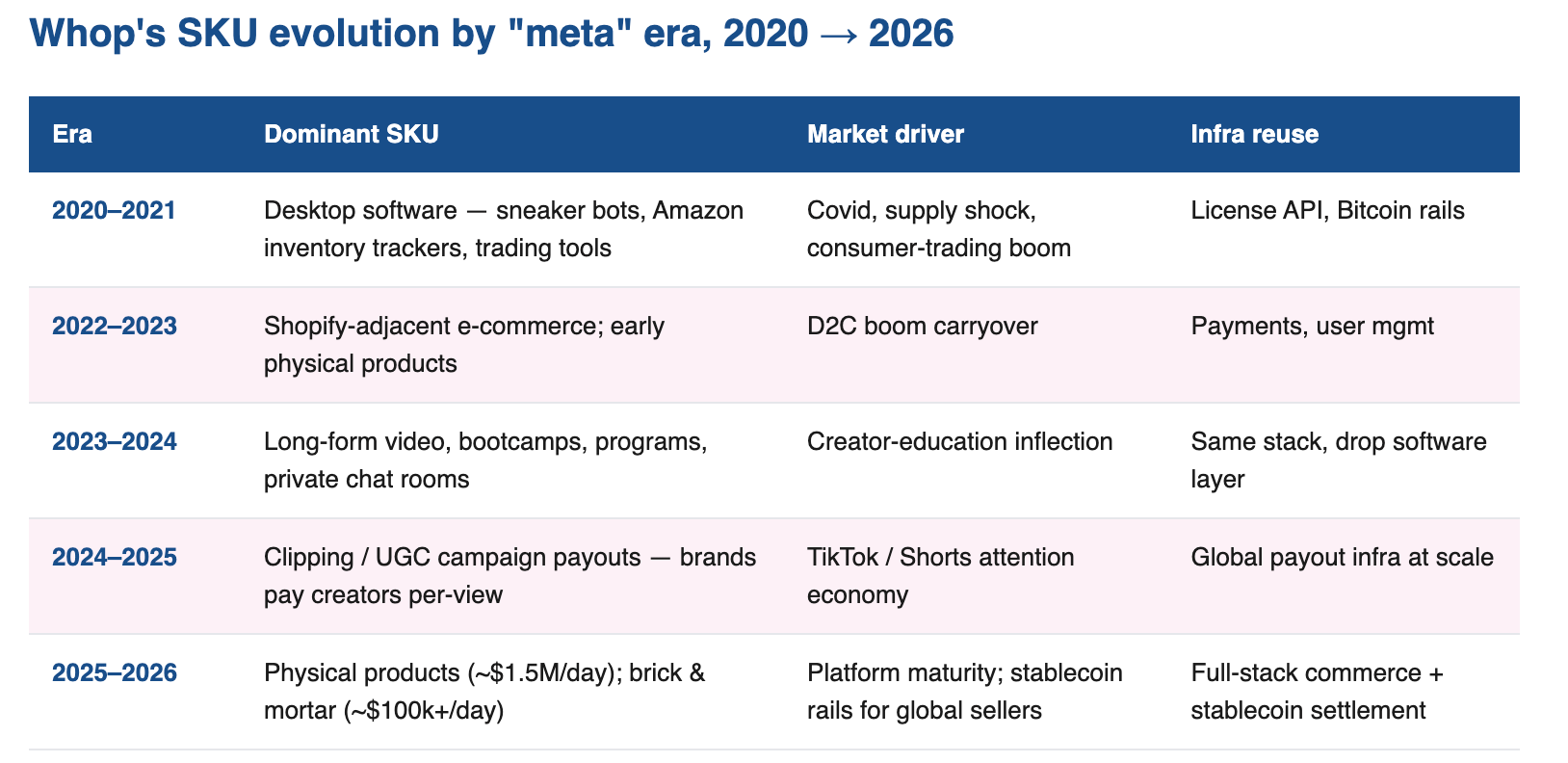
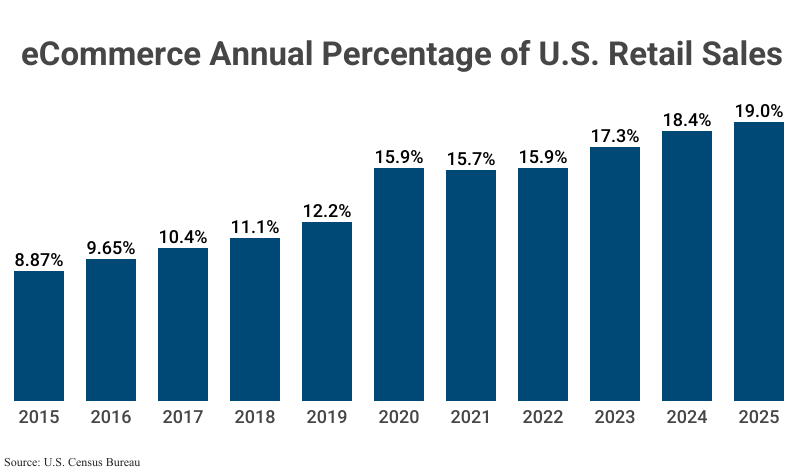
It quickly became people wanting to start businesses on Shopify. That naturally led us into a lot of e-commerce territory where we weren’t originally helping people sell physical products. Whether it be education, whether it be software, those were very popular SKUs in 2020 through 2023. Each year brought a new meta. If you fast-forward to 2023 and 2024, after the software craze, people wanted to put videos with their software as a way to explain how to use the software. Very quickly, people realized that they don’t actually need to sell software — they can just sell the video. That naturally led to an explosion of education products and people selling long-form video, people selling programs, people selling bootcamps and things like that.
When you had a lot of people selling video and selling private chat rooms with their software originally, and then you drop the software, you get a lot more types of SKUs without any change fundamentally to our infrastructure.
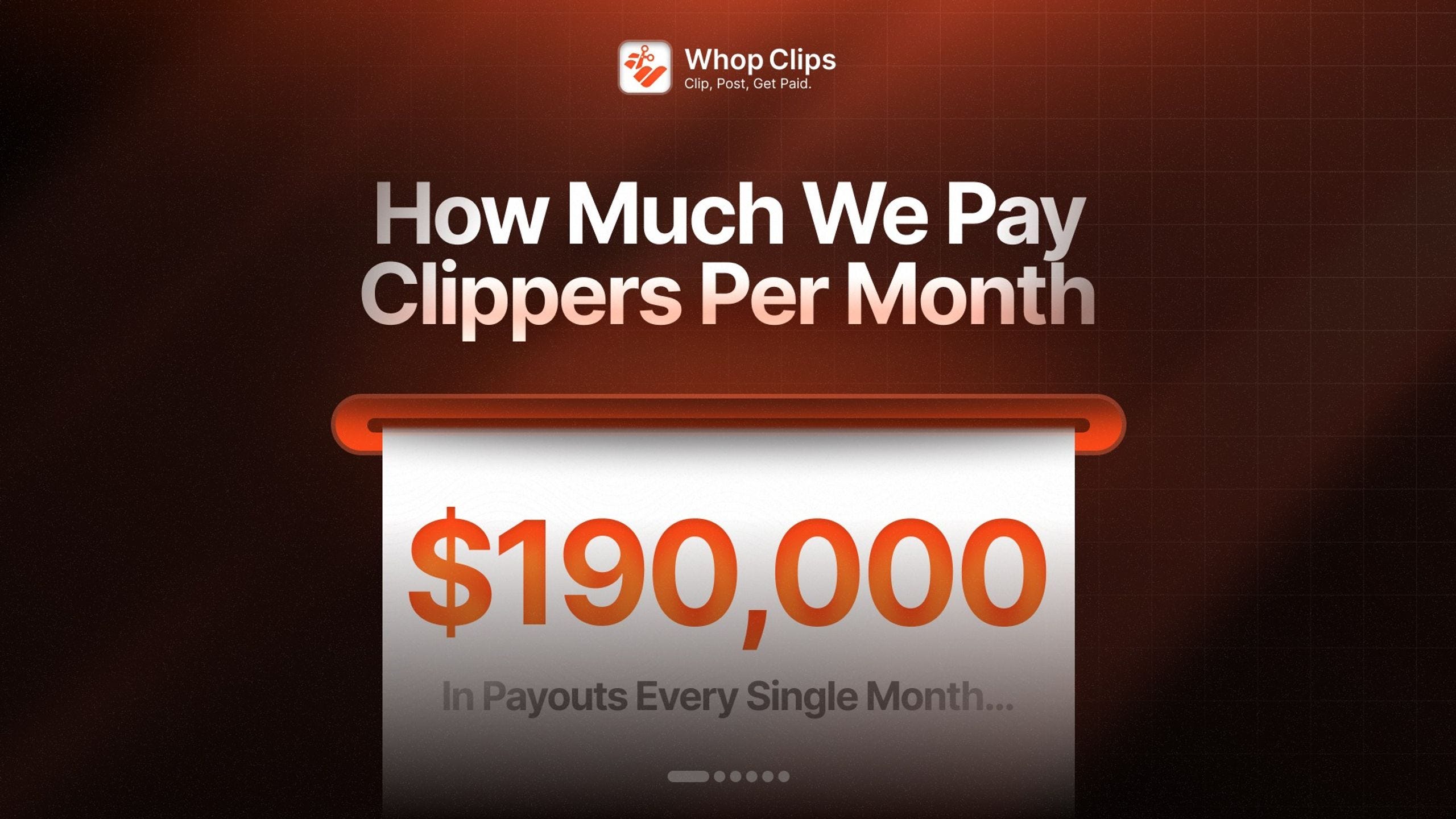
As we grew internationally and as we scaled what types of products were available on the site, we naturally had a pretty amazing financial infrastructure that started to be extended in use cases that we could never really imagine. One very popular one last year was all the clipping craze. As a brand, you could basically come to Whop and set up a campaign that would pay out all these people throughout the world to make content for you, which unlocked enormous business models for agencies specifically to go and organize campaigns that paid users out at scale using the infrastructure that we had.
So I would say we’ve never really predicted what types of businesses and products people will start, and instead have done a really good job giving people the tools and waiting for interesting use cases to pop up, and then making sure that those people are well supported and we build the right product for them. It started in software, went to long-form videos and chat rooms, and then that went to agency services. Now, we have a million and a half dollars a day in physical product sales, as well as hundreds of thousands of dollars a day in brick-and-mortar sales. And those are the smallest segments on our entire marketplace. So we’re starting to see almost complete closure and holistic service of every single type of business model that there is.
Lex Sokolin:
Did you have to change the type of people that you hire in order to build this? People who understand the creator economy are quite different from people who understand physical product fulfillment versus developers who do fintech. How have you built the company in a way to span these different markets?
Stephen Schwartz:
Most of our team in the early days were actually early customers of Whop. They fundamentally understood what we were trying to do. They fundamentally understood the internet economy, and they likely had created a number of different businesses before they joined our company. The spirit of being our own customers and the spirit of hiring entrepreneurs has gone unchanged, and we still do that to this day.
The scale brings a level of complexity that simply requires us to hire incredibly smart people. This is way beyond anything I could have imagined, as to how high this bar actually is, and how quickly you realize that you can’t keep up with the growth and you can’t accomplish what you want to accomplish without a bar that is so massively high surrounding you.
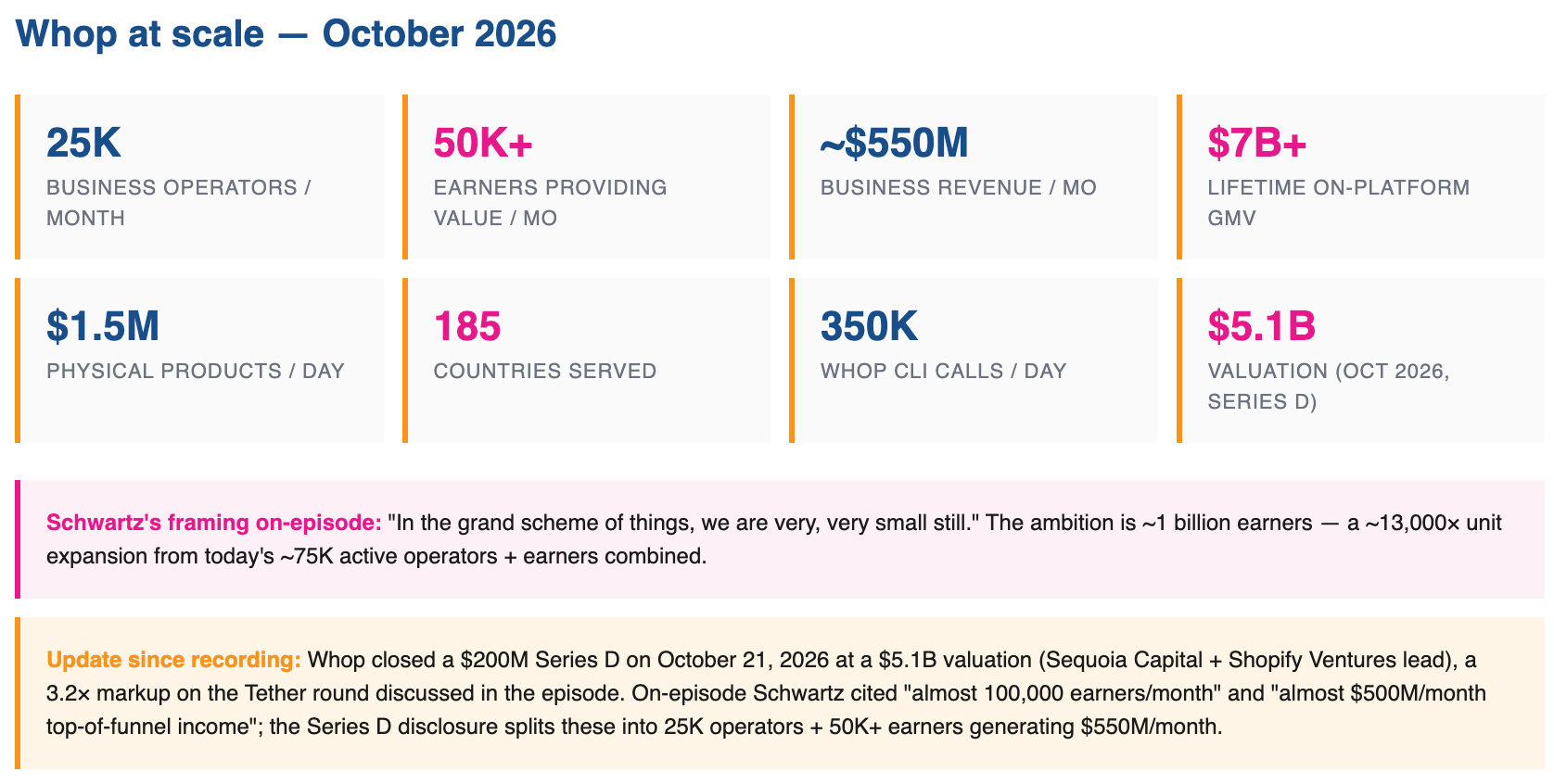
Where we are today is there’s people in every single country earning money on the platform, collectively almost $500 million a month in top-of-funnel income. That’s not easy to maintain and manage. The people that we bring on are just very, very smart and very high-agency. And they feel very responsible for what they’re working on. The bar has just gone straight up. The spirit is still very in line with how we began. We want to bring on entrepreneurs, former founders, people that are going to feel very responsible, people who understand our mission and are passionate about our mission, and can actually reasonably add value to our mission and aren’t just going to get excited about how much we need to monetize and make Whop fine — but actually have some tidbits of input there. That bar has just gone through the roof, I think, is the best way to describe the delta.
Lex Sokolin:
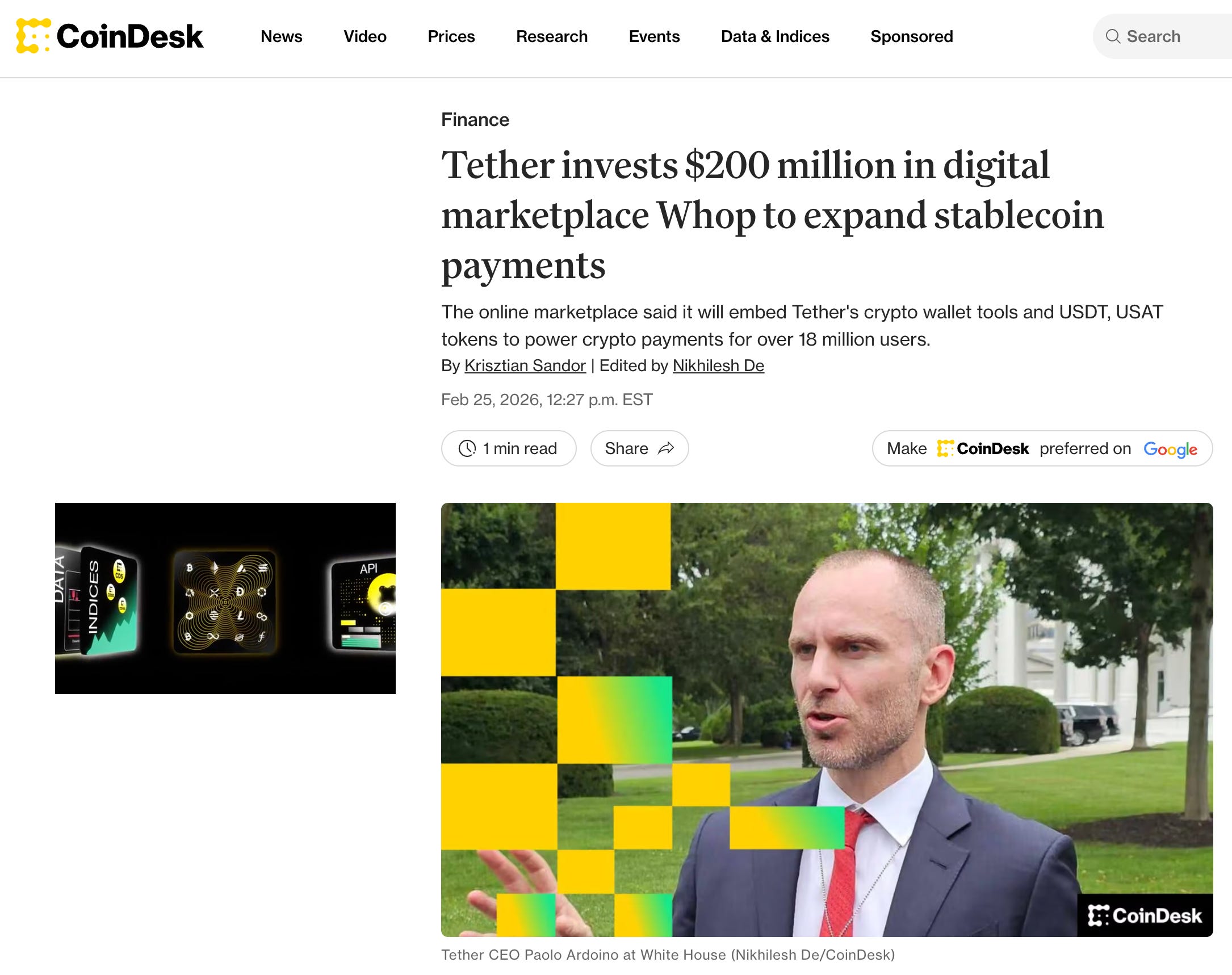
With this talent and the scale that you’re talking about — one of the changes that you’ve had in the business model is to lean into the fintech side, the payment side. And then you’ve recently received a $200 million investment from Tether, the issuer of USDT, the stablecoin. Can you talk about how you’ve leaned into that direction? What is the change in business model? Why is it interesting? And then what role does Web3 and DeFi play?
Stephen Schwartz:
I remember when we were growing up, the people that we dealt with internationally — when we had to, for example, hire a developer from India — I vividly remember having two options to pay them. One was Western Union and the other was Bitcoin. And this was maybe 2014. The reasons that I had crypto in the past were always to get somebody paid who was international.
People in the West have a tendency to undervalue and underappreciate how much financial infrastructure that we get to have. Anybody can go to their local Chase Bank or Bank of America and open an account, get a debit card, get a credit card, have a balance that you can hold money reliably. Those features are not available in most countries in the world. And when we’re looking at what we want to do with our mission and the type of customer base we want to serve — the word “global” is extremely important. We service today more countries than any other platform like us. That includes Shopify and Stripe, all the Square and Cash App, all the other places that people think of when they think of business. We can support a much broader base of people. The reason for that is because of how we’ve developed our technology.
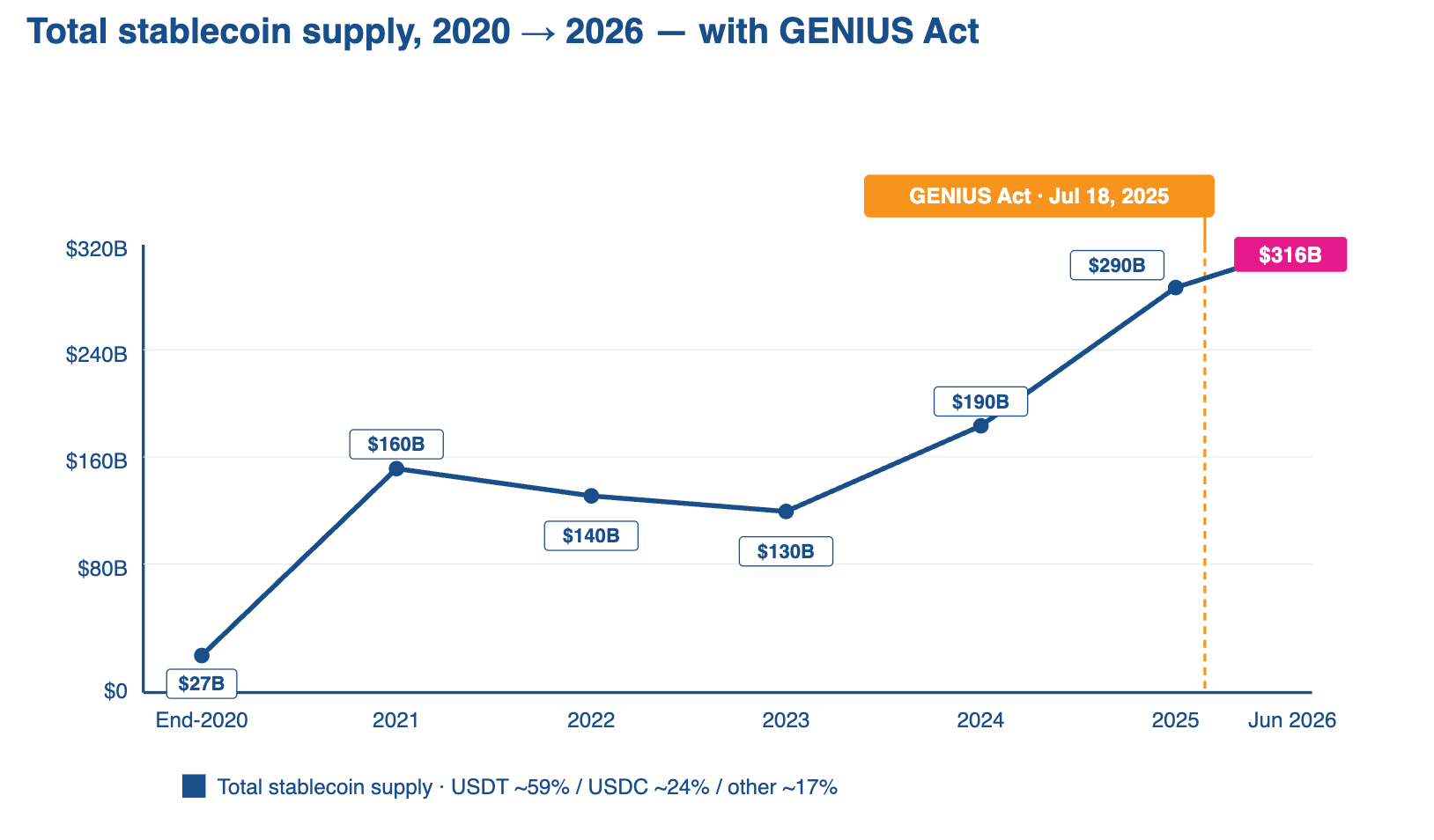
The reason we are leaning into stablecoins is because of the amount of service that they bring from a jurisdiction standpoint. When you look at the infrastructure available in a country like Morocco, Nigeria, or a lot of places in South America, in Southeast Asia and Vietnam and Thailand — there’s not a great unifying option. And stablecoins are a very great unifying option.
So we had decided that we want to be global. We want to make sure everybody can earn an income and has the same exact technology available. The only way to do that is via stablecoins. And Tether is obviously the largest stablecoin, the first ubiquitous stablecoin. People don’t realize this, but when you go to a country like El Salvador, people are actually selling coconuts on the street for Bitcoin and stablecoins. You pull your crypto wallet and you actually pay them on-chain in the self-custody wallet. That’s how they do money movement.
For us, it’s critical that we can get people paid, because that’s the whole point of what we’re doing here. And the stablecoin infrastructure is something that I think a lot of the traditional financial firms are trying to figure out rapidly, not just because of the global aspect, but because of how much you can tap into a huge base of decentralized applications. You can think about tokenized securities and think about prediction markets, think about Hyperliquid and all of the different perpetual exchanges and where the future of finance is going. What Robinhood just unveiled with a lot of their embedded financial tools — those are all things you can only interact with on-chain.
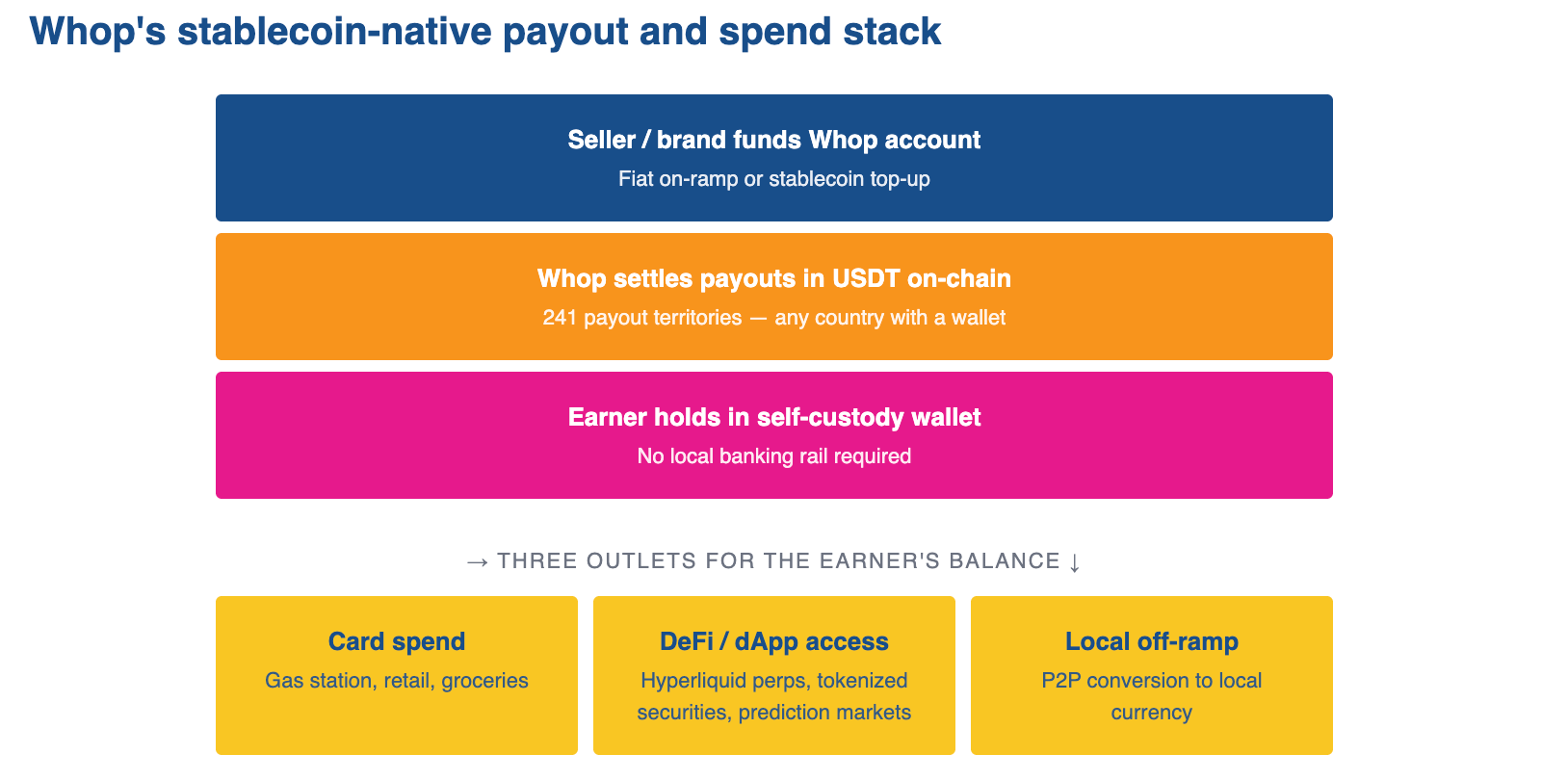
Because all of our money is ramping on-chain, people on our platform can not only access it and store it in every single country, but they can also do a lot more things with it. That’s reflected in our ability to let our users spend on cards, which is a very simple, rudimentary value prop that comes for free when you have investment into stablecoins. You have the ability to trade on decentralized applications and tap into all of the broader Web3 ecosystem. That’s why we did it.
We are not marketing ourselves as a crypto company. And frankly, there’s not a lot of inherent value when people hear “crypto.” It’s more that it’s extremely global. It’s extremely interoperable money. What you can do with your money on Whop is far more than what you can do with your money on other platforms. And that’s because of our investment into stablecoins. That’s what we are going to continue to do.
Lex Sokolin:
Was this a difficult decision, or is this part of just understanding where things are going? We started the conversation with what does it take to be internet-native. If you’re in the online culture, then having a crypto wallet, being on-chain, participating in those trends is just second nature. You can’t get away from it. Whereas a lot of people in the 9-to-5 world — for them, it’s like, “Oh, if it’s not in a bank, that’s not really money.” Do you think this is a cultural thing? Is it geographic? Is it generational? Or is it just an easy decision — why not?
Stephen Schwartz:
I think for us it’s all the utility that we know is brought to the end user. Whether or not the end user understands the technology that they’re using completely under the hood — they just want to get their money and they just want to be able to use a card at the gas station or anything that is not going to be overcomplicated. Crypto has a very bad habit of overcomplicating the technology and forgetting the customer journey.
For us, it was a very obvious decision because a lot of people at the company are, as I said earlier, very internet-native. We grew up with crypto, using crypto for the right reasons — which my story about India is a great example. That’s a very powerful use case that is simply not possible without stablecoins.
If we’re looking at the future of the internet economy and future of work, and we believe it’s going to be very global, and people in developing nations should be able to do business with people in developed nations because there’s a massive arbitrage there — then the only way to do that at scale, based on our assessment, is via stablecoins. So with that alone, it’s a very obvious decision.
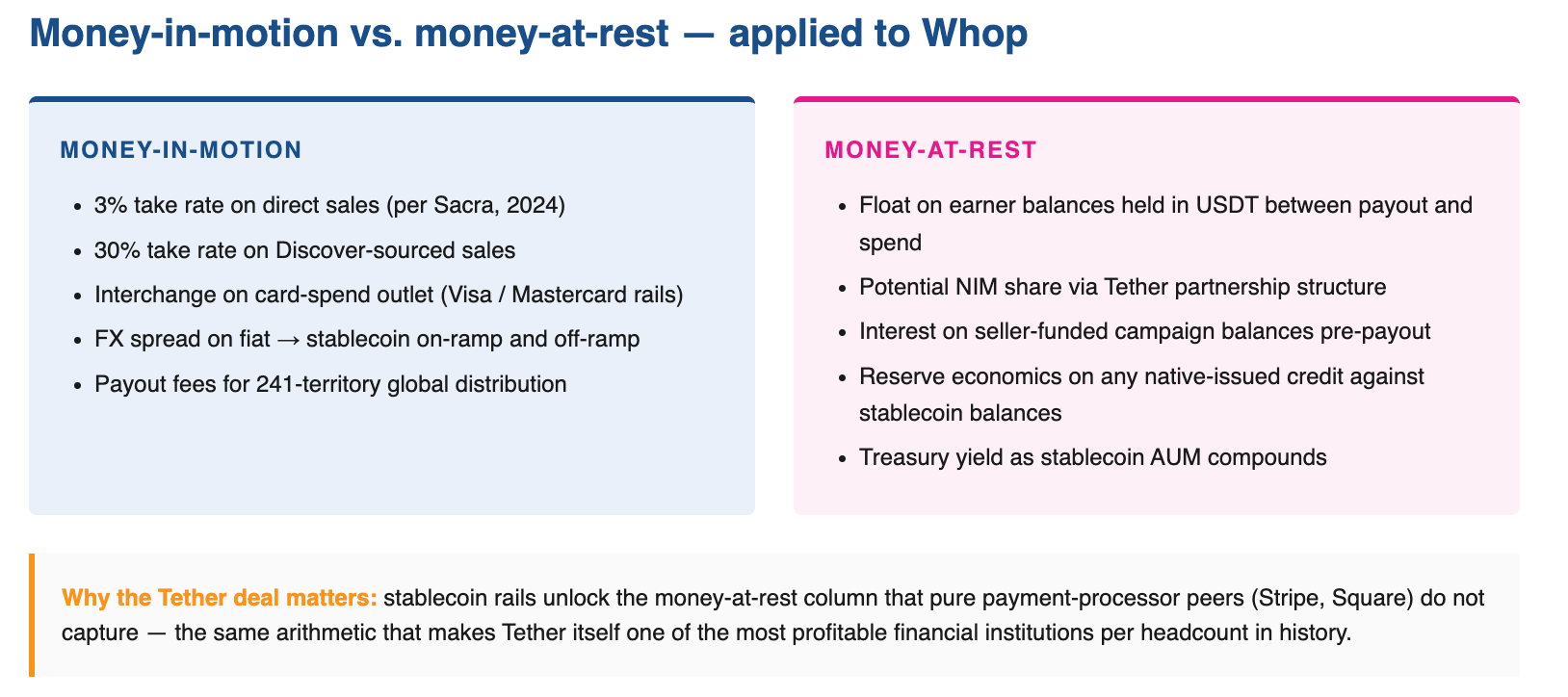
We’re building for the ultra-long term. And long-term, it’s going to be very obvious that money moves much faster, cheaper, and more freely on-chain. That’s going to pan out for not just us. When you look at what Visa is doing and what card networks are doing broadly, and what other payment platforms are doing — they’re leaning in very hard to stablecoins because they’re faster, cheaper, and more global. I think people would generally want those features. So it’s a very obvious decision for us.
Lex Sokolin:
I have to hit on generative AI and what’s happened to the creator economy from the release of generative AI — the massive productivity unlock. For some people, there are very few who have become unbelievably productive from generative AI. And then there are many people who are a bit enabled. And then there’s lots and lots of people who are like, “We don’t want this. This is scary. Don’t do it.”
But a lot of the people that have been using LLMs have been doing it to code, to create content — effectively to do what you describe as creating an alternative income stream online. What’s your industrial view from the perspective of Whop on that sector? Are you building big pipes into this thing? Is there a strategy that you have to capture this momentum? How do you think about it?
Stephen Schwartz:
I think that the AI wave has unleashed a promise that you can do almost anything with your laptop or with your phone. Even though people can almost do anything — and that is very much true — it’s not completely clear what to actually do. There’s almost a sense of decision overload or decision paralysis that comes with having infinite leverage to build and create all of what your imagination could let you create.

The way we approach the AI upgrades and the AI promise is that we want to give people a really clear playbook and structure of what to actually build and how to actually build it, and what steps to follow if you want to get an actual customer. The way we’ve approached that is by building a very API-first product that can be interacted with very well with agents and with any AI tooling.
If you look at a lot of the AI tools as somewhat commoditized — there’s several different options, people tend to have one that they like and subscribe to, but the reality is that they could be on a different one and there wouldn’t be too much delta, and people generally switch between them pretty fast — we are not playing the model game. We’re not playing the game with the frontier labs of Anthropic and OpenAI and xAI and Meta and all the major, major, major companies that are releasing models.
We want to make sure that our platform can be used by those models and can be used by all the tooling that is, in my view, getting somewhat saturated. There’s just a lot of different players in that market. We take the approach of: how interoperable is Whop with those agents, and how much can agents use Whop easily? The answer to that is quite easily.
I can tell my Claude right now to go spin up a business and have a website ready and have ads running, get people on the internet to fulfill my orders for me in one shot. I can have all that done with an LLC made, with an ad running, with a real customer imminently going to come into my shop and pay me for my flower subscription, for example. So that’s the approach we take with AI. We are very excited about all of the tooling that is coming out. People that are scared of it — that’s not a good thing, because it’s happening whether or not people wanted it to. So you may as well take advantage of it as much as you can. For us, that’s building a really awesome API that agents can interact with. That’s our approach with AI.
Lex Sokolin:
It’s extremely hard to position in front of this wave. But what you describe makes a lot of sense. Are you seeing any demand from within the LLMs yet? And similarly, you’ve got the advertising product. Are you thinking at all about how to acquire customers within the LLM interface?
Stephen Schwartz:
We definitely get a lot of traction from LLMs. LLMs use our product all day. People use AI to interact with our ecosystem constantly. We have more agent users than we do regular users when you look at our traffic and look at how people come into the site. So definitely, I think that you largely get a lot of that for free with the same efforts that have been placed on attracting users via SEO or UGC on social networks. The AI tends to eat that stuff up and get it to be front of the chat interface — if somebody’s having a chat about how to start a business, for example.

Lex Sokolin:
Super cool. One last parting question, which is around company stage and capital formation and your view to the future. You’re obviously growing super fast. The company’s been private for a while and growing through private rounds. How are you thinking about the scale of the business? What’s the home-run version of this? And how are you thinking about the public versus private decision? Is it interesting for you to be a public company? Or are you looking at other public companies in your space being like — they’re not having a great time?
Stephen Schwartz:
Two questions. The first part — what does a home-run success look like for us? In the grand scheme of things, we are very, very small still. There’s almost 100,000 people — but still less than a hundred thousand people — that earn money each month on Whop. And that should be closer to a billion people. And in not even so long. That means that we’re living up to our mission.
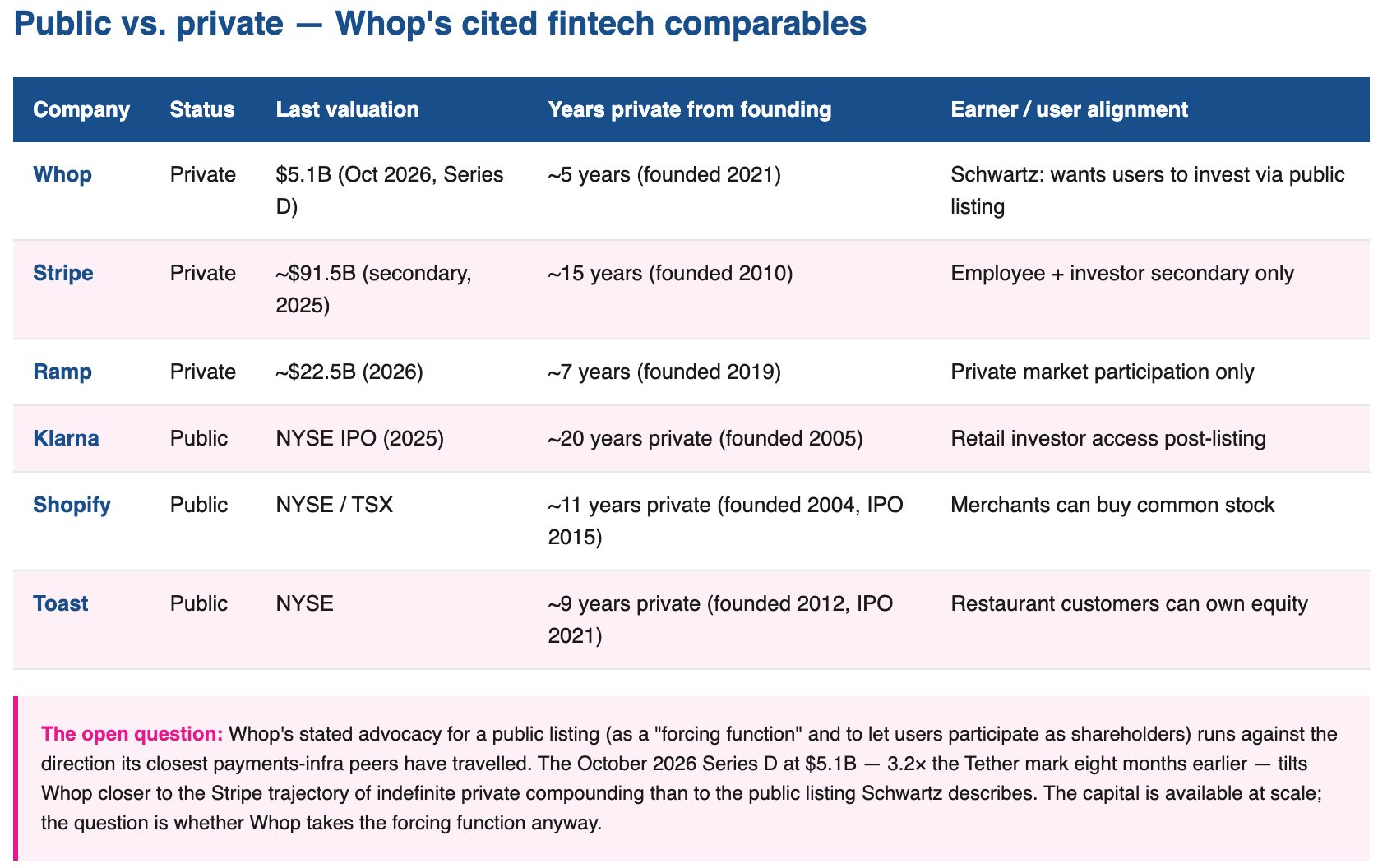
On the public market front, there’s not enough companies that operate in fintech-land, operate in money-land, that are public. You look at the last several fintech darlings, whether it’s Stripe or Ramp and so on — they’re not public, and maybe they will go public, but they’re not yet. There’s a level of transparency and alignment with customers that is really exciting when you’re public. What I mean by that is letting customers and users invest and participate in the company’s future is really exciting to us. If we were to go public, the most exciting thing is letting our user base invest in Whop and participate in our long-term success. And that should happen.
My view is anything that’s going to be related to the transparency factor, or quote-unquote “having a hard time with quarter reports” and so on — I think those are necessary parts of building a company anyway. If there’s a huge wrench thrown in your day-to-day because you’re a public company, I think there’s a deeper problem in the organization. I view it as a wonderful forcing function: if you want to run a company that is going to endure and have long-term sticking power, then what are you trying to hide by not going public?
So I’m a very big advocate that we definitely should be public, and definitely should allow our users and businesses to invest in what we’re building, and have an amazing forcing function to make sure that the business is perfectly captured and told to the world. That’s my view on public versus private.
Lex Sokolin:
Stephen, you have profound conviction in your mission and amazing execution. It’s been a total pleasure having this conversation with you. If our listeners want to learn more about you or about Whop, where should they go?
Stephen Schwartz:
They can just go to whop.com or check us out on X.
Lex Sokolin:
Fantastic. We’ll put the link in the show notes. Thanks again for joining me today.
Stephen Schwartz:
Cool. Thanks for having me. Bye bye.
Postscript
Sponsor the Fintech Blueprint and reach over 200,000 professionals. 👉 Reach out here.
Read our Disclaimer here — this newsletter does not provide investment advice
For access to all our premium content and archives, consider supporting us with a subscription.


