
GM Fintech Futurists,
Today, we highlight the below items:
DIGITAL ASSETS: The Prime Broker Problem in Prediction Markets
CURATED UPDATES: Financial Institutions and Adoption; DeFi and Digital Assets; Blockchain Protocols; NFTs, DAOs and the Metaverse
To support this writing and access our full archive of newsletters, analyses, and guides to building in Fintech & DeFi, subscribe below (if you haven’t yet).
In Partnership with zerohash

Customers need faster ways to move money across borders, 24/7. zerohash and Visa announced a game-changing partnership to help meet that need.
Powered by zerohash’s regulatory and technical stack, Visa Direct enables eligible clients to prefund accounts and make payouts directly in stablecoins, moving money across dozens of blockchains and stablecoins, built right into the Visa Direct network they already use.
With Visa Direct reaching more than 18 billion endpoints across eligible cards, accounts, and digital wallets in more than 195 countries and territories, we’re together unlocking stablecoin money movement at a truly global scale.
DIGITAL ASSETS: The Prime Broker Problem in Prediction Markets
Betterment recently published its 2026 Retail Investor Survey.
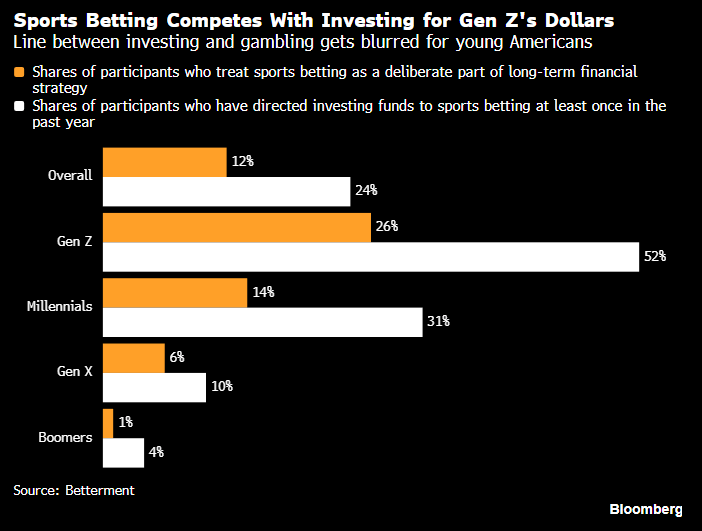
The headline finding: 26% of Gen Z investors treat sports betting as a deliberate part of their long-term financial strategy, and 52% have redirected money originally intended for investing toward it in the past year.
Across 1,000 US retail investors fielded in early April, the numbers drop quickly with age — 31% and 14% for millennials, 10% and 6% for Gen X, 4% and 1% for boomers. Betterment CEO Sarah Levy’s framing was blunt: when a prediction market or sportsbook starts to feel like a retirement strategy, we have a problem. Combined monthly volume across Kalshi and Polymarket reached $44.8 billion in June, more than triple the roughly $14 billion average monthly handle across every legal US sportsbook in 2025.

Let’s explore whether that flow is big enough to support a dedicated institutional layer beneath it.
Earlier this month, River Markets raised $8.5 million in seed funding to build what it calls the first institutional-grade execution and prime brokerage platform for prediction markets. Haun Ventures led, with Y Combinator, Coinbase Ventures, Qube Research & Technologies and Cherry Ventures participating, alongside angels from Citadel, HRT, JPMorgan, NVIDIA and Google.
The firm has been live with trading clients since 1 May and publicly names five: Chimera Capital Management, Game Point Capital, Cleat Street, Skywalk and 646 Equity. It claims three of the top ten traders on Kalshi and Polymarket, plus several quant funds running on its API. The problem they are solving is real and unglamorous. Liquidity in prediction markets is spread across venues that quote different prices for the same resolution, with separate accounts, separate balances, separate APIs and no consolidated view of risk. A trader running the same event across Kalshi and Polymarket is working two books by hand and reconciling them afterwards.
River aggregates the venues into one terminal and one API with a single ticker schema, adds execution algorithms the exchanges do not offer natively (icebergs, pegs, stop-losses, take-profits) and routes eligible orders to the best available price across connected books. It is live on Kalshi, Polymarket and Polymarket US, with Novig and Crypto.com in integration.
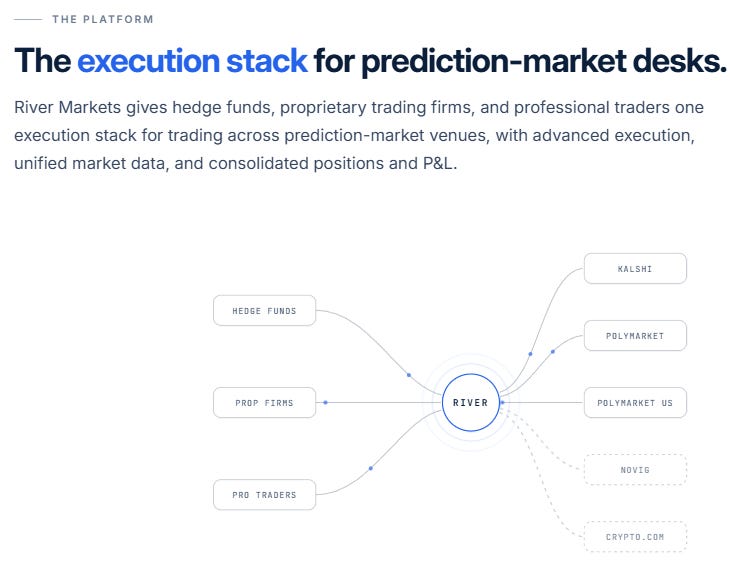
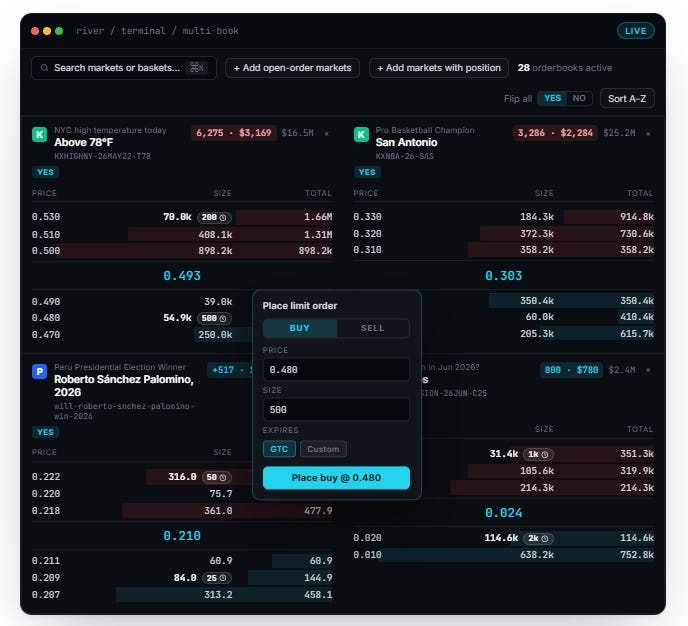
It is, today, an order and execution management system rather than a prime broker — a distinction River draws itself. Its FAQ states that the live platform covers execution, routing, data and P&L, that customer funds stay in venue accounts rather than being pooled, and invites firms to get in touch about financing, collateral and cross-venue requirements.
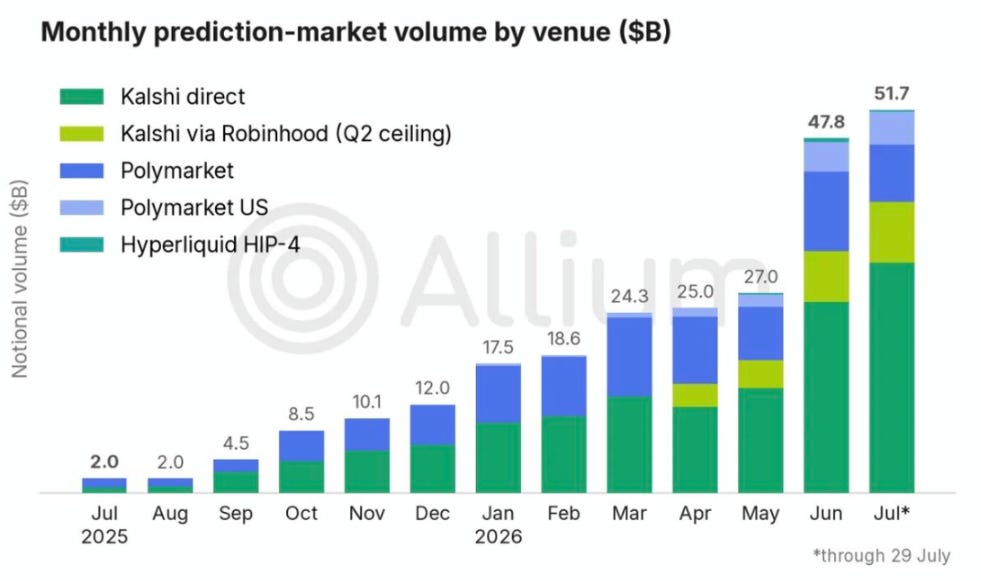
Prediction markets crossed $150 billion in combined lifetime volume in May, and Kalshi alone traded $31.5 billion in June against Polymarket’s $10.8 billion. Kalshi is now in final talks for at least $750 million at a $40 billion valuation; Polymarket is raising at $15 billion on the back of $2 billion committed by ICE across two tranches. Kalshi’s annualized revenue topped $4 billion in July, roughly double its $2 billion pace two months earlier, with daily fees exceeding $13 million on peak World Cup days.

In an August case study on a 50,000-contract Fed decision trade, the River fee was $53 against $38,500 of notional — roughly fourteen basis points. At that rate, the hundreds of millions of annualised volume River is targeting by year-end is around $700,000 of revenue, and a $10 million business requires routing something over $7 billion a year.
Set against Kalshi's roughly $378 billion annualised run rate, that is under 2% of the flow at a single venue. The volume bar is not the problem. Nor is the value proposition thin. In the same snapshot, routing the order passively across venues came in $945 cheaper than taking the best single venue outright — 238 basis points of all-in savings, after River's fee.
The client base is the real limitation.
The Wall Street Journal’s analysis of 1.6 million Polymarket accounts found that 67% of all profits went to 0.1% of accounts. Fewer than 2,000 traders, netting close to half a billion dollars, while more than 70% of users lost money. Separate on-chain work across roughly 2.5 million wallets put the number clearing $100,000 in lifetime profit at 840.
Kalshi’s own figure is 2.9 unprofitable users for every profitable one.
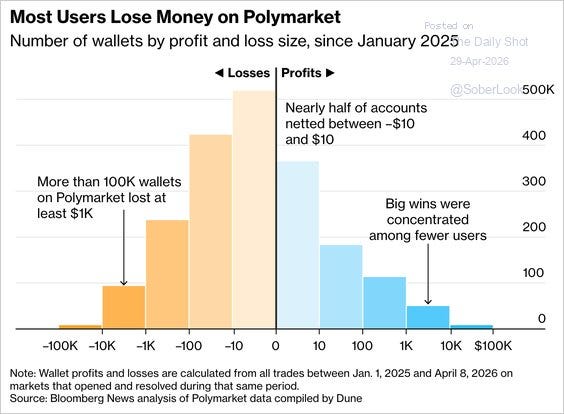
That concentration is usually cited as evidence that retail is being farmed.
Set against comparable markets, it is unremarkable. Academic work on retail day trading found 84.3% of day traders lost money at a median return of −8.7%, with unprofitable traders generating 72% to 80% of all volume. The Brazilian index futures work found 97% of persistent day traders are losing capital. Kalshi’s own comparison puts around 74% of its traders in the red, against roughly 81% in equities and 96% in sportsbooks.
It is also the addressable market. The customers who need consolidated cross-venue risk are the ones who make money. There are a few hundred of them, of whom perhaps fifty are actual firms — a small professional cohort taking most of the P&L off a large retail base.
So, let’s get back to prime brokerage. The business is financing: margin lending against a client’s book, securities lending against their positions, cross-margining so that a hedged position ties up less capital than two gross ones, and the spread earned on customer cash sitting idle. Goldman and Morgan Stanley did not build prime brokerage to route orders, they built it to lend.
None of that exists in event contracts. A prediction market position is fully collateralised by construction. Buy a contract at 40 cents and you post 40 cents, because the maximum loss is known and bounded at the price paid. There is no margin to extend, no position to rehypothecate, and no basis on which to lend. Full collateralisation is the regulatory bargain that lets a CFTC-designated contract market offer binary outcomes to retail at all.
This is why River's live product stops at execution today. It is what the market structure permits.
The financing pool is being created, though — just not in event contracts, and not by a third party. Kalshi launched Kalshi Prime in June as its own CFTC-registered futures commission merchant (FCM), and on 12 August appointed Jeff Bandman, the former head of the CFTC’s Division of Clearing and Risk and the lawyer who secured Kalshi’s 2020 designation, as its chief executive. Its stated purpose is margin-backed perpetual futures. Bandman is already talking publicly about widening eligible collateral to corporate bonds, money market funds and stablecoins. Kalshi’s crypto perps, launched in June, did $5.5 billion in their first two weeks at zero fees.
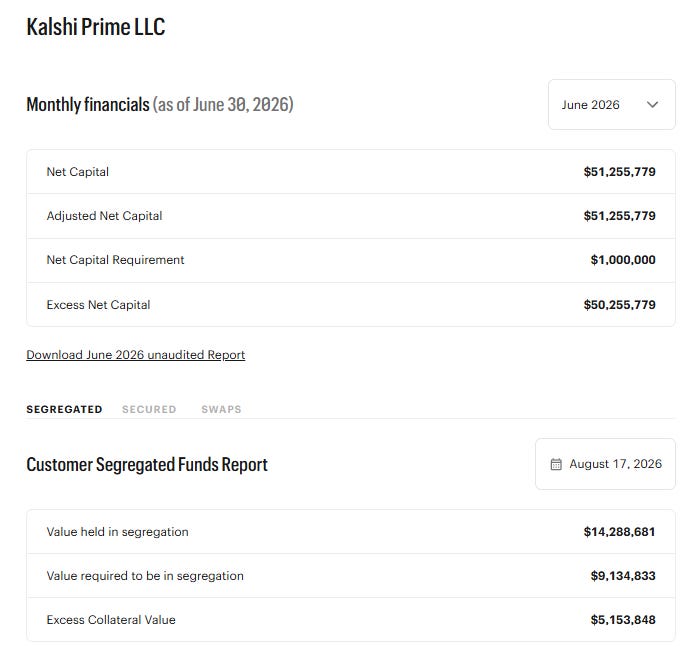
A perpetual future is margined rather than prepaid, which is why the leverage shows up there first. That sequence favours the venue: Kalshi lists the leveraged product, Kalshi’s own FCM finances it, and Kalshi decides what counts as collateral. But an FCM can only margin positions held on its own exchange. So Kalshi Prime captures the financing economics without solving the problem River exists to solve — a desk running the same event across three venues still cannot net across them, and no single venue can offer that.
The same pattern is visible elsewhere.
Consider Ondo. For over a year, Ondo was building Ondo Chain, a dedicated layer 1 for tokenised real-world assets — the canonical version of the tokenisation thesis, getting spot assets onto a ledger. Just recently, it shelved that and launched the Ondo Network instead: an off-chain matching engine running inside trusted execution environments, verified by a decentralised attestor set, settling asset transfers to public chains.
The first and only application on the network is Ondo Perps, launched 7 July, offering perpetual futures on equities, indices and commodities at up to 20x leverage, with tokenised stocks and ETFs accepted as collateral.
It has done roughly $8 billion in volume in its first month. Issuing tokenised treasuries and equities is a custody-and-issuance business with a thin take rate. Perpetual futures are a high-velocity fee business with funding payments attached. Ondo figured out where the revenue sits today.

Another example is Alpaca, the API-first brokerage and crypto provider, which has just registered with the CFTC as a futures commission merchant. That’s the first into the land of derivatives, whether on crypto or stocks and bonds.
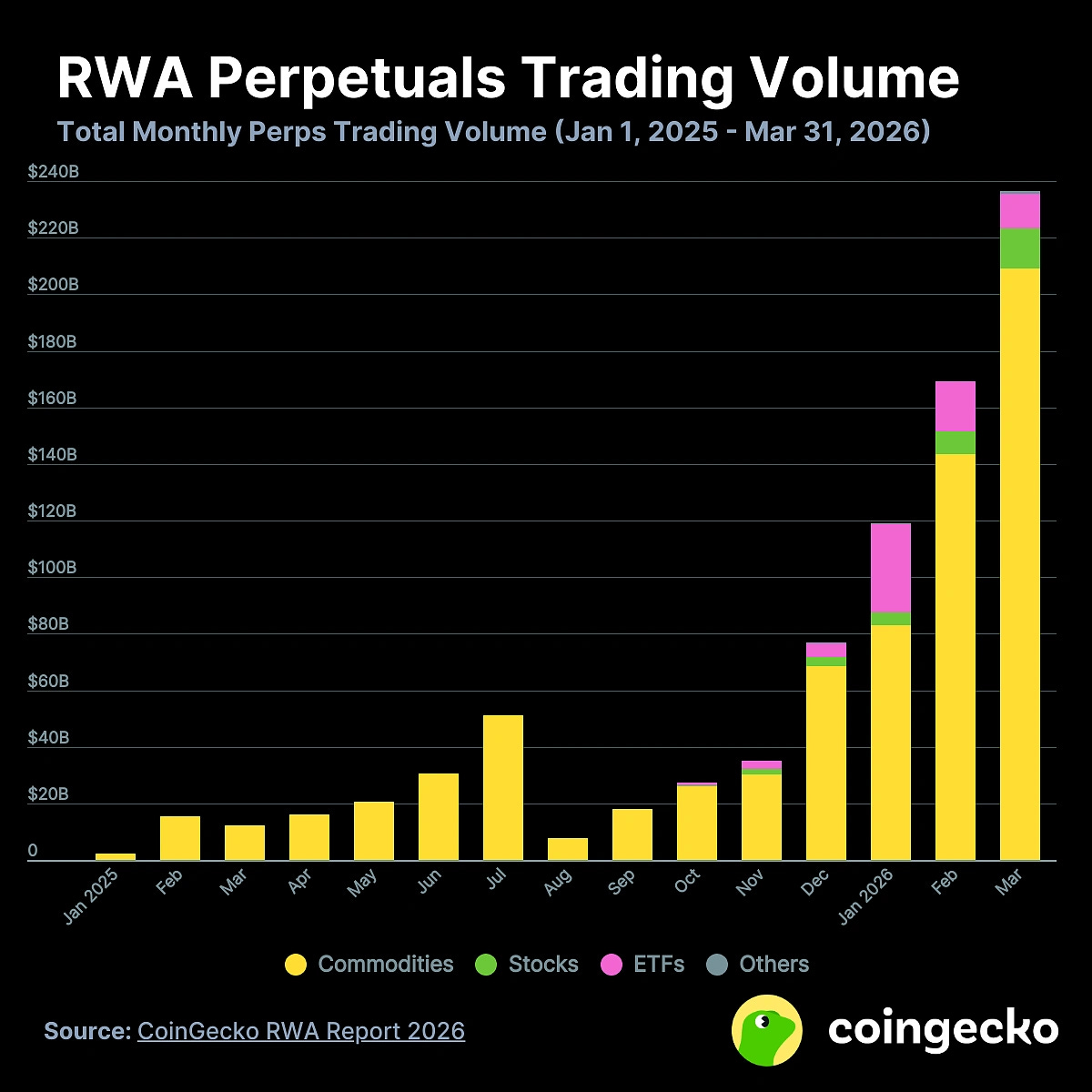
Hyperliquid is the core case study here.
In the week of 13 July, perpetual futures on real-world assets did $25 billion of volume on the platform — 52% of its $48 billion total, and the first time RWA markets out-traded every crypto category on the venue combined. Single-stock contracts drove 61% of that flow.
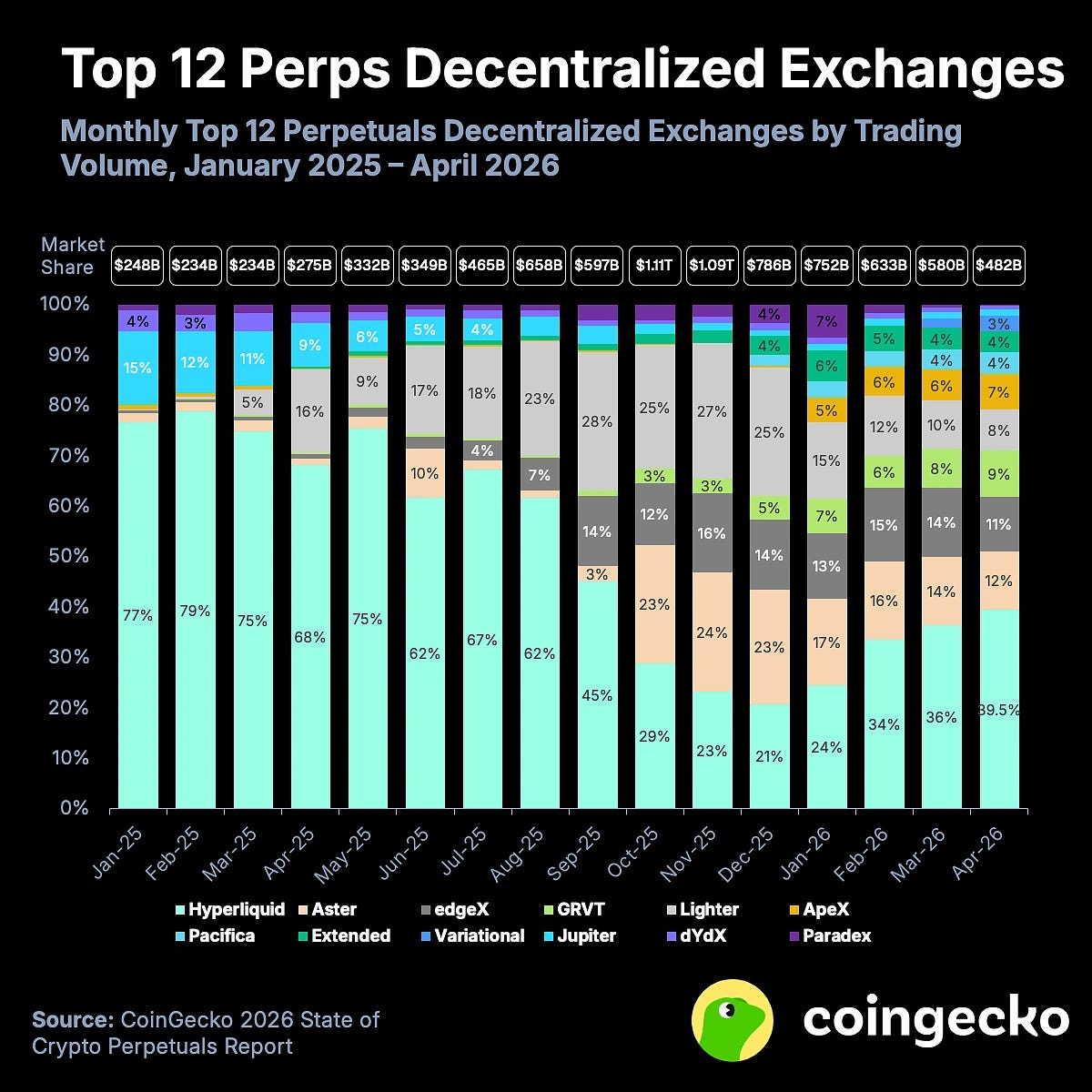
The conclusion is uncomfortable for the tokenisation thesis.
Tokenised assets are not arriving as spot instruments that gradually accumulate liquidity. They are arriving as collateral for derivatives on themselves. The demand is for the exposure, not the asset, which is what the Betterment survey says about the people generating the demand, and what Kalshi Prime says about where the infrastructure is being built to serve it.
The enormous growth is the argument for building infrastructure in this market — the financialization of the attention economy. Under $5 billion a month to $44.8 billion in nine months, against roughly $14 billion a month across every legal US sportsbook in 2025.
A generation has decided that a synthetic levered position matters more than holding the underlying asset, and the manufacturers of financial products are just building what the people will buy. Ondo abandoned a blockchain over it, Hyperliquid’s RWA book now out-trades its crypto book, and Kalshi is standing up an FCM. The venues are getting to prime brokerage first, and they are likely to keep the financing inside their own walls.
👑Related Coverage👑


DIGITAL ASSETS: Why Revolut Survived and the Metaverse Didn’t, a Tale of Financial Fashions
We examine why financial narratives like ICOs, NFTs, and AI agents can attract billions before the underlying economy actually arrives.
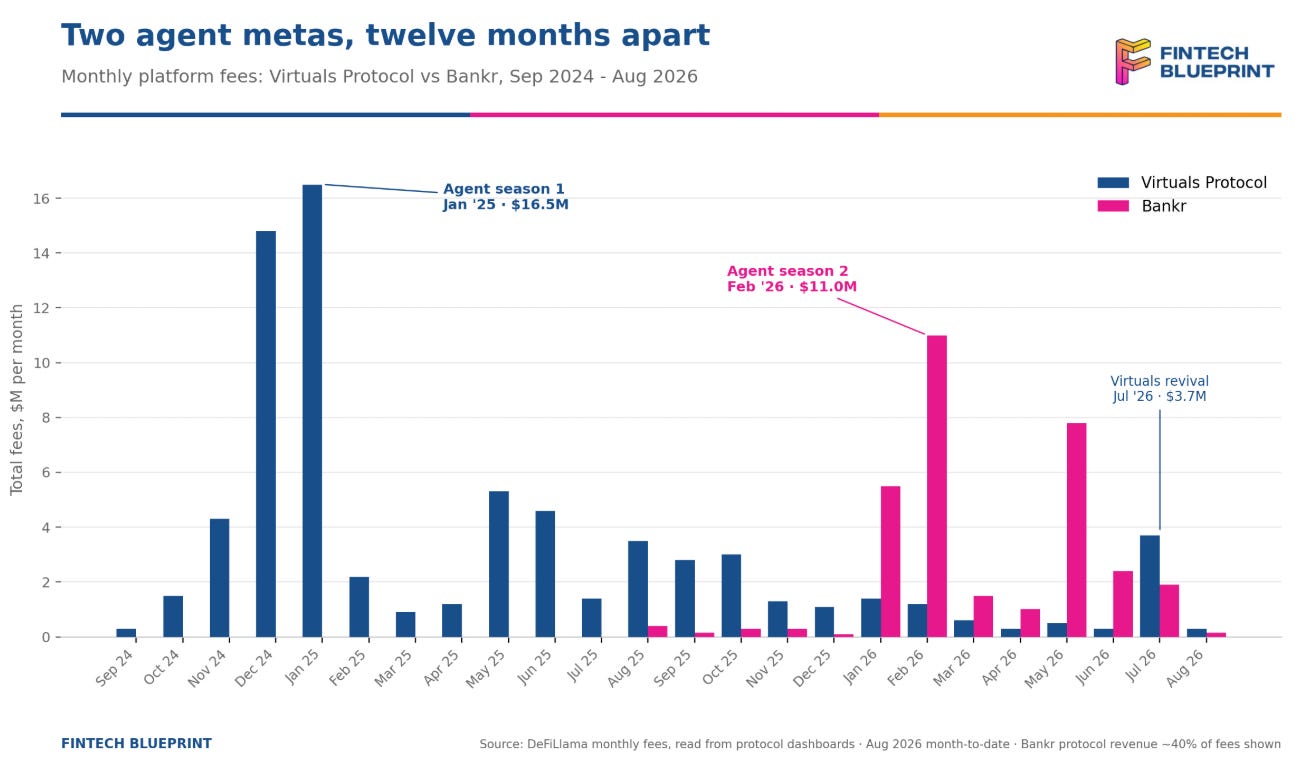
Bankr and Virtuals illustrate the problem: both generated substantial fees during their respective agent-token booms, then saw activity collapse by more than 90% as attention moved elsewhere. We propose five tests for separating a temporary financial “meta” from durable technology: external revenue, miracle count, chokepoints, boring prices, and clock speed. The key distinction is whether value depends on continued attention and speculation or survives through real customers, cash flows, infrastructure, and distribution.
Curated Updates
Here are the rest of the updates hitting our radar.
Financial Institutions and Adoption
eToro Agrees to Acquire TradeZero in $231M US Expansion, Stock Tanks 10% - Decrypt
US regulator approves bank charter for Trump-backed crypto company World Liberty Financial - Reuters
Mastercard completes acquisition of BVNK to advance global stablecoin capabilities - Mastercard
OCC says crypto firms can pursue U.S. bank charters - crypto.news
DeFi and Digital Assets
The economics behind Aave proposal to ditch 6 chains that earn loose change in revenue - CoinDesk
Ethereum DeFi Platform Ether.fi Adds Tokenized Stocks and Portfolio-Backed Loans - Decrypt
Coinbase Expands Derivatives Access to UK Professional Investors - Coinbase
Blockchain Protocols
After Coldcard Was Hacked, $15 Billion in Bitcoin Moved to Safety - Decrypt
NFTs, DAOs and the Metaverse
OpenSea and Pudgy Penguins to Launch Collector Park at NFT NYC - ABAB News
Former Pudgy Penguins Executive Makes an NFT Comeback Four Years After His Ouster - Cointribune
🚀 Level Up
Join our Premium community and receive all the Fintech and Web3 intelligence you need to level up your career. Get access to Long Takes, archives, and special reports.
Sponsor the Fintech Blueprint and reach over 200,000 professionals.
👉 Reach out here.Check out our AI newsletter, the Future Blueprint, 👉 here.
Read our Disclaimer here — this newsletter does not provide investment advice
Fintech Blueprint 🤖🏦🧭 is a reader-supported publication. To receive new posts and support my work, consider becoming a free or paid subscriber.